
King of the Freshwater Giants: The Global Story of Macrobrachium rosenbergii
Introduction The giant river prawn, Macrobrachium rosenbergii, sits at the intersection of biology, gastronomy, and sustainable…
Introduction
The giant river prawn, Macrobrachium rosenbergii, sits at the intersection of biology, gastronomy, and sustainable aquaculture. It is a freshwater titan capable of growing longer than many marine shrimp species, a culinary centerpiece across South and Southeast Asia, and a strategic production asset for emerging aquaculture economies seeking scalable, low-impact protein sources. Its global ascent isn’t an accident. This species delivers strong growth rates, wide environmental tolerance, distinctive flavor, and a value chain that rewards producers, processors, and chefs alike. Understanding this organism requires diving into ecology, culture, chemistry, and cuisine — because the giant river prawn isn’t just a crustacean. It’s a case study in how a species becomes an economic engine.
Taxonomy
Macrobrachium rosenbergii belongs to the family Palaemonidae. Its genus comprises dozens of freshwater prawns, though M. rosenbergii stands out for its size, commercial reliability, and adaptability. It is commonly known in English-speaking regions as the giant river prawn or giant freshwater prawn. In Thailand it is called กุ้งก้ามกราม (“kung kam kram”). In Malaysia and Singapore, it appears as udang galah. In Vietnam, it is tôm càng xanh. In Bangladesh and parts of India, especially West Bengal and Kerala, it is golda chingri or freshwater scampi. These names carry culinary and economic weight; they identify a prized species that commands premium prices in domestic and export markets.
Biology
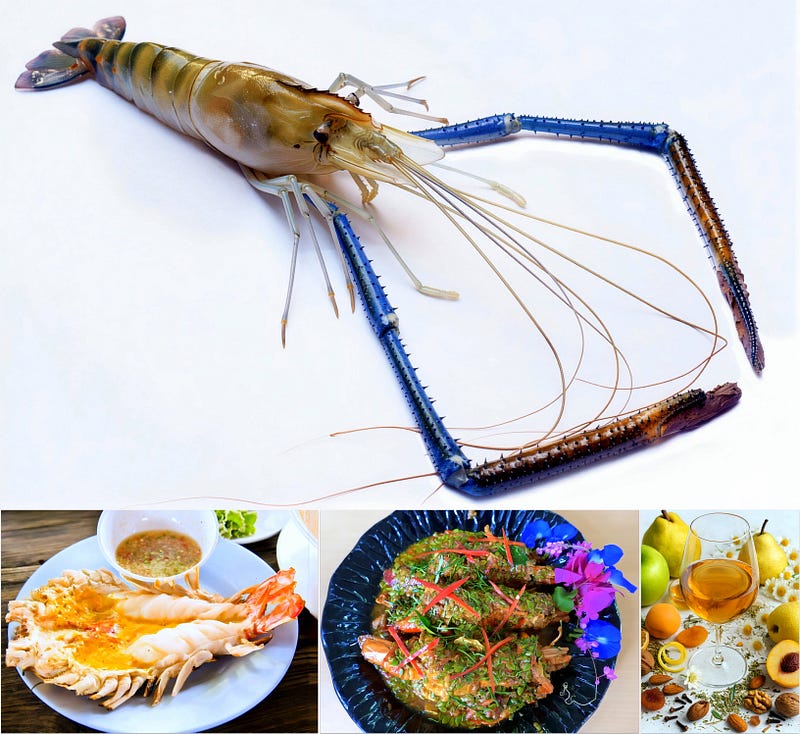
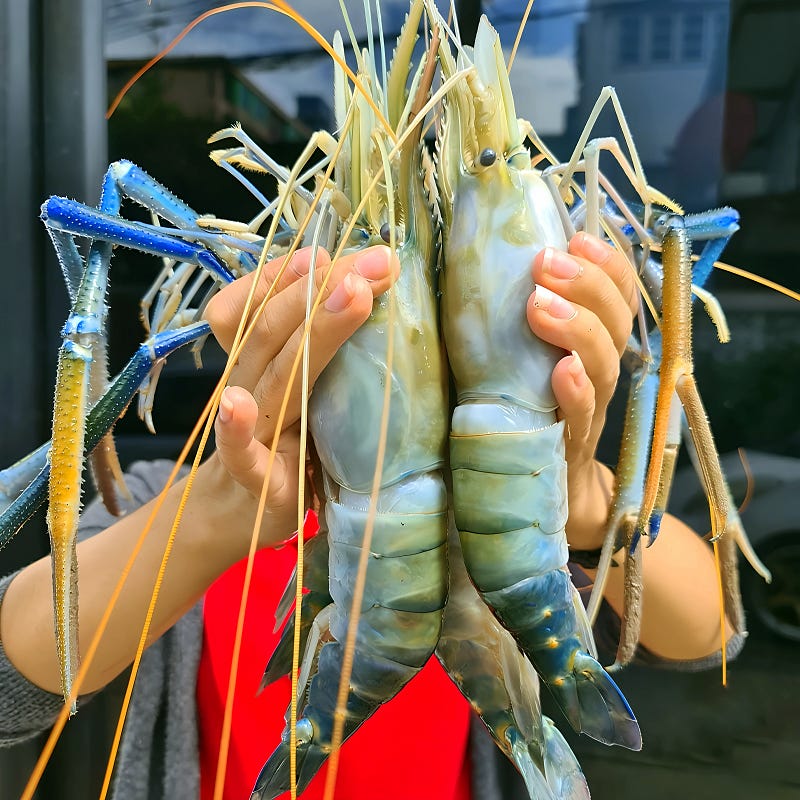
The species is notable for its dimorphic (showing two different forms) claw structure: males, particularly the dominant “blue claw males,” carry long, bright blue chelipeds (claw-bearing legs) that may reach 12 in (approximately 30 cm) in length. In contrast, females and subordinate males bear shorter claws. Adults commonly reach 12–16 oz (about 340–450 g), though premium specimens exceed 20 oz (roughly 570 g). The life cycle bridges fresh and brackish (slightly salty) water. Eggs hatch in low-salinity environments, larvae undergo several planktonic (drifting) stages, and juveniles migrate upstream into freshwater rivers and ponds. This amphidromous (moving between fresh and brackish water) pattern allows farms to optimize hatchery, nursery, and grow-out phases by adjusting salinity from 10–14 ppt (parts per thousand) in hatcheries to 0 ppt in grow-out ponds.
Physiologically, M. rosenbergii is built for efficiency. It converts feed with strong performance in warm water ranging from 79°F (approximately 26°C) to 86°F (about 30°C). It demonstrates rapid growth when stocking densities (number of individuals per unit area) and sex ratios (proportion of males to females) are adequately controlled. It shows high tolerance to fluctuations in dissolved oxygen. The prawn’s muscular tail contains the bulk of its edible mass, and its exoskeleton (hard outer shell) carries carotenoid pigments that intensify in color during cooking.
Ecology
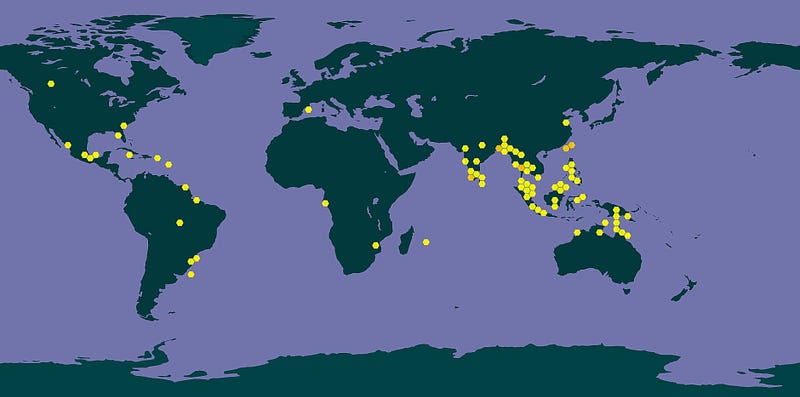
Native to the Indo-Pacific region, M. rosenbergii occupies rivers, estuaries (areas where rivers meet the sea), and floodplain wetlands. Its ecological role includes grazing on detritus (dead organic matter), small invertebrates (animals without backbones), and biofilms (microbial layers), thereby contributing to nutrient cycling and ecosystem balance. In properly managed aquaculture systems, the species supports sustainability goals because integrated pond designs allow for co-culture (raising multiple species together) with finfish or mollusks, reducing waste and improving efficiency. However, escape events in non-native regions require strict biosecurity (measures to prevent disease and escape) to avoid competition with local crustaceans. Climate variability affects growth cycles, making predictive water management core to long-term viability.
Uses
The primary edible portion is the tail meat, though the head — containing rich fat and tomalley-like material — contributes to intensely flavored stocks. Typical cooking yields depend on production system and stocking density, with pond-based systems producing 1–3 metric tons per hectare (equivalent to about 0.89–2.67 short tons per 2.47 acres). Calories per 100 g average 100–105 kcal, with protein content reaching 20–21 g per 100 g. Key nutrients include selenium, omega-3 fatty acids, and vitamin B12. Antinutrients are negligible, though iodine levels should be considered for individuals with thyroid-related restrictions. Toxicity concerns are minimal provided prawns are harvested from clean water and handled in accordance with standard sanitation protocols.
Processing typically includes chilling, deheading (removing the head), peeling (removing the shell), deveining (removing the digestive tract), and blast freezing (rapid freezing to preserve quality). Commercial products include whole head-on prawns, headless shell-on products, peeled deveined tails, skewers, and value-added ready-to-cook packs. The aroma is clean and slightly mineral before cooking, intensifying to a sweet, shellfish-forward scent once heat is applied. Texture is firm but yielding, less crisp than marine shrimp and more tender than lobster. The cooking behavior reflects its protein structure: it sears beautifully, maintains shape under high heat, and absorbs marinades readily without losing moisture.
Medicinally, crustacean extracts are sometimes used in traditional remedies for joint strength or general vitality, though scientific evidence is limited. Safety concerns relate primarily to shellfish allergies. Regulatory frameworks vary by region: export markets require HACCP-driven traceability, periodic residue testing, and compliance with maximum residue limits for veterinary compounds. Major producers include Thailand, Bangladesh, India, Vietnam, Myanmar, and, increasingly, parts of Latin America, establishing freshwater prawn industries.
From a feed and livestock perspective, prawn heads and shells can be converted into high-value chitin and chitosan products through deproteinization, demineralization, and purification steps. Concentration ranges vary from 15 to 30 percent chitin, depending on shell thickness. Applications include bioplastics, wound dressings, water-purification membranes, and agricultural seed coatings. These materials exhibit functional properties, including biodegradability, tensile strength, and antimicrobial activity. Hazards are minimal provided processing facilities manage alkaline extraction streams responsibly.
Agro-industrial uses include pond mud enriched by prawn production, which can support soil organic matter and bacterial diversity when applied to crop fields at low rates. Habitat value within managed ponds can support microfaunal communities that marginally increase carbon sequestration, though precise quantification remains variable. Community rights and equitable benefit-sharing remain priority issues in regions where freshwater territories serve both wild harvesters and emerging commercial farms. Traceability systems, QR-coded batch tracking, and certification programs (such as Best Aquaculture Practices) increasingly define market access and price premiums.
Culinary Aspects
The giant river prawn delivers a distinctive culinary signature: sweet, clean, slightly creamy, and concentrated. The tail meat feels firm yet succulent, while the head fat provides a deep umami character comparable to crab roe. The balance leans toward sweetness, followed by a savory finish with mild mineral notes. Mouthfeel is velvety when grilled or poached, more structured when sautéed, and richly layered when cooked with the shell on. The aftertaste is long and warm, carrying subtle caramelization when exposed to high heat.
Culturally, the prawn occupies iconic status. In Thailand, grilled giant prawns served with spicy seafood nam jim represent coastal identity. In Bengal, golda chingri malai curry marries prawn richness with coconut milk. In Malaysia, freshwater prawn noodles rely on head fat to deepen broth intensity. Optimal cooking methods include grilling over charcoal, poaching in aromatic court-bouillon, pan-searing, steaming with ginger, or simmering in curries. Each method preserves its natural sweetness while unlocking different layers of aroma.
Wine Pairings
A dish featuring grilled M. rosenbergii brushed with garlic oil pairs well with Austrian Grüner Veltliner from the Wachau. The wine’s white pepper note, brisk acidity, and citrus focus cut through the head fat while amplifying the prawn’s sweetness.
For a Bengali-style golda chingri malai curry, Alsatian Pinot Gris offers a strategic fit. Its gentle residual sugar, smoky undertones, and stone fruit core harmonize with coconut richness and chili heat without overwhelming the palate.
A Malaysian-style prawn noodle soup pairs cleanly with Portuguese Arinto from Bucelas. Its saline edge, taut acidity, and lemon-pith bitterness reinforce the broth’s depth without clashing with aromatics like fried shallot or prawn oil.
A Thai charcoal-grilled prawn presentation enriched with nam jim aligns seamlessly with Georgian Rkatsiteli, whose tannic white-wine grip and citrus-infused spine lock onto chili, lime, and garlic elements while refreshing the palate.
A simple steamed tail with ginger and Shaoxing aromatics benefits from a dry Canadian Riesling from the Okanagan Valley, whose razor acidity and petrol-mineral complexity amplify the delicate sweetness of the prawn without intruding.
Conclusion
Macrobrachium rosenbergii exemplifies how a single species can catalyze cultural, culinary, and economic value across continents. Its biology equips it for efficient aquaculture; its ecological role supports sustainable diversification; and its culinary versatility places it among the most admired freshwater delicacies. As global protein demand intensifies, this prawn’s ability to integrate into responsible production systems — and its role in traditional cuisines — positions it as a strategic contributor to food security and gastronomic heritage alike.