Murderabilia and the Marketplace of Violence: Inside the Macabre World of True Crime Collecting
Introduction In the shadow of America’s obsession with true crime lies a booming underground market where horror is commodified and…
Introduction
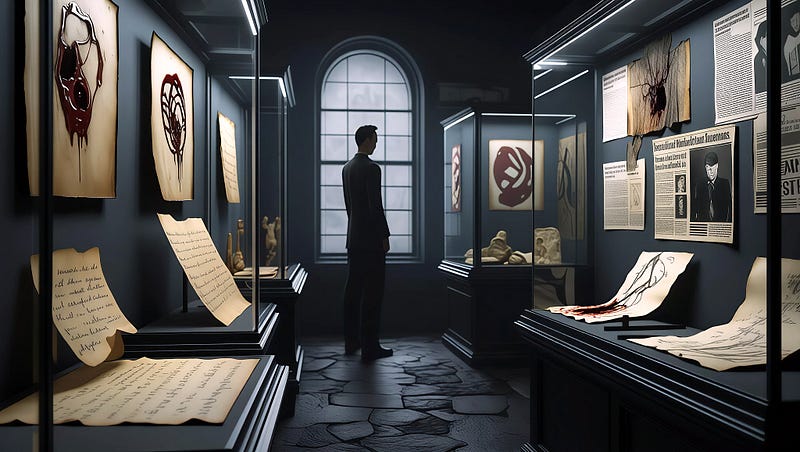
In the shadow of America’s obsession with true crime lies a booming underground market where horror is commodified and violence is packaged for profit. “Murderabilia” — a portmanteau of murder and memorabilia — refers to the artifacts linked to infamous criminals and grisly crimes: letters from serial killers, clothing stained by history, artwork rendered by hands that took lives. What began as a criminological curiosity has evolved into a full-fledged commercial ecosystem. While collectors defend the trade as historical preservation, critics see it as trauma repackaged and sold. At the center of this controversial industry stands MurderAuction.com, a platform as reviled as it is unrivaled — and the man behind it, William Harder, is as complex as the artifacts he sells.
What Is Murderabilia?
Murderabilia encompasses a wide array of items associated with notorious criminals — from John Wayne Gacy’s pastel clown paintings to Charles Manson’s hair clippings and Ted Bundy’s signed documents. Collectors often seek out:
- Personal belongings like prison IDs, dentures, or clothing worn during crimes
- Handwritten letters and signed envelopes
- Legal documents, artwork, and even handcrafted items made in prison
Though macabre, this fascination isn’t new. In 19th-century Europe, criminology museums displayed execution tools and death masks. The modern twist? These relics are now for sale to the highest bidder — not in academic halls, but on niche websites and collector forums.
The Dark Economy: Pricing, Players, and Psychology
After eBay banned the sale of murderabilia in 2001, a cottage industry flourished. Today, specialized platforms like Serial Killer Ink, Cult Collectibles, and most notably MurderAuction.com cater to a global clientele of collectors, historians, and curiosity-seekers.
Prices vary wildly depending on notoriety and provenance:
- John Wayne Gacy’s paintings can fetch over $7,000
- Ted Kaczynski’s letters have sold for $1,750
- Even obscure criminals’ items hold value, drawing niche buyers
Why do people buy these objects? Some claim academic or psychological interest — a desire to study criminal minds. Others describe an “aura effect,” a belief that these items radiate residual energy or meaning. This impulse is not unlike relic worship or artifact collecting: a secular, macabre mysticism.
The Architect of the Trade: William Harder and MurderAuction.com
No one has done more to legitimize — or provoke — the murderabilia trade than William Harder, the controversial operator of MurderAuction.com. His journey began in 2000 as a depressed 22-year-old who wrote to serial killer Richard Ramirez. When Ramirez wrote back, a door opened into a world Harder would not only enter — he would dominate.
By 2009, he had acquired full control of MurderAuction.com, transforming it into the largest murderabilia marketplace on Earth, boasting:
- Over 4,000 live auctions
- Inventory from 45+ countries
- A community of 1,200+ active members
Harder isn’t just a businessman. He’s cultivated personal relationships with over 70 incarcerated killers, even witnessing executions. He presents himself as a “cultural preservationist” — a vegan pacifist who claims to ask the questions journalists and criminologists won’t: Why did you kill?
But his role is fraught with contradiction. He profits from violence while claiming to reject it. He’s banned in Texas prisons, investigated in California, and reviled by many victims’ families.
Ethical Storms and Legal Gray Zones
The murderabilia market exists at the volatile crossroads of free speech, capitalism, and moral repugnance. Critics argue it retraumatizes victims’ families and glorifies perpetrators. Laws have tried — and largely failed — to intervene:
- eBay’s ban removed murderabilia from mainstream commerce, but drove it underground
- “Notoriety for Profit” laws exist in eight states, preventing criminals from directly profiting
- A 2010 federal bill to ban sales died in Congress amid First Amendment concerns
Meanwhile, ethical debates rage on. Some compare murderabilia to museum collections or academic archives. Others say it crosses the line from documentation into exploitation. The victims’ perspective is often drowned out in the bidding wars.
MurderAuction.com’s Market Power and Cultural Legacy
Harder’s platform now hosts thousands of items monthly. Its global reach spans letters from Canadian serial killer Clifford Olson to photos of Mafia crime scenes. Upcoming plans include launching a social network — “Murder Space” — for true crime enthusiasts, pushing the culture even further toward normalization.
Among the macabre memorabilia: John Wayne Gacy’s grotesque clown paintings, eerily preserved and sold posthumously for up to $7,000 — even as protesters tried to erase their legacy in bonfires. Gary Heidnik’s signed envelope, tainted by his notoriety as the “Basement of Horrors” killer, fetched $300 — its mundane form a grotesque echo of the horrors it accompanied. And for $85, one could possess the final frozen moment of Albert Anastasia’s life: a stark crime scene photo from his 1957 barbershop assassination, historic and haunting in equal measure.
Victims’ families remain vocal. The sister of James Byrd Jr., whose white supremacist killer’s photo was listed on the site, called it “a slap in the face.” Others use harsher words: “sick,” “disrespectful,” “grotesque.”
Conclusion: Capitalism’s Coldest Corner
Murderabilia reveals a chilling truth: in a free market, even horror has value. William Harder has carved a niche where no one else dared — not simply by selling killers’ relics, but by embodying the paradox of modern true crime culture. Is he a ghoulish profiteer or an archivist of criminal history? Depends on whom you ask. But with no federal restrictions on the horizon and a growing global audience, MurderAuction.com isn’t going away.
Harder himself put it bluntly:
“What sets me apart is that instead of watching documentaries, I visit killers and ask ‘why?’”
The deeper question, perhaps, is: Why do we keep watching?