
Rare Earth Elements: Powering Innovation, Threatening Future
Beneath the surface of our modern technological civilization lies a paradoxical dependency on a group of elements that are both abundant…

Beneath the surface of our modern technological civilization lies a paradoxical dependency on a group of elements that are both abundant and critically scarce. Rare earth elements, a collection of seventeen chemically similar metals, have become the unsung heroes of the digital age and the green energy transition. Their unique properties make them indispensable components in everything from the smartphone in your pocket to the electric vehicle on the road and the wind turbine generating clean power. Yet, their extraction is environmentally fraught, and their supply chain is geopolitically charged, creating a silent crisis that threatens to undermine the very technological progress they enable. Understanding these elements — what they are, why they are so useful, and the challenges they present — is essential for navigating the future of global technology, economics, and security.
The Fundamental Nature of Rare Earth Elements
Despite their name, rare earth elements are not particularly rare in terms of their overall abundance in the Earth’s crust. In fact, elements like cerium are more common than copper. The term “rare earth” originates from the historical difficulty in finding these elements concentrated in economically mineable deposits and the challenge of isolating them from their oxide forms, which early chemists referred to as “earths.” The group consists of the fifteen lanthanides on the periodic table, spanning atomic numbers 57 through 71, along with scandium and yttrium, which are included due to their similar chemical properties. These metals are typically divided into two sub-categories based on their atomic weight and chemical behavior. Light Rare Earth Elements include lanthanum, cerium, praseodymium, neodymium, promethium, and samarium. Heavy Rare Earth Elements include europium, gadolinium, terbium, dysprosium, holmium, erbium, thulium, ytterbium, lutetium, and yttrium. The heavy rare earths are generally scarcer and often more valuable due to their superior magnetic properties and critical roles in high-performance applications. These elements rarely exist in pure, concentrated forms. Instead, they are found combined within a variety of minerals, with the most economically significant being bastnäsite, monazite, and lateritic ion-adsorption clays, the latter being a key source for the heavier elements.
The Unparalleled Properties Driving Technological Revolution
The immense value of rare earth elements stems from a suite of exceptional physical and chemical properties that make them virtually irreplaceable in modern technology. Their unparalleled magnetic strength stands out as a defining characteristic. Elements like neodymium enable the creation of permanent magnets that are incredibly powerful and efficient, capable of exerting forces up to a thousand times their own weight. This strength is crucial for devices that require powerful miniaturized motors or generators. Furthermore, certain rare earths exhibit unique luminescent properties, meaning they can emit light of particular and vibrant colors when excited. Europium, for instance, provides the rich red color in television and computer monitor screens, while terbium is responsible for green phosphors. This precise control over light is fundamental for high-quality display technologies and energy-efficient lighting.
Beyond magnetics and optics, rare earths serve as powerful chemical catalysts. Their specific electron configurations make them highly effective at speeding up chemical reactions without being consumed in the process. Lanthanum and cerium are widely used in automotive catalytic converters and petroleum refining, where they help break down harmful pollutants and increase fuel processing efficiency. Additionally, some rare earth elements have high melting points, making them suitable for high-temperature applications in aerospace and metallurgy. Yttrium, for example, is used to enhance the heat resistance of jet engine alloys. It is this combination of magnetic, luminescent, catalytic, and thermal properties, often found together in a single group of elements, that renders rare earths so uniquely useful and foundational to a vast array of advanced technologies.
Indispensable Applications Across Modern Industries
The applications of rare earth elements are so widespread that they touch nearly every facet of contemporary life and industrial activity. The push for a greener global economy is heavily reliant on these materials. High-strength neodymium magnets are the heart of the direct-drive generators used in many modern wind turbines, with a single turbine capable of requiring over a ton of rare earth material. The electric vehicle revolution is similarly dependent on them; permanent magnet motors, which use alloys of neodymium, praseodymium, and dysprosium, provide the high torque and efficiency essential for electric powertrains. A typical electric vehicle can contain several kilograms of these powerful magnets. Furthermore, lanthanum is a key component in nickel-metal hydride batteries used in many hybrid vehicles.
The consumer electronics and telecommunications industries are built upon the capabilities of rare earth elements. The vivid colors of LED and LCD screens are produced by europium and terbium phosphors. The miniaturized speakers and vibration motors in every smartphone rely on neodymium magnets. Fiber-optic cables, which form the backbone of the global internet, use erbium-doped amplifiers to boost light signals over long distances. The defense and aerospace sectors classify these elements as strategically critical. They are essential for precision-guided munitions, satellite communication systems, radar and sonar equipment, and high-performance jet engines. In medicine, gadolinium is used as a contrast agent in Magnetic Resonance Imaging to obtain clearer diagnostic images. From the mundane to the most advanced systems, rare earth elements are the invisible enablers of modern functionality.
Geopolitical and Environmental Challenges
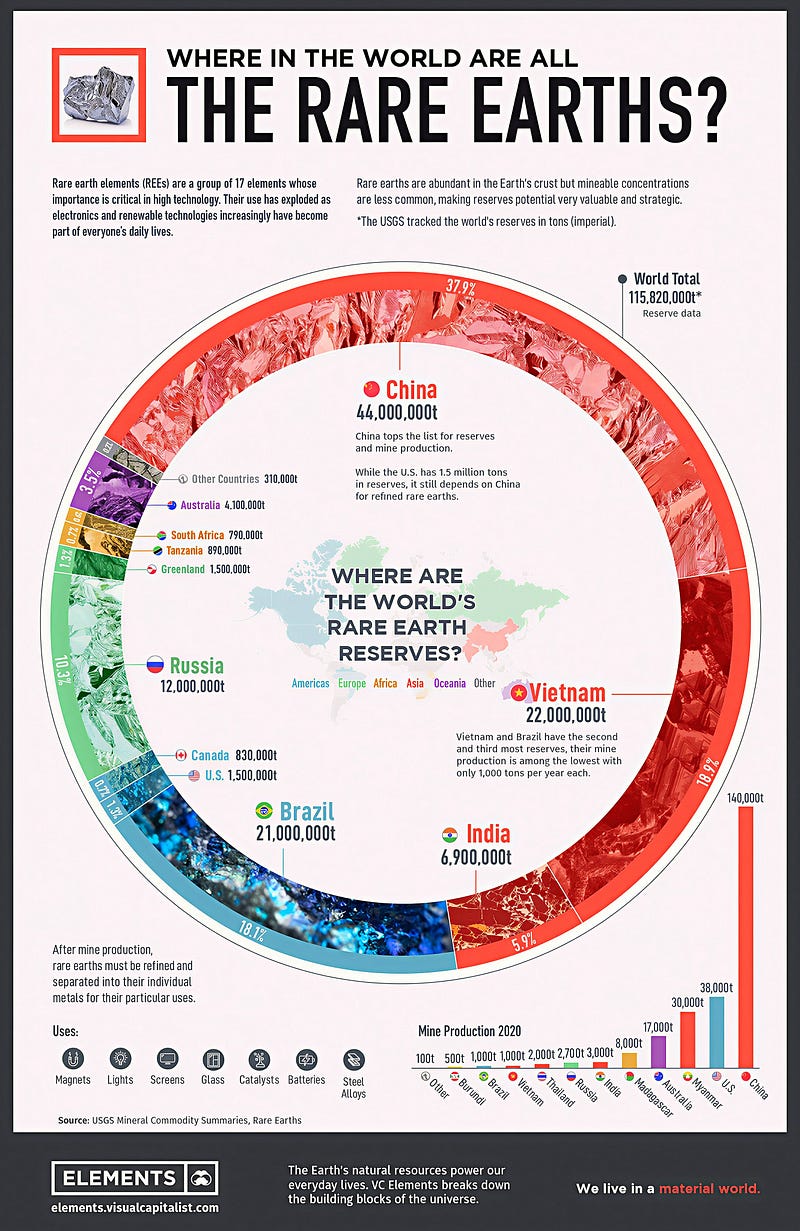
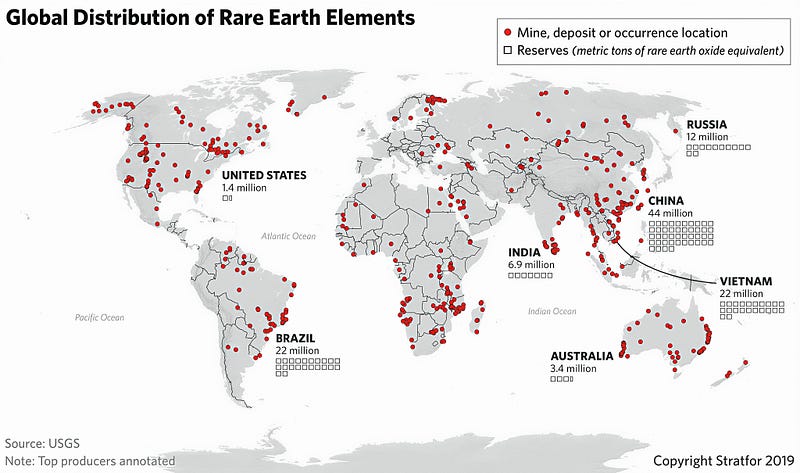
The very importance of rare earth elements has created a set of complex geopolitical and environmental challenges. The global supply chain is dangerously concentrated, with China dominating the landscape. For decades, China has pursued policies that allowed it to develop a stranglehold on the market, currently controlling an estimated sixty to seventy percent of global mining output and a staggering eighty-five to ninety percent of the complex processing capacity. This dominance gives China significant geopolitical leverage, a tool it has not been afraid to use, as demonstrated in 2010 when it restricted exports to Japan during a territorial dispute, sending shockwaves through global high-tech manufacturing. This event served as a wake-up call for many nations, highlighting the vulnerability of their economies and national security to supply disruptions.
The environmental cost of rare earth production is equally concerning. Conventional mining and processing are inherently dirty operations. The extraction process involves crushing large amounts of ore and using intensive hydrometallurgical techniques, including acid leaching and solvent extraction, to separate the individual elements. This generates substantial volumes of toxic and sometimes radioactive waste, as the minerals often contain traces of thorium and uranium.

In regions with lax environmental oversight, this has led to severe soil and water contamination, creating ecological and public health crises. The immense energy and chemical inputs required also contribute to a significant greenhouse gas footprint, presenting a painful irony where materials critical for clean energy solutions are themselves sourced through environmentally damaging methods. This creates a difficult balancing act for policymakers and industry leaders who must secure these critical resources while mitigating their ecological impact.

The Path Forward and Future Outlook
Recognizing these vulnerabilities, nations and corporations are actively pursuing strategies to build a more resilient and sustainable rare earth economy. Supply chain diversification is a primary focus. Countries like the United States and Australia are reviving and expanding their domestic mining and processing capabilities, as seen with the Mountain Pass mine in California and the Mount Weld project in Australia. Strategic partnerships, such as the Quad Alliance between the U.S., India, Japan, and Australia, are being forged to collaborate on secure supply chains and reduce collective dependence on any single source. Technological innovation is also paving the way for alternative sources. Significant research is being directed toward improving recycling methods to recover rare earths from electronic waste, though currently, less than one percent of rare earths are recycled from end-of-life products. Scientists are also exploring material science to develop substitutes that can reduce or eliminate the need for certain rare earths in some applications, though finding equivalents for their high-performance properties remains a formidable challenge.
The future demand for these critical elements is projected to grow exponentially. The global rare earth elements market is expected to expand dramatically in the coming decade, driven overwhelmingly by the clean energy transition. As nations worldwide commit to net-zero emissions targets, the demand for electric vehicles, wind turbines, and other green technologies will surge, potentially tripling the consumption of rare earths by 2040. This escalating demand, set against a backdrop of geopolitical tensions and environmental constraints, ensures that rare earth elements will remain at the forefront of discussions about resource security, technological sovereignty, and sustainable development for the foreseeable future. The nations and industries that successfully navigate this complex landscape by securing sustainable supplies and fostering innovation will secure a decisive advantage in the twenty-first-century global order.