Restoring Consent: America 2025 and the Conservative Social Contract
Introduction and Philosophical Framework
Introduction and Philosophical Framework
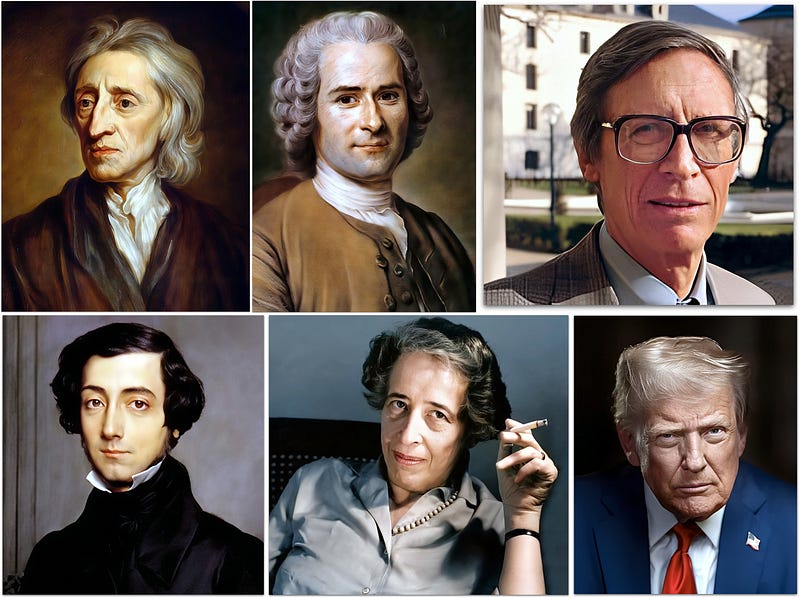
This story explores America’s political landscape in 2025 through the lens of five seminal thinkers — John Locke, Jean-Jacques Rousseau, Alexis de Tocqueville, John Rawls, and Hannah Arendt. Each represents a distinct phase in the evolution of Western political thought: from the origins of liberal consent theory to modern analyses of justice, democracy, and truth. Before applying their frameworks to current events, it is necessary to understand who they were and why their ideas remain relevant to today’s constitutional and cultural crises.
John Locke (1632–1704) was an English philosopher and physician, often regarded as the father of classical liberalism. His Two Treatises of Government articulated the doctrine of natural rights — life, liberty, and property — and established the notion that governments derive legitimacy from the consent of the governed. Locke’s ideas directly influenced the American Founding Fathers and continue to frame modern conservative debates about sovereignty, property rights, and limited government.
Jean-Jacques Rousseau (1712–1778), the Genevan political philosopher, championed civic virtue and the concept of the general will — the collective moral and political direction of a community. Though often invoked by egalitarian movements, Rousseau’s emphasis on civic unity and the moral obligations of citizenship also resonates with modern conservative calls for national cohesion and shared responsibility.
Alexis de Tocqueville (1805–1859), a French aristocrat and keen observer of the early American republic, wrote Democracy in America, perhaps the most penetrating study ever made of democratic life. He praised America’s spirit of local governance and voluntary association while warning that democracy could decay into “soft despotism” — a state of bureaucratic paternalism where citizens trade freedom for comfort. His work provides a roadmap for understanding both the populist revival and the dangers of overcentralization.
John Rawls (1921–2002), an American political philosopher at Harvard University, reshaped modern liberalism with his Theory of Justice (1971). He proposed that just societies are those that rational actors would design behind a “veil of ignorance,” ensuring fairness to all. While often cited by progressives, Rawls’s concern for institutional stability and basic liberties also underwrites conservative commitments to due process, equal opportunity, and civic order.
Hannah Arendt (1906–1975), a German-born political theorist and refugee from totalitarianism, wrote extensively about authority, power, and the fragility of truth. Her works — especially The Origins of Totalitarianism and The Human Condition — examine how mass movements, propaganda, and bureaucratic conformity can erode freedom. Arendt’s insistence that truth and independent judgment are prerequisites of political legitimacy speaks directly to America’s polarized information environment.
With this philosophical groundwork, we can now turn to the contemporary moment. The sections that follow apply these thinkers’ frameworks to five defining themes of 2025: executive power, immigration, fiscal governance, judicial authority, and climate responsibility. The goal is to evaluate whether the conservative restorationist impulse — embodied most visibly in Donald Trump’s second administration — constitutes a legitimate reaffirmation of consent and order or a perilous overreach of authority.
John Locke’s concept of the social contract remains one of the most enduring frameworks for evaluating political legitimacy. Its central premise — that government exists by the consent of the governed and must protect life, liberty, and property — was never meant to sanctify weakness. Locke’s philosophy justified limited government, but not impotent government. In 2025, as the United States faces deep polarization, institutional fatigue, and widespread distrust, conservative America has reinterpreted Locke’s call for legitimate authority as a call for decisive restoration. From this perspective, Donald Trump’s second administration, for all its controversy, represents an attempt to reassert control, revive national coherence, and counter what many see as decades of drift. The question is not simply whether Trump’s exercise of executive power fits within Locke’s model of consent, but whether the modern conservative project itself — asserting law, sovereignty, and realism — can still align with the principles of Rousseau, Tocqueville, Rawls, and Arendt when applied to a chaotic republic.
Locke and the Conservative Demand for Effective Governance
Locke wrote in an age when tyranny was embodied by kings who taxed and ruled without consent. Today’s conservative reading of Locke focuses less on absolute monarchy and more on what might be called “bureaucratic absolutism”: a diffuse, unaccountable administrative state that issues rules without electoral legitimacy. Trump’s sweeping executive orders — most notably the reinstatement of Schedule F, reclassifying thousands of federal employees as at-will positions — can be read in this light. The conservative argument is straightforward: if the “governed” have chosen a president to implement specific policies, but a permanent bureaucracy can obstruct him, then the consent of the governed has already been violated.
Locke would likely recognize this tension. While he prized the separation of powers, he also saw government as a fiduciary — a trustee of the people’s will. A government unable to carry out its mandate ceases to serve its function. Thus, Trump’s restructuring of federal employment, while alarming to progressives, might in Lockean terms represent a corrective — an effort to ensure that the agents of government remain accountable to its elected trustees. Still, Locke’s warning against arbitrary rule remains relevant. Consent must remain active and continuous, not merely symbolic. If executive purges or sweeping decrees silence legitimate dissent within government, then the cure risks becoming the disease.
Arendt would add a caution of her own. She distinguished authority from mere power. Authority, for her, rested on shared legitimacy — an agreement among citizens about the right of institutions to command obedience. When authority erodes, leaders often resort to force to maintain control. The danger in 2025 is that America’s bureaucratic paralysis and populist rebellion feed off one another: the administrative state’s inertia invites populist force, and populist force then justifies more bureaucratic entrenchment. Locke and Arendt together remind us that a strong executive can restore order only if it restores trust, not fear.
Rousseau’s General Will and Populist Sovereignty
Jean-Jacques Rousseau, though often claimed by the Left, speaks powerfully to conservative populism. His notion of the general will — the collective expression of a people seeking the common good — resonates with Trump’s argument that he embodies the true voice of forgotten citizens. The rallies, the executive actions framed as “giving America back to its people,” the rejection of technocratic elites — all of these appeal to Rousseau’s idea of direct civic sovereignty.
However, Rousseau would test this claim by one standard: unity. A leader cannot merely channel resentment; he must convert it into shared purpose. The general will requires that citizens act as participants in a moral community, not as warring factions. Here lies the philosophical challenge for 2025’s populist right: Can its assertion of sovereignty translate into civic renewal, or does it merely invert the elitism it despises? Trump’s approach to immigration enforcement, for instance, can be seen both as Rousseauian (reasserting national identity and shared obligation) and as factional (alienating segments of society).
Rousseau’s modern conservative relevance lies in his warning that moral decay — not foreign enemies — is the greatest threat to republics. When citizens pursue only private advantage, the state becomes ungovernable. Trump’s rhetoric about “America First,” when stripped of partisan noise, contains this very insight: a nation divided by globalist priorities, identity politics, and bureaucratic privilege cannot act as a unified sovereign body. Rousseau would likely agree that restoring a sense of shared destiny — even through rough populist means — may be a necessary stage in national renewal.
Tocqueville and the Double-Edged Sword of Democracy
Alexis de Tocqueville, America’s most perceptive 19th-century observer, saw that democracy’s greatest weakness is not rebellion but comfort. In Democracy in America, he warned of a “soft despotism” — a government that smothers liberty not through terror, but through endless regulation, moral tutelage, and economic dependency. Tocqueville’s warnings echo through the conservative reading of 2025: sprawling bureaucracy, dependency culture, and the rise of an “expert class” insulated from accountability.
Trump’s appeal to dismantle regulations, empower local governance, and reassert national pride can be read as a Tocquevillian attempt to rekindle civic energy. When federal agencies dictate everything from school curricula to energy policy, the people’s ability to exercise democratic virtue diminishes. Tocqueville valued self-governing citizens, not managed populations. His prescription was not anarchy but responsibility — local, moral, and institutional.
Yet Tocqueville would also warn that populism, if untethered from prudence, risks becoming its own despotism. The populist leader who derides all expertise and central authority may end up producing the very dependency he claims to fight, as citizens learn to rely solely on the will of one man rather than on local virtue. Thus, while the administrative state’s excesses justify reform, the conservative project must build institutions of self-government, not merely dismantle oversight.
Rawls, Fairness, and Conservative Justice
John Rawls, often championed by progressives, is equally relevant to conservative governance when understood correctly. His concept of “justice as fairness” does not demand radical equality; it demands stable institutions that secure liberty and opportunity for all. In 2025, the American right faces the challenge of showing that economic revitalization and law-and-order politics are not only efficient but also just.
Rawls’ difference principle — that inequalities are acceptable only if they benefit the least advantaged — could validate Trump’s emphasis on working-class prosperity. If deregulation and border enforcement produce greater job opportunities for ordinary Americans, they meet Rawlsian standards of fairness more effectively than bureaucratic welfare that breeds dependency. Conservatives can, therefore, claim that their economic nationalism is not selfish but restorative — a rebalancing of fairness away from global elites toward citizens who have been left behind by decades of policy neglect.
However, Rawls’ first principle — the inviolability of basic liberties — remains a warning. Any conservative order that erodes civil rights, undermines judicial independence, or suppresses dissent violates the very fairness it seeks to restore. In 2025, the administration’s conflict with the judiciary, the press, and parts of civil society will need to be judged by whether its measures preserve liberty for all, or only for those who approve of its ends.
Immigration, Law, and the Limits of Authority
Few issues crystallize philosophical tensions as sharply as immigration enforcement. For conservatives, this is not primarily about xenophobia but sovereignty. A government that cannot defend its borders has forfeited its basic claim to authority. Locke would agree: the social contract depends on mutual protection; citizens obey the law because the state can defend them from harm. The 2025 expansion of ICE operations and the reintroduction of mass deportation initiatives, while divisive, thus reflect a core Lockean duty — defense of the community’s integrity.
Still, Locke’s second treatise also warns that punishment must follow known laws and due process. Arbitrary or excessive enforcement erodes legitimacy. Rousseau would add that a state that excludes millions from participation without offering a path to integration cannot maintain the unity essential to the general will. Tocqueville would see the tension between majority will (demanding enforcement) and minority rights (protecting immigrants and their families). For Rawls, fairness requires that the burdens of immigration policy not fall solely on the powerless. And Arendt, who fled statelessness herself, would insist that every human being — citizen or not — retains a right to dignity.
The philosophical synthesis here is clear: conservative immigration policy can be legitimate and even noble, but only if it is executed with restraint, proportionality, and compassion. Enforcement without cruelty, sovereignty without dehumanization — this is the Lockean balance.
Economic Stability and the Debt Ceiling Wars
In early 2025, the United States once again approached the debt ceiling brink. Trump’s allies argued that perpetual borrowing undermines sovereignty; progressives countered that failure to raise the limit would devastate markets. The standoff revealed the core divide: one side saw fiscal prudence as a moral duty, the other saw spending as a social necessity.
Locke would side instinctively with those who see debt as a moral issue. A government that spends beyond its means violates the trust of future generations — the ultimate form of taxation without consent. Yet he would also warn that an inflexible refusal to govern responsibly, allowing economic collapse, is equally illegitimate. Rousseau would interpret the crisis as proof that America’s general will has fragmented; no common vision binds its fiscal choices. Tocqueville would see the drama as democracy’s paradox: the same people who demand services resent taxation, preferring to live on borrowed prosperity.
Rawls would insist that justice demands long-term stability: no policy, left or right, is fair if it mortgages the future of the least advantaged. Arendt would add that fiscal irresponsibility reflects moral irresponsibility — the abandonment of truth in numbers. A balanced conservative response, therefore, requires neither austerity nor excess but disciplined stewardship: living within means while ensuring the social contract remains viable for the next generation.
Supreme Court, Rights, and the New Public Square
In NetChoice v. Moody and related cases, the Supreme Court in 2024–2025 reaffirmed the right of social media platforms to moderate content without state coercion. For conservatives, this decision cuts both ways. On one hand, it restrains progressive states seeking to force companies to suppress conservative viewpoints; on the other, it frustrates red-state laws attempting to mandate “neutrality” in private moderation.
Locke would applaud the outcome as a victory for private property and free association: the state cannot compel individuals or businesses to publish what they reject. Tocqueville would view it as a triumph for civil pluralism, where different communities can govern themselves. Arendt would caution that this freedom must not devolve into propaganda — private power carries public responsibility. The Court’s decision reflects a core conservative truth: the protection of liberty often means restraining the state, even when the state wears your own party’s colors.
Climate, Responsibility, and the Politics of Truth
No issue better tests modern conservatism’s philosophical maturity than climate change. In 2025, devastating wildfires and floods have turned skepticism into crisis. Yet the administration’s downplaying of climate science has revived charges of denialism. Locke would consider environmental protection an extension of the social contract’s duty to preserve life and property. To ignore credible scientific risk is to fail that duty. Rousseau would see nature’s degradation as a sign of moral disorder — luxury and greed overpowering communal restraint. Tocqueville would warn that too much central planning in climate policy erodes local freedom, while too little action endangers civilization itself.
Arendt would deliver the harshest verdict: denial of objective reality — whether about climate, crime, or economics — is the first symptom of totalitarian decay. Truth must not be partisan. A conservative government, if it is to restore legitimacy, must ground itself in facts, however inconvenient. Rawls would tie this back to fairness: those least responsible for environmental damage — future generations — will suffer the most. Stewardship is therefore not a leftist value but a moral obligation rooted in justice.
Conclusion: The Conservative Social Contract
In 2025, America’s political struggle is not between democracy and dictatorship, but between two competing visions of legitimacy. The progressive Left grounds legitimacy in inclusivity, technocracy, and global cooperation. The conservative Right grounds it in sovereignty, order, and moral clarity. Locke, Rousseau, Tocqueville, Rawls, and Arendt remind us that neither side owns the truth. Government must be both strong and lawful, both representative and restrained, both pragmatic and principled.
Trump’s America is testing whether strength can coexist with consent. For conservatives, the task is to prove that restoring order need not mean crushing liberty, that affirming national identity need not mean rejecting humanity, and that decisive governance can still serve the people’s true will. A restorationist conservatism worthy of Locke’s heritage would rebuild the social contract not through fear, but through legitimacy — rooted in consent, tempered by fairness, and anchored in truth.