
The Abrahammic Catastrophe: How Patriarchal Divisions Forged in Genesis Fractured Humanity
And as for Ishmael, I have heard thee: Behold, I have blessed him, and will make him fruitful, and will multiply him exceedingly; twelve…
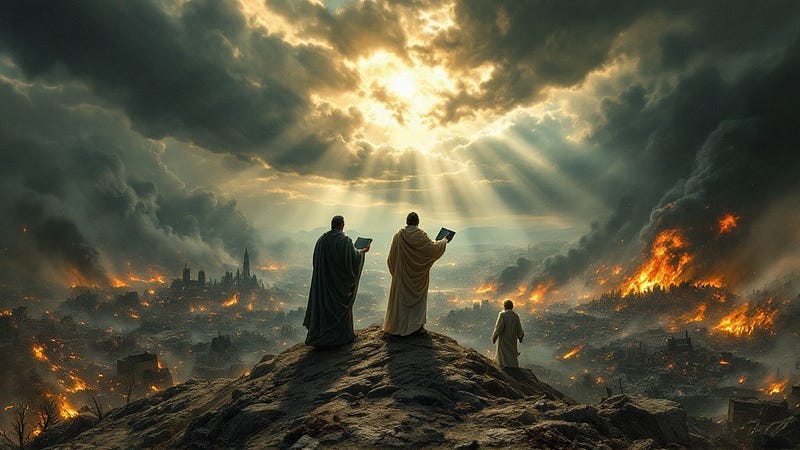
And as for Ishmael, I have heard thee: Behold, I have blessed him, and will make him fruitful, and will multiply him exceedingly; twelve princes shall he beget, and I will make him a great nation. But my covenant will I establish with Isaac, which Sarah shall bear unto thee at this set time in the next year.
The Book of Genesis introduces a foundational narrative that would, through its very premise of chosenness and exclusive covenant, sow the seeds of perpetual conflict across human civilization. The story of Abraham, positioned as the patriarch of three major world religions — Judaism, Christianity, and Islam — did not unify humanity under a common spiritual heritage but rather provided the theological groundwork for millennia of division, violence, and a relentless us-versus-them mentality. This ancient text, while rich in moral and cultural significance, has inadvertently functioned as a blueprint for religious exclusivity, compelling disparate faiths born from its traditions to view one another not as siblings in a shared story but as rivals in a divinely sanctioned contest for truth and dominion.
The core mechanism of this division lies in the concept of the covenant itself — a pact established between a singular deity and a specific lineage. This inherently creates a binary worldview: the chosen and the unchosen, the blessed and the unblessed, the inheritor of the promise and the outsider. While each Abrahamic faith interprets this covenant differently, claiming its own community as the true heirs of Abraham’s legacy, the underlying structure remains one of spiritual elitism. This theological framework has been weaponized throughout history to justify conquest, subjugation, and the eradication of indigenous and polytheistic belief systems. The mandate to be a separate and holy people, extracted from its original narrative context, has been perverted into a license for cultural imperialism, fueling centuries of crusades, jihads, forced conversions, and pogroms that have stained human history with bloodshed in the name of a partisan God.
Furthermore, the Abrahamic traditions embedded in Genesis have propagated a dangerous paradigm of scarcity in divine favor. If one group is the chosen recipient of God’s ultimate promise, then by logical extension, all others are secondary, erroneous, or condemned. This has compelled the three faiths into an endless loop of polemical conflict and apologetics, each attempting to supersede or invalidate the other. This rivalry has prevented a genuine synthesis of human spiritual wisdom, stifling philosophical and ethical progress by trapping vast segments of the global population within competing dogmatic silos. The intellectual and creative energy expended on defending doctrinal purity and prosecuting theological disputes represents an incalculable loss to human advancement, diverting attention from collective earthly problems to eternal otherworldly quarrels.
The impact extends beyond inter-religious violence into the very fabric of human society. The reinterpretation of the Abrahamic narrative has often been employed to legitimize oppressive social hierarchies. The subjugation of women finds a putative justification in the patriarchal structure of the Genesis accounts, where lineage and promise are transmitted exclusively through male figures. The notion of a promised land has provided a theological pretext for territorial expansion and the displacement of existing populations, creating intractable geopolitical conflicts that remain unresolved to this day. These traditions have fostered a mindset that perceives difference as deviation and dissent as heresy, eroding the principles of pluralism, tolerance, and secular governance that are essential for a harmonious global society.
In conclusion, the Abrahamic traditions originating from Genesis have acted not as a unifying force but as a primordial wedge driven into the heart of humanity. By sacralizing the concepts of election and exclusivity, they have compelled the religions that spring from Abraham into a tragic, often violent, competition for a singular title of truth. This has ruined the human race not through any inherent evil in the texts themselves, but through their relentless capacity to be interpreted in ways that fracture human solidarity, justify immense suffering, and hinder our collective evolution towards a more inclusive and enlightened global community. The legacy is a world fractured along the very fault lines that a single family’s story was meant to bless.
