The Algorithm of War: How Artificial Intelligence Is Reshaping Global Conflict
Introduction
Introduction
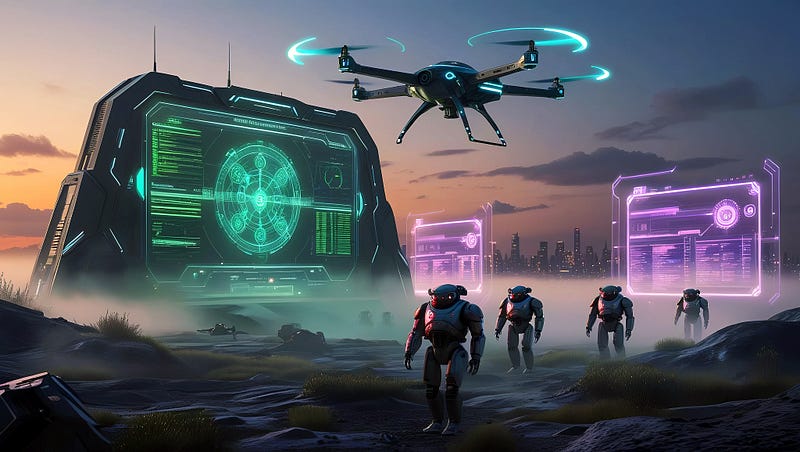
Once confined to the realm of science fiction, the idea of machines waging war has now become a stark reality. Artificial Intelligence (AI) is rapidly transforming modern warfare — driving drones, guiding missiles, defending cyberspace, and even shaping propaganda. With governments racing to secure dominance in the AI arms race, the battlefield is evolving faster than diplomacy, ethics, or international law can catch up. From autonomous weapons to disinformation campaigns, the implications are as profound as they are unsettling. This article explores how AI is revolutionizing war — and what it may cost us.
The Many Faces of AI in Warfare
Autonomous Weapons: Machines That Kill Without Mercy
At the heart of the AI warfare debate are Lethal Autonomous Weapon Systems (LAWS) — machines capable of selecting and engaging targets without human input. The U.S. MQ-9 Reaper drone and Turkey’s Kargu-2, allegedly used in autonomous attacks in Libya, serve as harbingers of a new kind of warfare. These weapons don’t suffer fatigue, fear, or moral hesitation. But this lack of humanity is precisely the point of contention. What happens when the decision to take a life is outsourced to code?
Surveillance and Reconnaissance: Watching from Above, Analyzing Below
AI’s capacity to analyze vast streams of data in real time has revolutionized surveillance. In programs like the Pentagon’s Project Maven, AI reviews drone footage faster and more accurately than any human analyst. Facial recognition systems scan satellite imagery, identify enemy movement, and monitor civilians. The line between security and overreach blurs with each new algorithm.
Cyber Warfare: The Digital Battlefield
Forget tanks and trenches — the wars of the future may be fought in code. AI is now both shield and sword in cyber warfare. Intelligent defense systems autonomously detect, counter, and even anticipate cyberattacks. DARPA’s Cyber Grand Challenge showcased machines combating cyber threats in real-time, without human intervention. But what if these same technologies fall into malicious hands?
Strategic Decision-Making: When AI Advises the General
In war, information is power — and AI is the ultimate analyst. The Pentagon’s Joint Artificial Intelligence Center (JAIC) is developing decision-support tools that help commanders process battlefield data, predict enemy actions, and craft tactical responses. Yet this raises uncomfortable questions: when human judgment is filtered through machine logic, is war more precise — or more detached?
Psychological Warfare: Deepfakes and Digital Lies
AI isn’t just changing how wars are fought — it’s altering how they’re perceived. Deepfake videos, AI-generated bots, and algorithm-driven disinformation campaigns are being weaponized to manipulate public opinion. Russia and China have both been accused of deploying such tactics, injecting false narratives into the bloodstream of democracies. In the age of AI, the first casualty of war may be the truth.
Ethical and Legal Minefields
Accountability: Who Pulls the Trigger When No One Does?
When an autonomous drone strikes a civilian target, who is to blame? The programmer? The commanding officer? The machine? International law has yet to answer this. The absence of clear accountability mechanisms is a ticking time bomb. Without rules of engagement for AI, the fog of war becomes algorithmic.
The Loss of Human Oversight
Delegating life-and-death decisions to machines threatens foundational humanitarian principles. Critics argue that LAWS dehumanizes warfare and increases the risk of unlawful killings. The United Nations has debated bans, but geopolitical gridlock means no binding agreement has emerged. For now, the machines march on — unchecked.
The AI Arms Race: Cold War 2.0
The United States, China, and Russia are locked in a silent but fierce arms race — not for nuclear supremacy, but algorithmic dominance. Smaller nations and non-state actors are entering the fray too, often purchasing off-the-shelf AI systems for tactical advantage. The accessibility of this technology could trigger global instability, leveling the playing field for those with little to lose.
Vulnerabilities in the Digital Domain
As AI systems grow in complexity, so do their attack surfaces. A successful AI-powered cyberattack could paralyze power grids, shut down hospitals, or crash financial markets. The same intelligence that defends can be turned to destroy. In a fully digitized world, there is no front line — every node is a target.
Terrorism Gets Smarter
The nightmare scenario is no longer hypothetical: terrorist organizations using autonomous drones or launching AI-coordinated cyberattacks. The proliferation of cheap, powerful AI tools means that destructive capabilities are no longer the sole domain of nation-states. Extremism, armed with intelligence, becomes exponentially more dangerous.
Looking Through the Research Lens
Academics worldwide are racing to decode the implications of AI in warfare. Recent studies explore AI’s role in everything from strategic military planning to nuclear deterrence. Some warn of overreliance, others caution against underestimating adversaries’ ambitions. A particularly alarming analysis suggests that AI could unintentionally trigger escalation in already fragile geopolitical environments. The message is clear: the technology is here, but the ethics and strategy are not.
Conclusion: A Crossroads of Code and Conscience
Artificial Intelligence offers military capabilities once thought impossible — speed, precision, and foresight. But it also opens a Pandora’s box of moral, strategic, and existential risks. As nations sprint toward supremacy in this new domain, they must pause to ask: What kind of wars are we preparing to fight? And more importantly, what kind of world are we creating in the process?
We stand at a crossroads. One path leads to smarter defense and safer nations. The other veers into a dark future where machines wage wars beyond human control. The choice is ours — if we have the foresight to make it.