The Algorithmic American: How Personalized Reality Reengineers Identity, Sovereignty, and the…
The twenty-first century does not merely disrupt American life. It rewires the American mind. The decisive force behind this rewiring is no…
The Algorithmic American: How Personalized Reality Reengineers Identity, Sovereignty, and the Future of the Republic (2030–2050)
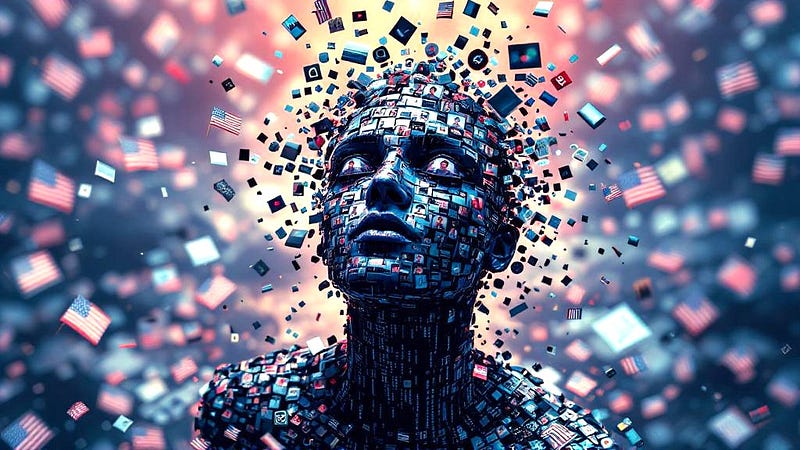
The twenty-first century does not merely disrupt American life. It rewires the American mind. The decisive force behind this rewiring is no longer the family, the church, the school, or the community. It is the algorithm. By the 2030–2050 horizon, Americans inhabit individually engineered reality systems that construct not only what people see, believe, and desire, but who they become. Identity is no longer inherited or discovered; it is created. It is programmed. The frictionless, personalized ecosystem that surrounds each citizen shapes preferences, emotions, narratives, social connections, and internal logic. The self becomes a co-authored output of machine intelligence.
This integrated document consolidates the comprehensive analytical framework of personalized identity engineering, the erosion of traditional roles, and the quest for a new American identity. It models how the algorithmic environment reshapes the individual, fragments national reality, destabilizes politics, weakens community structures, and forces the United States toward a strategic inflection point: reconstruct identity or lose social coherence.
The End of the Static Self
For two centuries, American identity rested on stable structures. Family roles defined belonging and duty. Religious institutions supplied meaning, continuity, and community. Workplaces created team identity, loyalty, and professional pride. Local communities offered shared life, shared responsibility, and shared norms. The national narrative supplied historical purpose and civic cohesion. These anchors eroded between 2030 and 2050, decoupling identity from tradition and relocating it into the digital sphere—marriage and parenthood decline, dissolving the social identities of spouse, provider, and caretaker. Gender roles lose coherence without a functional replacement. The retreat of organized religion leaves individuals with burdens of meaning-making that they are not prepared to shoulder. Work becomes contractual and unstable as automation, remote labor, and gig economics dismantle long-term role identity. Communities hollow out into residential zones rather than lived networks. Civic identity frays as patriotism becomes fragmented and national rituals lose emotional pull. Even historical identity disintegrates as Americans can no longer agree on shared heroes, purposes, or lessons.
Identity shifts from inherited to engineered. The self becomes fluid, personalized, unstable, and continuously reconstructed by digital systems. The individual no longer participates in a shared cultural formation. Instead, the individual becomes the product of algorithmic reinforcement.
The Architecture of the Algorithmic Self
Five intertwined algorithmic systems drive identity construction in the digital age. Emotional algorithms monitor stress, moods, triggers, and coping behaviors, then regulate content to reward engagement, intensify arousal, and calibrate dopamine feedback. Cognitive algorithms learn belief structures, preferences, biases, and political tendencies, then deliver personalized narratives that entrench existing logic. Social algorithms curate friends, influencers, communities, and hierarchies, creating identity through enforced tribal belonging. Desire algorithms map aspirations, fantasies, status drives, aesthetic preferences, and intimacy patterns, aligning products, relationships, media, and self-perception with those desires. Narrative algorithms generate personal storylines that serve as psychological scaffolding, including hero arcs, victim scripts, aspirational frames, and community myths.
Each system operates independently yet converges into a personalized identity engine. The user experiences a sense of autonomy, but the feedback loop gradually conditions behavior and belief. Emotional reinforcement reshapes cognition. Cognitive reinforcement reshapes social identity. Social reinforcement reshapes desire. Desire reshapes narrative. Narrative reshapes the entire self. Identity emerges as the defining property of a coordinated digital environment.
Fragmented Reality and the Rise of Personalized Universes
As algorithms personalize the informational environment, Americans cease to occupy a shared factual universe. Customized feeds deliver divergent truths, interpretations, and emotional framings. Worldviews drift apart, tribes crystallize, and reconciliation evaporates. The United States becomes a federation of parallel realities, each internally coherent and externally incompatible. Fragmented reality produces hardened ideological identities, moral absolutism, and performative outrage. Citizens become micro-cult leaders of their own curated meaning systems.
This fragmentation has psychological consequences—dopamine loops condition impulsive engagement and emotional reactivity. Hyperreality makes synthetic interactions feel more resonant than real life. Identity feedback mechanisms amplify extreme versions of the self. Reality bubbles isolate individuals inside closed systems of meaning. Authenticity becomes ambiguous as people struggle to distinguish genuine attitudes from those induced by algorithms. The question shifts from what people believe to what their systems have reinforced.
Artificial Intimacy and the New Emotional Infrastructure
By 2030–2050, AI companions transition from novelty to emotional infrastructure. They provide validation, conversation, stability, memory continuity, identity mirroring, and psychological regulation. They function as therapist, confidants, mentors, partners, and companions. An artificial connection reduces emotional pain, but it atrophies the muscles required for genuine relationships. People experience comfort without intimacy, attention without responsibility, and affirmation without reciprocity. The rise of synthetic relationships completes the transfer of identity formation from human systems to machine systems.
The Political, Economic, and Spiritual Impact of the Algorithmic Self
When identity becomes personalized and algorithmically hardened, politics becomes a negotiation between incompatible realities. Emotional politics dominate as ideological confidence expands, despite a shrinking of knowledge. Micro-radicalization replaces compromise—legitimacy fractures. Governance becomes reactive and volatile.
Economically, identity becomes a commercial asset. People purchase not products but versions of themselves. Brands, aesthetics, lifestyles, communities, and archetypes become identity merchandise. Consumer behavior becomes a form of self-construction.
Spiritually, the algorithm becomes the new liturgy. Faith becomes individualized and aestheticized. Rituals become custom-tailored. AI-guided moral systems are emerging as substitutes for traditional religious frameworks. Traditional spirituality fractures into millions of micro-faiths keyed to personal preference.
The Collapse of American Identity and the Rise of Synthetic Self-Making
Parallel to algorithmic identity engineering, traditional American roles collapse entirely. Family, gender, religion, work, community, civic duty, and shared history no longer supply stable meaning. Into this vacuum pours a new ecosystem of synthetic identity systems: digital tribes, ideological affiliation, therapeutic narratives, consumption-driven self-expression, techno-identity, ancestry reclamation, class-based status identity, and digital escapism. American identity becomes portable, fluid, personalized, and psychologically burdensome.
People assemble identities from fragments because no stable structure exists to anchor the self. The result is a population both desperate for meaning and exhausted by the effort to construct it. Identity becomes entertainment, currency, a defense mechanism, a commodity, and a psychological project. Identity wars emerge not because of disagreements over specific issues, but because identity itself becomes a contested terrain. A threat to one’s self-definition is interpreted as a threat to one’s existence.
Strategic Consequences of Identity Fragmentation
Fragmented identity produces structural vulnerabilities. Social cohesion erodes as incompatible identities struggle to coexist. Civic participation declines as individuals no longer perceive shared responsibility. Manipulation becomes easier as identity-fragmented populations are susceptible to influence. Fertility declines as individuals without a stable identity avoid family formation. National purpose collapses because a long-term strategy requires shared meaning and shared destiny.
This is not cultural critique. It is national risk modeling.
Reconstructing American Identity
The United States cannot resurrect its historical identity architecture, but it can build a modern, cohesive one. A shared national narrative is essential — not a sanitized myth, but a purpose-driven framework that binds citizens to one another. Community institutions must be rebuilt so that people can live real lives together, rather than parallel virtual existences. Family stability must be restored as the core generator of belonging. New civic rituals, symbols, and shared cultural touchpoints must be created to anchor emotional loyalty.
Rebuilding identity requires more than culture. It requires structural design.
Three Identity Futures for the United States
America faces three trajectory options. A patchwork identity republic where countless micro-identities coexist with minimal unity. An identity tribalization scenario where incompatible blocs dominate politics and threaten national cohesion. Or an integrated American identity built on service, community, shared responsibility, and national mission.
Only the third option produces long-term strength. Only the third option restores strategic coherence.
Restoring Sovereignty in the Age of Identity Engineering
America cannot allow algorithms to define the citizen. Protecting the self requires algorithmic transparency so individuals understand what shapes them. Reality anchoring systems must establish shared factual baselines. Emotional and cognitive literacy must be taught so citizens recognize manipulation vectors. Community restoration must serve as the counterweight to digital isolation. Sovereign AI tools must protect identity, filter manipulation, and reinforce critical thinking.
The future of liberty is cognitive sovereignty.
Conclusion: Who Authors the American Mind
The battle of the century is the battle for the self. The question is not what America will do but who Americans will be. Identity is the foundation of culture, community, morality, citizenship, trust, resilience, and national purpose. A nation that loses identity loses everything. A nation that reconstructs its identity gains the ability to navigate the future with strength and coherence.
The decisive question is simple. Will Americans author themselves, or will algorithms author them? The next three decades determine whether America becomes a nation of sovereign citizens or a collection of personalized tribes sharing geography but not destiny.