The Amazon Sailfin Catfish: A Spiny Treasure of Rivers, Kitchens, and Sustainability
Introduction In the winding, tea-colored arteries of the Amazon basin, a curious fish glides along the muddy bottom, armored like a knight…
Introduction
In the winding, tea-colored arteries of the Amazon basin, a curious fish glides along the muddy bottom, armored like a knight and adorned with a sweeping dorsal fin that unfurls like a sail. Known to science as Pterygoplichthys pardalis and to riverside communities simply as the sailfin catfish, this species is more than a biological oddity. It is a symbol of resilience in shifting ecosystems, a humble staple on certain dinner tables, and a case study in how humans can work with, rather than against, nature’s intricate designs. In a world searching for sustainable food sources, the Amazon sailfin catfish has a story worth telling — one that merges the elegance of biology with the art of cuisine.
Taxonomy
Classified under the family Loricariidae, Pterygoplichthys pardalis belongs to a group affectionately known as armored catfish. Its genus, Pterygoplichthys, includes several varieties often mistaken for each other in markets, from the spotted sailfin catfish to its striped cousins. Among local fishers, names shift with dialects: plecos, suckermouth catfish, and in some regions, simply “armored pleco.” While not all are eaten, pardalis stands out for its relative abundance and manageable size, which makes it suitable for culinary use.
Biology
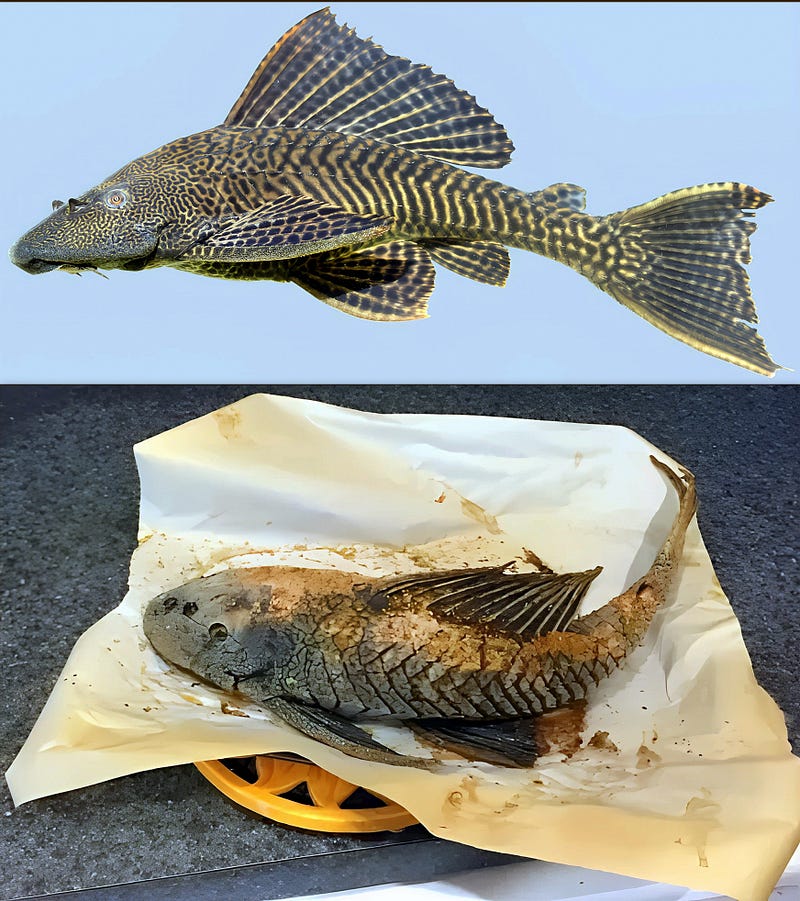
To hold this fish in your hands is to marvel at evolution’s artistry. Its body is sheathed in bony plates that gleam like polished stones. Its signature dorsal fin rises dramatically, catching the light in an almost theatrical display. These adaptations are not merely aesthetic; they serve as protection from predators and as stabilizers in strong currents. Equipped with a ventral mouth shaped like a suction cup, the sailfin catfish grazes on algae and detritus, cleaning riverbeds as it feeds. In the wild, individuals can live well over a decade, reaching lengths of half a meter. Their life cycle is punctuated by monsoon-fed breeding seasons, when males excavate riverbank burrows and vigilantly guard clutches of eggs. This behavior speaks to a fierce instinct for survival.
Ecology
The sailfin catfish thrives in the silt-laden waters of South America, but its story extends far beyond the Amazon. Introduced, sometimes accidentally, into waterways across Asia, Africa, and even North America, it has become a species both admired and contested. In its native range, it plays a crucial ecological role as a natural recycler, turning organic waste into biomass. Yet in regions where it is non-native, its robust survival traits can disrupt local ecosystems. Here lies the challenge and opportunity: responsible management can transform what some consider an invasive nuisance into a sustainable resource, easing pressure on overfished native species.

Uses
Economically, Pterygoplichthys pardalis is a quiet contributor. In rural markets, its armored body is often stacked in woven baskets, sold fresh or smoked, and traded among families who have fished these rivers for generations. It also appears in the ornamental fish trade, although its size eventually outgrows most aquariums. For communities willing to experiment, farming sailfin catfish offers a path toward protein security without overtaxing fragile ecosystems. As aquaculture technology advances, there is growing interest in integrating this hardy species into polyculture systems, where it can clean ponds while providing a secondary crop.
Culinary Aspects
Ask someone who grew up along the Rio Negro or the Tocantins, and you will hear that the sailfin catfish, despite its armored exterior, yields surprisingly tender flesh. Once cleaned and carefully filleted, the meat is pale, lean, and mild, with a faint sweetness reminiscent of tilapia. In village kitchens, it is simmered in coconut milk stews, grilled over wood fires with a dash of lime and coarse salt, or tucked into banana leaves to roast in earthen ovens. Beyond its flavor, it is a nutritional gem — low in fat, high in protein, and rich in micronutrients drawn from its algae-based diet.
Wine Pairings
Pairing wine with a fish armored like a warrior might seem whimsical, yet the sailfin catfish’s subtle taste rewards a thoughtful choice. A crisp Sauvignon Blanc elevates its delicate sweetness when served grilled, cutting through the smokiness with citrus brightness. For stews enriched with coconut or peppers, a lightly oaked Chardonnay brings a creamy depth that echoes the broth. Adventurous palates might enjoy a dry Riesling, whose acidity dances alongside the catfish’s earthy undertones, revealing layers of complexity.
Conclusion
The Amazon sailfin catfish is not just a fish; it is a testament to adaptability, a bridge between ecology and economy, and a culinary surprise waiting to be embraced. In an era when sustainability is no longer optional but essential, Pterygoplichthys pardalis challenges us to look deeper into overlooked species. As we learn to honor its role in the river and its potential on our plates, we may find a model for future food systems that are both resilient and respectful of the wild rhythms that sustain us.