The Blunted Mind: Unraveling Cannabis-Induced Neurocognitive Decline
Long-term heavy marijuana use can lead to serious intellectual and emotional effects. These include problems with memory, cognition, and…

Long-term heavy marijuana use can lead to serious intellectual and emotional effects. These include problems with memory, cognition, and motivation, as well as a higher risk of mental health issues. The impact can vary based on when a person starts using, how often they use, and the strength of the THC.
Intellectually, heavy users, especially those who start in their teenage years, may experience significant memory and learning deficits, along with slower information processing. Studies suggest that heavy use can also be linked to a decline in IQ and worse academic and career results, with lower grades, fewer high school or university completions, and lower income. Users might show signs of “amotivational syndrome,” which includes apathy, lack of interest, and reduced productivity, symptoms similar to depression that can improve after quitting.
Emotionally, regular use, particularly daily, increases the risk of anxiety and depression, which can worsen rather than help mental health issues. It also raises the risk of psychosis and schizophrenia, especially among teens. Heavy use can lead to cannabis use disorder, resulting in withdrawal symptoms when stopping, and generally, heavy users report lower life satisfaction and relationship issues.
Abstract
Long-term, heavy marijuana use, particularly with the high-potency cannabis products available today, represents a significant public health concern with profound implications for neurocognitive and emotional functioning. This comprehensive report synthesizes current scientific understanding of the mechanisms through which chronic, heavy tetrahydrocannabinol (THC) exposure can lead to apparent retardation, or more accurately, a significant impediment and delay, in both intellectual and emotional domains. The analysis delves into the disruption of fundamental endocannabinoid system signaling, structural and functional brain changes, and the consequent real-world deficits in executive function, memory, and affective regulation.
Introduction
The endocannabinoid system (ECS) is a ubiquitous neuromodulatory network critical for maintaining homeostasis in the brain. It regulates synaptic plasticity, the fundamental process by which neural connections are strengthened or weakened in response to experience, which is the biological basis for learning and memory. The primary psychoactive component of cannabis, THC, functions as an exogenous cannabinoid receptor agonist, overwhelming this delicate system. Chronic, heavy administration of THC leads to a profound dysregulation of the ECS, initiating a cascade of neuroadaptive changes that can result in lasting cognitive and emotional deficits, mimicking a state of developmental retardation.
Neurobiological Mechanisms of Impairment
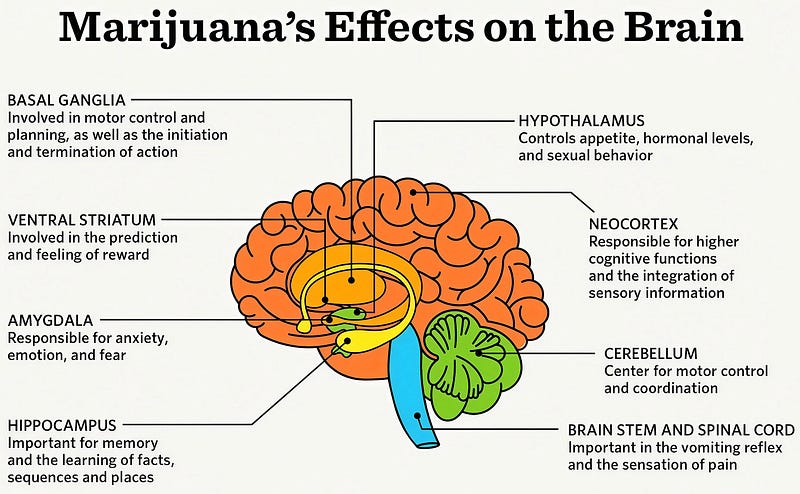
The core mechanism of impairment lies in the persistent overstimulation of the CB1 receptors, which are densely concentrated in brain regions central to cognition and emotion, including the prefrontal cortex, hippocampus, and amygdala. Under normal conditions, endocannabinoids like anandamide are released on demand to fine-tune neurotransmitter release. Chronic THC flooding causes a compensatory downregulation of CB1 receptors and a blunting of their signaling efficiency. This process, known as internalization and desensitization, means that even after cessation of use, the ECS operates at a diminished capacity for a significant period.
This receptor downregulation has direct structural and functional consequences. Neuroimaging studies consistently show alterations in the microstructure of white matter tracts, impairing the efficiency of communication between different brain regions. Perhaps more critically, heavy cannabis use is associated with reduced volume and abnormal activity in the hippocampus, a structure indispensable for memory formation and consolidation. The prefrontal cortex, the seat of executive functions such as decision-making, impulse control, and abstract reasoning, also demonstrates hypoactivity. This combination of impaired neural communication and reduced computational power in key areas creates a biological substrate for cognitive and emotional retardation.
Manifestations of Intellectual Retardation
The intellectual deficits observed in long-term, heavy users are not a reflection of innate low intelligence but rather a functional decline attributable to neurobiological changes. The most pronounced deficit is in the domain of executive functions. Individuals exhibit significant impairments in their ability to plan, organize, solve complex problems, and switch between tasks mentally. This presents as a pronounced mental inflexibility and an inability to formulate and execute goal-directed strategies.
Memory function is severely compromised, particularly verbal memory and working memory — the mental scratchpad used to hold and manipulate information. New learning becomes inefficient, and recall is often fragmented and unreliable. Attentional control is also diminished, characterized by increased distractibility and an inability to sustain focus on demanding tasks. The cumulative effect is a measurable decline in overall cognitive capacity, often described by users as a “brain fog.” This state effectively retards intellectual progression, hindering academic achievement, occupational performance, and the ability to engage in higher-order reasoning, creating a functional intellectual impairment that can persist for extended periods after quitting.
Manifestations of Emotional Retardation
Parallel to the cognitive deficits is a syndrome of emotional retardation, characterized by a failure to develop or a regression in emotional maturity and regulation. The amygdala, a key region for processing fear and emotional responses, is modulated by the ECS. THC-induced disruption leads to affective dysregulation. Individuals often present with a markedly blunted affect, demonstrating apathy, diminished motivation (amotivational syndrome), and a reduced capacity to experience pleasure from normally rewarding activities (anhedonia).
More provocatively, this emotional impairment extends to social cognition. Heavy users frequently show deficits in recognizing emotional cues in others, particularly subtle expressions of fear or anger. This impairment in empathy and theory of mind — the ability to understand the mental state of others — leads to significant social maladjustment. Emotional responses become poorly modulated, potentially swinging between apathy and irritability. This stunting of emotional intelligence disrupts interpersonal relationships, vocational stability, and the overall ability to navigate complex social environments, effectively locking the individual into an emotionally immature state.
Developmental and Public Health Considerations
The risk of significant and lasting retardation is highest when heavy use begins during adolescence, a critical period of active brain development and synaptic pruning. The introduction of high-dose THC during this vulnerable window can permanently alter the trajectory of brain maturation, leading to more severe and enduring deficits. The increasing potency of cannabis products, with THC concentrations far exceeding those of decades past, exacerbates this risk, creating a generation of users exposed to a neurochemical insult of unprecedented strength. The public health implications are vast, encompassing reduced educational attainment, lowered economic productivity, and increased demands on mental health services. This is not a harmless recreational activity but a behavior with tangible and severe consequences for the human mind.
Conclusion
Long-term, heavy marijuana use induces a state of functional neurocognitive decline that can be accurately described as a form of intellectual and emotional retardation. This is not a permanent genetic condition but an acquired and potentially persistent deficit stemming from the pharmacological hijacking of the endocannabinoid system. The resulting downregulation of CB1 receptors, structural brain changes, and functional hypoactivity in critical networks lead to profound impairments in executive function, memory, and emotional regulation. While some recovery may occur with prolonged abstinence, evidence suggests that early and heavy use, particularly with high-potency cannabis, may cause irreversible changes. This demands a sober, science-based reevaluation of cannabis and its potential to impair the very faculties that define human intellect and emotion.