The Conscious Clockmaker: Free Will as an Emergent Property of the Mind
Introduction
Introduction
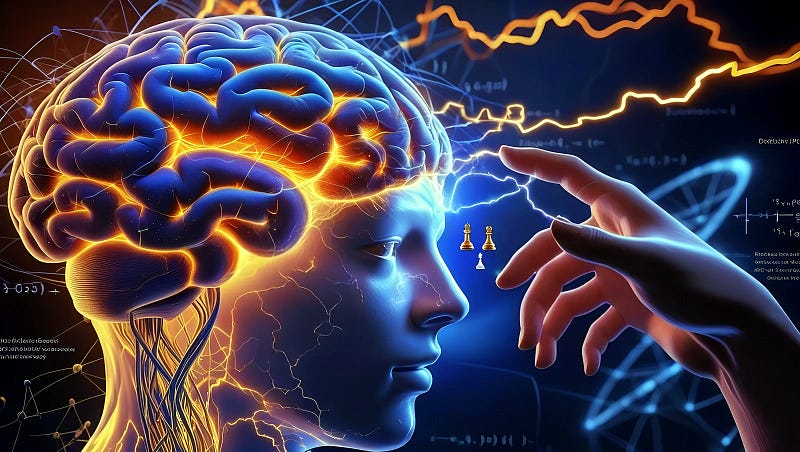
Are we the masters of our choices — or passengers on a neurochemical ride we don’t control? The debate over free will has long split philosophers, neuroscientists, and theologians alike. While hard determinists argue that every decision we make is the result of prior causes, and libertarians invoke a metaphysical will untethered from physics, a third path is emerging — one grounded in the science of complexity and consciousness itself.
This article explores the provocative idea that free will is not an illusion, nor a divine gift, but an emergent property of conscious cognition. Much like how life emerges from inanimate molecules, free will may arise from the mind’s intricate self-organization — real, not because it’s metaphysically uncaused, but because it transcends the reductionism of brute physics.
The Nature of Emergence: When More Becomes Different
In complex systems, the whole becomes greater than the sum of its parts. A single neuron doesn’t think, but a hundred billion intricately networked, give rise to thought. This is the principle of emergence — where higher-order behaviors appear that can’t be predicted solely from individual components.
Free will, in this framework, emerges from layers of perception, memory, attention, emotion, and abstract reasoning interacting in real time. It’s not about breaking the laws of physics, but about organizing them in such a way that something new — choice — appears.
Consciousness as Creative Conductor
Consciousness isn’t just a camera recording stimuli — it’s a dynamic integrator of internal and external experience. It filters impulses, simulates outcomes, weighs moral dimensions, and crafts plans that can override reflexes or instincts. In that sense, consciousness serves as a top-down director, capable of reorganizing inputs into novel outputs.
Imagine a person choosing to forgive someone they once hated. The raw ingredients — anger, memory, pain — are deterministic in origin. But the decision to forgive? That’s constructed within a space of conscious self-awareness that alters future behavior, rewiring the past’s influence.
This is self-causation, not acausal randomness: a decision born not from chance, but from the emergent agency of a system aware of itself.
Challenging Determinism Without Abandoning Reality
Critics of emergent free will argue that if every neuron fires due to physics, then all choices are just dominoes falling. But emergentists counter that complex systems can reorganize cause-and-effect relationships in unpredictable ways. Your brain is not a line of dominoes — it’s more like weather: chaotic, recursive, and sensitive to initial conditions.
Just as slight atmospheric shifts can yield storms, minor variations in neural states may culminate in dramatically different decisions. Add consciousness to the mix, and the brain becomes a decision-making engine capable of interpreting its states and modifying its future path.
Evidence from Mind and Matter
Neuroscience does raise thorny questions. Benjamin Libet’s famous experiment found that subconscious brain activity appears before people report making a decision. Some took this as proof that free will is an illusion. But Libet himself argued that we retain veto power — the conscious ability to halt an unconscious impulse.
This aligns with Global Neuronal Workspace Theory, which posits that consciousness enables access to widespread brain areas, allowing flexible, goal-directed control — precisely the kind of architecture needed for emergent agency.
On the systems side, complexity theory supports the idea that high-dimensional networks like the brain can exhibit unpredictable, creative behaviors — hallmarks of emergent phenomena. Meanwhile, philosophers like John Searle and Daniel Dennett contend that consciousness need not be supernatural to be real, just biologically emergent and evolutionarily useful.
Objections: Is This Just a Clever Illusion?
Skeptics raise several valid challenges.
First, if emergence depends entirely on physical substrate, is it free — or just a prettier kind of determinism?
Second, there’s the danger of epiphenomenalism: If consciousness is like steam from a locomotive — produced by the engine but not influencing it — then agency is cosmetic.
And what about quantum indeterminacy? Some propose randomness at the subatomic level as a loophole for free will. But randomness isn’t choice. An effective emergent model must show how consciousness harnesses complexity, not chaos, to generate decisions.
Conclusion: A Conscious Middle Ground
Framing free will as an emergent property of consciousness offers a compelling reconciliation. It honors the laws of physics while making room for the lived reality of self-awareness and responsibility. It suggests that our brains are not just reactive meat machines, but conscious clockmakers, shaping their futures from the inside out.
This approach avoids magical thinking, respects scientific rigor, and reclaims space for personal accountability. We are not gods, nor puppets — we are evolving architects of choice, bound by nature but liberated through its complexity.
In the words of philosopher Alva Noë:
“Consciousness isn’t a ghost in the machine — it’s the machine organizing itself into new patterns of agency.”
If that’s not free will, it’s the closest thing evolution has built.