The Cosmic Silence: Why Aliens Probably Exist But Haven’t Visited Earth
Introduction:
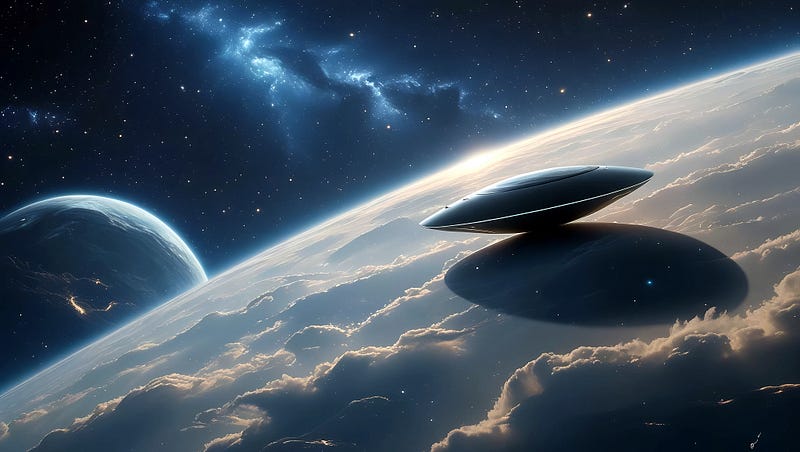
Introduction:
We gaze into the night sky and wonder: Are we alone? It’s one of the oldest questions humanity has asked, and science now offers a staggering reason to think we aren’t. With billions of galaxies and trillions of planets, the odds suggest that life — possibly even intelligent life — is out there somewhere. Yet, in all of human history, not a single verified visitor has arrived from the stars. No spacecraft in the sky. No greetings from afar. Just silence.
This paradox — where probability screams “yes,” but evidence whispers “no” — isn’t just a question of belief. It’s a scientific mystery that exposes the limits of our understanding and the reach of our imagination. Let’s take a reasoned journey through the paradox of cosmic companionship.
The Math Favors Life
The universe is not just vast — it’s mathematically overwhelming. Astronomers estimate that there are more planets than grains of sand on Earth. And many of those orbit stars similar to our own, within habitable zones where water could exist. These so-called Goldilocks planets aren’t just theoretical: NASA’s Kepler mission has already cataloged thousands of them.
Life on Earth emerged quickly after the planet cooled, suggesting that, given the right ingredients, abiogenesis — life from non-life — might not be a fluke. Multiply that potential by a trillion, and the conclusion becomes hard to ignore: We are probably not the only life in the universe.
The Fermi Paradox: A Question That Haunts Us
Despite the optimistic math, physicist Enrico Fermi posed a haunting question in 1950: Where is everybody?
This is the Fermi Paradox in its simplest form. If the universe is teeming with life, why haven’t we encountered any? The possible answers are sobering. One theory, The Great Filter, posits that some catastrophic or near-impossible step in evolution prevents most life forms from advancing to the stage of space travel. Maybe it’s the leap from unicellular to intelligent life. Maybe it’s surviving technological self-destruction.
Another explanation is timing. Civilizations might flicker into existence, burn brightly for a few centuries, then vanish — like cosmic fireflies that never overlap in the dark.
Interstellar Travel: The Physics Problem
Let’s assume intelligent aliens do exist. Could they physically reach us? Here, the cosmos throws up massive roadblocks.
The closest star system, Proxima Centauri, is 4.24 light-years away. Even traveling at light speed — a feat far beyond our current capabilities — it would take over four years to get there. For spacecraft traveling at more realistic speeds, the journey would span tens of thousands of years.
The energy needed to push a spacecraft to even a fraction of light speed is monumental. No known propulsion system — chemical, nuclear, or theoretical — is capable of delivering the energy required without collapsing under its weight. And then there’s the problem of survival: space is a minefield of radiation, micrometeorites, and life support challenges. For organic life, it’s not just a long journey. It’s a death sentence.
Evidence: Or the Lack Thereof
If extraterrestrials had reached us, we would expect something — a signal, a craft, a piece of alien technology. Yet, no such evidence has ever passed rigorous scientific scrutiny.
Yes, there are UFO sightings. But most of them are explained by atmospheric phenomena, drones, or military technology. Even the Pentagon’s recent UAP disclosures — though intriguing — fail to leap to alien origin.
Ancient astronaut theories are captivating, but speculative at best. They often underestimate the ingenuity of ancient human civilizations. Meanwhile, alleged alien abductions can often be traced to neurological phenomena like sleep paralysis or memory distortion. Simply put, the most extraordinary claims in human history remain unsupported by extraordinary evidence.
The Myth of Visitation
The appeal of alien visitation is emotional as much as it is intellectual. It taps into our longing for connection, wonder, and validation. But we must separate hope from evidence, and fantasy from science.
A clear-eyed look at the data leads to a humbling conclusion: life may be common, but interstellar visitation likely isn’t. The distances are too great. The silence is too complete. The barriers are too formidable.
Conclusion:
The universe is almost certainly not empty. Microbial life could be thriving in subterranean oceans beneath the ice of Europa or Titan. Somewhere, intelligent species may be pondering the cosmos just as we do — wondering if they’re alone.
But visiting Earth? That’s another story. The silence of the skies isn’t proof of absence, but it is a call to skepticism. Until we have hard evidence, the idea that aliens have come — and gone — remains fiction.
Yet the search continues. Not because we need aliens to validate our existence, but because the act of looking reminds us who we are: a curious, tenacious species staring out into the void, waiting for the universe to whisper back.