The Duality of Michael Savage: An Intellectual and Ideological Examination
Michael Savage, born Michael Alan Weiner, is an American author, political commentator, and former radio host whose career is best…
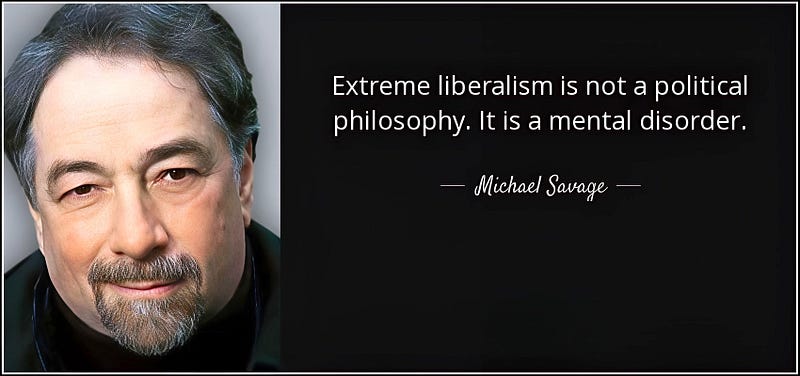
Michael Savage, born Michael Alan Weiner, is an American author, political commentator, and former radio host whose career is best understood through the lens of duality. His professional life presents a stark bifurcation: that of a respected academic and author in the fields of natural science and medicine, and that of a multimedia firebrand who became a leading voice in American conservative talk radio. This report offers a comprehensive intellectual and ideological profile of Savage, dissecting his core arguments, tracing his career trajectory, and exploring the philosophical and psychological underpinnings that inform his controversial public persona. By examining the man behind the microphone, it is possible to gain a more complete understanding of his enduring influence on a significant segment of the American population.
The Intellectual Foundation: From Academia to Activism
The genesis of Michael Savage’s public identity is found in his rigorous academic and professional background, a period of his life spent operating under his birth name, Michael Weiner. His intellectual credentials are both extensive and specialized. He holds a Bachelor of Science degree from Queens College, followed by two master’s degrees from the University of Hawaii in medical botany and medical anthropology.1 His academic journey culminated with a Ph.D. from the University of California, Berkeley, where he earned a doctorate in nutritional ethnomedicine, a distinction he has noted makes him the sole recipient of that specific degree from the institution.1 This scholarly foundation informed his early literary work, which includes books on health, herbal medicine, and homeopathy under the name Michael Weiner.1 Titles such as Herbs That Heal, Earth Medicine — Earth Food, and Maximum Immunity reflect a deep and sustained interest in natural remedies and the historical relationship between humanity and plant-based medicine.4
The pivotal moment that led to his transformation from academic author to political activist was the rejection of a manuscript he had written in 1994 titled Immigrants and Epidemics.6 This proposed book, which centered on the theme of foreign diseases entering the country via undocumented immigrants, was not accepted for publication due to what Savage maintains was its “politically incorrect subject matter”.6 This perceived act of intellectual marginalization was the direct catalyst for a fundamental career change. Frustrated by the establishment’s refusal to publish his work, he recorded a radio demo based on the very manuscript that had been rejected and sent it to 250 radio stations.6 This action initiated his career as a radio host and marked the birth of The Savage Nation. The shift from a scholarly pursuit to a populist, unmediated platform in talk radio was not a random pivot but a direct response to a specific professional rejection. This experience reinforced his conviction that American culture and institutions were being degraded by a progressive agenda, a central theme that would come to define his entire political career.
The Savage Canon: A Thematic Analysis of Major Works
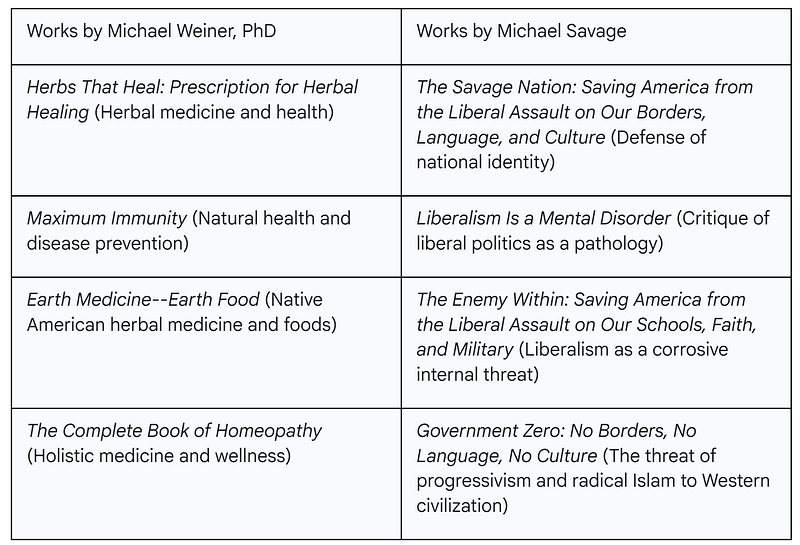
A thematic analysis of Michael Savage’s literary career reveals a deliberate and dramatic shift in focus and tone, mirroring his transition from Michael Weiner to his public persona. As Michael Weiner, his books were educational and focused on individual and collective health, a reflection of his academic background. In contrast, his political works, written as Michael Savage, adopted a combative lexicon of warfare and disease, transforming his literary output into a sustained ideological assault on what he identifies as the forces corrupting American society.
The titles of his political books are indicative of this thematic shift. They include The Savage Nation, Liberalism Is a Mental Disorder, The Enemy Within, Government Zero, and Stop the Coming Civil War.7 Each work tackles a specific facet of his overarching critique of liberalism and progressivism.
The Savage Nation: Saving America from the Liberal Assault on Our Borders, Language, and Culture introduces his central philosophical triad and argues that American freedoms are under siege from both governmental and foreign forces.8
Liberalism Is a Mental Disorder uses the provocative language of psychological pathology to delegitimize his political opponents, framing their ideology not as a different set of political beliefs but as a form of societal illness.13
The Enemy Within further develops this metaphor, asserting that “liberal propaganda and agendas” have infiltrated the core institutions of American life, including schools and churches, positioning liberalism as a corrosive internal threat.9
Government Zero: No Borders, No Language, No Culture serves as the most complete articulation of his core philosophy, arguing that a coalition of “progressives and radical Islamists” are working to dismantle Western civilization in favor of a “socialist, Third World dictatorship”.10 Finally, the book Diseases Without Borders stands as a unique synthesis of his dual identities, leveraging his Ph.D. in epidemiology to argue that new and resurgent diseases are entering the U.S. as a direct result of unregulated immigration.11
This distinct thematic and tonal transition in his published works is made clear by a direct comparison:
The Triad of American Identity: Borders, Language, and Culture
Michael Savage’s political philosophy is summarized by a concise, three-word maxim: “borders, language, and culture”.1 This triad serves as the central, unifying principle of his thought and a framework for understanding his political arguments and activism.
His stance on borders is framed as the defense of national sovereignty and security. He is a vocal opponent of illegal immigration, citing what he views as a range of negative consequences, including the spread of diseases, the strain on public services, and the erosion of American nationalism.1 This position is directly linked to the rejected manuscript that launched his career, where he applied his academic background in epidemiology to a politically charged topic. His call to “read my lips: no new immigrants” is a direct expression of this core belief.1
The defense of a common language is another pillar of his philosophy. He is a staunch supporter of the English-only movement, believing that a shared language is essential for national cohesion and civic identity.1 He has expressed concern that the erosion of a common tongue undermines the sense of a shared American identity, making it more difficult to maintain a unified nation.
Culture is perhaps the most encompassing and foundational element of his triad. Savage argues that liberalism and progressivism are actively “degrading American culture” and its traditional values.1 This belief extends to a defense of what he describes as the Judeo-Christian foundation of American society.18 His political philosophy, which he calls “conservative nationalism” 1, is an attempt to conserve and protect this cultural bedrock from what he considers both external and internal threats. His focus on these three elements can be seen as a deeply personal conviction, as the son of immigrants who embraced the American identity, he believes in the necessity of a clear, coherent framework for national belonging. His experience of having his work on immigration rejected by the establishment reinforced his view that the very institutions meant to protect the nation were compromised, making his nationalistic arguments feel all the more urgent and personal.
Philosophical and Spiritual Beliefs: The Search for Meaning
Beyond the domain of political commentary, Michael Savage has explored a more personal and introspective side of his intellectual life, most notably in his book God, Faith, and Reason. This work offers a rare glimpse into a spiritual journey that is far more nuanced and eclectic than his public persona might suggest. The book is not a formal theological treatise but rather an autobiographical narrative, drawing on a wide array of sources, including Christian, Jewish, and Buddhist traditions, as well as personal anecdotes and reflections from his life and radio show.18 The title itself suggests a central tension in his thought: the attempt to reconcile personal faith with rational inquiry in a secular age.
Savage’s philosophical reflections on the nature of God challenge conventional orthodoxies. He has written about the idea that God is “omnipresent,” or everywhere at all times, but not necessarily “omnipotent,” or all-powerful.21 He finds this distinction crucial for reconciling the existence of God with the presence of suffering and evil in the world, a problem that has “plagued mankind from the beginning of recorded history”.21 He also grapples with the decline of universal morality in what he calls an “age of relativity” and provides his own interpretations of scripture, such as distinguishing between “murder” and “killing” in the Hebrew text of the Ten Commandments.21 His spiritual journey, which he describes as a difficult road, suggests that his public certainty is a professional posture, while his private life is one of deep philosophical and theological inquiry.
A striking and seemingly contradictory aspect of his belief system is his strong advocacy for wildlife conservation.1 He often highlights the shared root of the words “conservative” and “conservation” to argue that the two concepts are not mutually exclusive. He has publicly pleaded with the Trump administration to reverse policies that would harm wildlife, stating that “dominion over animals doesn’t mean destroying or terrorizing them”.1 This position, while seemingly at odds with a figure often accused of fostering hatred, can be seen as an extension of his core philosophy: to conserve that which is valuable and essential to the nation’s heritage, whether it be a natural resource or a cultural principle.
The Rhetoric of the Iconoclast: A Psychological and Communicative Lens
Michael Savage’s public identity is defined by a deliberately confrontational and provocative communication style, which is a central component of his rhetorical strategy. The title of his book, Liberalism Is a Mental Disorder, is a prime example of this approach.13 By using a term from the field of psychology to describe a political ideology, he attempts to delegitimize his opponents not just as political rivals but as individuals who are irrational or mentally unwell. This maneuver shifts the debate from a clash of ideas to a contest of sanity, a powerful and disarming tactic for a popular media figure.
His most notable controversies, from his firing from MSNBC to his permanent ban from the United Kingdom, are not accidental occurrences but are instead systemic outcomes of his communication strategy.1 He was dismissed from his MSNBC show in 2003 following a highly controversial exchange with a caller, where he made homophobic remarks and told the caller he should “get AIDS and die”.1 When awarded a “Freedom of Speech Award,” Savage framed C-SPAN’s decision not to broadcast his pre-recorded speech as “censorship”.1 Similarly, when he made controversial remarks about autism, describing it as a “racket” and suggesting that 99 percent of cases were “a brat who hasn’t been told to cut the act out,” he offered no apology, instead reframing his comments as an attempt to “boldly awaken” parents to what he called an over-diagnosis by the medical community.23 These events and his responses to them create a self-fulfilling prophecy. His willingness to use harsh, unsubstantiated claims and his subsequent refusal to apologize position him as a modern-day iconoclast, a truth-teller fighting against a corrupt system, thereby validating his core arguments for his audience.
The Antagonist of the Airwaves: Michael Savage’s Conservative Feuds
Michael Savage’s identity in conservative media is inextricably linked to his long-standing and vitriolic feuds with other prominent personalities. These conflicts, rooted in professional competition and a deep-seated view of himself as an outsider challenging a corrupt establishment, define his contrarian brand. His most publicized rivalry was with the late Rush Limbaugh, whom Savage perceived as the ultimate mainstream gatekeeper. This animosity reached a tragic nadir in 2020 following Limbaugh’s cancer diagnosis, when Savage took to social media to attack him, drawing widespread condemnation for his heartless comments.
Savage maintains a similarly bitter and long-running feud with Mark Levin, another titan of conservative talk. Their conflict exemplifies a clash of styles, pitting Savage’s populist and nationalist fervor against Levin’s more constitutional and legalistic approach. Savage has repeatedly launched deeply personal insults at Levin, referring to him as a “flea,” an “old dog,” and a “boring schmuck.” In turn, Levin has dismissed Savage as a miscreant and a sick individual, though he generally avoids engaging directly by name.
The rivalry with Sean Hannity intensified in 2014 when Savage’s show moved into the same prime afternoon timeslot as Hannity’s on key radio stations. Savage has consistently criticized Hannity as a “fake conservative” and “one of the most shallow men” in media, often questioning his credentials and derisively nicknaming him “The Wallbanger” in reference to Hannity’s past in construction. Hannity’s strategy has been one of dismissal, rarely engaging directly and instead alluding to Savage as an obsessed figure.
While professional tension existed with Dennis Miller — particularly when Miller’s show replaced Savage’s on certain stations in the mid-2000s — it never escalated into a public feud of insults comparable to the others. The suggested moniker “Miller, the ex-comedian” is apocryphal but aligns with Savage’s pattern of dismissive rhetoric toward figures he deems lacking his academic rigor. Beyond these, Savage has also clashed with figures like Bill O’Reilly, Ann Coulter, and Laura Ingraham, each conflict reinforcing his foundational narrative: that he alone is the authentic conservative voice, perpetually besieged by fraudulent rivals and establishment gatekeepers.
Legacy and Influence: A Synthesis
The intellectual and ideological contributions of Michael Savage are best understood as an intricate mosaic of his academic background, his personal experiences, and a deliberate cultivation of a provocative public persona. His career trajectory from Michael Weiner, a scholar of nutritional ethnomedicine and author of health-related books, to Michael Savage, a nationally syndicated political commentator, was not merely a change in profession but a fundamental ideological transformation. The rejection of his academic work on immigration catalyzed for him to embrace a more populist, nationalist form of conservatism, which he distilled into the powerful and easily digestible triad of “borders, language, and culture.”
His influence on the American conservative movement is significant. His early and strong support for Donald Trump, a self-proclaimed fan and regular guest on his show, places Savage at the forefront of the more populist, nationalist wing of the Republican party that has emerged in recent years.1 He served as a crucial bridge between traditional talk radio and a new generation of conservative media, translating complex anxieties about national identity into a simple, confrontational framework.
Ultimately, Savage’s legacy is defined by a series of enduring paradoxes. He is the scholar who critiques academia, the self-described individualist who espouses a nationalist ideology, the firebrand who writes a book on spiritual introspection, and the conservative who champions environmental conservation. These contradictions are not weaknesses but the very source of his complex and enduring appeal. They allow his listeners to see in him a reflection of their own multifaceted concerns — a man who uses a sharp, even “savage,” public identity to defend what he believes are the threatened foundations of American life, all while grappling with deeper philosophical questions in private.
Michael Savage, conservative nationalism, borders language culture, talk radio, political commentary
Works cited
- Michael Savage — Wikipedia, accessed August 25, 2025, https://en.wikipedia.org/wiki/Michael_Savage
- Authors Michael Weiner Archive | Post Hill Press, accessed August 25, 2025, https://posthillpress.com/authors/michael-weiner
- Michael A. Weiner — Penguin Random House, accessed August 25, 2025, https://www.penguinrandomhouse.com/authors/32706/michael-a-weiner/
- List of books by author Michael A. Weiner — ThriftBooks, accessed August 25, 2025, https://www.thriftbooks.com/a/michael-a-weiner/403501/
- Earth Medicine, Earth Foods — Michael Weiner — The Vespiary, accessed August 25, 2025, https://www.thevespiary.com/foodcooking/earth-medicine-earth-foods-michael-weiner
- The Savage Nation — Wikipedia, accessed August 25, 2025, https://en.wikipedia.org/wiki/The_Savage_Nation
- www.google.com, accessed August 25, 2025, https://www.google.com/search?q=Michael+Savage+books+list
- The Savage Nation : Saving America from the Liberal Assault on Our Borders, Language, and Culture — Better World Books, accessed August 25, 2025, https://www.betterworldbooks.com/product/detail/the-savage-nation-saving-america-from-the-liberal-assault-on-our-borders-language-and-culture-9780785263531
- The Enemy Within : Saving America from the Liberal Assault on Our Churches, Schools, and Military used book by Michael Savage: 9780785261025, accessed August 25, 2025, https://www.betterworldbooks.com/product/detail/the-enemy-within-saving-america-from-the-liberal-assault-on-our-churches-schools-and-military-9780785261025
- Government Zero: No Borders, No Language, No Culture by Michael Savage | eBook, accessed August 25, 2025, https://www.barnesandnoble.com/w/government-zero-michael-savage/1122539858
- Diseases without Borders by Michael Savage | Hachette Book Group, accessed August 25, 2025, https://www.hachettebookgroup.com/titles/michael-savage/diseases-without-borders/9781455536634/?lens=center-street
- The Savage Nation: Saving America from the Liberal Assault on Our …, accessed August 25, 2025, https://www.logos.com/product/12781/the-savage-nation-saving-america-from-the-liberal-assault-on-our-borders-language-and-culture
- Liberalism Is a Mental Disorder: Savage Solutions|Paperback — Barnes & Noble, accessed August 25, 2025, https://www.barnesandnoble.com/w/liberalism-is-a-mental-disorder-michael-savage/1112055562
- The Enemy Within by Michael Savage: 9780785261025 | Bookstores.com, accessed August 25, 2025, https://www.bookstores.com/books/the-enemy-within-michael-savage/9780785261025
- Government Zero: No Borders, No Language, No Culture — Savage, Michael: 9781455536115 — AbeBooks, accessed August 25, 2025, https://www.abebooks.com/9781455536115/Government-Zero-Borders-Language-Culture-1455536113/plp
- Diseases without Borders: Boosting Your Immunity Against Infectious Diseases from the Flu and Measles to Tuberculosis by Michael Savage | eBook | Barnes & Noble®, accessed August 25, 2025, https://www.barnesandnoble.com/w/diseases-without-borders-michael-savage/1123185840
- List of Books by Michael Savage — Paperback Swap, accessed August 25, 2025, https://www.paperbackswap.com/Michael-Savage/author/
- God, faith, and reason — Brooklyn Public Library, accessed August 25, 2025, https://discover.bklynlibrary.org/item?b=12106333
- God, Faith, and Reason by Michael Savage | Goodreads, accessed August 25, 2025, https://www.goodreads.com/book/show/34220543-god-faith-and-reason
- God, Faith, and Reason by Michael Savage, Paperback | Barnes & Noble®, accessed August 25, 2025, https://www.barnesandnoble.com/w/god-faith-and-reason-michael-savage/1126792984
- God, Faith, and Reason Quotes by Michael Savage — Goodreads, accessed August 25, 2025, https://www.goodreads.com/work/quotes/55272213-god-faith-and-reason
- ADC Welcomes MSNBC’s Cancellation of “The Savage Nation”, accessed August 25, 2025, https://adc.org/adc-welcomes-msnbcs-cancellation-of-the-savage-nation/
- Challenging the Myths of Autism — Harvard Club of Toronto, accessed August 25, 2025, https://hctoronto.clubs.harvard.edu/article.html?aid=124
- Savage Defends Remarks Questioning Autism — CBS News, accessed August 25, 2025, https://www.cbsnews.com/news/savage-defends-remarks-questioning-autism/