The False Ontology of Ethical Butter: How Synthetic Lipids Betray Being in the Name of Progress
The modern justification for fake butter — carbon neutrality, animal welfare, global accessibility — is not just a commercial argument but…
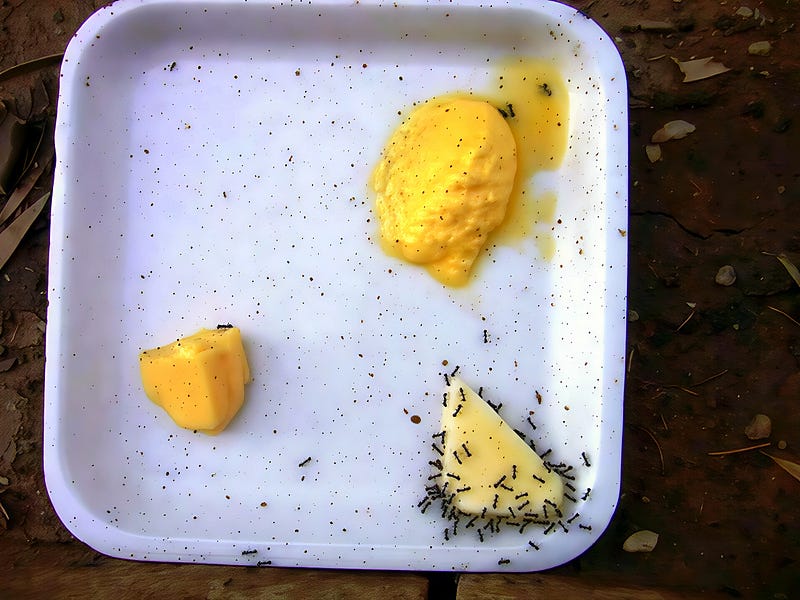
The modern justification for fake butter — carbon neutrality, animal welfare, global accessibility — is not just a commercial argument but an ontological assault. It replaces the being of butter with a simulated ethical ideal, a substance that does not emerge from the natural order but is instead imposed upon reality in the name of moral and economic convenience.
Real butter is given — it arises from the irreducible processes of life: grass, cow, milk, churn. Its being is inseparable from its origin. But synthetic butter is manufactured — an engineered lipid assembly designed to approximate butter while rejecting its essence. The claim that it “tastes just like the real thing” is not merely deceptive marketing; it is a metaphysical falsehood. The tongue may detect fatty richness, but the mind knows the difference. The being of butter is not reducible to its sensory profile — it is bound up in its history, its material truth.
This is where the philosophy of Being (Heidegger’s Dasein, the “is-ness” of things) clashes with the philosophy of reality (the brute facts of existence). Fake butter exists — it is real in the sense that it occupies space, has chemical properties, and can be purchased in stores. But it does not participate in the being of butter. It is an ersatz entity, a shadow cast by industrial logic onto the palate of the world.
The ethical argument — that fake butter is “better” because it spares cows, cuts emissions, or feeds the masses — is a sleight of hand. It mistakes functional equivalence for ontological legitimacy. One might as well argue that a plastic tree is “better” than a real one because it never needs water. The substitution is not just a matter of preference; it is a denial of being in favor of a controlled, artificial alternative.
This is the core deception: that reality can be edited without consequence. That we can strip away the essence of a thing — its connection to life, to soil, to blood and milk — and replace it with a laboratory construct, all while pretending nothing has been lost. But ontology does not bend to ideology. Butter is not just a “product.” It is a manifestation of a particular way of existing in the world. Fake butter, no matter how virtuous its marketing, can never be — it can only mimic.
And so the question is not whether fake butter “works” as a substitute. The question is: What kind of world are we building when we replace the given with the fabricated? When we sever food from its roots and pretend the simulation is just as good? The ontologist’s answer is clear: A world where being is negotiable is a world where reality itself becomes contingent — and that is a far more dangerous recipe than any hydrogenated oil.