The Giant that Cries: The Chinese Giant Salamander’s Biology, Culinary Fame, and Fragile Future
To understand the Chinese giant salamander today is to navigate biology, ancient food culture, and a sustainability puzzle that will shape its fate.
Introduction
The sound, when it escapes the animal’s cavernous mouth, is uncannily like a human infant’s whimper—a trait that earned the Chinese giant salamander the local name wawayu, or “baby fish,” and simultaneously elevated it to a legendary delicacy rumored to bestow vitality. In the mountain-ringed banquet halls of Guizhou, a whole salamander braised in a clay pot with cloud ear fungus and Shaoxing wine still signals profound respect for a guest. Yet the animal behind this theatrical presentation is far more than a gastronomic status symbol. It is the world’s largest amphibian, a living fossil whose lineage stretches back to the Jurassic, a keystone predator of cold-water streams, and now a creature balanced precariously between commercial farming and extinction in the wild. To understand the Chinese giant salamander today is to navigate biology, ancient food culture, and a sustainability puzzle that will shape its fate.
Taxonomy and Names
The Chinese giant salamander belongs to the family Cryptobranchidae, a small, ancient group of fully aquatic salamanders that also includes the Japanese giant salamander (Andrias japonicus) and the North American hellbender (Cryptobranchus alleganiensis). Within the order Caudata and class Amphibia, its full scientific designation is Andrias davidianus, named in 1871 after the French missionary and naturalist Père Armand David, who first brought it to Western scientific attention. English common names are straightforward: Chinese giant salamander, or occasionally Yangtze giant salamander when referencing specific regional populations. Vernacular names across its range are richer and more evocative. In standard Mandarin it is dàní, literally “large salamander,” but the vivid folk name wawayu (“baby fish”) dominates everyday speech, owing to the distress call that reminded farmers of a crying child. In the Cantonese culinary lexicon it may appear as wawa yü. Some high-mountain communities in southern Shaanxi call it shānjiāo yú (“mountain pepper fish”) for the faintly peppery odor of its skin secretions. While genetic research now suggests that Andrias davidianus may be a complex of several cryptic species, for culinary and trade purposes the name still denotes the robust, heavily folded amphibian that features on Chinese menus and in conservation breeding centers alike.
Biology and Adaptations
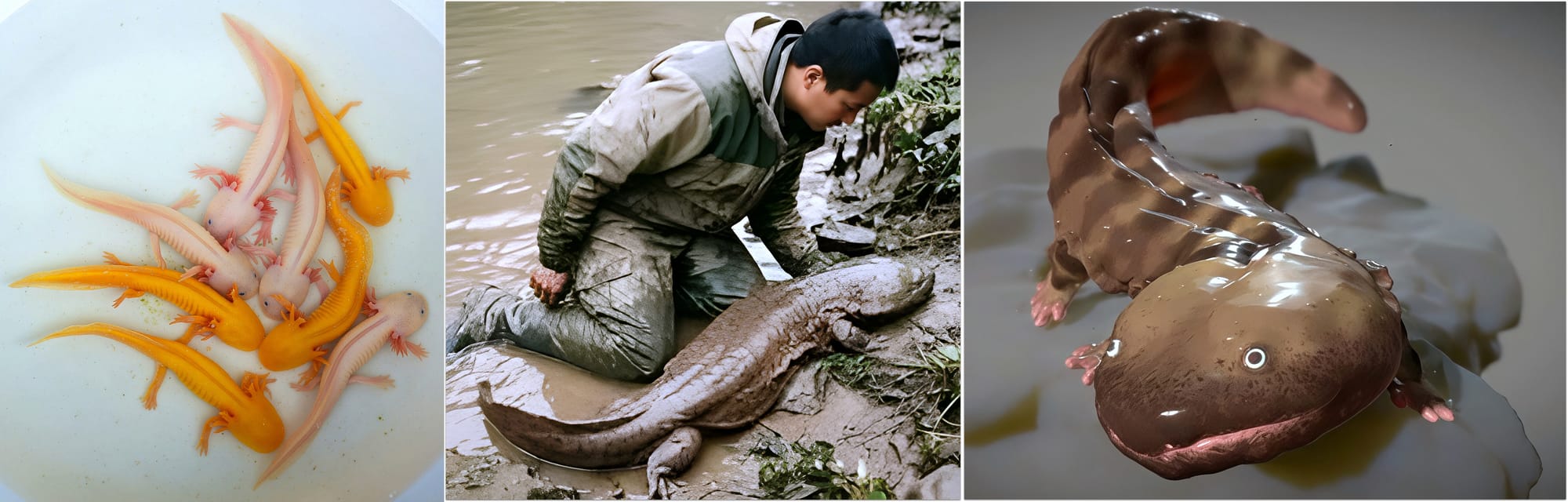
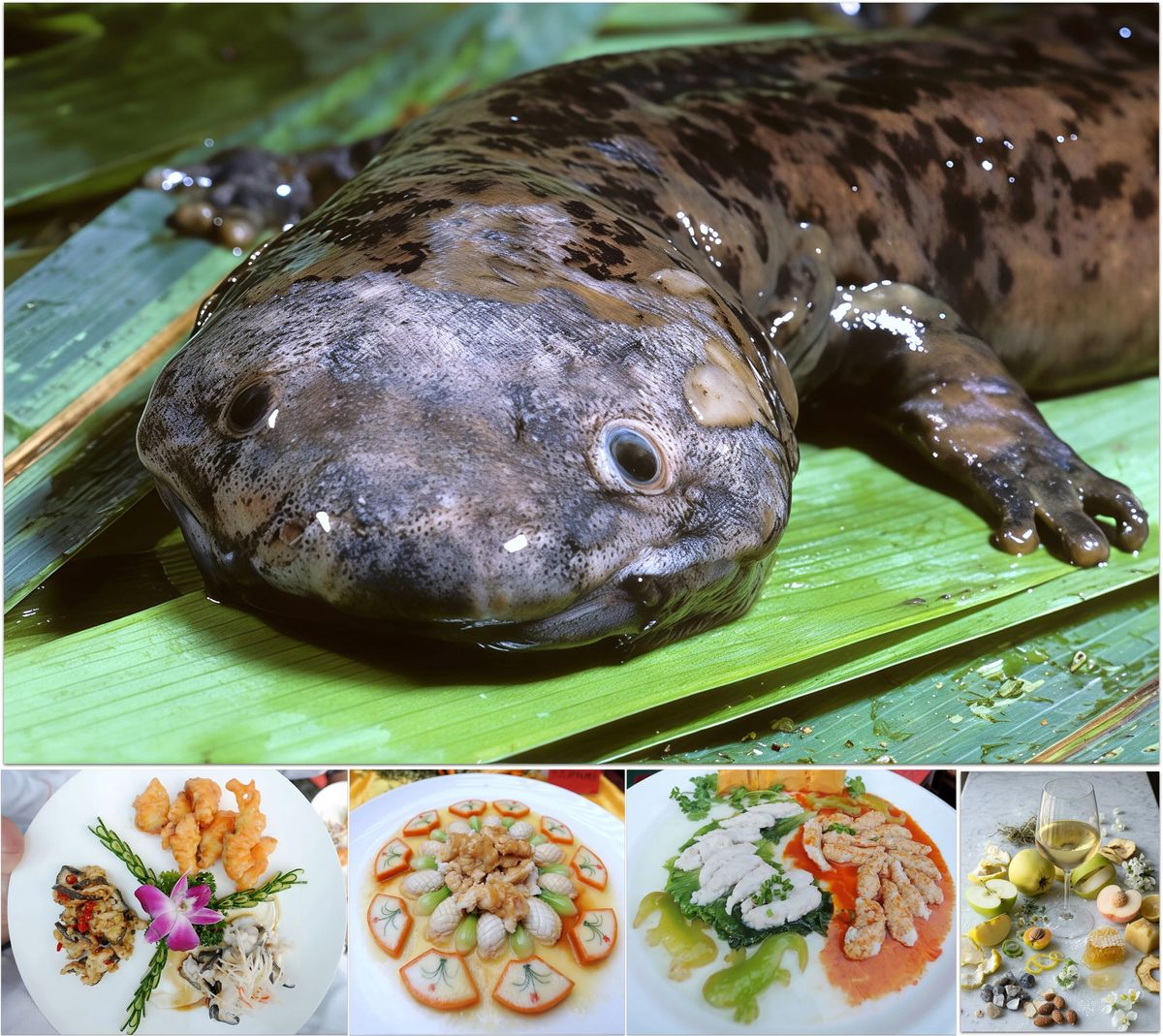
A fully mature Chinese giant salamander can stretch to 1.8 meters (5.9 feet) in length and reach a mass of 50 kilograms (110 pounds), although wild specimens this large have become vanishingly rare. The body is dorsoventrally flattened, coloured in mottled browns, ochres, and slate greys that mirror the cobble beds of its torrential habitat. The skin hangs in loose, wrinkled folds along the flanks, dramatically increasing the surface area available for cutaneous respiration, an adaptation crucial in the fast, oxygen-rich streams it calls home. Lungs are present but provide only supplementary respiration; the salamander gleans most of its oxygen directly from the water.
The head is broad and blunt, with tiny, lidless eyes set far apart. Vision is poor, yet the animal is a formidable nocturnal ambush predator because its lateral line system and sensory nodes studding the snout detect minute vibrations and electrical fields from passing fish, crayfish, crabs, and frogs. Prey is drawn into the mouth by a rapid gape-and-suck mechanism, aided by fine teeth on both jaws. Despite its ancient reputation as a “living fossil,” the creature possesses sophisticated physiological equipment.
Longevity in the wild remains poorly documented, but captive individuals have survived beyond sixty years, growing slowly and reproducing irregularly. Breeding occurs in late summer when males excavate underwater nest cavities beneath boulders. A female deposits two long strings of eggs, after which the male guards the clutch aggressively until hatching. Larvae lose their small external gills after a few months and shift to skin-based respiration. The species is paedomorphic in subtle ways, retaining a flat, aquatic body form that never develops the terrestrial ambitions of many other salamanders. Much of its secretive life history—dispersal distances, growth rates in natural streams, precise age at sexual maturity—remains inferred rather than measured, and the extreme size records themselves may apply only to a few genetic lineages within the broader species complex.
Ecology, Range, and Sustainability
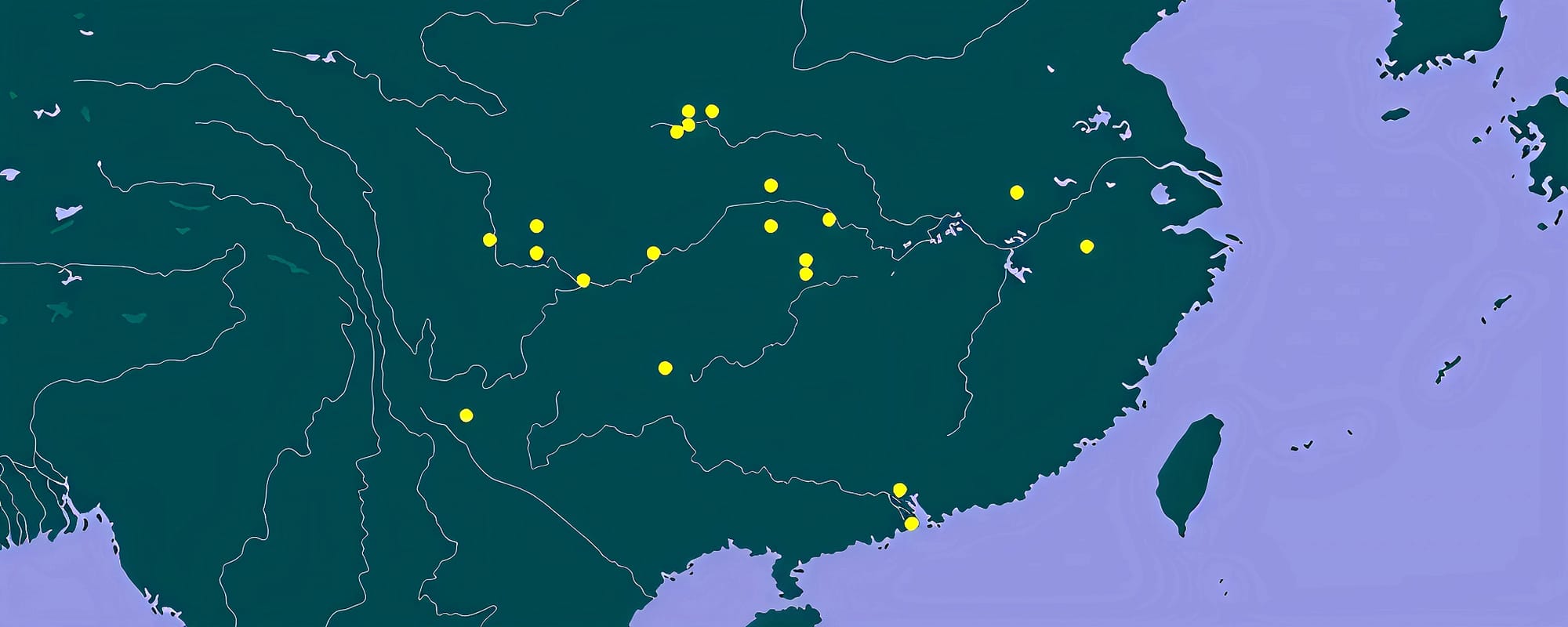
The Chinese giant salamander historically inhabited cold, well-oxygenated tributaries of the Yangtze, Yellow, and Pearl River systems, from steep karst gorges in Guizhou to forested valleys in Shaanxi at elevations between 100 and 1,500 meters (330 to 4,920 feet). Water temperatures in preferred habitat typically range from 10°C to 20°C (50°F to 68°F), and the animal rarely tolerates sustained warmth beyond 24°C (75°F). As a top-of-the-stream predator, it regulates populations of benthic fish and crustaceans, but its ecological role has been hollowed out wherever numbers have collapsed.
Field surveys suggest that wild populations have declined by more than eighty per cent since the 1960s. The drivers are manifold: fragmentation from dams, agricultural run-off, limestone quarrying, and relentless poaching for the luxury food and traditional medicine trades. In response, China has developed a large-scale farming sector. Official figures place farmed numbers in the millions, with operations concentrated in Zhejiang, Jiangxi, and Guangdong. These farms use artificial concrete raceways, often supplied with fresh mountain water, and feed a diet of trash fish and pellets. Yet sustainability remains elusive. Early farming relied heavily on wild-caught juveniles, depleting headwater streams, and many facilities still top up their broodstock with wild genetics. Disease outbreaks, particularly ranavirus and chytrid fungus, have swept through high-density farm ponds and can spill into wild waterways during floods or through effluent.
The species has been listed on Appendix I of the Convention on International Trade in Endangered Species (CITES) since February 2019, which prohibits international commercial trade in wild-caught specimens and tightly controls trade in parts and derivatives, allowing limited movement only from registered captive-breeding operations that meet strict criteria. Within China, licensed farms may sell into the domestic market, but a pervasive illegal trade persists. For the chef or food buyer seeking to offer Chinese giant salamander responsibly, a practical checklist includes insisting on a verifiable farm registration number, a CITES re-export certificate if sourced from a second country, traceability back to a known F2 (second-generation captive) line, and confirmation that the animal was hatched in captivity rather than wild-caught as a larva. Farms that participate in genetic diversity monitoring or restocking programs tend to represent the safest supply chains. In many export markets, however, legal import is effectively impossible, prompting chefs to look for gelatinous-textured substitutes such as skin-on black cod cooked low and slow, or thick-cut jellyfish marinated to mimic the signature bounce.
Culinary Profile and Kitchen Reality

The edible appeal of the Chinese giant salamander centers on two contrasting pleasures: the clean, mild sweetness of its flesh and the extraordinary texture of its thick skin. The tail and flank meat is white when raw and cooks up flaky and tender, with a flavor that sits somewhere between freshwater eel and firm white fish, never muddy when the animal has been purged in clean water. The skin, densely packed with collagen, transforms under heat into a supple, almost sticky gelatinous layer that coats the palate and carries sauces beautifully. In Chinese gastronomy, this melting-rich texture is described as niánhuá, an elusive mouthfeel prized in luxury ingredients such as fish maw and shark fin.
Classic preparations lean on gentle, moist heat to honor these properties. A whole juvenile salamander, weighing around 1 to 2 kilograms (2.2 to 4.4 pounds), is often braised whole in a clay pot with ginger, star anise, dark soy, and a splash of aged Shaoxing wine at a bare simmer of roughly 85°C to 90°C (185°F to 194°F), because a vigorous boil will shatter the delicate collagen structure. Alternatively, fillets are sliced thin and swished through a bubbling hot pot broth for no more than eight seconds, emerging with a translucent curl. Across Guizhou and Hunan, cooks steam salamander steaks with fermented chillies and black beans, while in high-end kitchens in Shanghai or Hong Kong the tail fin may be deep-fried into a crisp, airy puff that mirrors pork crackling. Nutritionally, the meat is lean—a 200-gram (7-ounce) portion can supply roughly 40 grams of high-quality protein with little saturated fat—and the skin contributes glycine, proline, and other collagen-building amino acids. Traditional Chinese medicine credits the salamander with nourishing qi and supporting recovery after illness, though these benefits remain outside the scope of modern clinical evidence.
Processing requires considerable skill. The skin exudes a faintly peppery mucus that must be scrubbed away with salt and hot water; some chefs briefly blanch the whole animal at 70°C (158°F) to set the slime for easy removal. The internal organs are discarded, and the creature is thoroughly bled to avoid any lingering bitterness. Because legal trade outside mainland China is heavily restricted, a chef working in London or San Francisco will rarely, if ever, handle a legally sourced whole salamander. In such contexts, it is worth noting that farmed channel catfish skin or slow-braised eel can evoke comparable collagen-rich silkiness, although the salamander’s singular bounce remains unmatched.
Wine Pairings
For a steamed fillet with silvered ginger and scallions, the glass should show fragrant drive and a linear acidity that can cut through the silky fat droplets released by the skin. A dry Furmint from Hungary’s Tokaj region, bottled with the volcanic minerality of the Mád village vineyards, answers perfectly: its white peach and lemon-thyme notes lift the sweetness of the flesh without overwhelming it, while its racy acidity cleanses the palate between bites.
When the salamander is braised with shiitake mushrooms, chestnuts, and a glossy brown sauce, the earthiness and gentle tannins of a Mencía from the slate slopes of Bierzo in north-west Spain offer a compelling match. Mencía’s red-berry fruit and faintly herbal, smoky edge echo the warmth of the clay pot, and its modest structure respects the meat’s tenderness instead of bulldozing it.
A double-boiled salamander and ginseng soup, traditionally served from a lidded Yixing vessel, calls for a white wine with waxy breadth and honeyed age. An aged Chenin Blanc from Savennières in the Loire Valley—bottled at five to seven years of age, by which time the wine has shed its primary fruit and developed lanolin and quince layers—mirrors the gelatin-rich, savory depth of the broth while remaining dry enough to avoid clashing with the medicinal ginseng note. A standard 750-millilitre bottle (25.4 fluid ounces) shared among four guests provides a 150-millilitre (5-fluid-ounce) pour per person, sufficient to follow the soup’s evolving aromas from first steam to last spoonful.
If the kitchen presents a cold appetizer of salamander skin dressed in black vinegar, sesame oil, and finely slivered coriander, a Manzanilla sherry from Sanlúcar de Barrameda proves transformative. Its briny salinity, almond bitterness, and flor-derived yeastiness latch onto the gelatinous skin and the nutty sesame, creating a savory resonance that lingers long after the morsel has slipped away.
Conclusion
The Chinese giant salamander embodies a rare tangle of ancient biology, culinary reverence, and ecological urgency. To move it from a threatened curiosity onto a sustainable menu demands more than enthusiasm; it requires fluency in the animal’s life history, an unblinking assessment of farm supply chains, and a willingness to pay for traceability that supports wild populations rather than parasitizing them. When a chef buys a farmed salamander that can be documented from hatchery to kitchen, that purchase becomes a small but real investment in the species’ future, encouraging the shift from extractive farming to genuinely closed-cycle aquaculture. The same plate of braised tail in a clay pot that once signalled luxury can also signal a deliberate, informed choice—one that may help ensure that the crying baby of China’s mountain streams persists not only in memory but in the cold, clear water where it belongs.