
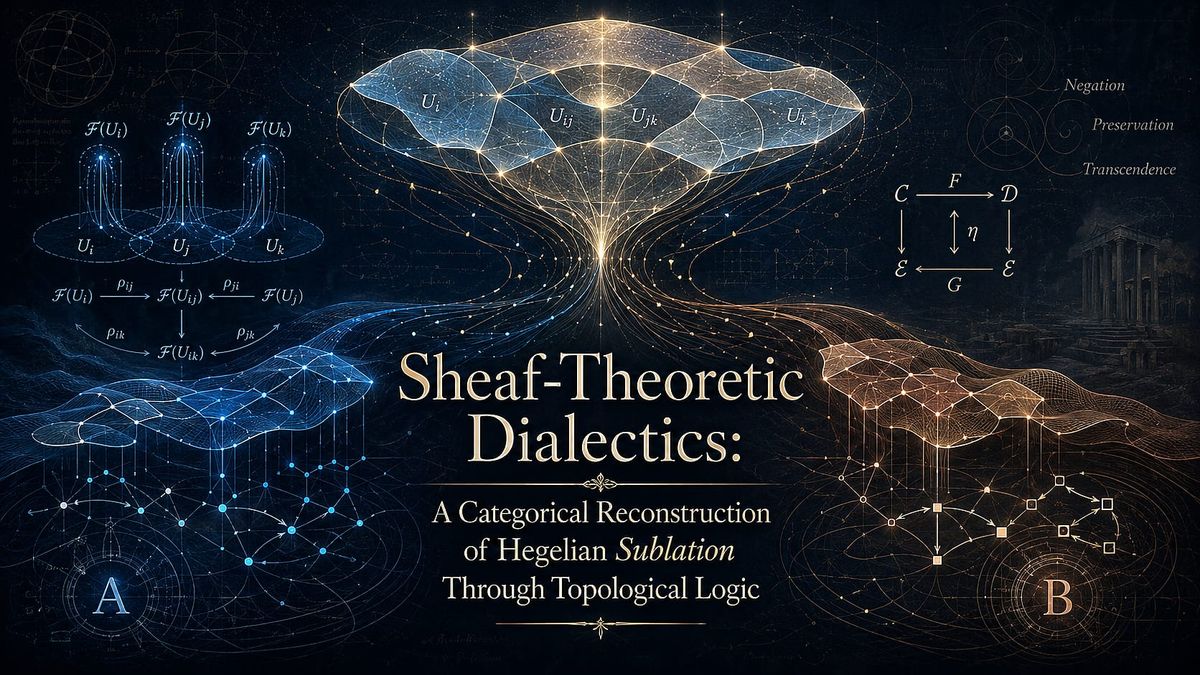
Sheaf-Theoretic Dialectics: A Categorical Reconstruction of Hegelian Sublation Through Topological Logic
This reconstruction transforms Hegelian dialectics from linguistic abstraction into a mathematically tractable local-to-global procedure. The resulting framework establishes contradiction as structured information rather than logical breakdown.
Abstract
This paper reconstructs dialectical reasoning through Category Theory, Sheaf Theory, and Topos Theory. Rather than interpreting contradiction as propositional inconsistency, contradiction is modeled as a topological obstruction to global coherence. A thesis is represented as a local section over an open set within a conceptual space. Contradictions arise when restriction maps fail to preserve compatibility across overlaps, generating cohomological obstruction classes. Antithesis is formalized as the determinate exterior implied by these failures. Sublation (Aufhebung) becomes a sheaf-theoretic gluing operation achieved through a Lawvere–Tierney closure operator within a higher-order topos. This reconstruction transforms Hegelian dialectics from linguistic abstraction into a mathematically tractable local-to-global procedure. The resulting framework establishes contradiction as structured information rather than logical breakdown.
Keywords
Dialectics; Hegel; Category Theory; Sheaf Theory; Topos Theory; Cohomology; Lawvere–Tierney Topology; Conceptual Topology; Formal Philosophy.
Introduction
From Linguistic Obscurity to Topological Clarity
It is widely acknowledged that the writings of Georg Wilhelm Friedrich Hegel remain among the most difficult texts in Western philosophy. Hegel’s prose operates through recursive definitions, unstable conceptual transitions, and internally shifting categories. This difficulty is not merely stylistic. It results from an attempt to express dynamic conceptual motion through static language.
Natural language is linear. Dialectical development is recursive.
The Hegelian concept evolves through negation, mediation, contradiction, and preservation. Such movement often exceeds the expressive capacity of ordinary philosophical prose. Interpretations therefore become metaphorical rather than structural.
The central problem is representational rather than literary.
This paper proposes that Hegel’s dialectic becomes tractable when translated into topology and category theory. Rather than treating dialectics as literary argumentation, this work formalizes conceptual movement through mathematical structure.
The title itself defines the methodological program:
“Sheaf-Theoretic Dialectics: A Categorical Reconstruction of Hegelian Sublation Through Topological Logic.”
The aim is not to interpret Hegel psychologically or historically, but to reconstruct the mechanics of dialectical movement through formal mathematics.
Dialectics is treated here as a local-to-global problem.
A thesis becomes a local section.
Contradiction becomes a boundary obstruction.
Antithesis becomes the exterior implied by incompleteness.
Sublation becomes gluing within a sheaf topos.
This framework relocates dialectical complexity into a mathematically rigorous environment where conceptual instability can be modeled explicitly (Mac Lane & Moerdijk, 1992; Goldblatt, 2006).
Conceptual Space as Topological Domain
The Space X as Conceptual Topology
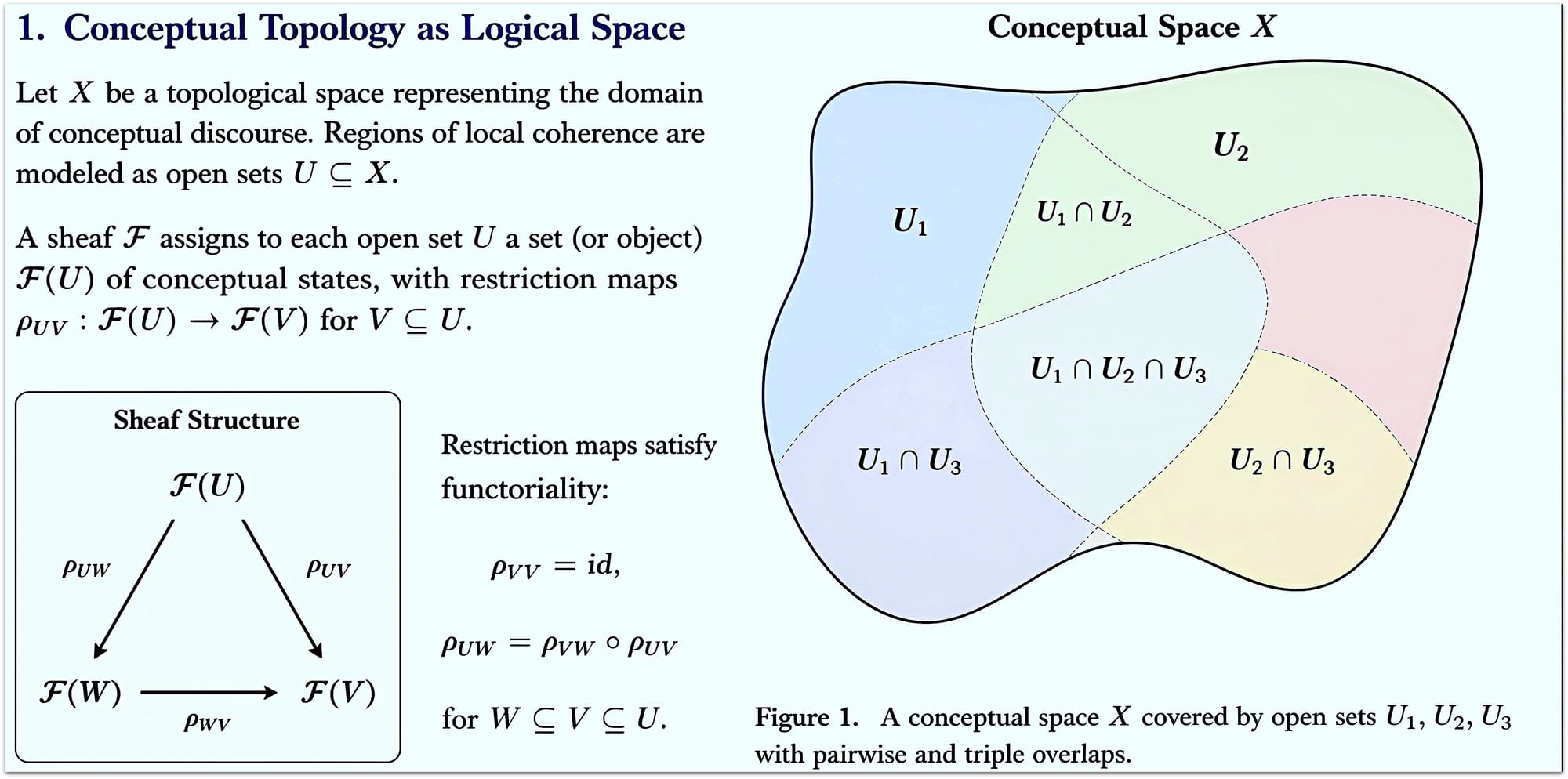
Let X denote a conceptual topological space.
Open subsets:
U ⊆ X
represent domains in which conceptual structures remain coherent.
A sheaf:
F : Open(X)^op → C
assigns conceptual content to each region.
For every inclusion:
V ⊆ U
there exists a restriction morphism:
ρ_UV : F(U) → F(V)
Restriction maps preserve contextual coherence.
Topology formalizes conceptual locality.
This shift replaces universal propositions with region-dependent validity.
Truth becomes domain-sensitive.
Meaning becomes structured through overlaps.
This approach follows standard sheaf semantics in topology and categorical logic (Tennison, 1975; Awodey, 2010).
Thesis as Local Section
Local Validity Rather Than Universal Assertion
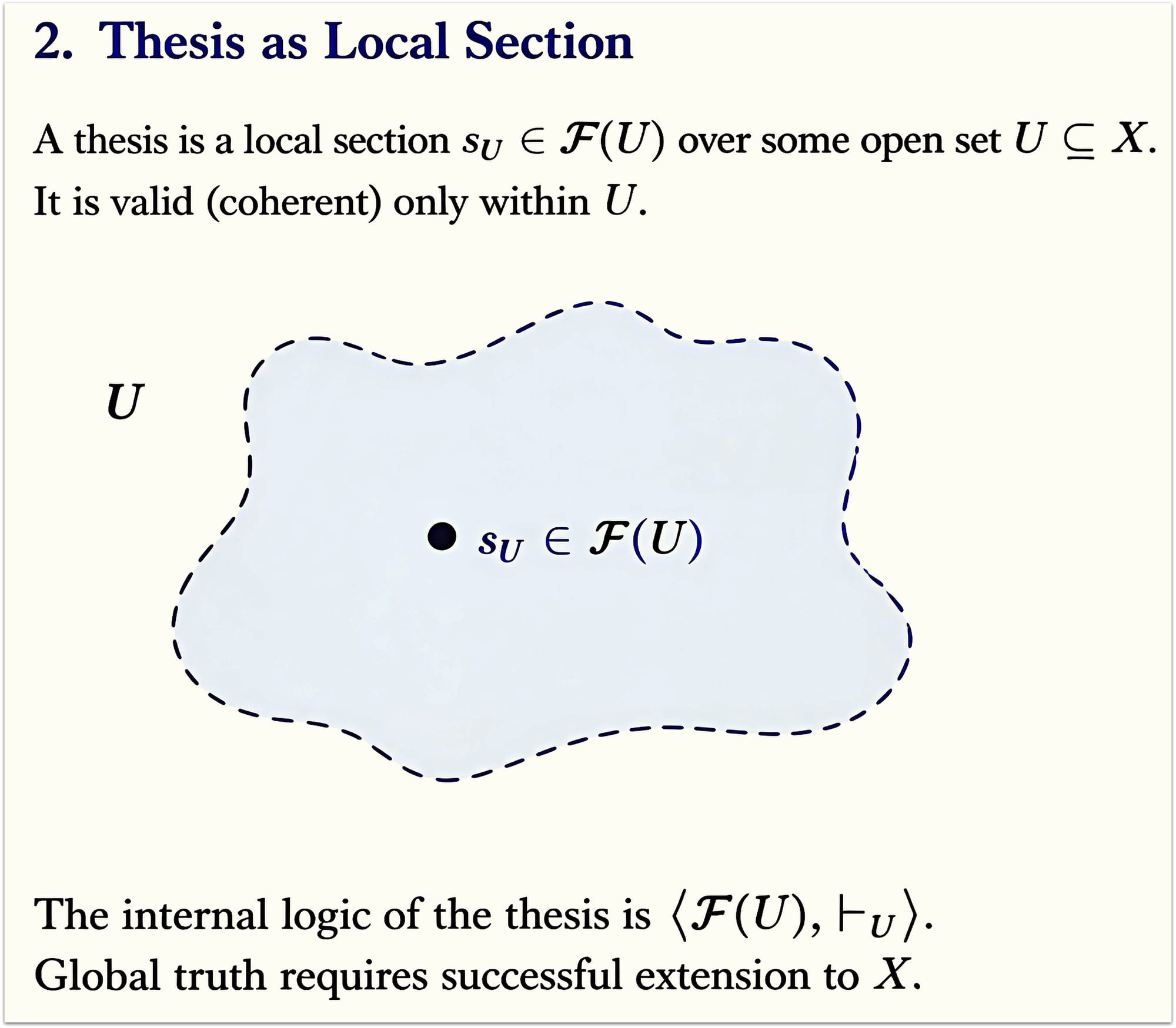
A thesis is represented by:
T = (U, s_U)
where:
s_U ∈ F(U)
The thesis exists only within its domain.
It is not globally valid.
It is locally coherent.
The internal logic of the thesis is:
Logic(T) = <F(U), ⊢_U>
where:
⊢_U
represents entailment internal to U.
A thesis is therefore a section of conceptual stability.
This interpretation parallels intuitionistic truth inside topoi (Johnstone, 2002).
Contradiction as Boundary Failure
Contradiction Emerges at Overlap
Suppose:
{U_i}_i∈I
forms an open cover.
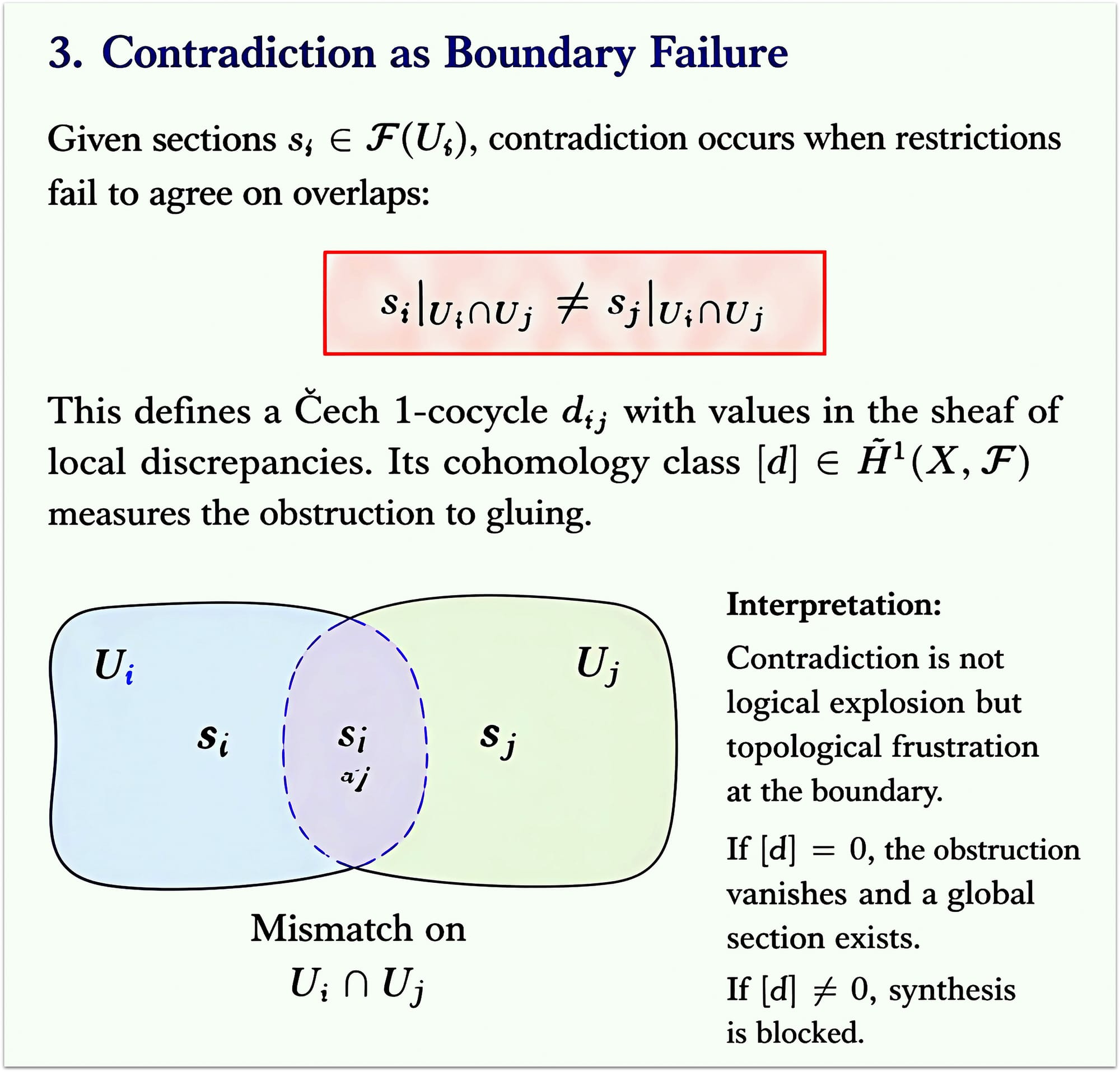
For local sections:
s_i ∈ F(U_i)
compatibility requires:
s_i | (U_i ∩ U_j) = s_j | (U_i ∩ U_j)
Contradiction occurs when:
s_i | (U_i ∩ U_j) ≠ s_j | (U_i ∩ U_j)
This mismatch defines a failure of descent.
Contradiction is not falsehood. It is failed gluing.
Boundary inconsistency generates a cocycle:
d_ij
whose cohomology class belongs to:
[d] ∈ Čech H¹(X, F)
This class measures obstruction to globalization (Bott & Tu, 1982).
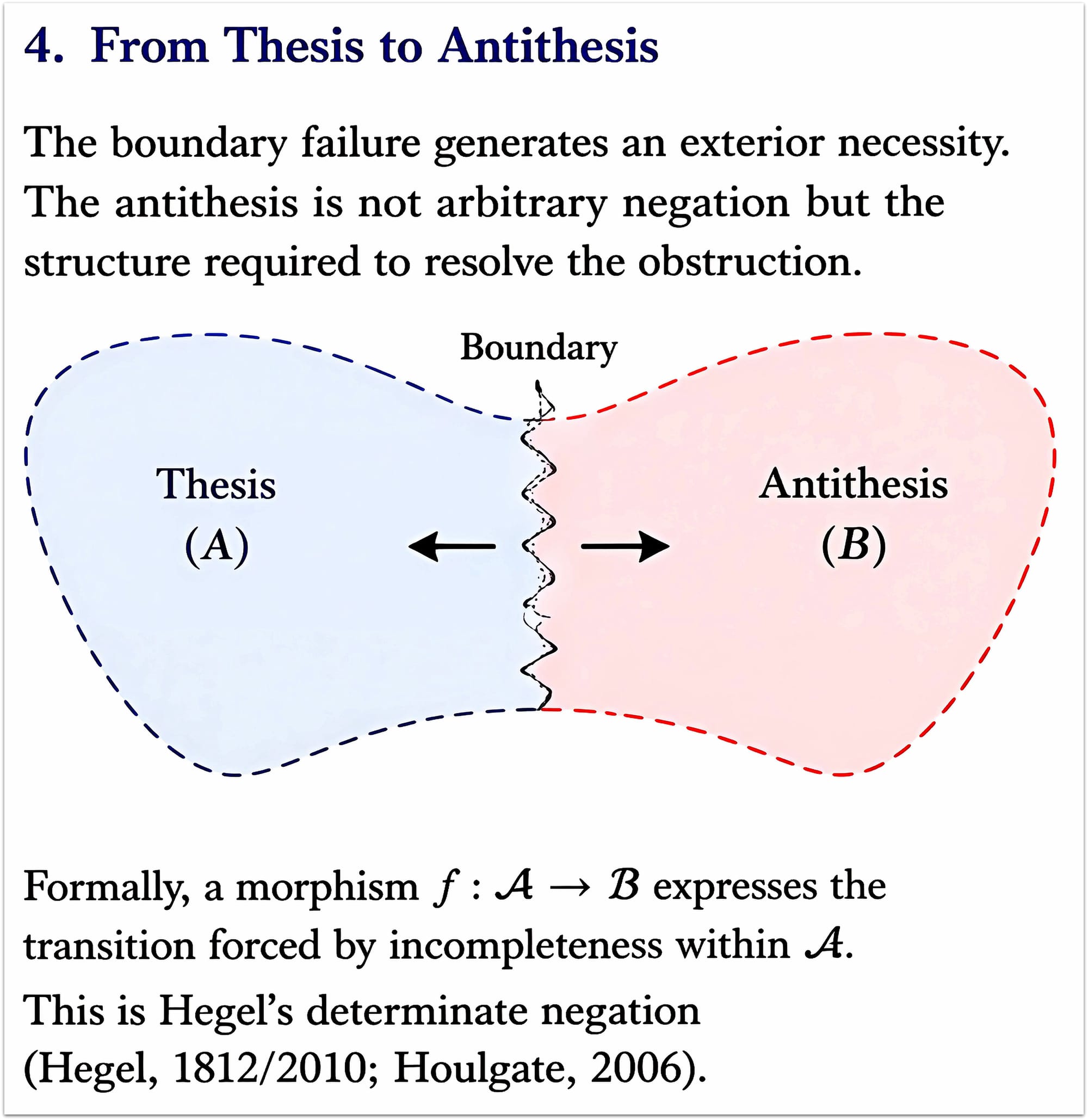
Antithesis as Determinate Exterior
Negation Generated by Structural Failure
Hegelian negation is determinate.
It does not produce abstract opposition.
It produces the exact exterior implied by conceptual incompleteness (Hegel, 1812/2010; Pippin, 1989).
Let:
A
be the thesis category.
The antithetical exterior is:
B
generated through:
f : A → B
The antithesis is the geometry of what the thesis cannot include.
Boundary failure forces emergence of exterior structure.
Antithesis is therefore necessary.
Not optional.
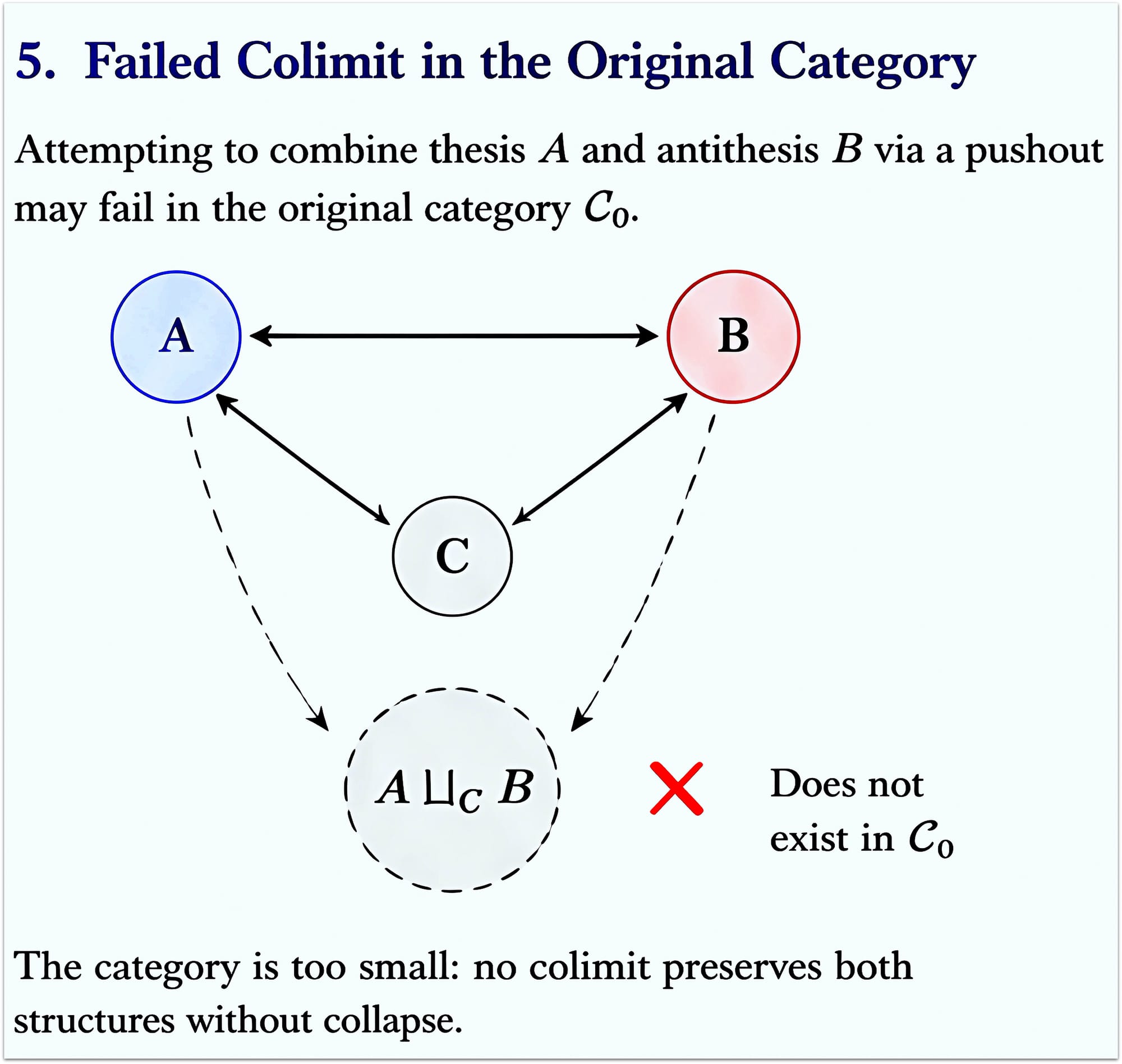
Failed Colimits and Category Expansion
Why Ordinary Logic Cannot Resolve Contradiction
Suppose synthesis is attempted through a pushout:
A ← C → B
with desired colimit:
A ⨿_C B
Inside the original category:
C_0
this colimit fails.
Either:
- thesis absorbs antithesis,
- or antithesis destroys thesis.
The category lacks sufficient expressive power.
Dialectical contradiction therefore signals categorical insufficiency.
The system requires elevation into a richer environment.
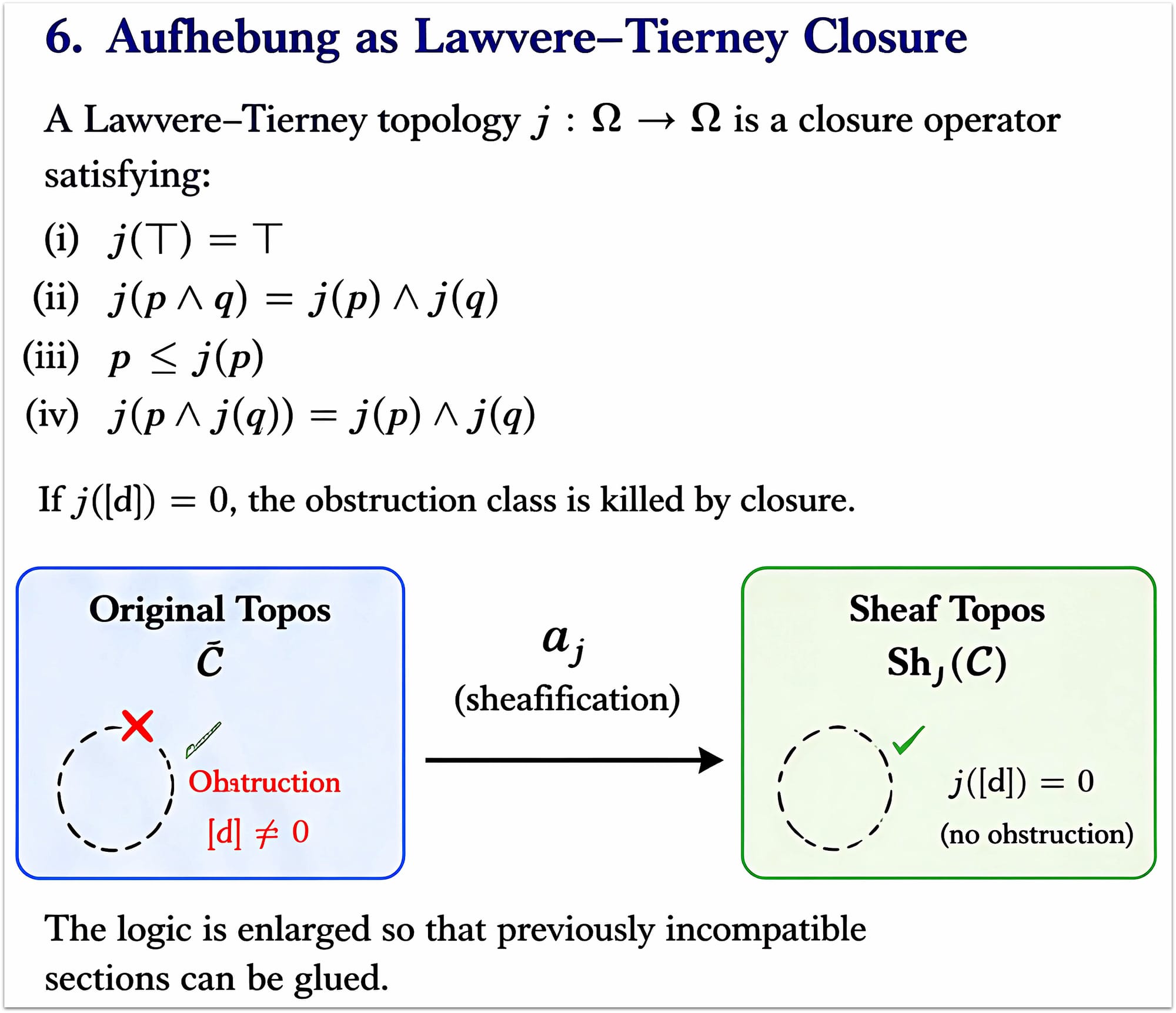
Aufhebung as Closure Operator
Lawvere–Tierney Topology as Sublation
Within a topos, truth values belong to:
Ω
A Lawvere–Tierney operator:
j : Ω → Ω
redefines admissibility (Lawvere & Tierney, 1970).
Closure changes the logical environment.
If:
j([d]) = 0
then obstruction disappears after closure.
The sheafification functor:
a_j : Ĉ → Sh_j(C)
moves the system into a higher-order semantic space.
Sublation is not compromise. It is logical enlargement.
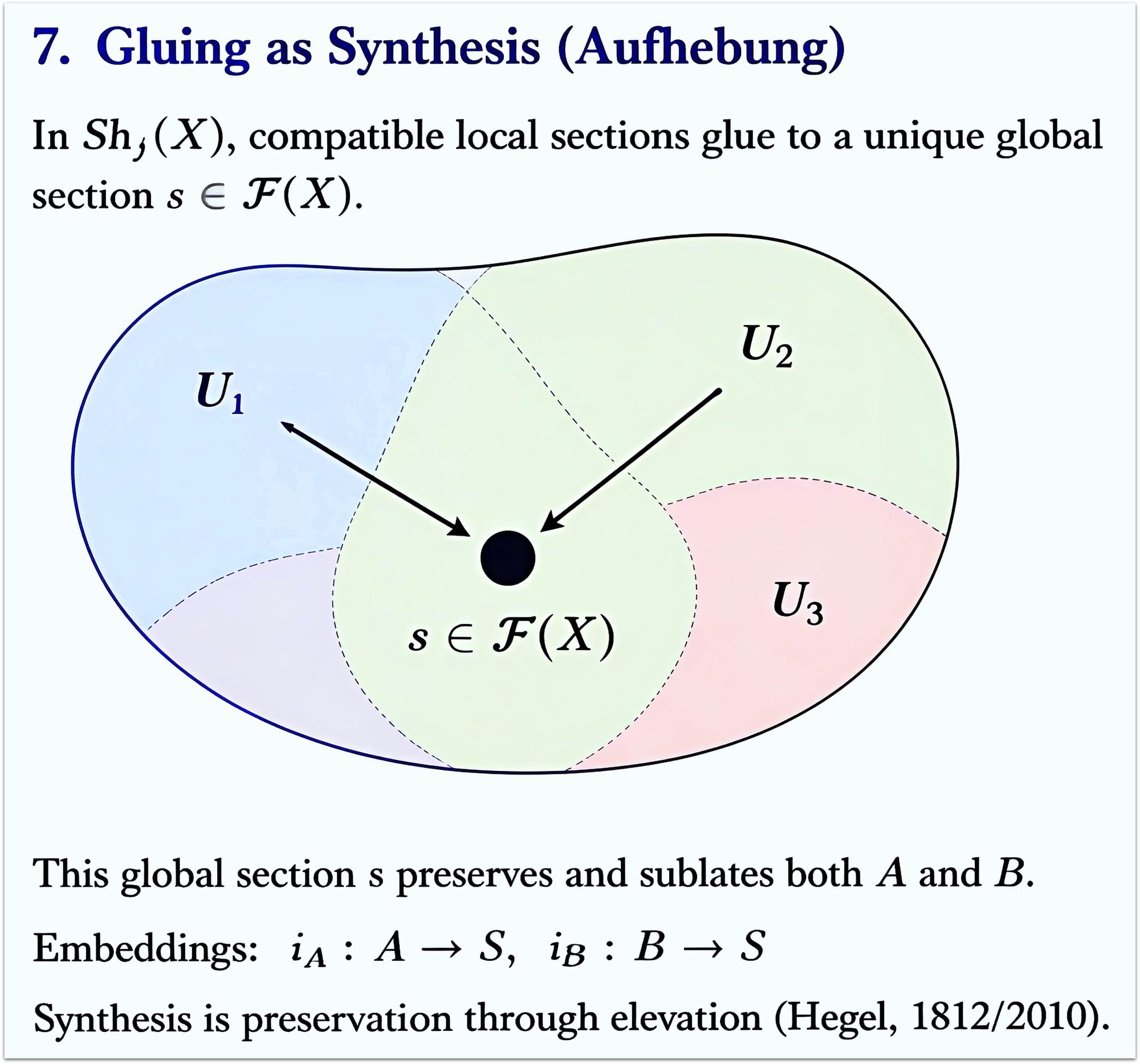
Gluing as Dialectical Synthesis
The Global Section
If compatible local sections exist, then:
s ∈ F(X)
exists uniquely.
The synthesis object:
S
satisfies:
S = A ⨿_C B
inside:
Sh_j(X)
The embeddings:
i_A : A → S
i_B : B → S
preserve both thesis and antithesis.
Synthesis retains contradiction as structured memory.
No information is erased.
Only reorganized.
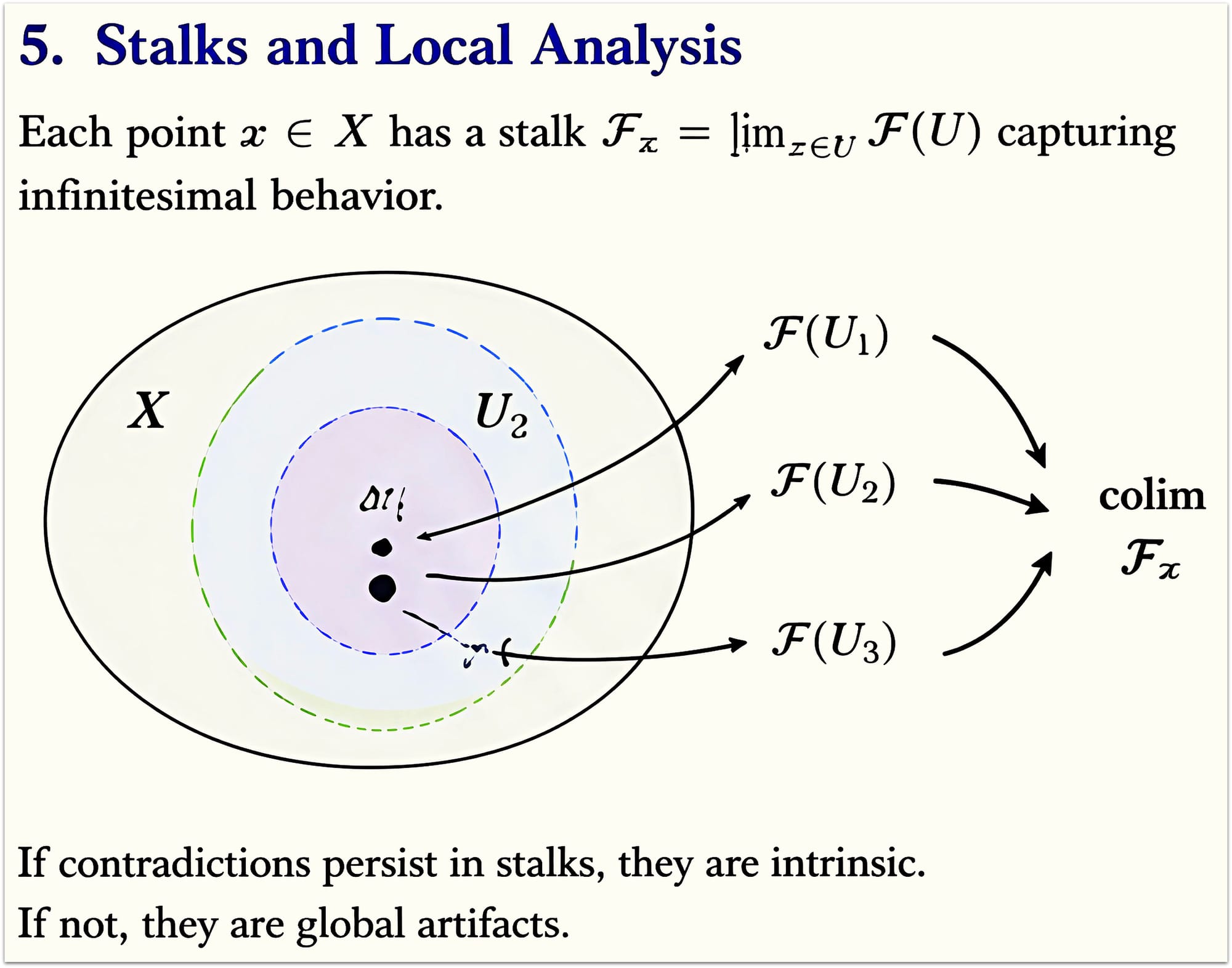
Stalk-Level Interpretation
Infinitesimal Contradiction
For each point:
x ∈ X
the stalk is:
F_x = lim→_(x∈U) F(U)
Stalks capture local conceptual behavior.
If contradiction persists in stalks:
s_x ≠ t_x
then incompatibility is intrinsic.
Stalks detect the microscopic site of dialectical instability.
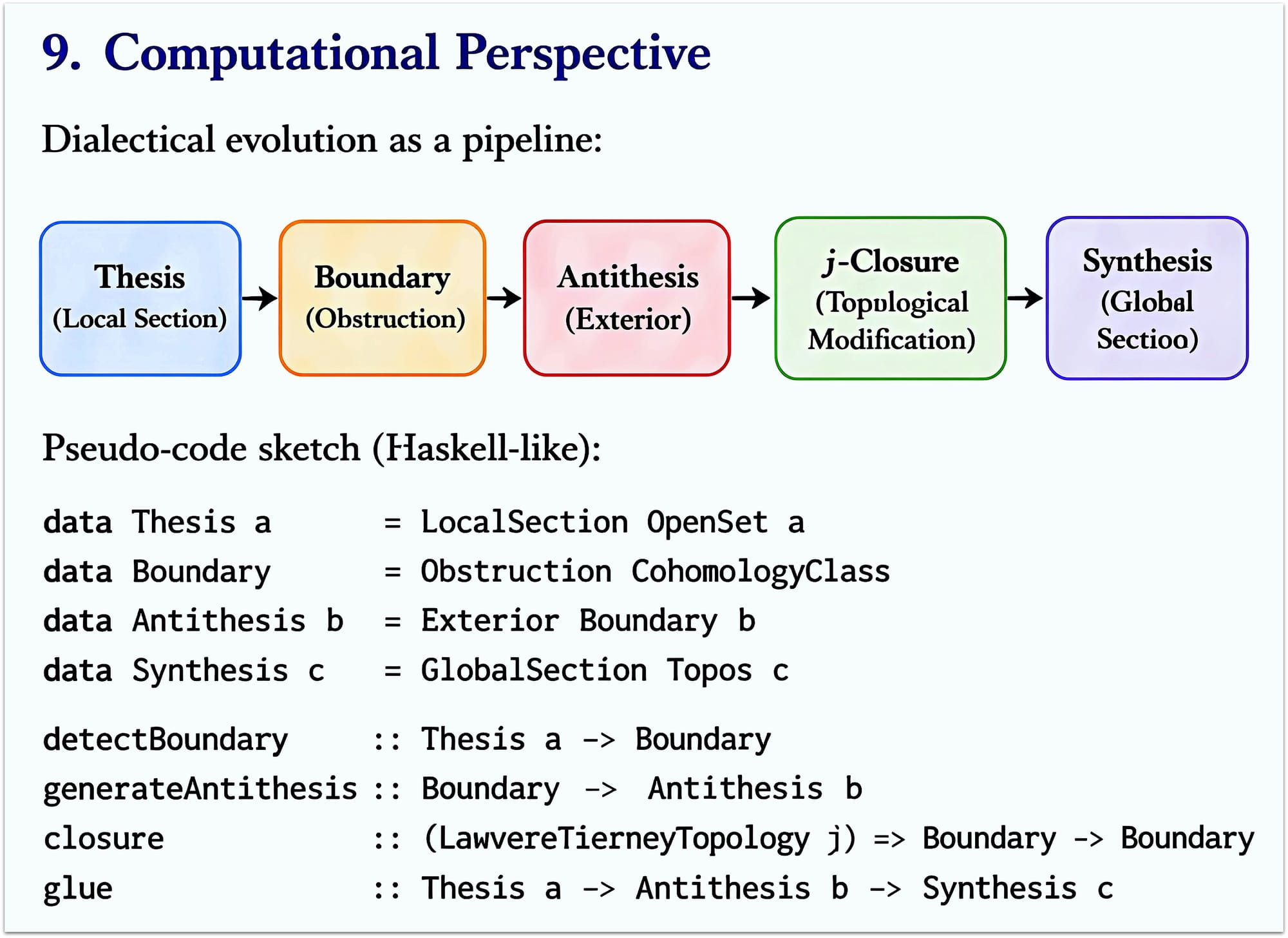
Computational Formalization
Dialectics as State Transition
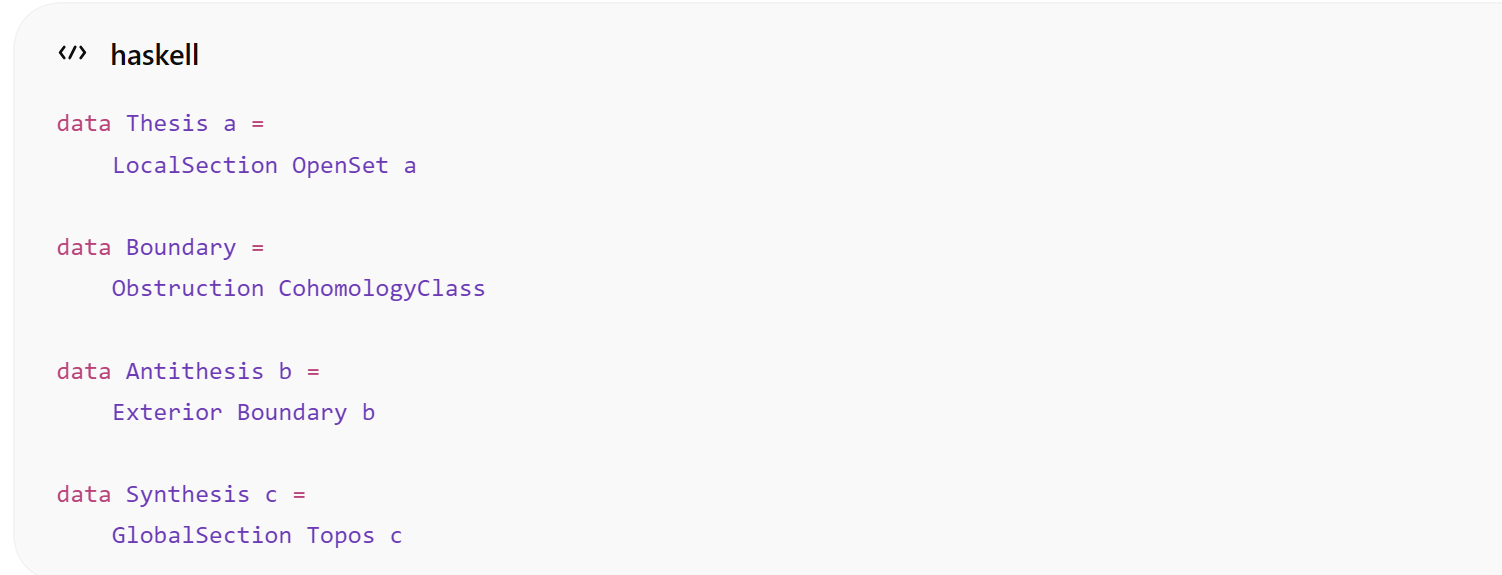
Pipeline:
Thesis
→ Boundary
→ Antithesis
→ j-Closure
→ Global Section
Contradiction becomes computation rather than collapse.
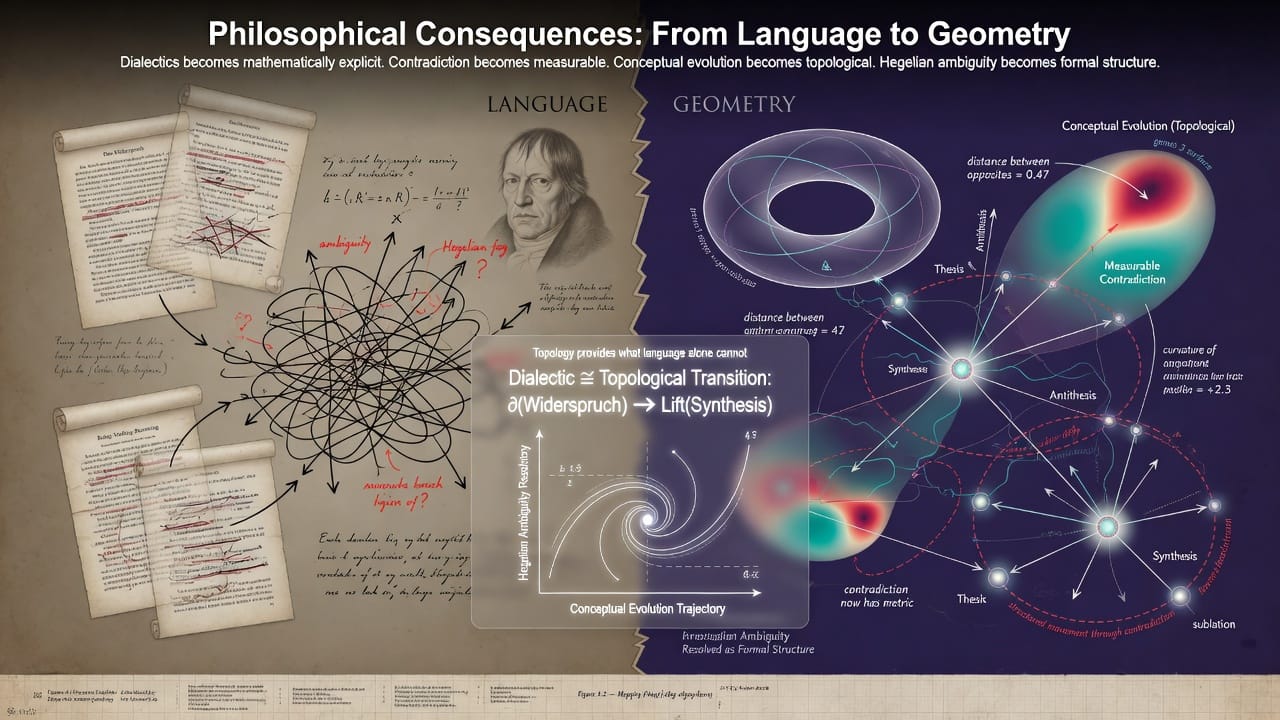
Philosophical Consequences
From Language to Geometry
This framework produces several consequences:
- Dialectics becomes mathematically explicit.
- Contradiction becomes measurable.
- Conceptual evolution becomes topological.
- Hegelian ambiguity becomes formal structure.
Topology provides what language alone cannot: structured movement through contradiction.
Conclusion
Dialectics as Topological Logic
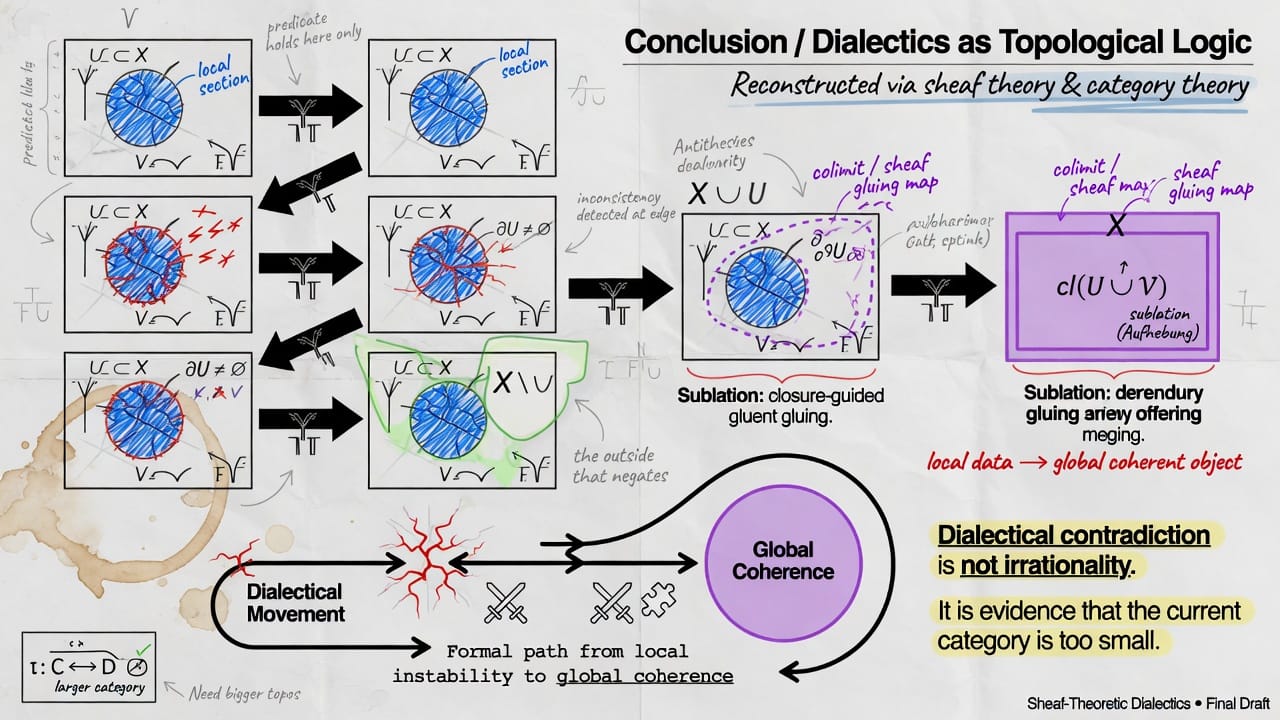
This paper has reconstructed dialectical movement using sheaf-theoretic and categorical machinery.
A thesis is local.
Contradiction is boundary failure.
Antithesis is determinate exteriority.
Sublation is closure-guided gluing.
The movement:
s_U
→ [d]
→ Ext([d])
→ a_jF
→ Γ(X, a_jF)
defines a formal path from local instability to global coherence.
Dialectical contradiction is not irrationality. It is evidence that the current category is too small.
References
Awodey, S. (2010). Category Theory. Oxford University Press.
Bott, R., & Tu, L. (1982). Differential Forms in Algebraic Topology. Springer.
Goldblatt, R. (2006). Topoi: The Categorical Analysis of Logic. Dover.
Hegel, G. W. F. (2010). Science of Logic (G. di Giovanni, Trans.). Cambridge University Press. (Original work published 1812).
Houlgate, S. (2006). The Opening of Hegel’s Logic. Purdue University Press.
Johnstone, P. T. (2002). Sketches of an Elephant: A Topos Theory Compendium. Oxford University Press.
Lawvere, F. W., & Tierney, M. (1970). Quantifiers and sheaves. Proceedings of the International Congress of Mathematicians.
Mac Lane, S. (1998). Categories for the Working Mathematician. Springer.
Mac Lane, S., & Moerdijk, I. (1992). Sheaves in Geometry and Logic. Springer.
Pippin, R. (1989). Hegel’s Idealism. Cambridge University Press.
Tennison, B. R. (1975). Sheaf Theory. Cambridge University Press.