The Pigeon’s Double Life: From Rooftops to Royal Kitchens
Introduction
Introduction
Few creatures straddle the divide between city pest and royal delicacy like the pigeon. Known scientifically as Columba livia domestica, this bird is both reviled and revered. In one context, it’s dismissed as a dirty nuisance; in another, it’s a culinary treasure, prized for its tender meat and ancient pedigree. The truth is more layered than either caricature suggests. The domestic pigeon, commonly known as squab when prepared as food, is a biological marvel and a cultural artifact — one that has evolved in tandem with human civilization.
This article offers a comprehensive look at this often-misunderstood bird, tracing its taxonomic origins, biological traits, ecological significance, culinary value, and economic role across time and cultures. Whether you’re a chef, a naturalist, a sustainability advocate, or simply curious, the pigeon has a story worth your time — and possibly your table.
Taxonomy: The Bird with a Thousand Faces
The domestic pigeon belongs to the family Columbidae, under the genus Columba and species livia. Its full designation, Columba livia domestica, identifies it as the domesticated subspecies of the wild rock dove. While most people know it simply as “pigeon” or “squab,” its global aliases reflect its widespread presence: paloma doméstica (Spanish), pigeon biset (French), piccione (Italian), paloma (Portuguese), and カワラバト in Japanese.
Through centuries of selective breeding, humans have cultivated over a thousand pigeon varieties. Some are bred for their appearance, others for racing prowess — but for our purposes, the utility breeds are most relevant. These include the King pigeon, Carneau, and Texan Pioneer, all optimized for meat production. These birds are broad-chested, fast-growing, and yield the succulent young squabs that chefs prize.
Biology: The Architecture of a Perfect Protein
Pigeons are medium-sized birds, typically 12 to 14 inches in length with a wingspan of up to 28 inches. While wild-type rock doves exhibit slate-gray feathers with black wing bars and an iridescent neck, domesticated pigeons boast an astonishing range of colors, from snowy white to chestnut and deep blue-black.
Pigeons are monogamous and can breed year-round. A mated pair will typically produce two eggs per clutch, which they incubate for about 18 days. Unique among birds, both male and female pigeons produce a nutrient-rich substance known as crop milk, which they regurgitate to feed their young. This high-fat, high-protein milk allows squabs to double their weight in just a few days.
By four weeks of age, squabs are fully feathered but have not yet flown. At this stage, their muscles are underdeveloped from lack of use, which is exactly what makes their meat so tender. In the wild, pigeons may live 3–5 years, while domesticated or protected individuals can exceed 15.
Anatomically, pigeons have adaptations suited for their original cliff-dwelling life. Their strong breast muscles and pointed wings allow for agile flight, while their ability to drink water by suction is rare among birds. They are also highly intelligent, capable of recognizing themselves in mirrors and navigating using Earth’s magnetic field.
Ecology: Global Citizen, Urban Survivor
Originally native to southern Europe, North Africa, and parts of Asia, rock doves naturally nested on cliffs and rocky outcrops. As humans built cities, pigeons adapted easily to the ledges, towers, and bridges of urban life. Today, feral pigeons can be found on every continent except Antarctica.
These birds play an important ecological role as seed dispersers and as a food source for predators such as hawks and falcons. In cities, they contribute to a secondary food web that supports raptors like the peregrine falcon, whose urban populations have rebounded thanks to an abundant pigeon supply.
Though their conservation status is “Least Concern,” true wild-type rock doves are becoming increasingly rare due to interbreeding with feral populations. In some regions, pure populations are now genetically diluted beyond recognition.
From a sustainability standpoint, pigeon farming has a low environmental impact. Squabs require minimal space, consume modest quantities of grain-based feed, and grow quickly. Their droppings are also nitrogen-rich, historically used as a potent fertilizer.
Uses: From Message Bearers to Market Staples
Pigeons are among the oldest domesticated birds, with evidence of dovecotes dating back to 3000 BCE. They’ve served humanity as message carriers, religious offerings, symbols of peace, and, crucially, as a consistent source of protein.
In the culinary world, squab is considered a premium meat, especially prized in Chinese, French, Middle Eastern, and Mediterranean cuisines. In Egypt, squab is stuffed with rice and grilled. In Morocco, it’s featured in pastilla — a rich pastry dish combining squab meat, almonds, and cinnamon. In French haute cuisine, squab is served roasted, often with wine reductions or truffles.
Economically, pigeon farming remains niche but profitable. In the U.S., California leads in squab production, with farmers raising hundreds of thousands of birds annually. Most of the output serves gourmet restaurants and Chinese markets. China, however, dominates global production, reportedly raising over a billion squabs each year.
Unlike chicken or turkey farming, pigeon breeding remains artisanal. Pigeons mate for life and require individualized nesting. Attempts to industrialize pigeon farming have largely failed, which keeps squab a specialty product. This also makes the industry more sustainable, avoiding the ethical and environmental pitfalls of factory farming.
Culinary Aspects: The Cadillac of Fowl
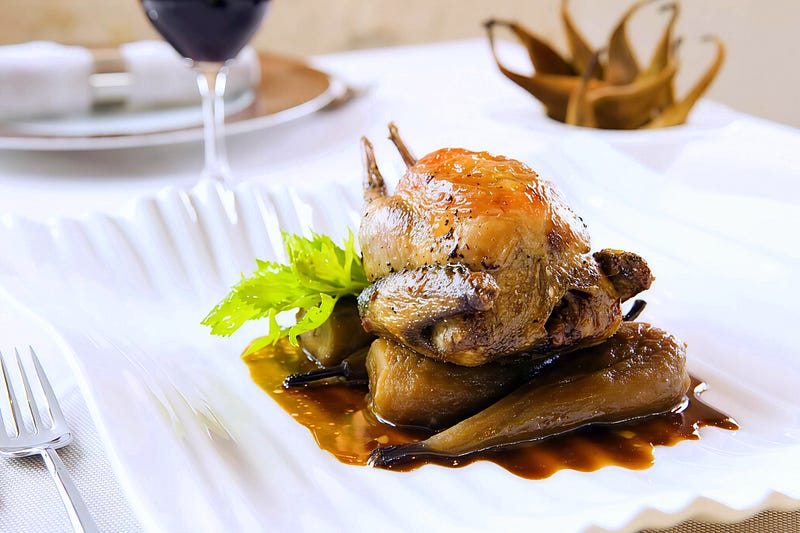
Squab meat is a delicacy, celebrated for its rich, gamey flavor and velvet-like texture. It’s lean, dark meat — more akin to duck than chicken — but without the greasiness. When cooked properly, the breast remains blush-pink and succulent, while the legs develop a pleasing chewiness.
Biologically, the tenderness of squab comes from its age. Harvested before it learns to fly, the bird’s muscles remain soft and undeveloped, making for an extraordinarily tender cut of meat.
Common preparations include roasting, braising, grilling, and deep-frying. In French cuisine, squab is often roasted with herbs and served with peas or mushrooms. In Chinese cuisine, it may be deep-fried until the skin is crispy and the meat juicy, often accompanied by five-spice powder or a dipping sauce of salt and Sichuan pepper.
Nutritionally, squab offers high-quality protein, essential amino acids, iron, and B-vitamins. It’s lower in fat than most red meats and often easier to digest. Its dense nutritional profile and small serving size make it both gourmet and efficient.
For home cooks and chefs interested in exploring squab, recommended resources include:
- The Whole Beast: Nose to Tail Eating by Fergus Henderson
- Hunter Angler Gardener Cook blog by Hank Shaw
- D’Artagnan’s squab recipe archives
- Julia Child’s squab roasting video on YouTube
Wine Pairings: Elegant Birds Deserve Elegant Bottles
Pairing wine with squab is a culinary art unto itself. The bird’s rich, slightly gamey flavor calls for wines that are nuanced but not overpowering.
A classic match is Pinot Noir, especially a mature red Burgundy or Oregon varietal. The wine’s earthy undertones mirror the natural flavors of the bird, while its acidity cuts through the richness of the meat.
For more robust preparations — such as squab served with port reduction or Moroccan spices — a Syrah, Grenache blend, or Rioja provides enough tannin and spice to hold its own.
If your squab is part of an Asian-style dish — fried, soy-glazed, or peppered — consider a rosé Champagne, Gewürztraminer, or even a lightly chilled Beaujolais Cru for a bright counterbalance.
Ultimately, the best pairing depends on preparation. As a rule, medium-bodied, earthy reds offer the most versatile and satisfying accompaniment.
Conclusion
The pigeon is more than a city bird or historical footnote. It’s a living testament to the bond between humans and animals — a bond forged in dovecotes and maintained across millennia of cuisine and culture. As a biological marvel, ecological participant, and culinary gem, Columba livia domestica deserves not just our tolerance, but our appreciation.
Whether it’s nesting on your roof or braised in a red wine reduction, the pigeon carries a story worth savoring. Understanding its biology, respecting its role in our ecosystems, and celebrating its place on our tables brings us closer to a more mindful and delicious world.
Endnotes (Resources & Further Reading)
- Wikipedia: Columba livia (Rock Dove)
- Wikipedia: Squab (Meat)
- Hillinger, Charles. “In Marketplace for Gourmet Squab, Modesto’s Growers Rule the Roost.” Los Angeles Times
- Chang, Lingling et al. “Evaluation of Meat Quality of Local Pigeon Varieties in China.” Animals (MDPI)
- D’Artagnan Blog: “What Is Squab?”
- Hank Shaw, Hunter Angler Gardener Cook — “Roast Pigeon Recipe”
- Wine Enthusiast — “Pairings: Rules of the Game”
- Kravtchenko, Viktor — Distribution Map via Wikimedia Commons (Public Domain)
- Julia Child — “Roast Squab” video demonstration (YouTube)
- The Whole Beast: Nose to Tail Eating by Fergus Henderson