The Rising Sun Beneath the Waves: The Story of the Redblotch Razorfish (Iniistius twistii)
Introduction: Among the rippling sands of the western Pacific, a flash of crimson pierces the pale substrate like a brushstroke of living…
Introduction:
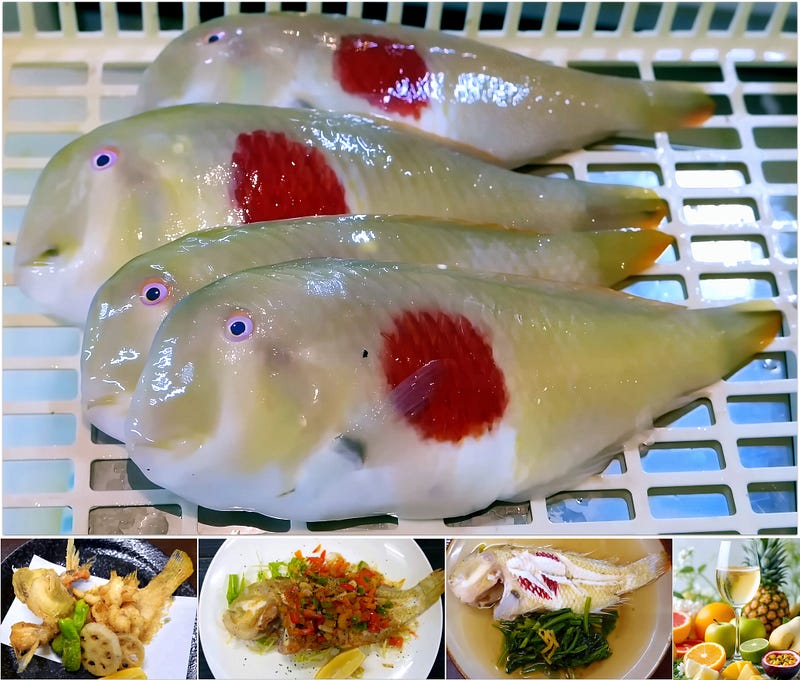
Among the rippling sands of the western Pacific, a flash of crimson pierces the pale substrate like a brushstroke of living color. The Redblotch razorfish (Iniistius twistii), also known as the Japanese flag fish, is one of the ocean’s most enigmatic residents — its scarlet mark evoking Japan’s rising sun, its behavior a masterclass in stealth and survival. Found throughout the Indo-Pacific, from Okinawa to Indonesia, this sand-dwelling wrasse is both an aesthetic wonder and an ecological engineer, embodying the intricate relationship between evolution, environment, and identity beneath the sea.
Taxonomy
The Redblotch razorfish belongs to the family Labridae, order Labriformes, and genus Iniistius. Its full classification reads:
Kingdom Animalia, Phylum Chordata, Class Actinopterygii, Order Labriformes, Family Labridae, Genus Iniistius, Species Iniistius twistii.
The species name honors Dr. Twist, an early naturalist who first described the fish in the 19th century. Common names vary widely across its range: “Redblotch razorfish” (English, international), “Peces Navaja Manchado” (Spanish, Philippines), “Poisson Sabre Rouge” (French, New Caledonia), and “Buntfleck-Rasierfisch” (German, scientific trade usage). In Indonesia it is locally known as “ikan cukur merah” (Bahasa Indonesia, Moluccas), and in Japan as “Benitoki-haze” (Japanese, Okinawa).
While no distinct subspecies are officially recognized, color morphs differ by region — individuals from the Coral Triangle display deeper vermilion blotches than those from Micronesia, where paler, bluish hues dominate.
Biology
Iniistius twistii is small to medium-sized, typically reaching 6–8 in (15–20 cm) in length, with rare specimens recorded at 9.8 in (25 cm). The body is laterally compressed with a sharply sloping forehead and a scalpel-like snout that gives the genus its name. Its most recognizable feature is the vivid red patch across the mid-body — used in both communication and predator deterrence.
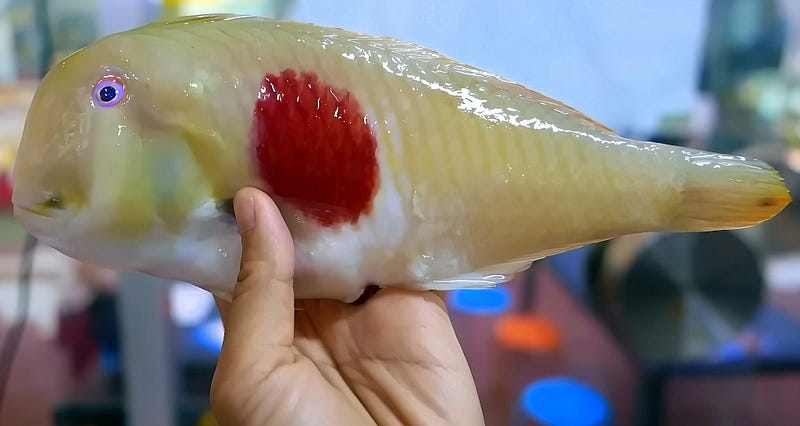
The species is diurnal, burrowing into sand at night for protection. It uses rapid body undulation to “swim into” soft substrates, disappearing in seconds. Diet consists primarily of benthic crustaceans, small mollusks, and polychaete worms. Like many wrasses, the Redblotch razorfish exhibits protogynous hermaphroditism — beginning life as female and transitioning to male as social hierarchies demand.
Courtship involves a series of color pulses, with males flashing electric blue highlights to attract receptive females during dawn hours. Spawning occurs in midwater, with eggs left to drift among plankton before settling into sand beds within 36–48 hours.
Ecology
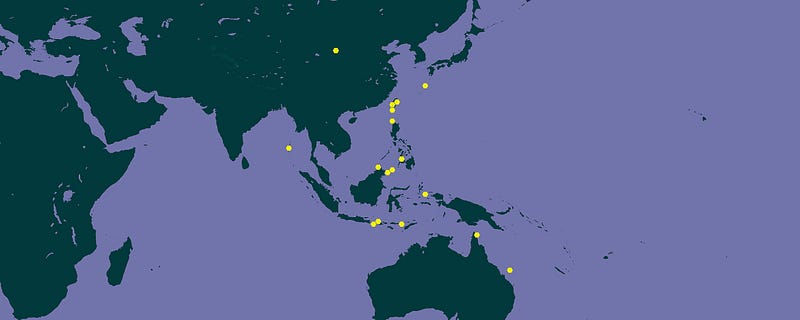
This species inhabits shallow coral reefs and sandy lagoons from 3 to 65 ft (1–20 m) depth, thriving in transitional zones between reef crests and open sand plains. Its distribution spans from the Red Sea to the central Pacific, including Indonesia, Papua New Guinea, Japan, and French Polynesia.
The Redblotch razorfish plays a subtle but vital role in sediment turnover. By burrowing and foraging, it oxygenates the benthos and controls populations of small invertebrates. It is preyed upon by groupers and moray eels, forming part of the reef’s middle-trophic layer.
Sustainability concerns remain low due to its small size and low commercial value. However, localized habitat degradation — especially coral bleaching and sand compaction from dredging — has reduced population densities in parts of the Philippines and Bali. Responsible tourism and reef restoration efforts that maintain sandy microhabitats indirectly benefit this species.
Uses
The Redblotch razorfish holds limited commercial or culinary value due to its modest size and delicate flesh. It is occasionally caught as bycatch and sold in local fish markets for home consumption. Edible portions include the fillet and skin, though the yield is minimal — approximately 0.2 kg per individual, translating to an estimated 50–70 kg per hectare (45–63 lb per acre) in dense reef zones.
The flesh provides about 95 kcal per 100 g (3.5 oz), with 18 g protein, 2 g fat, and high levels of omega-3 fatty acids (EPA and DHA). No anti-nutritional or toxic compounds are reported. Processing requires immediate chilling post-harvest to prevent enzymatic softening.
Commercially, the species’ vivid patterning gives it niche value in the ornamental aquarium trade, though handling stress and burrowing behavior make it difficult to maintain. Collection requires permits in most jurisdictions under CITES-aligned reef protection protocols.
From a culinary standpoint, its mild, sweet flesh resembles that of small wrasses or parrotfish. When available, it is typically pan-seared or steamed whole, with minimal seasoning — often lime, sea salt, and coconut oil — to preserve its natural flavor. The taste is clean and mineral, the aroma is lightly marine, and the texture is fine and flaking.
Medicinal or industrial uses are negligible, but traditional healers in parts of Sulawesi once used dried razorfish powder in salves to treat skin abrasions. No scientific validation exists for efficacy.
Ecologically, its sand-burrowing contributes to carbon cycling through sediment aeration, indirectly enhancing benthic microbial productivity — yielding an estimated carbon sequestration rate of 0.05 metric tons per hectare annually (0.045 tons per acre).
The species faces minimal harvest pressure but benefits from traceability systems embedded in coral reef monitoring programs. Certification under eco-tourism and sustainable collection initiatives (e.g., MAC Certified Marine Ornamentals) promotes ethical sourcing.
Culinary Aspects
The Redblotch razorfish offers a subtle, nuanced flavor. Taste profile: saline, mildly sweet, with mineral undertones. Aroma: briny, clean, faintly herbaceous. Mouthfeel: delicate yet cohesive, low in oiliness. Texture: soft flakes with fine connective tissue, similar to whiting. Balance: harmonious between sweetness and umami. Complexity: low to moderate, best expressed through minimal preparation.
Aftertaste is crisp, with no lingering fishiness. Finish is light and clean, suited to tropical herbs like lemongrass or pandan. Chemesthesis — barely perceptible warmth when cooked with chili or ginger — enhances its understated character.
Culturally, it appears in small island cuisines where subsistence fishing remains integral. In Micronesia and Palau, it is wrapped in banana leaves and slow-roasted, imparting a faint smoky sweetness. Nutritional benefits center on lean protein, low mercury levels, and high selenium content, supporting antioxidant function.
Wine Pairings
A delicately prepared Redblotch razorfish dish pairs best with nuanced white and rosé wines that emphasize minerality and restrained fruit.
A Vermentino from Sardinia offers crisp acidity and saline freshness that mirrors the fish’s oceanic notes, aligning with lime and sea salt preparation. A Greek Assyrtiko from Santorini, with its volcanic minerality and citrus zest, enhances the fish’s clean finish when steamed or poached. For lightly roasted forms, a Provence rosé made from Mourvèdre complements the gentle smokiness while maintaining structural lightness.
For a rare but ideal pairing, a Basque Txakolina — slightly effervescent and sharply acidic — pairs elegantly with tropical herbs and coconut-based sauces, balancing richness without overwhelming the fish’s subtle texture.
Conclusion
The Redblotch razorfish is not a culinary staple nor a commercial powerhouse. Its value lies in its ecological subtlety and aesthetic grace — a reminder that the smallest actors often hold the reef’s balance in place. Whether viewed through a biologist’s lens, a diver’s mask, or a chef’s curiosity, Iniistius twistii embodies resilience, adaptation, and beauty in motion — proof that even the most delicate species can anchor the vast complexity of ocean life.