Consent on the Brink: America 2025 Through Locke’s Lens — with Rousseau, Rawls, Tocqueville, and…
John Locke’s political philosophy — with its emphasis on natural rights, the social contract, and the consent of the governed — offers a powerful lens for interpreting America’s turbulent political landscape in 2025.
Consent on the Brink: America 2025 Through Locke’s Lens — with Rousseau, Rawls, Tocqueville, and Arendt
Introduction
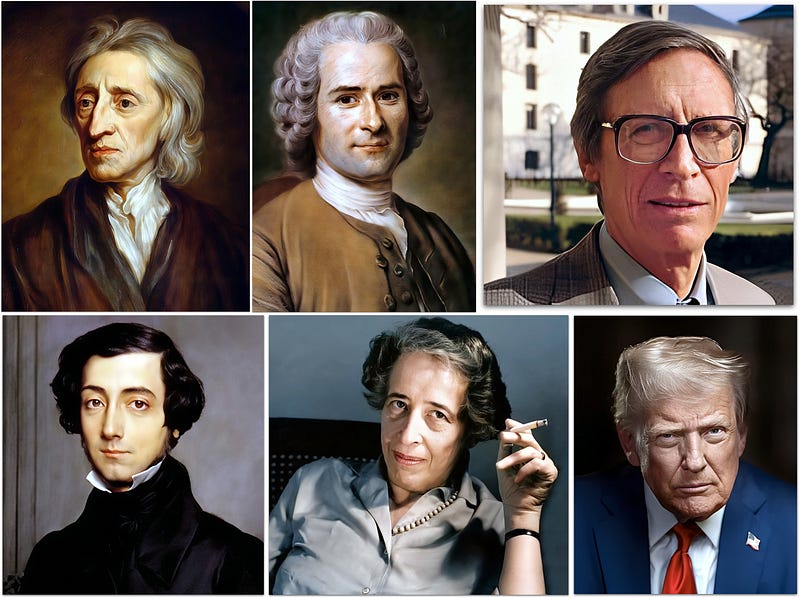
John Locke’s political philosophy — with its emphasis on natural rights, the social contract, and the consent of the governed — offers a powerful lens for interpreting America’s turbulent political landscape in 2025. This year has been marked by intense polarization and controversy, from the inauguration of Donald Trump for a second presidential term to fierce debates over executive power, immigration crackdowns, economic showdowns, and fundamental rights. The challenges of 2025 are not occurring in an intellectual vacuum; they echo concerns that have long been examined by thinkers such as Locke, Jean-Jacques Rousseau, Alexis de Tocqueville, John Rawls, and Hannah Arendt. Each of these philosophers offers insight into distinct aspects of the present moment. Locke’s warning against tyranny and insistence that government legitimacy rests on popular consent resonate amid contentious executive orders and accusations of authoritarianism. Rousseau’s notion of the general will — the true common interest of the people — offers a yardstick to evaluate divisive policies such as immigration enforcement and whose interests they actually serve. Tocqueville’s observations on the tyranny of the majority and the vibrancy of American democracy cast light on how majorities and minorities clash in courtrooms and legislatures over rights and regulations. Rawls’ theory of justice as fairness, centered on equality and the protection of the least advantaged, sharpens debates on economic policy and whether partisan fiscal brinkmanship honors or undermines social justice. Meanwhile, Arendt’s reflections on authoritarianism and the fragility of truth in politics sound eerily relevant as leaders battle over climate change facts and the line between truth and falsehood blurs in public discourse. In what follows, we will develop a theoretical framework from these thinkers and then apply it to analyze key themes in American politics in 2025 — from surging executive power to immigration raids, debt-ceiling standoffs, Supreme Court rulings, and climate disasters — thereby assessing contemporary events through an applied philosophical perspective.
Theoretical Framework
Locke’s Liberal Contract and Natural Rights: John Locke (1632–1704) laid down principles that became cornerstones of liberal democracy and deeply influenced America’s founders. In Locke’s view, legitimate government arises from a social contract in which individuals consent to form a political community primarily to safeguard their natural rights — including life, liberty, and property. Government power is thus held in trust and must be limited, used to serve the common good, and protect citizens’ rights. If rulers violate the trust of the people — by acting arbitrarily, violating rights, or ruling without consent — Locke argues they enter a state of tyranny. In such cases, the people are morally entitled to withdraw their consent and even to resist or overthrow the offending government. This right of resistance to tyranny is a core Lockean idea: when government ceases to protect rights and instead subverts them, it loses legitimacy. Another pillar of Locke’s philosophy is the consent of the governed: laws and policies are only just when they reflect the consent (direct or tacit) of the society’s members. Locke also emphasizes the separation of powers and the rule of law as bulwarks against tyranny. Overall, Locke provides a framework in which governmental authority must be both empowered to protect rights and constrained by law and popular consent — a framework highly pertinent to assessing strong executive actions and rights controversies in 2025.
Rousseau’s General Will and Popular Sovereignty: Jean-Jacques Rousseau (1712–1778) also theorized the social contract, but arrived at different conclusions from Locke. Rousseau’s vision of a legitimate polity centers on the general will — the collective will of the citizenry directed toward the common good. In his view, true sovereignty lies with the people as a whole, who must participate directly (or at least fully conscientiously) in making laws that apply to everyone. The general will is not merely the will of the majority; it is the shared interest that all citizens would recognize if they set aside private agendas and considered only the common good. Laws are just when they reflect this general will, securing freedom and equality for all members of the community. Importantly, Rousseau believed that individuals who stray from the general will might need to be “forced to be free” — compelled to obey the laws that embody the common interest — since true freedom consists in living under laws one has prescribed for oneself as a member of the polity. Rousseau was deeply concerned with moral equality and argued that extreme inequality corrodes the general will by allowing private interests (factions of the rich or powerful) to capture the state. While Locke stresses individual rights and the protection of property, Rousseau emphasizes communal decision-making and the moral unity of the body politic. His ideas provide a contrast to Locke’s: whereas Locke might ask whether policies respect individual natural rights and minority interests, Rousseau prompts us to ask whether policies express a genuine common will or merely the will of some faction. In 2025, Rousseau’s perspective becomes relevant in analyzing whether divisive policies — such as immigration enforcement crackdowns or emergency fiscal measures — truly reflect a coherent general will aimed at the public good, or whether they are driven by partisan or factional interests that leave parts of the populace alienated.
Tocqueville’s Democracy and the Tyranny of the Majority: Alexis de Tocqueville (1805–1859), a French observer of early American democracy, contributed penetrating insights into the strengths and dangers of democratic society. In Democracy in America (1835/1840), Tocqueville praised the United States’ vibrant civil society, local self-government, and widespread political engagement. But he also warned of a unique peril in democracy: the tyranny of the majority. In a democratic system, because power ultimately comes from majority opinion, there is a risk that an impassioned majority could oppress minority groups or individuals, overriding their rights and silencing dissenting voices. Tocqueville noted that in America, social conformity to majority opinion could be so strong that it stifled independent thought: “I know of no country in which there is so little independence of mind and real freedom of discussion as in America,” he observed with concern. The majority’s tyranny, in Tocqueville’s view, might not always come through formal laws; it could also manifest as the weight of public opinion crushing those who disagree. However, Tocqueville believed this danger could be mitigated by constitutional checks and balances, a free press, judicial independence, and the American habit of forming associations. Courts, in particular, he saw as a potential counterweight to momentary popular passions, since judges (especially in the U.S. system of judicial review) could defend constitutional rights against majority encroachments. Tocqueville’s framework thus sensitizes us to majority-minority dynamics in 2025: Are policies or laws oppressing certain groups to satisfy a majority’s demands? Are institutions like the Supreme Court acting to prevent or enable such tyranny? Tocqueville would likely pay close attention to how majority sentiment — for instance, a public outcry over crime or online content — is balanced against individual liberties and minority rights in America’s current political dramas.
Rawls’ Justice as Fairness: In the 20th century, John Rawls (1921–2002) redefined social contract theory for a modern liberal democracy with his landmark work A Theory of Justice (1971). Rawls asks what principles of justice rational people would choose for their society if they did so behind a “veil of ignorance,” unaware of their own class, race, talents, or other accidental attributes. He argues that two principles would emerge from this hypothetical fair agreement: first, each person should have an equal claim to a scheme of basic liberties (such as freedom of speech, conscience, and the person) compatible with the same scheme for all; second, social and economic inequalities are permissible only if they are attached to positions open to all under conditions of fair equality of opportunity, and if they work to the greatest benefit of the least-advantaged members of society (this second part is known as the difference principle). Rawls’ philosophy, often called “justice as fairness,” thus combines a strong emphasis on equal basic rights with a concern for the distribution of wealth and opportunities, ensuring that the poor and vulnerable are not sacrificed for the benefit of the better-off. In evaluating political conflicts, Rawls would ask: Are we upholding equal liberties for all? And are the inequalities produced by our policies arranged to help those who have the least? He would likely critique political strategies that risk the well-being of society’s most vulnerable for the sake of power plays or advantages for the privileged. Rawls also underscores the importance of public reason and mutual respect in a democratic society — the idea that political decisions should be justified with reasons all citizens might reasonably accept, not merely with sectarian or partisan interests. His framework will be valuable in examining the fairness (or lack thereof) in 2025’s budget battles, economic policies, and any scenario where some groups bear disproportionate burdens.
Arendt’s Warnings on Authoritarianism and Truth: Hannah Arendt (1906–1975), a political theorist who escaped Nazi Germany, devoted much of her work to analyzing how totalitarian and authoritarian regimes arise and how they operate. In The Origins of Totalitarianism (1951), Arendt explored the mechanisms by which fascist and communist totalitarian movements subjugated individuals — partly through terror and brute force, but also through the manipulation of truth and public opinion. Arendt famously pointed out that in an authoritarian political climate, truth itself becomes fragile. Regimes bent on domination will deliberately blur the line between fact and falsehood, eroding the shared reality necessary for people to deliberate and act together. In her essay “Truth and Politics” (1967), Arendt noted that factual truths (as opposed to mere opinions or ideological notions) are acutely vulnerable in the political arena: even obvious truths can be denied or spun, and if a critical mass of people accept the lies or become indifferent to the distinction between truth and falsehood, factual reality can crumble in the public consciousness. She observed that constant lying can create a “defactualized” world, one in which citizens are not sure of anything and thus become cynical or apathetic, which opens the door to manipulation. Additionally, Arendt examined how authoritarian leaders often appeal to mass resentment and simplistic narratives, offering false certainty in place of complex truths. She warned that simply shouting “but that’s a lie!” is not enough to stop political lying — outrage can even be co-opted by demagogues to further destabilize factual discourse. Instead, preserving truth in politics requires active effort by institutions, a free press, and citizens committed to critical thinking. Arendt also wrote about the nature of authority and freedom, lamenting how populist authoritarian movements can exploit loneliness and social atomization. In 2025, Arendt’s insights into how authoritarianism can take root — through the expansion of unchecked executive power, the undermining of institutions, and the blatant denial of factual reality — are uncannily pertinent. Her perspective will help us critique developments like aggressive assertions of presidential power, propaganda in policymaking (for example, around climate science), and the ways truth is contested or upheld in the American political sphere.
With this theoretical grounding, we can now analyze how these principles manifest in the concrete events of 2025. Each major development — from Trump’s flurry of executive orders to immigration enforcement raids, fiscal brinkmanship, landmark court decisions, and climate-related catastrophes — can be examined both for what it tells us about American politics and for how it stands up to the scrutiny of our chosen philosophers.
Analysis
Executive Power and the Consent of the Governed: The year 2025 opened with an extraordinary assertion of executive authority. Donald Trump’s second inauguration in January was quickly followed by a blitz of executive orders aimed at reshaping federal governance. On his very first day back in office, Trump signed a staggering 100 executive orders, instituting “sweeping changes throughout the federal government and beyond”. These directives included dramatic measures to centralize control over the civil service. One order, tellingly titled “Restoring Accountability to Policy-Influencing Positions Within the Federal Workforce,” resurrected a controversial plan from Trump’s first term: it created a new category of federal employment (dubbed “Schedule F” or “Schedule Policy/Career”) that strips civil service protections from tens of thousands of federal employees in policy roles. By reclassifying these officials as at-will employees, the administration sought to make it “easier for agencies to remove them from their positions”. In effect, career experts and bureaucrats deemed insufficiently aligned with the President’s agenda could be fired with minimal due process. Locke’s philosophy practically leaps off the page in response to this power play. Locke would remind us that government officials are entrusted with power only for the public’s benefit; they are fiduciaries of the people’s trust, not the personal instruments of a single ruler. If the executive branch purges impartial civil servants in favor of loyalists, does this not jeopardize the impartial rule of law and the balance of power that ensures government by consent rather than by personal will? To Locke, arbitrary dominance — even under the color of law — smells of tyranny. The consent of the governed begins to erode if the mechanisms of governance are bent toward one man’s “private advantage” rather than the public good.
From another angle, Hannah Arendt’s insights into authoritarianism cast a long shadow over these events. Arendt warned that authoritarian leaders often dismantle or dominate independent institutions (like a professional civil service or autonomous agencies) so that there are no checks on their personal power. Trump’s Schedule F initiative was widely seen by its supporters as a way to “drain the swamp” of an allegedly obstructive bureaucracy, but critics described it as a step toward autocratic control — enabling what one federal employee union lawsuit called “employment rules for political appointees” to be applied to nonpartisan staff. This recall of a late 2020 plan (reversed by President Biden in 2021) signaled a desire to consolidate executive authority in unprecedented ways. Arendt would likely see in this a classic move of authoritarian governance: remove the professionals and watchdogs, and replace them with unquestioningly loyal cadres. Moreover, Arendt’s notion of the fragility of truth is also relevant. A politically purged bureaucracy is one where objective expertise might be subordinated to political dictates. If scientific agencies, statistical offices, or regulatory bodies are led only by those who echo the leader’s claims, the factual basis of policymaking can be distorted at will. Indeed, throughout 2025, the Trump administration demonstrated a willingness to reject expert consensus — for instance, issuing reports that downplayed climate change using debunked science — and to rely on the loyal implementation of these contested narratives. Locke, in his time, insisted that rulers must govern by “established standing Laws, promulgated and known to the People,” not by arbitrary decrees issued on the fly. The flurry of Trump’s executive orders, implemented with minimal consultation or legislative input, tests that Lockean standard. Are these orders expressions of the people’s will, or simply the will of the president? The answer determines whether they align with Locke’s principle of consent or veer into what he’d label an exercise of force without right.
The consent of the governed is further called into question by how these executive actions have been received. Large protests and a vocal opposition arose in response to fears of authoritarianism. Notably, shortly after Trump’s inauguration and early orders, a grassroots movement culminated in a nationwide demonstration known as “No Kings Day,” in which millions rallied in cities across the country to demand democracy and decry what they perceived as autocratic tendencies. The very name “No Kings” harkens back to the American Revolution’s ethos — a refusal to be subject to unchecked authority — and echoes Locke’s argument that the people have a right to resist tyrants as they once resisted monarchical absolutism. When Trump responded to those protests not with conciliation but with defiance — at one point even hosting a grand military parade on his birthday, complete with martial displays in Washington, D.C., which critics likened to power theatrics — the stage was set for a Lockean confrontation between executive claims of power and popular assertions of the social contract. It is as if 2025 is testing a fundamental question: Can a modern American presidency accumulate such power and still be said to govern with the people’s consent? Locke would likely be heartened that Americans were invoking the principle of consent (with slogans like “No Kings”) to hold their leaders accountable, even as he would be deeply wary of the concentration of executive power that necessitated such protests in the first place.
Immigration Crackdowns, Natural Rights, and the General Will: Few issues illustrate the clash between individual rights and collective will as starkly as the Trump administration’s hardline immigration enforcement in 2025. After returning to the office, Trump doubled down on aggressive immigration tactics that he had begun in his first term. By mid-2025, federal agencies — especially Immigration and Customs Enforcement (ICE) — were carrying out sweeping operations in major cities, often with militarized flair. In June, Trump openly promised “the single largest Mass Deportation Program in history,” ordering ICE agents via social media to expand detentions and removals in Democratic-led cities like Los Angeles, Chicago, and New York. This announcement came on the heels of the “No Kings” protests and was widely interpreted as political retaliation against jurisdictions that opposed his policies. By September, operations like “Operation Midway Blitz” in Illinois were underway: ICE raids in Chicago aimed ostensibly at “hardened criminals” but conducted so broadly that local officials said they “terrorize[d] Latino communities”. Illinois’s governor and Chicago’s mayor — neither informed in advance — condemned the large-scale ICE sweep as “a political stunt designed to intimidate” immigrant neighborhoods and city authorities. Reports from Chicago described menacing scenes: National Guard troops patrolling streets alongside ICE, residents snatched off sidewalks or from their jobs (even a flower vendor was arrested while working). Trump officials defended the crackdown by pointing to a handful of serious criminals among those targeted, arguing the operations were necessary because so-called “sanctuary” laws in cities prevented local police from handing over suspects to ICE. Yet critics noted the deep human costs: families living in fear, the rights of long-time residents (even U.S. citizens of certain ethnic appearances) jeopardized, and the specter of racial profiling and mass detention looming. In fact, on the very same day as the Chicago raids, the U.S. Supreme Court issued a controversial 6–3 decision allowing federal agents in Southern California to proceed with immigration sweeps that detain people based on their race, ethnicity, language or accent, even without reasonable suspicion of unlawful status. This effectively gave judicial sanction to racial profiling in immigration enforcement, a ruling that many civil libertarians decried as a profound erosion of equal protection and due process.
How might Locke and Rousseau help us parse these developments? From Locke’s perspective, every person — not just every citizen, but every person — has natural rights to life and liberty that governments must respect. Locke does allow that a political community can enforce its laws and punish violations of rights (he was not an anarchist), and clearly, entering or residing in a country unlawfully can be deemed a violation of the state’s legal order. However, Locke would insist that enforcement must be bound by natural law and basic justice. Dragnet raids that detain individuals “without ‘reasonable suspicion’” of wrongdoing run afoul of fundamental principles of justice that even a non-citizen is owed by virtue of common humanity. The Supreme Court’s approval of detentions based purely on racial or linguistic appearance would alarm Locke on two levels: first, it violates the equality aspect of natural law (treating people not “according to fixed standing rules” but on arbitrary traits); second, it hints that the judiciary — which Locke saw as an essential part of government’s duty to adjudicate by known law — is abdicating its role as guardian of rights. Locke wrote that the state’s power to punish must be guided by the law of nature, which teaches that no one ought to harm another in their life, health, liberty, or possessions. Do mass deportation drives that break apart families or detain individuals on slim pretexts respect those injunctions? If those targeted are violent criminals, Locke would have no qualm with their punishment or expulsion — indeed, protecting the community from harm is a key reason we empower government. But Locke would also carefully ask: are these actions truly focused on actual threats, or are they “pursuits of innocent people under pretense of public good”? The presence of U.S. citizens and petty offenders among those swept up, and the rhetoric of intimidation, suggest the latter.
Rousseau offers a different but complementary critique. He would ask whether this harsh immigration policy reflects the general will of the American people or the will of a faction. There’s no denying that a segment of the populace — especially Trump’s political base — strongly supports stricter immigration enforcement, seeing it as necessary for public order and national integrity. If one viewed the general will as simply whatever the majority at a given moment desires, one might say these crackdowns have popular legitimacy. But Rousseau’s general will is subtler: it is about the common good of all citizens. Would a policy of fear and round-ups, one that sows division between communities and possibly undermines social cohesion, qualify as serving the common good? Rousseau might be skeptical. The fact that these crackdowns seem driven by partisan aims (“vengeance” for rebellious liberal cities) and are implemented over the vehement objections of local elected leaders suggests they are more the product of factional will than general will. The millions who protested on No Kings Day, as well as widespread public discomfort with images of military-style immigration raids, indicate that a large portion of the citizenry does not share in this as a vision of the common good. For Rousseau, an authentic general will would likely aim for a solution that balances the community’s security with humanity and justice — perhaps reforms that address root causes of unauthorized migration, fair legal processes for immigrants, and consensus-driven policies. Instead, what we see is policy by edict and spectacle. Indeed, even in the heart of these enforcement actions, there are signs of internal contradiction reflecting the absence of a clear general will: at one point in 2025, after backlash from farmers and businesses hurt by losing migrant workers, the Trump administration actually paused certain ICE workplace raids, acknowledging that “very aggressive” tactics were harming industries that rely on immigrant labor. This pause was short-lived; Trump soon reversed himself again and escalated deportation rhetoric once more. Such vacillation suggests a policy driven by impulse and political theater rather than a stable collective mandate. Rousseau might say that the true general will of Americans regarding immigration is still elusive or clouded by polarization — the crackdowns represent, not a united populace acting for the common good, but the imposition of one group’s will upon others (urban communities, immigrants, political opponents) without a unifying social consensus.
There is also a deeper philosophical tension here between Locke and Rousseau’s approaches. Locke’s primary concern would be whether individual natural rights (to due process, to not be arbitrarily detained, to personal security) are being upheld. Rousseau’s concern is whether the policy sustains the moral unity of the community (are all citizens treated as members of one body politic pursuing the commonweal?). The 2025 immigration raids could be seen as failing on both counts: by skirting due process and equal protection, they offend Locke’s principles; by deepening societal cleavages and targeting certain communities as outsiders or threats, they undermine the Rousseauian ideal of a cohesive general will. The plight of migrants — many of whom are longtime community members, albeit without legal status — also raises the question of rights in a more cosmopolitan sense. Locke did not explicitly write about immigration, but his theory implies that even non-citizens have natural rights that must be respected. One might argue that the social contract for Locke is among a particular people (citizens), and outsiders don’t have the same claim to membership. Yet even if that is so, basic natural rights don’t vanish at the border. Images of families separated or people of certain ethnicities being summarily rounded up would violate Locke’s sense of natural law and invite what he termed appeal to heaven if no earthly authority would check such power. In fact, we see real pushback: state governors, mayors, and courts (with the notable exception of that one Supreme Court ruling) have tried to push back on aspects of the crackdown, invoking constitutional rights and humane values. The friction between federal power and local general will (e.g., sanctuary city policies that arguably reflect local popular will to protect immigrant neighbors) is itself telling — it’s a duel of social contracts at different levels of community. Rousseau might sympathize with local democratic communities like Chicago or Los Angeles, which believe they are acting in their common interest by limiting cooperation with deportations, against what they perceive as a despotic imposition from above. This clash of wills indicates a breakdown of the unified general will on a national scale. The American polity is in disunion over who “the people” are and what “the people’s will” truly calls for regarding newcomers in their midst.
Fiscal Standoffs, Property Rights, and Fairness: Another major drama of 2025 has been the battle over the federal debt ceiling and government funding, an episode that showcases the perils of partisan brinkmanship in economic policy. After years of rising national debt, the United States once again hit its statutory debt limit shortly after the new administration took office. What ensued was a high-stakes confrontation in Congress, heavily influenced by President Trump’s intervention. In December 2024 — during the transition period after Trump’s election but before he took office — a bipartisan group of lawmakers had negotiated a bill to extend the debt ceiling deadline into 2025, hoping to ensure economic stability. In a striking move, Trump (then President-elect) torpedoed that deal at the last minute by urging Republican allies to oppose it. He made it clear he wanted to leverage the imminent debt ceiling for his own policy agenda, rather than tie his hands with a pre-set extension. As a result, the United States entered 2025 without a resolved debt limit, setting the stage for a game of chicken over the nation’s creditworthiness. By spring and summer 2025, as the Treasury’s “extraordinary measures” were running out, financial markets grew jittery at the prospect that the U.S. might default on its obligations. Partisan divisions ran deep. The White House and congressional Republicans floated a proposal to suspend the debt limit for two years — not out of pure generosity, but because Trump favored abolishing the debt ceiling altogether to remove constraints on his promised tax cuts and spending plans. Democrats, meanwhile, wary of giving the administration a blank check, especially after seeing a budget that “rips health care coverage away from 16 million people to pay for tax cuts for the ultra-rich”, insisted on pairing any debt limit hike with safeguards or a shorter timeframe. Each side accused the other of risking economic calamity for political gain. Indeed, Senator Elizabeth Warren pointed out the stark irony that while Republicans rhetorically deplored debt, they were simultaneously pushing massive tax cuts that would add trillions to the debt — illustrating that the debt ceiling was functioning as “merely a political weapon”, not a genuine fiscal restraint. The pattern was familiar: years earlier, Republicans had used the debt ceiling in 2011 to force spending cuts (costing the economy millions of jobs), whereas under Republican presidents, they had raised the ceiling routinely to accommodate tax cuts and spending. By June 2025, the impasse had grown so dire that U.S. credit default swap spreads (an indicator of perceived risk of default) spiked, and analysts warned of severe market volatility if the limit was not lifted in time. Under pressure, a last-minute deal emerged: Congress suspended the debt ceiling for a shorter period in exchange for modest spending caps — essentially kicking the can down the road. But the partisan rancor left scars.
Locke’s and Rawls’ ideas both come into play in judging this fiscal brinkmanship. Start with Locke: he championed property rights as a fundamental natural right and viewed government’s protection of property (in a broad sense, including one’s estate, opportunities, and by extension the stability of the economic environment) as a primary justification for authority. The debt ceiling showdown posed a direct threat to the property and economic security of citizens. A government default would have meant unpaid salaries, frozen benefits, soaring interest rates, and a likely financial crisis — in short, an assault on the assets and livelihoods of countless Americans. Locke would likely view with dismay a scenario in which political actors, entrusted to secure the “lives, liberties, and estates” of the people, instead gamble with those very estates to score political points. He wrote that the power of taxation (which underpins debt, since debt is deferred taxation or spending) must be given by the people’s consent and used for the public good. One could argue that the debt ceiling itself is a law reflecting consent — a self-imposed constraint by the people’s representatives to check borrowing. However, using that constraint as leverage in a partisan struggle, such that one faction threatens to wreck the economy unless its demands are met, could be seen as a breach of the fiduciary responsibility officials owe to the public. In Locke’s terms, that is an abuse of delegated authority: the legislature is meant to act “not for their own pleasure, but for the use of the governed”. Holding the full faith and credit of the nation hostage, and thereby endangering the property and well-being of all, hardly seems consistent with acting for the people’s benefit. Locke was very sensitive to the idea of trust: We the people entrust our welfare to our representatives. If those representatives instead produce economic chaos, Locke would ask whether this amounts to an abdication — potentially giving the people the right to seek new guardians for their safety and property (though in practice that would play out via elections or intense public pressure rather than immediate revolt).
Rawls provides a different angle, focusing on justice and fairness. The debt ceiling battles of 2025 can be scrutinized under Rawls’ two principles. The first principle, guaranteeing equal basic liberties, is indirectly implicated: a government shutdown or default could disrupt citizens’ ability to exercise freedoms (for example, courts closing would affect the right to a fair trial, or unpaid law enforcement could affect public safety, etc.), but more directly, it’s the second principle — socio-economic justice — that is center stage. Rawls would be especially concerned with how the burdens and benefits are distributed in these maneuvers. Who is at risk if the debt ceiling isn’t raised? Primarily, ordinary Americans: federal workers might lose pay, vulnerable groups might see benefits delayed (Social Security checks, veterans’ benefits), and a default-driven recession could cost countless jobs. Meanwhile, what was being bargained for? In Trump’s case, a key aim was large tax cuts heavily favoring the wealthy (as evidenced by the budget Warren referenced, which not only cut services for the poor but still added $2.4 trillion to the debt via tax breaks for corporations and rich individuals. Rawls’ difference principle says that inequalities in society are acceptable only if they benefit the least advantaged. The “big, beautiful” budget bill touted by Trump — which Warren derided for its transfer of wealth upward — violates that principle on its face, since it advantages the rich at the expense of the poor (ripping away health coverage from millions of poorer Americans to give tax windfalls to the rich). Using the threat of economic meltdown via the debt ceiling to try to force such a bill into law would be, in Rawls’ view, doubly unjust: both the means and the ends are unfair. The means are unfair because they put the most vulnerable at risk as bargaining chips. The ends are unfair because they magnify inequality and harm those who can least afford it. Rawls would likely highlight the moral arbitrariness of such brinkmanship. If we imagine ourselves behind a veil of ignorance, not knowing if we’ll be rich or poor, debtor or creditor, would we design a system where one party could threaten to tank the economy unless certain partisan demands are met? Almost certainly not — we would want stable rules ensuring fiscal continuity and good-faith negotiation, rather than hostage-taking that could victimize any of us. In fact, Rawls might echo what a bipartisan chorus of economists and even some politicians (like Senator Warren and, surprisingly, Trump himself at one point) suggested: the debt ceiling as a mechanism serves no real constructive purpose and ought to be abolished to prevent such unjust standoffs. When Trump and Warren, ideological opposites, both mused that “the smartest thing” would be to eliminate the debt limit, one hears a Rawlsian rationality peeking through: a basic structure of society should not allow games of chicken with the entire economy at stake.
From Tocqueville’s vantage, the debt ceiling crisis also illustrates a pathology of modern democracy: partisan factions exploiting veto points in government in a way that holds the majority’s interest hostage. The majority of Americans, polls showed, disliked using the debt ceiling as a bargaining tool; they just wanted the government to pay its bills and avoid calamity. Yet a relatively small group in Congress was able to wield outsized power by this procedural quirk. Tocqueville might compare this to how a determined minority (in his time, perhaps the slaveholding interests or others) could frustrate the broader public’s welfare. However, in 2025, the blame doesn’t lie solely with a minority faction; it’s a failure of the system to reflect the general interest due to hyper-partisanship. In Federalist 10, Madison argued the extended republic and its systems would prevent dangerous factionalism — Tocqueville believed America’s multiplicity of sects and interests usually did balance out. But the debt ceiling fight shows a case where the constitutional system’s checks (like requiring both Congress and the President to agree to raise the limit) became choke points amplifying conflict rather than balancing interests. The eventual resolution — a temporary suspension — came not from any grand principled compromise on fairness, but from sheer necessity and market pressure. Rawls would probably conclude that justice was not truly served in this episode: it was a narrowly averted self-inflicted wound that, even in being averted, extracted concessions that hurt the vulnerable (for instance, if spending caps led to cuts in social programs, as indeed the deal included tightened work requirements for food aid that could push some poor Americans off assistance). Locke would second that assessment by noting how dangerously close the government came to betraying its fundamental duty to preserve the nation’s property and safety. Both would likely urge reforms to prevent a recurrence. And notably, there is evidence that many in 2025 learned this lesson: calls to permanently remove the debt ceiling grew louder, invoking both common-sense economic management and the moral argument that “the debt limit doesn’t stop a single penny of spending” and only serves to enable political hostage-taking. It’s a rare case where Trump and some of his opponents momentarily agreed on a systemic fix — albeit for different reasons — and it indicates a potential path to more Lockean stability and Rawlsian fairness in the future if such a reform were enacted.
Rights and Tech Regulation: Majority Rule vs Minority Rights: The Supreme Court’s role in 2025 has been pivotal in adjudicating the balance between majoritarian policy impulses and individual rights, especially in areas shaped by new technology. One high-profile arena has been the regulation of social media and online speech — a 21st-century frontier for First Amendment jurisprudence. Republican-led states, reflecting a growing sentiment among conservatives that Silicon Valley has an anti-conservative bias, have enacted laws (for example, in Texas and Florida) restricting how large social media platforms can moderate content. These laws essentially sought to prevent companies like Facebook or Twitter from “censoring” users based on viewpoint, a response to allegations that right-leaning speech was being unfairly taken down. On its face, such laws had populist appeal: they were presented as protecting the majority’s ability to speak freely on dominant public platforms, ensuring a diversity of views. But they also raised the question of whether the rights of a private minority (the tech companies, and by extension, communities on their platforms) were being infringed by government compulsion to host speech. In mid-2024, the Supreme Court weighed in on this tension in the case NetChoice v. Moody (consolidated with a Texas case). By July 2024, the Court ruled that these state social media laws likely violated the First Amendment rights of the platforms. In a nuanced decision, a majority of Justices affirmed that even though social media companies are powerful gatekeepers, they do have a constitutional right akin to that of newspapers or publishers to decide what content to carry. The Court rejected the argument that platforms could be treated as mere common carriers devoid of speech rights; it held that forcing them to display content they wish to remove (in the name of “viewpoint neutrality”) is a form of compelled speech that runs afoul of the First Amendment. However, the Court stopped short of a final word on every aspect — it vacated the lower court rulings and remanded for further analysis, instructing lower courts to parse the laws’ provisions in detail under First Amendment standards. The clear message, though, was that there are significant First Amendment barriers to letting a political majority dictate content moderation policies on private platforms.
Tocqueville’s concept of the tyranny of the majority is directly relevant here. In states like Texas and Florida, the majority (through their legislatures and governors) attempted to impose their will on the digital public square, ostensibly to protect the speech of some citizens (often the majority’s own faction) by preventing other private entities from exercising control. In Tocqueville’s time, of course, the idea of a private corporation controlling discourse would have been alien, but he did foresee that majorities might use the instruments of government to silence or force compliance from dissenting voices. Interestingly, in this instance, it is the conservative majority in those states trying to prevent what they see as a majority viewpoint (or at least a widespread viewpoint) from being suppressed by a presumably liberal minority (tech executives or content moderators in San Francisco). It flips the usual script: here, the “minority” to protect could be the tech companies and the online communities they curate, while the “majority” is the popular sentiment in certain regions that feels silenced. The Supreme Court’s stance essentially protected a minority right — the right of the platforms to curate content and of online communities to set standards — against majority interference. Tocqueville, who admired the American judiciary as a bulwark against the tyranny of the majority, would likely approve of this outcome. The Court acted cautiously but firmly to say: the fact that a lot of people might want certain speech allowed (or disallowed) on platforms does not mean the state can just override others’ rights to create their own community standards. This is akin to how Tocqueville observed that American courts could intervene to uphold a higher law (the Constitution) when majorities tried to push something beyond the pale. In a sense, the principle that “Facebook can ban who it wants” might be analogized to a community of interest or association exercising its freedom — something Tocqueville celebrated as a hallmark of American freedom, the ability of people to associate and set rules for their associations.
Locke’s perspective on this tech case would focus on property and contract. Locke might view a social media platform as a kind of private property or enterprise. The owners have a property right to decide how it’s used, and users have entered into a kind of contract (terms of service) with the platform. If a state comes in and decrees that, say, a platform cannot remove disinformation or hate speech if doing so would be “viewpoint discrimination,” Locke would likely see that as the government overstepping and infringing on the platform owners’ property rights and the liberty to dispose of their property as they see fit (so long as they aren’t harming others’ rights). Unless one could argue that big tech platforms are akin to utilities or public squares — an argument Texas made, but the Court was skeptical of — Locke’s default is to favor freedom in the private sphere. Moreover, Locke is a champion of the individual’s freedom of expression and conscience. Paradoxically, the state social media laws purported to protect free expression of users, but by doing so through state coercion, they threatened the free expressive choices of others (the platform and possibly its users who do want a moderated environment). The whole situation is a tangle of whose freedom counts more. The Court’s job was to disentangle it, and it leaned toward the classical liberal notion (very much in Locke’s spirit) that the state should not compel private actors to publish or host speech against their will. Locke also wrote of the importance of toleration and pluralism — in a modern sense, one could say having different platforms with different moderation policies is a pluralistic solution, as opposed to a one-size-fits-all mandate from government. Thus, Locke’s ideals align with the Court’s defense of private editorial liberty.
Beyond social media, the Supreme Court in 2025 made other rulings touching core rights amidst polarized issues. For example, recall the immigration raids decision mentioned earlier: the Court there (in a 6–3 split) sided with law enforcement over civil liberties, allowing race and ethnicity to factor into immigration stops. This can be seen as an instance of the Court not intervening against a potential tyranny of the majority. If one interprets immigration crackdowns as having majority support (or at least fervent support from a significant constituency), the Court’s deference in that case could worry Tocqueville. It suggests that when the minority being targeted (undocumented immigrants or even citizens of certain ethnic appearances) lacks political power, the majority’s will might steamroll their rights — and the Court might not always save the day. Tocqueville would remind us that the tyranny of the majority can penetrate even the courts if judges align with prevailing public fervor or political pressure. In contrast, in the tech case, the Court served as a counter-majoritarian check. So the Supreme Court’s record in 2025 is mixed: sometimes bolstering individual and minority rights (as with digital free speech and also, for instance, decisions protecting religious liberty or gun rights could be seen in that light, though those weren’t explicitly asked about), and sometimes appearing to allow majoritarian impulses to ride roughshod (as with the immigration profile case).
From a Rawlsian viewpoint, one might evaluate these rulings by asking if they uphold equal basic liberties for all and protect the disadvantaged. The social media decision upholds a basic liberty (freedom of speech/press) in a novel context — arguably a win for liberty, though one could debate if it harms some users’ ability to speak. The immigration decision arguably fails the Rawlsian test: it curtails basic rights (freedom from arbitrary detention, equal protection under law) for a subset of people based on ethnicity, who are certainly among the less powerful in society. Rawls would likely say that a just society cannot have one law for one group and a different law for another based on such irrelevant characteristics — that violates the first principle of justice (equal basic rights). Tocqueville might add that this is a case where democratic prejudice (fear of immigrants) overwhelms the commitment to individual dignity. Arendt, always attuned to the plight of stateless persons and minorities, would be alarmed too, seeing in that decision echoes of dark historical precedents where legal systems slowly stripped rights from those deemed “others.”
Meanwhile, Arendt’s concern with truth arises in the context of tech and rights in another way: the regulation of online content often hinges on questions of truth vs misinformation. In 2025, debates raged about how to handle false information on social media — from election lies to pandemic misinformation to deepfake videos. Arendt would observe that the battle to either allow or curtail certain speech is, at its core, a battle over maintaining a shared factual world. Authoritarian-minded actors often love an unregulated information space because it allows lies to flourish and confuse the public (Arendt noted how totalitarian regimes use constant lies to make people doubt everything). Yet, ironically, those very actors in the U.S. claimed that content moderation by private companies was “Orwellian censorship” and pushed for laws to stop it. Arendt might find it grimly amusing that terms like “Orwellian” were invoked by officials defending the use of propaganda. For instance, when the Department of Energy in 2025 issued a report denying the severity of the climate crisis — calling climate change “a challenge — not a catastrophe” and railing against “cancel culture” in science — it was an Orwellian move in itself, attempting to upend the scientific consensus with politically motivated falsehoods. The Supreme Court’s refusal to endorse state-imposed “neutrality” on platforms could actually be seen as a small barrier erected against the flood of falsehood: it preserved the ability of platforms (and by extension, society) to label and remove outright lies or harmful propaganda. Tocqueville said that freedom in America depended on the capacity of individuals to combine and form associations that stand apart from government. In modern terms, a social media company exercising editorial judgment is a kind of association doing just that. The Court, by protecting that sphere, inadvertently also protected one line of defense against the defactualization of politics that Arendt feared. Of course, this is a contentious viewpoint — some would argue the platforms themselves distort truth — but at least, multiple independent centers of decision-making (various companies, fact-checkers, etc.) exist rather than a single government narrative.
In summary, 2025’s rights and tech landscape under judicial review reveals a contest between majority-driven policies and constitutional principles. Locke’s and Tocqueville’s ideas converge on praising the judiciary’s role in defending individual liberty (as with content moderation rights or other instances of upholding free speech and minority protections), while Rawls and Arendt would press the importance of substantive fairness and truth. The Supreme Court, as the counter-majoritarian branch, has been both a safeguard and, at times, a disappointment. But its very engagement with these issues affirms one of Tocqueville’s key observations: that in the United States, “Scarcely any political question arises… that is not resolved, sooner or later, into a judicial question.” That was true in 1835 and remains true in 2025.
Climate Disasters, the Social Contract, and the Fragility of Truth: The year 2025 pummeled the United States with a series of climate-related disasters that tested the government’s capacity — and willingness — to fulfill its most basic social contract obligations. Unprecedented wildfires, floods, and storms struck across the country, inflicting staggering damage. The first six months of 2025 alone saw an estimated $93–126 billion in losses from natural catastrophes — by far the most costly half-year for disasters in U.S. history. A freak winter wildfire siege in January ravaged Los Angeles’s outskirts, burning through upscale neighborhoods in Pacific Palisades and Eaton Canyon; these fires intensified with terrifying speed and ultimately earned the grim title of the costliest wildfires in world history. Dozens perished, and thousands lost their homes. This was followed by a spring of violent tornado outbreaks in the South and Midwest, and then early summer brought record floods — for example, Texas in July was hit by torrential rains that turned towns into lakes. By October, the toll of billion-dollar disasters had soared, confirming scientists’ warnings that climate change is amplifying extreme weather frequency and severity. Under a Lockean social contract framework, citizens have a reasonable expectation that their government will protect their lives and property from foreseeable catastrophes as much as possible. While no authority can prevent a hurricane or lightning strike, a government can certainly take steps: reducing greenhouse gas emissions to mitigate long-term climate change, building resilient infrastructure, responding swiftly to disasters, and basing its policies on the best available science. The events of 2025, however, exposed a profound breach between the scale of the crisis and the national response — a breach widened by the administration’s approach to climate policy, which has been colored by denial and deregulation.
Locke’s idea of the social contract implies that people delegate to the government the duty to safeguard their fundamental rights. One of those is the right to life — arguably threatened by climate disasters — and another is the property right — literally up in flames or underwater in 2025. If the government, through negligence or willful inaction, fails to act against known threats (or worse, exacerbates them), then it is failing in its most elemental duty. What makes the American government’s stance in 2025 especially troubling from a Lockean view is the element of consent and knowledge. The citizens did not consent to be misled about threats to their safety. Yet the administration not only played down climate change; it actively sought to purge or distort scientific findings that would inform the public. In mid-2025, Trump’s EPA and DOE moved to roll back the legal foundation for climate regulation — the endangerment finding that carbon emissions threaten public health — and issued a report filled with climate misinformation to justify this rollback. Top climate scientists blasted this report as “a farce,” comparing it to AI-generated disinformation trained on fossil fuel propaganda. The administration’s Energy Secretary wrote, “Climate change is a challenge — not a catastrophe,” in the report, directly contradicting the global scientific consensus and the lived reality of Americans fleeing wildfires and floods. By attempting to “[replace] legitimate science with pseudoscience,” the administration was arguably breaking the social contract’s informational basis. Locke emphasized that governance must operate in a framework of reason and natural law. To deny facts and promote lies for policy ends is to step outside the bounds of reason that legitimize authority. In Locke’s theory, if a government consistently works against the people’s preservation — and denying the climate crisis while dismantling protections certainly edges toward that — the people are entitled to consider that government illegitimate. We saw glimpses of this sentiment when, for example, state leaders and the public reacted strongly against attempts to defund climate research or muzzle scientists. There is an undercurrent of Lockean justified resistance in the many lawsuits filed by states, environmental groups, and even youth plaintiffs against the federal government in 2025 for failing to act on climate and thereby endangering citizens’ rights to life and property.
Hannah Arendt’s contributions help diagnose why this breach is happening. She would point squarely at the administration’s systematic war on truth. Arendt wrote that “Facts… are busily transforming themselves into opinions” in a climate of rampant political lying. The climate issue in 2025 exemplifies this. The scientific fact of anthropogenic climate change — “unequivocal” according to the UN IPCC — was treated by the ruling regime not as objective truth but as just another opinion to counter with an “alternative” viewpoint. By saying essentially, “We don’t believe the planet is in crisis; that’s just alarmism,” officials were attempting to create an alternate reality in which their policy of rolling back environmental regulations would seem justified. Arendt warned that when leaders successfully inject lies into the public sphere to the extent that citizens doubt obvious reality, totalitarianism has made a major step: people become unmoored from truth and thus malleable. In 2025, despite the searing heat, burning forests, and inundated cities, a segment of the public was told (and wanted to believe) that it’s all overblown — just as, in Arendt’s examples, people were told to doubt what was happening in the early stages of other historical calamities. The term Arendt used — “defactualization” — precisely captures the administration’s climate policy justification. Instead of a policy grounded in fact (the fact that emissions cause harm), we got a policy grounded in a fiction (that climate change is no big deal, maybe even a hoax). The fragility of truth becomes evident: despite decades of science, the determined efforts of a political leadership to sow doubt and confusion succeeded to a troubling extent in halting action.
Arendt would also note the banality of evil aspect — not in the sense of war crimes here, but in the mundane bureaucratic steps by which truth was suppressed. The EPA announcing repeal of the endangerment finding, the DOE churning out a misleading report, officials deriding scientists as purveyors of “cancel culture” — these could be case studies in how the administrative apparatus can be turned to erode truth. Importantly, Arendt wouldn’t solely blame the leader; she’d blame the enablers and the public who acquiesce. Why wasn’t there more outrage that, as one expert put it, “Science is the basis for climate regulation, so now they are trying to replace legitimate science with pseudoscience”? In part, because many people found it easier to accept the comforting lie (no need to change our fossil-fuel habits) than to face the uncomfortable truth. Arendt observed that “many people are keen for deceit” when reality is harsh. The American public’s division over climate change — despite living through its fury — attests to this disturbing reality.
Now, what about Rousseau and Rawls here? Rousseau might frame the climate crisis as a failure of the general will over particular interests. It is arguably in the common interest of the American people (indeed, humanity) to address climate change robustly, as everyone ultimately suffers from an uninhabitable planet. Yet the influence of powerful private interests (like the fossil fuel industry) and the ideological factions that resist climate action have prevented a unified general will from forming. If the general will were truly operating, Rousseau would expect to see a collective drive to protect nature as part of the social pact — because a healthy environment underpins the survival and welfare of all. The fact that policy is instead captured by what Rousseau would call “private wills” (the profit motives of polluters or the political calculations of leaders) is evidence that the social contract in this domain is badly malformed. The starkest proof: even as climate disasters strike red and blue states alike, the political system cannot agree on basic preventive measures. This disunity undercuts the idea of a general will; the social contract is frayed by faction.
Rawls, focusing on justice, would highlight the intergenerational and distributive injustice of climate inaction. The burdens of climate change fall disproportionately on the young and on poor and marginalized communities (who often live in more vulnerable areas and have fewer resources to adapt). Any reasonable observer behind the veil of ignorance would choose a society that earnestly combats such a threat to protect the least advantaged — and indeed to protect future generations who have no say today. The 2025 scenario, where short-term economic interests and partisan point-scoring lead to rolling back climate measures, fails Rawls’s test of fairness by sacrificing the future and the vulnerable for the sake of powerful incumbents. For example, the administration’s “drill, baby, drill” expansion of fossil fuel production might bring profits for oil companies and temporary cheap energy, but it externalizes huge costs onto those who will suffer the increased floods, fires, and heat. Rawls would likely argue that a just society would invest in sustainable infrastructure, help transition workers to green industries, and ensure that the costs of change do not fall on those least able to bear them. Instead, the 2025 federal policy moves — scrapping emissions rules, defunding climate research — show a disregard for fairness.
In concrete terms, the government’s performance in 2025 can be judged: Did it fulfill Locke’s social contract by protecting citizens from foreseeable harm? The wildfires and floods themselves are natural phenomena, but their severity is tied to climate policy. One striking metric: by mid-year, Americans had already endured damages double the previous record — an outcome scientists link to inadequate action on climate change. The federal response to disasters also matters. Reports were mixed; while FEMA and first responders worked heroically in many instances, funding shortfalls and delayed aid were frequent complaints. And as climate calamities piled up, Trump’s public responses often downplayed the role of global warming, instead emphasizing forest mismanagement or local failures. Locke would say: even if a government won’t acknowledge why these disasters are worsening, it is duty-bound to respond effectively and to learn from them. A government that prefers spin over learning is not acting rationally in the interests of its people.
Arendt, in conclusion, would likely issue a dire warning: when the fragility of truth coincides with the literal fragility of the world (burning forests, crumbling coastlines), the society is in a precarious position. Recovering factual truth becomes not an abstract ideal but a matter of survival. Encouragingly, one might note that reality has a way of reasserting itself. By late 2025, the accumulation of disasters was winning some converts to the cause of climate action even in previously skeptical quarters. Public opinion polls showed rising concern about climate change across the political spectrum as people personally experienced its effects. Scientists and civic organizations doubled down on public education efforts, effectively appealing to Locke’s empiricism — the idea that truth can be derived from clear evidence of the senses (such as orange smoke-choked skies and record-breaking heat). Additionally, courts and states took up the slack: several state governments continued aggressive climate policies irrespective of the federal stance, and a federal court even allowed a landmark youth climate lawsuit to proceed on the premise that government policies may be violating the younger generation’s constitutional rights. These could be seen as attempts to mend the social contract where the national government failed — a very Locke-like development (lower levels of government or the people themselves asserting their rights when the central authority defaults). It also echoes Tocqueville’s insight that local and civil action in America can ameliorate even what national politics botches.
Conclusion
America in 2025 stands at a crossroads where classical political theory and current reality dramatically intersect. Using John Locke’s principles as our main compass, supplemented by the insights of Rousseau, Tocqueville, Rawls, and Arendt, we can discern both alarming deviations from democratic ideals and signs of the polity’s underlying strength. Locke would likely critique the current political conditions in the United States as flirting with illegitimacy in certain respects. The expansion of executive power via unilateral decrees — such as Trump’s sweeping executive orders and the purge of career officials under “Schedule F” — runs contrary to Locke’s requirement that government exercise authority only within the bounds of laws and consent. Moves that concentrate power and sideline institutional checks carry a whiff of what Locke defined as tyranny: ruling by personal will rather than law and the common consent of society. At the same time, the spirited opposition and robust civil society response (protests, lawsuits, state-level resistance) to these power plays demonstrate that Locke’s concept of the people’s right (and ability) to resist tyranny is alive in the American ethos. In 2025, the American public did not passively accept an overweening executive; through elections, courts, and the free press, many citizens strove to hold leaders accountable, embodying Locke’s ideal that the governed are ultimately the custodians of their own liberty.
Rousseau’s perspective reveals a nation struggling to find its general will amid deep factionalism. Policies like the harsh immigration crackdowns clearly do not unite Americans in a sense of common purpose; rather, they pit groups against each other and reflect the will of one segment imposed on others. Rousseau might say that the social fabric is weakened when substantial portions of the population (immigrants and their communities, in this case) feel alienated from what the government defines as the public interest. Similarly, the failure to forge a collective will to tackle climate change indicates a paralysis of the sovereign general will, captive to special interests and transient political passions. And yet, one might also see Rousseauian democratic energy in the groundswell of citizen engagement and debate on these very issues — whether through protest movements or local initiatives to declare sanctuary cities or enact climate action. The general will may be divided at the national level, but at local levels, we often see communities coming together to articulate their common good (for instance, cities pledging to uphold the Paris Climate Accord goals in defiance of federal withdrawal). Such phenomena suggest that the idea of popular sovereignty and collective determination of the common good still has traction, even if the execution is fraught.
From Tocqueville’s vantage point, 2025 America is a vivid case of both the promise and perils of democracy he identified. The tyranny of the majority can be seen in surges of policy that marginalize minorities — be it ethnic minorities in the case of immigration profiling, or ideological minorities in attempts to curtail the voices of tech companies or dissenters. We see majoritarian impulses pushing up against constitutional barriers, and not always being stopped. Yet Tocqueville would also observe that American constitutional design and pluralism continue to provide correctives. The independent judiciary, despite some controversial rulings, stepped in to affirm rights in critical instances (such as free speech online), tempering the majority’s overreach. The multiplicity of power centers — federal, state, local — and a culture of association, allow minorities and dissidents to find refuge and rally support. When a state like California or New York opposes federal immigration tactics or leads on climate policy, they act as a counterweight to national majority rule, much as Tocqueville would expect in a federated republic. Tocqueville would likely give mixed marks: he might critique the erosion of norms that once guided majority rule (for example, a tradition of compromise in Congress that has given way to zero-sum brinkmanship), but he would praise the intense civic activism and the continued role of the jury, the press, and the local township in cultivating democratic virtues. He would probably counsel that America strengthen its intermediate institutions — those civic and legal structures that mediate between the individual and the state — to prevent any one faction or leader from dominating. The events of 2025, in Tocqueville’s eyes, reaffirm the need for what he termed the “art of association” and a renewed commitment to the spirit of democracy, rather than just the letter of its laws.
John Rawls might render a harsher verdict on 2025: he would see a society where fairness is often sacrificed on the altar of power. The debt ceiling saga, with livelihoods used as pawns and benefits for the poor on the chopping block, violated Rawlsian justice by not protecting the most vulnerable. Immigration policies that disregard humanitarian considerations fail to treat all individuals with the equal respect due under the first principle of justice. Climate inaction heaps risks on future generations, flouting the requirement to uphold fairness across time. However, a Rawlsian might also find hope in the fact that these very issues are being hotly debated with reference to moral principles: public discourse in 2025 is full of arguments about what is fair, what is constitutional, and what is morally right. The vocabulary of justice as fairness is not absent; indeed, the pushback to many policies often invokes fundamental fairness (e.g., “Dreamer” immigrants arguing they deserve a fair chance, or climate activists highlighting intergenerational justice). If anything, Rawls would likely encourage America to take a longer-term, more impartial view — akin to stepping behind a veil of ignorance — to redesign aspects of its politics that currently incentivize short-sighted or partisan outcomes. That could mean electoral reforms, campaign finance changes, or new institutional guardrails to ensure that, for example, raising the debt ceiling or addressing climate change are approached as non-negotiable duties to society rather than optional political gambits.
Hannah Arendt would offer perhaps the most trenchant criticism, zeroing in on the cultural and epistemic crises undergirding the political turmoil. She would warn that the creeping indifference to truth — whether it’s election lies, propaganda about migrants, or denial of scientific fact — is the most dangerous feature of all. In a society where truth is beleaguered, all other political evils become easier to perpetrate. Arendt would likely commend those journalists, scientists, and citizens who in 2025 have doggedly insisted on stating the facts and refuting lies, often at personal cost. She might highlight, as a positive development, the way the blatantly false climate report was met with a chorus of factual rebuttals and ridicule from the scientific community — indicating that the technocratic and academic institutions of truth-telling, though under pressure, remain resilient. She’d also point to the vibrant investigative journalism and real-time fact-checking that now occur in the media and online as democracy’s line of defense. Ultimately, Arendt would emphasize the need for civic education and a renewal of what she called “love of the world” — a commitment by citizens to care about reality and plurality enough to engage responsibly with facts and with each other. The political conditions of 2025, she’d argue, are a test of whether Americans can collectively reject the allure of “alternative facts” and re-anchor their politics in shared truth and genuine dialogue.
In closing, the philosophical appraisal of America 2025 yields a sobering yet not despairing picture. There are clear Locke-inspired red lines that have been approached or crossed — where government actions strain legitimacy — but there is also evidence of Locke’s remedy: active citizens and institutions striving to correct course. Rousseau would lament the fragmentation of the general will, but the potential for common purpose is still seen in how communities rally in crises (for example, neighbors helping each other during disasters, Americans of all stripes donating to relief efforts — suggesting an underlying solidarity that politics has not fully extinguished). Tocqueville’s fear of majority tyranny is relevant, yet the spirit of liberty he admired is also manifest in 2025’s fierce public debates and the clashing yet dynamic balance of powers. Rawls would find injustice in outcomes, but also note that the injustice is recognized as such by many and is being challenged — the reflective equilibrium of society’s moral sense is perhaps disturbed but not destroyed. And Arendt would decry the lies infiltrating politics, while finding allies in all those in media, science, and ordinary life who simply refuse to accept the dissolution of reality.
The year 2025 might very well be remembered as an inflection point — a time when American democracy confronted internal strains that had been long building. The philosophers we invoked do not give us a single verdict of either doom or redemption, but they do provide guiding lights. They collectively suggest that the health of a republic is measured by its ability to constrain power with law (Locke), to orient power toward the common good (Rousseau), to temper power with respect for minority rights (Tocqueville), to exercise power in the service of justice (Rawls), and to speak truth to power (Arendt). By these measures, America in 2025 has profound work to do. Yet the very act of engaging these philosophical critiques is a hopeful sign — it means that, despite the noise of partisan conflict, fundamental questions about rights, duties, and the nature of a good society are still very much alive in the American consciousness. In the contest between polarization and the principles of the social contract, the outcome remains unwritten. But the wisdom of Locke, Rousseau, Rawls, Tocqueville, and Arendt remains available as a resource, challenging and inspiring Americans to live up to their democratic ideals even in the face of daunting contemporary tests.