The Secret Life of the Common Snipe: Nature’s Master of Camouflage and Culinary Curiosity
Introduction In the twilight of marshes and wet meadows, a small, elusive bird takes flight with a sound like a bleating goat. This is the…
Introduction
In the twilight of marshes and wet meadows, a small, elusive bird takes flight with a sound like a bleating goat. This is the common snipe (Gallinago gallinago), a creature as storied in folklore as it is in gastronomy. Known for its darting, zigzag escape and mysterious drumming flight, the snipe has fascinated hunters, naturalists, and chefs for centuries. Though its name has inspired the term “sniper,” capturing this bird is a challenge, whether through a camera lens or a chef’s net. The common snipe bridges the worlds of wilderness ecology and culinary tradition, making it a species worth knowing deeply.
Taxonomy
The common snipe belongs to the family Scolopacidae, the sandpipers, and bears the scientific name Gallinago gallinago. Its closest relatives include the Wilson’s snipe (Gallinago delicata), found primarily in North America, and the great snipe (Gallinago media), a slightly larger cousin in Europe and Asia. Common names vary by region, from “heather bleater” in the British Isles to “marsh snipe” in northern Europe. Unlike domesticated poultry, no subspecies of the common snipe is commercially bred; any culinary use relies solely on wild harvest.
Biology
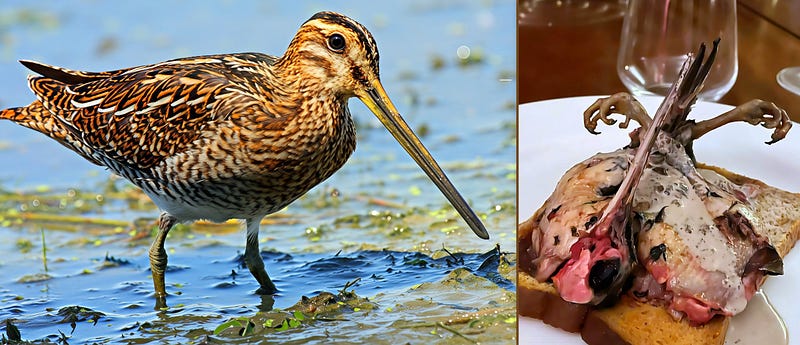
Compact and cryptic, the common snipe measures about 11 inches (28 cm) in length, with a wingspan of 17 inches (43 cm). It weighs around 3.9 ounces (110 g), making it a delicate prize for both predators and hunters. Its most iconic feature is its bill — roughly 2.5 inches (6.5 cm) long — perfectly adapted for probing mud in search of invertebrates. Its plumage, an intricate mix of browns, buffs, and blacks, allows it to vanish against reeds and sedges.
During the breeding season in spring, males perform a remarkable display called “drumming” or “winnowing,” achieved not by voice but by vibrating tail feathers during a steep dive. Females typically lay four mottled eggs, each about 1.4 inches (3.5 cm) long, in a grass-lined ground nest. Chicks are precocial, leaving the nest within 24 hours and foraging almost immediately — a vital adaptation for survival in exposed wetlands.
Ecology
The common snipe is a bird of marshes, wet meadows, and boggy tundra. It thrives where soft soil allows probing for worms, insect larvae, and small crustaceans. Its migratory habits are extensive: northern European populations winter as far south as North Africa and the Indian subcontinent, while Asian birds venture into Southeast Asia.
As a prey species, the snipe supports wetland raptors and foxes, while as a predator, it helps control insect populations. Wetland drainage and agricultural expansion have reduced suitable habitats in many regions. Conservation efforts emphasize protecting peatlands and marshes, which also benefit other waterfowl and amphibians. Sustainable hunting is possible under regulated seasons, but habitat preservation remains the cornerstone of its long-term survival.
Uses
Historically, the snipe held economic importance primarily through hunting. In 19th-century Europe, its small size and erratic flight made it a prized game bird, enhancing its cultural cachet as a symbol of sporting skill. Today, wild snipe hunting persists at low levels in parts of Europe and Asia, regulated to prevent overharvest. Its feathers, though not commercially significant, have been used in traditional fly-fishing lures.
In modern markets, snipe meat is a rarity, often limited to specialty restaurants or regions where traditional hunting continues. The economic relevance of the species now leans toward ecotourism and birdwatching, with wetlands serving as destinations for photographers hoping to glimpse its famous zigzag escape flight.
Culinary Aspects
Snipe has long held a place in classical European cuisine, known for its dark, rich flavor reminiscent of duck yet earthier. Traditional preparation involved roasting the whole bird, often with its head intact, and making use of its liver for game pâtés. Today, a typical serving might weigh 3.5 ounces (100 g) of cooked meat, making it a delicacy rather than a staple.
Flavor pairing benefits from the bird’s natural diet of worms and insect larvae, which impart a gamy, mineral complexity. Contemporary chefs may braise snipe in red wine or pair it with wild mushrooms to echo the forested wetland where it lives. While consumption is niche, its cultural legacy lingers in culinary history as the “hunter’s jewel” of the marsh.
Wine Pairings
The deep, earthy taste of snipe pairs elegantly with wines that mirror its rustic notes. A medium-bodied Pinot Noir from Burgundy or Oregon complements the meat’s subtle gaminess, while an aged Barolo offers an earthy depth that resonates with mushroom accompaniments. For those preferring white wine, an oaked Chardonnay with notes of toasted hazelnut and cream can soften the gamey edge without overpowering the delicate flesh.
Conclusion
The common snipe is a paradox of nature: both elusive and abundant, understated and storied. Its life in the wetlands reflects the delicate balance of water, soil, and sky, reminding us that conservation and culinary heritage can coexist. Whether admired through binoculars or savored on a plate, the snipe invites reflection on the value of the wild places that sustain life — and flavor — across continents.