The “Yeah, I Mean…” Epidemic and What It Reveals About Our Communication Crisis
We’ve all heard it — the trio of words infiltrating conversations from coffee shops to conference calls: “Yeah, I mean…” What began as…
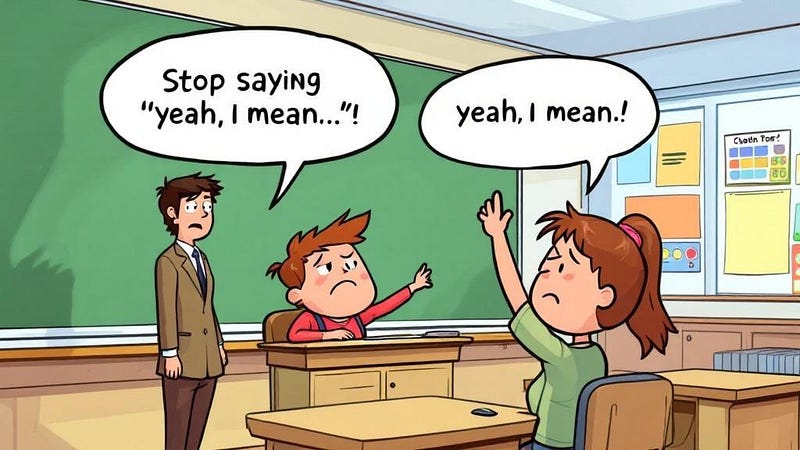
We’ve all heard it — the trio of words infiltrating conversations from coffee shops to conference calls: “Yeah, I mean…” What began as casual filler has hardened into a reflex, a verbal tic echoing through podcasts, meetings, and everyday dialogue. Linguists classify phrases like these as discourse markers — tools meant to organize thoughts or signal transitions. But when repeated incessantly, they cease to function as subtle guides and instead become noise, blurring the lines between speech and static.
The spread of this phrase is no accident. Psychologically, it serves as a buffer, granting speakers precious milliseconds to assemble their thoughts in real-time conversations. Socially, it acts as a softener, wrapping opinions in layers of agreement and hesitation to avoid confrontation. Culturally, it mirrors the speech patterns of our digital age, where the unscripted cadence of influencers and podcast hosts sets the rhythm for everyday language. The phrase has become tribal, a badge of informal authenticity in an era wary of polish.
Yet this verbal habit carries hidden costs. Each “Yeah, I mean…” dilutes the clarity of our ideas, stretching simple statements into bloated sentences that demand more attention for less substance. Studies suggest excessive fillers erode perceived credibility, framing speakers as uncertain or unprepared. For listeners, the repetition induces fatigue — a subconscious straining to locate the signal in the noise.
Technology magnifies the pattern. Virtual exchanges thrive on verbal placeholders to claim space in lag-filled video calls. Unscripted media rewards raw spontaneity, turning disfluency into a performance of “realness.” The result is a feedback loop: the more we hear these crutches, the more natural they feel, until they vanish from our awareness while grating on others’.
Beneath the linguistic surface, the epidemic reflects deeper cultural currents. “Yeah” falsely presumes agreement; “I mean” anticipates correction. Together, they form a rhetorical safety net for polarized times — a way to float opinions while readying for pushback. They speak to a collective anxiety: fear of misalignment, reluctance to own convictions, and the self-editing that pervades public discourse.
Breaking the cycle begins with awareness. Speakers can reclaim intentionality by embracing silence over filler, practicing concise phrasing, and recording themselves to spot patterns. Listeners can normalize pauses, resisting the urge to interpret brevity as bluntness. Leaders — whether on stages or in meetings — can model precision, replacing verbal padding with directness.
This isn’t about policing speech, but about honoring communication. In an attention-starved world, clarity is kindness. Every discarded “Yeah, I mean…” is a small reclamation of time, focus, and authenticity — a step toward trusting silence and letting ideas stand bare.