Unraveling the Cosmic Web: How Topology Maps the Hidden Shape of the Universe
Introduction Across the vast expanse of the cosmos, galaxies do not scatter randomly like seeds flung into the void. Instead, they cling to…
Introduction
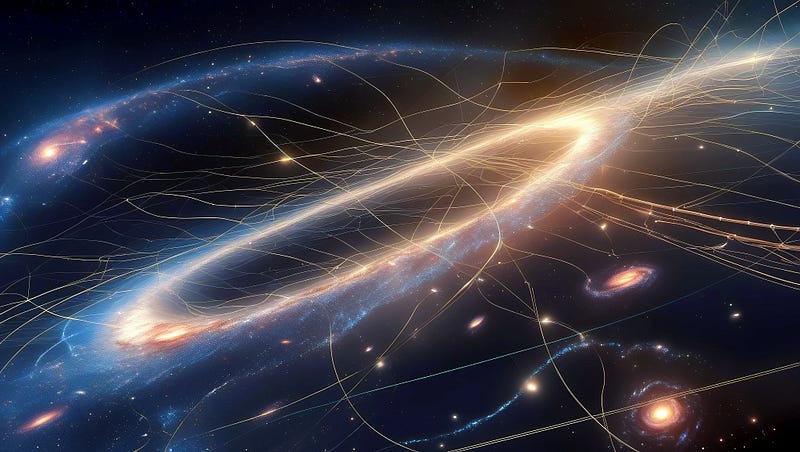
Across the vast expanse of the cosmos, galaxies do not scatter randomly like seeds flung into the void. Instead, they cling to invisible threads, gather in colossal clusters, and retreat from yawning chasms of nothingness. This grand architecture — the large-scale structure of the universe — is not chaos but cosmic choreography. What appears as disorder conceals an intricate pattern: a sponge-like web of matter stretching over billions of light-years. But how do we map such complexity? Increasingly, cosmologists are turning to a surprising discipline for answers: topology.
Unlike traditional statistics, which focus on individual components or local distributions, topology reveals the universe’s deeper shape — its connectivity, its voids, its curvatures. This article explores how topological analysis is transforming our understanding of the universe’s skeleton, from the tangled geometry of galaxies to the quantum seeds of creation.
The Foam-Like Fabric of the Universe
The idea that the universe has structure beyond the scatter of stars isn’t new. As early as the 1930s, astronomers noted that galaxies clumped together rather than spreading evenly. But it wasn’t until the late 20th century that redshift surveys like the Center for Astrophysics (CfA) maps exposed an astonishing reality: the observable universe resembles a colossal foam.
Clusters of galaxies collect at the junctions of filaments — thread-like structures that stretch for hundreds of millions of light-years. These filaments enclose vast empty regions, or voids, which make up most of the universe’s volume. This sprawling network, dubbed the “cosmic web,” forms a sponge-like topology. The Sloan Digital Sky Survey (SDSS) and 2dF Galaxy Redshift Survey have mapped this structure with exquisite detail, revealing a paradox: how did such lumpiness evolve from the almost perfectly smooth early universe seen in the Cosmic Microwave Background (CMB)?
That tension between early uniformity and modern complexity is known as the homogeneity problem. Solving it requires tools that can peer beneath the surface — tools that measure not just what’s there, but how it’s connected. Enter topology.
Persistent Homology: Fingerprinting the Universe’s Shape
Among the most powerful topological tools now employed in cosmology is persistent homology. This mathematical method tracks how features like voids, loops, and clusters appear and disappear as one changes the density threshold of a cosmic map.
Imagine zooming in and out of a 3D map of galaxies, watching how structures emerge and dissolve. Persistent homology captures these transitions in a “persistence diagram” — a fingerprint of topological features. Unlike conventional statistics that smooth over fine structure, this method detects rare, non-Gaussian phenomena — the telltale signatures of early-universe physics and dark energy.
Neural networks can even analyze these diagrams to estimate fundamental cosmological parameters — like the total matter content (Ω<sub>m</sub>) or the strength of primordial fluctuations (σ<sub>8</sub>) — more accurately than traditional techniques.
Percolation and the Threshold of Cosmic Connectivity
Another approach borrows from statistical physics: percolation theory. By modeling galaxies as nodes in a network, percolation analysis tracks how isolated clusters grow into an interconnected web.
At a critical threshold, the network “percolates,” forming a structure that spans the observable universe — mirroring the real transition seen in galaxy distributions. Interestingly, this method supports gravitational collapse models over hierarchical ones, suggesting that structures formed more through sweeping tidal forces than through tiny seed clusters combining over time.
Percolation theory doesn’t just illustrate how things connect — it reveals how the universe changes phase, not unlike water freezing into ice.
Minkowski Functionals: Curvature, Complexity, and Cosmic Texture
To quantify the shape of the cosmic web on a global scale, cosmologists turn to Minkowski functionals. These four geometric descriptors — volume, surface area, mean curvature, and the Euler characteristic — offer a rigorous framework to classify the universe’s morphology.
Of particular interest is the Euler characteristic, which measures the “holes” in a structure. A negative Euler number suggests a sponge-like topology, rich in tunnels and filaments — exactly what’s observed. Unlike homogeneity or isotropy, which treat space as a bland average, Minkowski functionals spotlight the richness of the universe’s shape.
Flat, Infinite, or Looped? The Global Topology of the Universe
While these tools examine local features, the global shape of the universe remains a subject of heated debate. Is space infinite and flat like a tabletop? Is it curved like a sphere, or saddle-shaped and hyperbolic?
Measurements from the Planck satellite peg the universe’s total curvature at essentially zero: Ω<sub>total</sub> ≈ 1. But local flatness doesn’t reveal whether space is infinite. A flat universe can still be multiply connected — like a 3-torus, a kind of higher-dimensional loop that wraps back on itself.
If the universe is multiply connected, then light could travel in circles. We might see repeated patterns — “matched circles” — in the CMB. Detecting these would revolutionize our view of cosmic topology and suggest that our infinite-seeming cosmos is finite and unbounded.
The Invisible Hand: Dark Matter and Inflation’s Legacy
The structure we observe today rests on two invisible pillars: dark matter and cosmic inflation. Dark matter, though unseen, exerts a gravitational influence that shapes the cosmic web. It acts as scaffolding, guiding where galaxies form.
Inflation, that explosive expansion just after the Big Bang, seeded the initial fluctuations that grew into today’s filaments and voids. These quantum tremors were stretched across light-years, embedding a pattern that topology now seeks to decode.
Some speculative theories suggest that topological defects from the early universe — like cosmic strings — could have shaped the web’s structure. While undetected, such features would produce gravitational waves, a signal we may one day capture.
Looking Ahead: The Next Frontier in Cosmic Cartography
As our observational tools sharpen, so too does our ability to dissect the universe’s topology. Upcoming missions like Euclid (ESA) and LSST (Vera Rubin Observatory) will chart galaxies with unprecedented detail. Paired with machine learning and persistent homology, these surveys promise tighter constraints on dark energy, matter density, and even inflation models.
Meanwhile, gravitational wave observatories like LISA may hunt for topological defects — fossils of the universe’s infancy. And with 21cm tomography, cosmologists can begin mapping not just space, but spacetime — tracking how the cosmic web evolves through billions of years.
Conclusion: Reading the Universe Through Its Shape
Topology doesn’t just sketch the universe — it interrogates it. The shape of space contains clues about its origin, composition, and fate. Through tools like persistent homology and Minkowski functionals, cosmologists have uncovered a cosmos that’s neither random nor uniform but deeply structured.
What we learn from this structure may one day resolve the deepest questions of cosmology: What came before the Big Bang? Is space infinite? What is the true nature of dark matter and energy?
The cosmic web, in all its elegance, is more than a map of matter — it is a shadow of the laws that sculpted reality itself.