Whispers in the Reeds: The Mysterious Lives of the Bittern
Introduction In the shadowy stillness of marshes and wetlands, where the reeds sway like sentinels and the air hangs heavy with the scent…
Introduction
In the shadowy stillness of marshes and wetlands, where the reeds sway like sentinels and the air hangs heavy with the scent of brine and decay, lives a ghost in feathers — rarely seen, barely heard, and master of disguise. The bittern, both the American Botaurus lentiginosus and its Eurasian cousin Botaurus stellaris, haunts the watery borderlands of two continents. It does not soar like the eagle or dazzle like the hummingbird. Instead, it vanishes into its landscape, camouflaged in streaks of tawny brown, frozen still among cattails. Yet for those who listen, the bittern tells a tale of resilience, culinary intrigue, and ecological significance. It croaks like a foghorn from another time — an echo of the ancient wilds we are always on the verge of forgetting.
Taxonomy
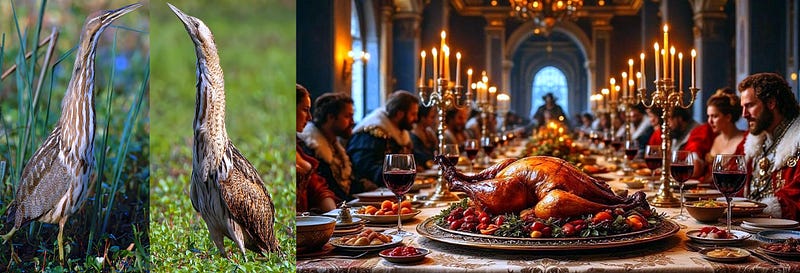
The American bittern (Botaurus lentiginosus) and the Eurasian bittern (Botaurus stellaris) belong to the heron family, Ardeidae, but differ markedly in behavior and habitat. While they are often mistaken for large brown herons, these birds are members of the genus Botaurus, which itself comes from Latin roots meaning “bull roar” — a reference to their booming call. Both species are monotypic, with no formally recognized subspecies, though variations in plumage can be observed between northern and southern populations. In medieval Europe, the Eurasian bittern was known by a range of names, from “bog blutter” to “mire drum,” attesting to its marsh-dwelling habits and the eerie sound of its voice. Today, both species are celebrated and protected in various parts of the world, and yet remain elusive symbols of wildness.
Biology
A bittern’s body is a feat of natural camouflage — its feathers patterned in ochres, rusts, and soft blacks, allowing it to “freeze” upright in reeds, disappearing into the vertical lines of its environment. The American bittern measures about 23 to 34 in long (58 to 86 cm), with a wingspan of roughly 36 to 52 in (91 to 132 cm). Its Eurasian counterpart is larger, averaging 27 to 35 in (69 to 89 cm) in length, with wingspans stretching 47 to 59 in (120 to 150 cm). These solitary birds live quiet lives, their main sounds being the low-frequency booming of the males in spring — a sound that can carry over 1.2 miles (2 km) in the right conditions. Bitterns breed in dense reedbeds, where the female alone constructs the nest and tends the young. Incubation lasts about 25 to 26 days. Chicks fledge in around 50 to 55 days, but stay hidden and vulnerable for much of that time. They feed on small fish, frogs, insects, and occasionally voles or birds — striking with dagger-like speed and precision.
Ecology
Bitterns are barometers of wetland health. They require pristine reedbeds, shallow freshwater marshes, and thick emergent vegetation. In North America, the American bittern breeds from Canada to the northern United States and migrates to the Gulf Coast and Central America in winter. The Eurasian bittern ranges from the British Isles and Scandinavia across Central Asia and into parts of Africa during the cold months. Their elusive nature makes them notoriously difficult to monitor, but recent conservation efforts — especially in the UK and France — have led to population rebounds due to wetland restoration. Nevertheless, habitat loss, water pollution, and reedbed drainage continue to pose threats, particularly in agriculturally intense regions. These birds are sentinel species, and where they vanish, other water-dependent organisms follow.

Uses
While bitterns today are primarily valued for their ecological presence and symbolic mystery, they once held economic and culinary weight. In Renaissance Europe, bittern was a delicacy reserved for nobility. Roasted or boiled, its meat was described as rich and slightly gamey, akin to duck. However, their elusive nature made them rare on the table. Laws in the 15th and 16th centuries protected them as prized quarry for royal falconers. Today, both species are protected under various wildlife acts across their ranges, and any trade or harvest is illegal. Ecotourism centered around bittern sightings — especially in reed-heavy bird reserves — has brought economic incentives for conservation. In the UK, sightings of breeding Eurasian bitterns in rewilded wetlands have helped draw thousands of visitors, contributing millions of pounds to local economies annually.
Culinary Aspects
Were one to speculate on the taste of bittern meat — now no longer legally or ethically sampled — it would likely be robust, oily, and faintly aquatic, similar to heron or wild duck. Historical records describe it as “succulent, with a marrowy aftertaste.” In older European cookbooks, bittern was marinated in red wine and spices or slow-roasted over open flame with bay leaf and juniper. The flesh, it was said, absorbed smoke and seasoning well. While bittern has vanished from modern cuisine, its culinary past still lingers in archival recipes and historical accounts, offering a tantalizing glimpse into what medieval feasts may have looked and tasted like.
Wine Pairings
If one were to pair wine hypothetically with bittern meat, given its historical flavor profile and proximity to duck, full-bodied reds would suit best. A Rhône Syrah with earthy undertones and notes of smoked meat would harmonize with the bird’s gamey richness. Alternatively, a bold California Zinfandel — clocking in at around 14.5% ABV — would offer a ripe fruit counterpoint to the savory core. For those imagining an older, more traditional palate, a fortified Madeira or a rustic French Cahors (Malbec) would speak the same ancient language as the bittern’s haunting boom across the water.
Conclusion
The bittern remains a master of concealment, not just in its habitat, but in the public imagination. It is a bird that asks nothing but to be left alone, and yet rewards the patient watcher with a glimpse of something eternal. In a world of noise, it speaks through silence. In a time of vanishing wilderness, it reminds us that some echoes are worth preserving. Whether you seek it in the damp hush of a fenland dawn or the aged pages of a hunting manuscript, the bittern stands as a quiet testament to the wild — unbending, untamed, and utterly irreplaceable.