All Wrongdoing Stems from Ignorance: A Socratic Examination of Virtue, Knowledge, and the Human Condition
"Fellow seekers of wisdom, picture the crowded court in Athens where I stood accused of impiety and corrupting the youth. Facing death, I declared the unexamined life is not worth living. This pronouncement, preserved in Plato’s Apology, forms the core of my divine mission from Delphi."
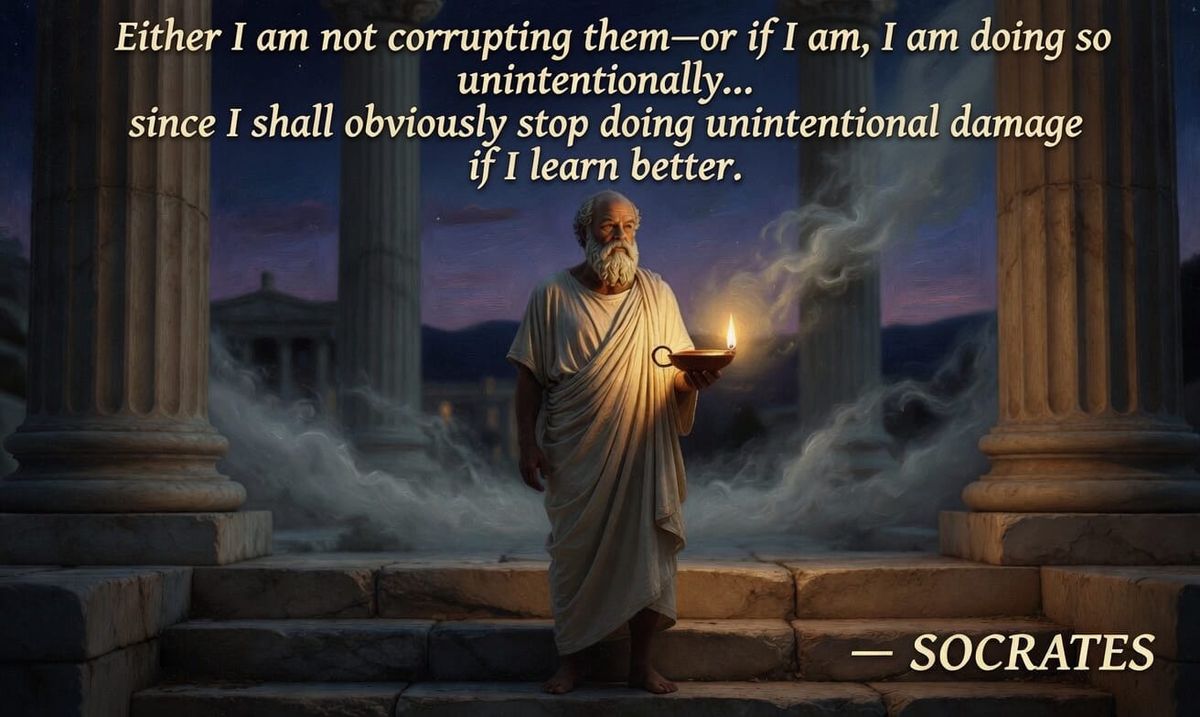
Fellow inquirers into the nature of the good life, imagine with me the sunlit streets of Athens in the fifth century before our common era, a city at the height of its democratic experiment yet shadowed by war, sophistic eloquence, and the restless pursuit of power and pleasure. It was here, amid the clamor of the agora and the solemn rites of the Acropolis, that I, Socrates, son of Sophroniscus the stonemason, was called by the Delphic oracle to examine lives—my own and those of my fellow citizens. The oracle declared me the wisest of men, yet I knew myself to be ignorant of the most vital matters. This paradox of my ignorance became the forge in which I hammered out the elenchus, that relentless questioning that strips away false certainties and reveals the soul’s true condition. From this practice emerged one of the most enduring and provocative claims attributed to me across the dialogues preserved by my student Plato: that all wrongdoing stems from ignorance. No one errs willingly; virtue is knowledge; and the apparent choice of evil is always a miscalculation born of not knowing what is truly good. This doctrine is no mere abstract speculation but the cornerstone of a philosophy that places the care of the soul above all else, insisting that the unexamined life is not worth living. To explore it fully, as experts in philosophy demand, requires us to trace its roots in the intellectual ferment of classical Greece, probe its hidden assumptions and potential fractures, weigh it against rival visions of human motivation, discern its profound implications for ethics and society, and finally witness its echoes in the practical arenas of law, education, therapy, and justice.
Let us begin by situating this teaching in its historical and foundational soil. Athens in my lifetime stood as the intellectual crucible of the Mediterranean world, a democracy forged after the Persian Wars yet strained by the Peloponnesian conflict with Sparta, oligarchic coups, and the seductive influence of traveling sophists who taught the arts of persuasion for a fee. I fought as a hoplite at Potidaea, Delium, and Amphipolis, witnessing firsthand the fragility of human excellence amid battlefield chaos and civic strife. The sophists—Protagoras, Gorgias, Hippias—proclaimed that “man is the measure of all things” and that virtue could be taught as a marketable skill, often equating it with success in the assembly or courtroom. In contrast, my mission, as recounted in Plato’s Apology, was to test whether anyone possessed genuine knowledge of the virtues: courage in the Laches, temperance in the Charmides, piety in the Euthyphro. Time and again, the elenchus exposed that those who claimed expertise—generals, politicians, poets—could not provide consistent definitions or live in accordance with their professed ideals. Out of these examinations arose the foundational principles. In the Protagoras, I argue that all human action aims at what the agent believes to be good or beneficial, for no one deliberately chooses what they judge harmful. Apparent wrongdoing, therefore, results from a false belief about what truly serves one’s eudaimonia, or flourishing—the harmonious well-being of the soul. The soul, I maintained, is our most precious possession; harm to it through injustice is far worse than any bodily or external misfortune. Knowledge of the good—wisdom as a craft-like technē—is both necessary and sufficient for virtue, rendering the virtues unified: one cannot be courageous without being just, temperate, and wise. As Plato records in the Meno and Gorgias, the tyrant who seems powerful in his crimes is in truth the most wretched, pitiable slave to ignorance, for he damages his own soul without realizing it. This is no idle paradox but a radical reorientation: evil is not a positive force but a privation, a darkness dispelled only by the light of understanding. My daimonion, that inner divine sign, never commanded wrongdoing but always steered me toward what preserved the soul’s integrity, reinforcing that true action flows from enlightened desire rather than coercion or passion unchecked by reason.
Yet even as this doctrine illuminates, it invites scrutiny of its underlying assumptions and potential inconsistencies, for genuine philosophy demands we turn the elenchus upon ourselves. At its core lies a psychological eudaimonism: every soul naturally desires its own greatest good and will pursue whatever it calculates as best at the moment of choice. Motivation is thus purely cognitive; there is no independent “will” or irrational force that can override knowledge. Desires, emotions, and volitions are not separate faculties but integral expressions of one’s evaluative beliefs—what one takes to be good or bad. This view assumes a remarkable unity and rationality in the human psyche: if akrasia, or weakness of will, appears to occur—knowing the better yet doing the worse—it must be illusory, a case of temporary ignorance or mismeasurement, as when one mistakes immediate pleasure for lasting benefit in the Protagoras’ analogy of the hedonic art. Biases here are subtle but consequential. The doctrine reflects the intellectual optimism of a craftsman’s son in a city prizing rational discourse, potentially undervaluing the embodied, habitual, or communal dimensions of moral life that later thinkers would emphasize. It risks an elitist tint: if only the knowledgeable can be virtuous, what of the uneducated masses or those shaped by corrupt polities? My own avowals of ignorance in the Apology create a further tension—how can I assert with confidence that ignorance causes wrongdoing while claiming I know nothing of virtue? Scholars have noted that this may be ironic, a spur to inquiry rather than dogmatic assertion, yet it reveals an inconsistency between epistemic humility and the strong motivational claims. Edge cases press further: what of the psychopath who seems to know harm yet feels no compunction, or the self-deceiver who constructs elaborate rationalizations? Does the doctrine collapse under the weight of unconscious motives or cultural conditioning, or does it invite us to redefine ignorance more broadly to encompass distorted perception itself? These fissures do not refute the teaching but demand we examine how biases toward rationalism might blind us to the phenomenology of moral struggle, where passion clouds judgment in ways that feel voluntary.
Competing perspectives arise inevitably, each illuminating strengths and exposing weaknesses when set beside the Socratic view. Aristotle, my student Plato’s own pupil, offers the most direct challenge in the Nicomachean Ethics, conceding that Socrates was right to link virtue with knowledge but wrong to deny akrasia outright. For Aristotle, moral virtue is a stable disposition of character shaped by habituation from youth, not pure intellect alone; practical wisdom (phronēsis) guides action, yet appetites and passions can temporarily overpower reason, as when a person “knows” temperance yet succumbs to anger like one drunk or asleep. Akrasia is real but partial— the incontinent person possesses knowledge in a qualified sense, not fully active or integrated. This preserves responsibility and the role of training while granting the Socratic insight that full virtue requires insight. Plato himself, in the Republic, evolves beyond strict intellectualism by introducing the tripartite soul—reason, spirit, and appetite—allowing internal conflict and the need for harmony through education and guardianship, thus accommodating apparent weakness without fully abandoning the ideal of knowledge’s sovereignty. Later traditions diverge sharply. Stoics radicalized the doctrine, insisting the sage’s knowledge renders passion impossible and vice a form of madness. Yet Nietzsche, in his critique of Socratic rationalism as decadent and life-denying, saw it as a symptom of resentment against the vital, instinctual will to power; true strength, for him, embraces becoming and affirms even the tragic without reducing it to ignorance. Modern psychology and philosophy introduce cognitive biases, hyperbolic discounting, or unconscious drives—Freud’s id, or behavioral economics’ heuristics—that mimic ignorance without requiring literal lack of propositional knowledge. Existentialists like Sartre emphasize radical freedom and bad faith, where one chooses ignorance actively. Each rival has strengths: Aristotle’s accounts for developmental psychology and habit with empirical nuance; Nietzsche highlights the motivational power of non-rational forces and cultural critique. Weaknesses emerge too—Aristotle’s habituation can seem circular without Socratic self-examination; Nietzsche’s vitalism risks glorifying power unchecked by justice. The Socratic position’s strength lies in its optimistic empowerment: wrongdoing is curable through dialogue, not fated by original sin or ineradicable passion. Its weakness is apparent determinism or excuse-making, potentially undermining culpability in the face of clear-eyed evil.
The broader implications ripple outward, reshaping not only ethics but our understanding of human potential and societal order. By locating the root of evil in ignorance rather than innate depravity or demonic will, the doctrine fosters a profoundly humanistic ethics centered on moral education as the highest civic and personal duty. It challenges retributive justice—why punish the unwillingly ignorant when instruction heals the soul?—and elevates philosophy as therapy for the polis. In a democracy like Athens, where rhetoric swayed the assembly toward disastrous wars, this view implies that enlightened citizens, guided by dialectic, could achieve collective virtue. It influences future developments profoundly: virtue ethics revivals in the twentieth century, from Anscombe to MacIntyre, draw on Socratic eudaimonism to counter rule-based or consequentialist systems; contemporary moral psychology tests whether knowledge of biases can prevent wrongdoing. Edge considerations arise in pluralistic societies—whose “knowledge” defines the good amid cultural relativism?—or in the face of systemic injustices that shape perceptions of self-interest. The doctrine shapes technology and governance too: if ignorance fuels harm, then transparent information, critical education, and AI designed to illuminate rather than manipulate become ethical imperatives. Its significance endures because it refuses to accept moral failure as inevitable, insisting instead that the examined life yields not only personal flourishing but a just community.
Finally, this teaching finds vivid life in real-world domains, where theory meets the forge of practice. In legal education, the Socratic method—questioning that exposes assumptions and hones reasoning—trains advocates to dismantle flawed arguments, mirroring my elenchus in courtrooms and fostering the critical discernment that prevents unjust advocacy born of ignorance. Criminal justice systems influenced by restorative approaches echo the doctrine by prioritizing rehabilitation and education over mere retribution; programs teaching empathy, decision-making, and the long-term costs of crime treat offenders as misguided rather than irredeemably wicked, reducing recidivism where punishment alone fails. In psychology, cognitive behavioral therapy employs Socratic questioning to challenge distorted beliefs—catastrophizing or all-or-nothing thinking—revealing how “irrational” actions stem from cognitive ignorance, empowering patients to align behavior with better knowledge of well-being. Education at all levels benefits: dialogic classrooms cultivate intellectual humility and virtue through inquiry rather than rote memorization, addressing the root ignorance that perpetuates prejudice or poor citizenship. In leadership and business ethics, workshops drawing on Socratic dialogue expose how short-term profit calculations mask long-term harm to stakeholders, promoting wiser governance. Even in parenting and international relations, the principle urges modeling and teaching the true good over coercion, though nuances persist—psychopathy or entrenched trauma may require supplementary habituation. Across these arenas, the doctrine proves its vitality not as dogma but as a living method: by illuminating ignorance, we transform potential wrongdoers into willing agents of the good.
Thus, my fellow examiners of life, the claim that all wrongdoing stems from ignorance remains a beacon and a challenge. It calls us to relentless self-scrutiny, confident that knowledge, once attained, will guide the soul aright. In an age still plagued by sophistry in new guises—misinformation, ideological echo chambers, algorithmic manipulation—the Socratic path offers not easy answers but the demanding pursuit of wisdom. Let us continue the dialogue, for only through such examination do we truly live.