Beyond the Impact: Rethinking the Dinosaur Extinction through a Multi-Causal Lens
Introduction
Introduction
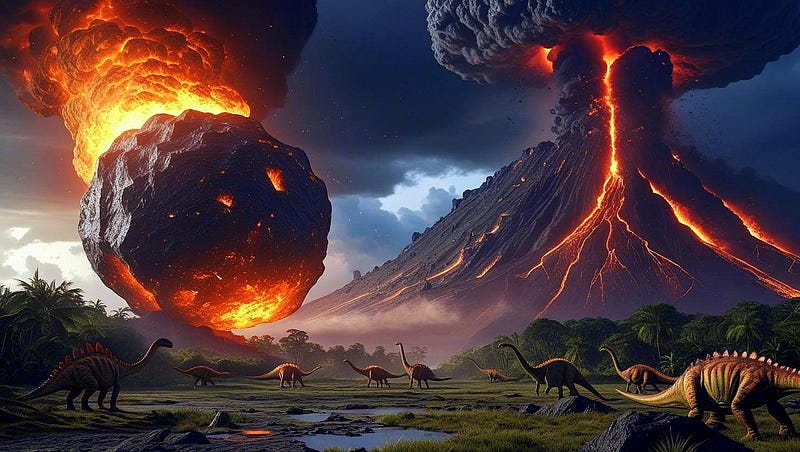
In the popular imagination, a single asteroid sealed the fate of the dinosaurs. The dramatic image of a fireball crashing into Earth 66 million years ago and triggering an instant apocalypse has dominated science classrooms, documentaries, and museum exhibits for decades. But recent discoveries in geology, paleontology, and climate science are challenging that narrative. Far from being a singular cataclysm, the Cretaceous-Paleogene (K-Pg) extinction event appears to be a symphony of disasters — some slow-building, others violent — all converging on an already fragile ecosystem. This article reexamines the Chicxulub impact not as the sole cause, but as the final act in a much longer story of planetary upheaval.
The Trouble with a Single-Cause Theory
The asteroid impact hypothesis — often called the Alvarez hypothesis — has compelling evidence on its side. A thin global layer of iridium-enriched clay, the presence of shocked quartz, and a massive crater buried beneath Mexico’s Yucatán Peninsula all point to a celestial collision of catastrophic proportions. Yet as science has advanced, cracks in this neat story have appeared.
Temporal Mismatch
Dating of volcanic layers in India’s Deccan Traps reveals that intense eruptions began nearly 400,000 years before the impact and continued well into the extinction period. These eruptions released staggering volumes of carbon dioxide and sulfur dioxide, destabilizing the climate long before the asteroid hit. Climate models suggest this prolonged volcanic activity could have already warmed the planet and acidified its oceans, weakening ecosystems from the inside out.
The Fossil Record Speaks
Dinosaurs were already in decline. Speciation rates for many groups had been falling for millions of years. In the oceans, plankton and mollusks vanished in waves, not all at once. These gradual extinctions don’t align neatly with a sudden asteroid-triggered apocalypse, but they do fit a model of prolonged ecological stress followed by a tipping point.
Volcanism’s Silent Fury
The Deccan Traps aren’t just massive — they’re apocalyptic in scale. Formed by one of the largest volcanic events in Earth’s history, they covered over half a million square kilometers in basalt. With each eruption, greenhouse gases surged into the atmosphere, altering rainfall patterns, warming ocean currents, and weakening the food web from the base up.
Unlike an impact, which strikes once, volcanism is relentless. It disrupts ecosystems persistently and unevenly. Evidence suggests that the final pulse of these eruptions coincided with the Chicxulub impact, creating a double blow of toxic skies and dimmed sunlight. In such conditions, many species simply couldn’t adapt quickly enough.
Deconstructing the Impact Evidence
Yes, the asteroid left a scar on Earth — but it may not have been a clean kill.
Iridium Isn’t Exclusive
Though elevated iridium is often associated with meteorites, it can also be produced by large volcanic provinces. Relying solely on this element as a smoking gun ignores alternative geological sources.
Shocked Quartz: Not Just from Space
While typically linked to impact events, shocked quartz can, under extreme volcanic pressures, be produced by terrestrial activity. If both the Deccan Traps and the Chicxulub event occurred nearly simultaneously, disentangling their mineral signatures becomes a complex puzzle.
Flawed Climate Models
Early models of an “impact winter” assumed a pristine climate beforehand. But if the atmosphere was already destabilized by volcanic gases, the effects of the asteroid would be less about initiating chaos and more about accelerating an existing spiral.
A Symphony of Destruction
This isn’t to downplay the impact’s significance — it’s to place it in its proper context. When ecosystems are already weakened by slow-burning threats like volcanism, sea-level regression, and biodiversity loss, a sudden shock can tip them over the edge.
Biotic Selectivity and Regional Survival
Some freshwater species and southern-hemisphere dinosaur populations appeared to survive longer than their northern counterparts. This selective survival hints at a geographically uneven extinction pattern, likely shaped by the reach of volcanic gases, changing climate zones, and varying ecological resilience.
Ecological Dominoes
Imagine Earth’s late Cretaceous biosphere as a tower of Jenga blocks. Volcanism, climate change, and habitat loss steadily remove pieces. Then the asteroid arrives — not as the first force of destruction, but as the one that causes the collapse.
Conclusion: Toward a New Extinction Paradigm
The story of the K-Pg extinction is not one of singular drama but of cumulative tension and final catastrophe. By expanding our lens beyond Chicxulub, we uncover a more intricate and sobering truth: mass extinctions rarely arise from one cause. Instead, they emerge from the convergence of many forces — natural and slow, sudden and violent — interacting in unpredictable ways.
As we grapple with modern ecological threats, this deeper understanding should serve as a warning. Earth’s biosphere is resilient, but it is not invincible. It takes more than an asteroid to end an era — but sometimes, it only takes a spark to finish what’s already begun.