Prior Restraint, Platforms, and TikTok: Where First Amendment Doctrine Actually Bites
Congress shall make no law respecting an establishment of religion, or prohibiting the free exercise thereof; or abridging the freedom of…
Congress shall make no law respecting an establishment of religion, or prohibiting the free exercise thereof; or abridging the freedom of speech, or of the press; or the right of the people peaceably to assemble, and to petition the Government for a redress of grievances.
Governments usually cannot stop speech before it happens. That is called prior restraint, and courts almost always strike it down. Social media companies are private, so their moderation rules are not governed by the First Amendment unless the government is pulling the strings. If officials threaten or pressure a platform to take down posts, that can become state action and raise First Amendment problems. TikTok’s main legal fight is different: Congress targeted who owns the app, not what users say on it. That kind of structural rule is not classic prior restraint, even though it can still affect speech. Bottom line: private moderation stands, government coercion is out, and broad ownership rules face scrutiny but usually are not treated like a prepublication ban.
The First Amendment started as a narrow limit on Congress, but through incorporation and evolving court rulings, it now applies broadly to federal, state, and local governments. Its protections have expanded over time, especially for political and unpopular speech, making it one of the most dynamic and contested parts of the Constitution.
In the digital age, the First Amendment’s traditional protections collide with new challenges posed by online platforms and government regulation. The doctrine of prior restraint, long viewed as the “least tolerable” infringement on free expression, resurfaces in debates over whether restricting access to apps like TikTok constitutes unconstitutional censorship or a permissible national security measure. At the same time, the state action doctrine complicates questions of accountability: while the First Amendment restrains government actors, it does not directly bind private companies, leaving disputes over social media moderation in a gray zone where platforms act as both private businesses and de facto public forums. Together, these tensions highlight the unsettled boundaries of free speech online, where courts must balance individual rights, corporate power, and state interests in ways the framers of the Constitution could never have anticipated.
Prior restraint is prior government suppression of expression. The Supreme Court treats it as presumptively unconstitutional and subject to the heaviest burden. Near v. Minnesota, 283 U.S. 697 (1931), framed the core rule by invalidating a statutory scheme that enjoined publication in advance. Bantam Books, Inc. v. Sullivan, 372 U.S. 58 (1963), extended the doctrine to “informal” state pressure masquerading as advisory notices. New York Times Co. v. United States, 403 U.S. 713 (1971), required an extraordinary showing to enjoin publication on national-security grounds. Freedman v. Maryland, 380 U.S. 51 (1965), demanded strict procedural safeguards for any licensing system, including prompt judicial review and the government’s burden of proof. Nebraska Press Ass’n v. Stuart, 427 U.S. 539 (1976), treated trial-gag orders as last-resort tools almost never justified. These cases mark the constitutional red zone for ex ante restraints. Supreme Court
Social media changes the locus of control but not the state-action predicate. The First Amendment constrains government, not private editors. In Manhattan Community Access Corp. v. Halleck, 587 U.S. ___, 139 S. Ct. 1921 (2019), the Court held that operating a speech forum does not transform a private entity into a state actor; editorial choices remain private unless the government compels or commandeers them. This premise matters for platform content policies. The core default is that private moderation is not a state action and therefore not subject to First Amendment limits. Supreme Court
When the state tries to override platform curation, the analysis shifts. In Moody v. NetChoice, LLC, 603 U.S. ___ (2024), and its companion NetChoice, LLC v. Paxton, 603 U.S. ___ (2024), the Court vacated and remanded challenges to Florida and Texas social-media laws, but it set the framework: platform content curation can implicate First Amendment interests akin to editorial discretion, and lower courts must evaluate any state intrusion accordingly. The holdings did not finally decide the laws’ validity. They confirmed that government regulation of ranking, removal, or labeling engages First Amendment scrutiny and cannot be assumed content-neutral simply because it targets “platforms.” Supreme Court+2SCOTUSblog+2
Government jawboning is the gray zone between private choice and state compulsion. If officials coerce or significantly encourage moderation decisions, the conduct may be attributed to the state, and prior-restraint principles can attach. The template is Bantam Books, where “requests” coupled with threats and police follow-up constituted unlawful informal censorship. In Murthy v. Missouri, 603 U.S. ___ (2024), the Court resolved the case on standing, not merits, but it reiterated the core divide: persuasion by government is permissible; coercion or significant encouragement is not. The doctrinal trigger is evidence of threats, penalties, or control that convert private choices into government action. Justia Law
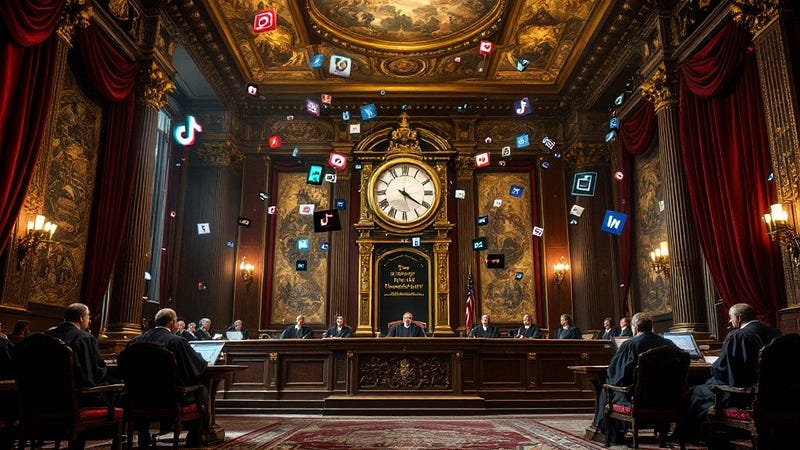
TikTok places these doctrines in a structural posture. Congress enacted the Protecting Americans from Foreign Adversary Controlled Applications Act in April 2024, conditioning U.S. distribution of certain foreign-controlled applications on a qualified divestiture or, failing that, a prohibition. See Protecting Americans from Foreign Adversary Controlled Applications Act, H.R. 7521, 118th Cong. (2024). The statute defined “foreign adversary controlled application” to include platforms operated directly or indirectly by ByteDance Ltd. and TikTok, and it supplied a compliance path via divestiture. On January 17, 2025, the Supreme Court rejected a facial First Amendment challenge and allowed the divest-or-ban framework to operate. TikTok Inc. v. Garland, №24–656, 603 U.S. ___ (2025). The official materials emphasize that Congress and the Executive considered less-restrictive alternatives for years and tailored the remedy to structural control rather than to specific content. Congress.gov+2Supreme Court+2
Labeling the TikTok statute a classic prior restraint is a stretch under current doctrine. Traditional prior restraint targets publishing itself through licensing, preclearance, or injunctions directed at content. The TikTok law targets ownership and control of the intermediary based on foreign-influence risk. That is a speech-affecting regulation, but it is not a licensing veto on posts in the Near or Pentagon Papers sense. The burden remains substantial because shuttering or excluding a platform predictably reduces the volume and diversity of user speech, yet the state argues content neutrality, alternative channels, and a narrow focus on adversary control. The Supreme Court’s refusal to enjoin the act signals that, at least facially, the law falls on the structural side of the line, not the classic prior-restraint side. Supreme Court
Implementation details matter. Executive actions in 2025, including Executive Order №14,166, applied and staged enforcement of the act, with timelines to facilitate a qualified divestiture. The White House described the statute’s prohibitions on providing distribution or hosting services for designated applications absent compliance and documented the temporary delay of enforcement to allow restructuring. If that restructuring results in a U.S.-controlled entity with independent governance, mandatory data localization, and algorithmic custody, the constitutional risk profile tracks structural regulation of ownership and security rather than content preapproval. If, however, national-security oversight bodies or government-designated directors begin to direct viewpoint-level editorial decisions, the analysis flips to state action and potentially to Bantam Books-style informal prior restraint. The facts will drive attribution. The White House
Two lanes should stay distinct to avoid category errors. Lane one is private moderation. Under Halleck, platforms remain private speakers with editorial discretion unless the state compels or commandeers them; ordinary content policies are not First Amendment events. Lane two is state suppression. Classic prior restraint arises when the government pre-screens content, imposes licensing, or enjoins publication; Near, Freedman, and Nebraska Press control that lane. The TikTok statute occupies a third lane: structural regulation of a distribution intermediary based on foreign control. That lane still triggers exacting scrutiny because of predictable speech effects, but it is doctrinally distinct from prepublication content bans. Moody/NetChoice adds a live thread: when states attempt to force platforms to carry content or to bar ranking and removal, courts must analyze those mandates as intrusions on editorial discretion, not as neutral utility rules. Murthy keeps the jawboning guardrail in view: persuasion is allowed; coercion is not. Justia Law+3Supreme Court+3SCOTUSblog+3
Bottom line. A direct prepublication ban on TikTok content would almost certainly fail under Near and New York Times. Government pressure that crosses from persuasion to coercion exposes the state to Bantam Books liability. By contrast, Congress’s divest-or-ban statute — now operative after TikTok v. Garland — regulates the platform’s ownership rather than user speech in the first instance. That posture blunts a pure prior-restraint claim while preserving room for as-applied challenges if structural oversight becomes editorial control. Future litigation will test those edges, but the current framework is clear: private moderation is private; state coercion is actionable; ex ante content licensing remains the First Amendment’s third rail.