Sumac: The Scarlet Spice of Mountains and Memory
Across the sunbaked slopes of the Mediterranean and the rugged hills of Western Asia, one shrub flashes crimson each summer —…
Introduction
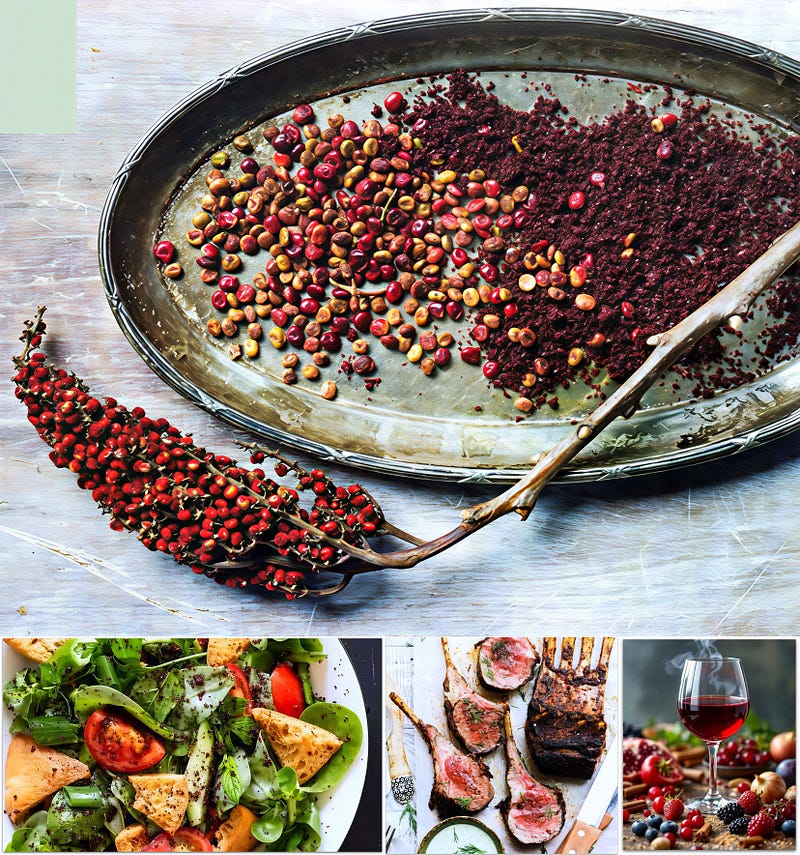
Across the sunbaked slopes of the Mediterranean and the rugged hills of Western Asia, one shrub flashes crimson each summer — its berries shimmering like embers in dry wind. Rhus coriaria, better known as sumac, has seasoned civilizations for millennia. Beyond its culinary sparkle lies a deeper story of botany, chemistry, and culture — where spice meets soil, and the old world’s landscapes sustain a legacy of tang and resilience.
Taxonomy
Sumac belongs to the family Anacardiaceae, the same botanical group as cashew (Anacardium occidentale) and mango (Mangifera indica). Its full classification is: Kingdom Plantae, Order Sapindales, Family Anacardiaceae, Genus Rhus, Species Rhus coriaria. Edible relatives include Rhus typhina (staghorn sumac) and Rhus glabra (smooth sumac), though Rhus toxicodendron — poison ivy — reminds us that beauty and danger can share a lineage.
Common names reflect their broad cultural reach. In Arabic, it is called “Summaq” (سماق) in Lebanon, Syria, and Jordan. In Turkish, “Sumak”; in Persian, “Somāgh”; in Italian, “Sommacco”; and in Greek, “Soumaki.” Each term ties the plant to local cuisines, from Levantine fattoush to Iranian kebabs dusted in its tart powder.
Biology
Rhus coriaria is a deciduous shrub reaching 1–3 m (3.3–9.8 ft) tall, with compound leaves of 9–15 serrated leaflets. Its flowers, pale greenish-white, appear in dense clusters during late spring, followed by red drupes roughly 5 mm (0.2 in) in diameter. The fruit’s outer layer, or pericarp, contains malic and citric acids, creating sumac’s defining tartness. The shrub thrives in limestone and calcareous soils with good drainage, tolerating drought and salinity. Adapted to Mediterranean climates, it endures temperatures from 5°C to 35°C (41°F to 95°F).
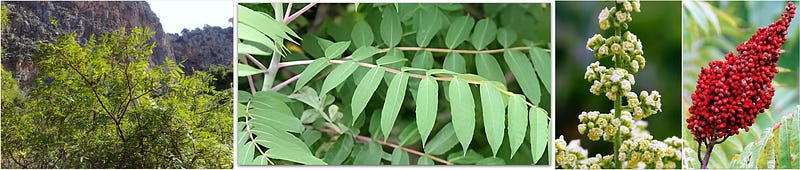
Its lifecycle is perennial; propagation occurs through seeds or cuttings, with fruit production beginning in the third to fourth year after planting. The leaves and stems contain tannins, once used in traditional leather tanning across southern Italy and Anatolia.
Ecology
Native to the Mediterranean Basin and West Asia, Rhus coriaria grows on dry slopes, rocky hillsides, and degraded pastures — places where few crops survive. It prevents erosion through its dense root system and supports pollinators like bees and hoverflies during its blooming phase. The plant’s drought tolerance makes it a sustainable crop in semi-arid zones, suitable for soil restoration and low-input agriculture.
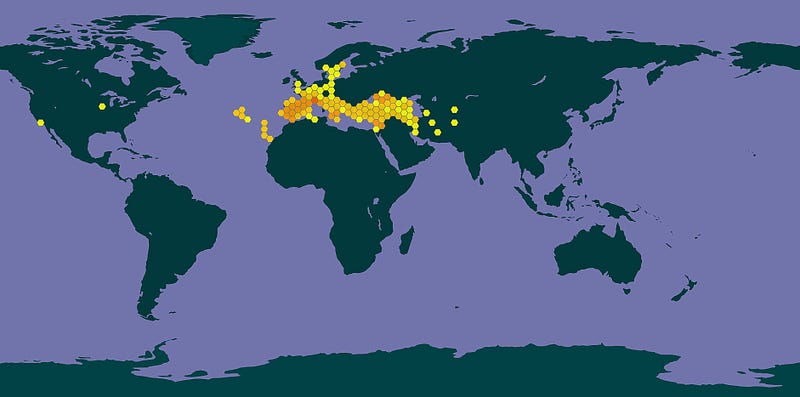
Sumac’s ecological value extends beyond its culinary fame. It enhances biodiversity, sequesters an estimated 1.8–2.2 metric tons of CO₂ per hectare (1.6–2 tons per acre) annually, and serves as a refuge for small fauna. Its use in reforestation projects in Turkey and Iran exemplifies a dual purpose: economic yield and environmental repair.
Uses
Edible parts include the dried fruits, whose outer skin is ground into a deep crimson powder. Harvesting occurs between August and September, when the fruits’ acidity peaks. Average yield ranges between 1,200–1,800 kg/ha (1,070–1,605 lb/acre). Each 100 g (3.5 oz) of dried sumac provides approximately 330 kcal, containing 11 g protein, 21 g fat, and 55 g carbohydrates. It is rich in polyphenols, anthocyanins, and flavonoids, with moderate vitamin C and potassium content.
Anti-nutritional factors include oxalic acid and high tannin content in leaves, though the fruits are safe when processed correctly. Toxicity is minimal, except in allergic individuals sensitive to other Anacardiaceae species.
Processing involves drying the fruits under the sun for 3–5 days at temperatures around 30°C (86°F), then crushing and sieving to obtain the spice. Commercial products include ground spice, infused oils, extracts, and ready-to-use blends like za’atar. Industrial applications extend to natural food coloring, antimicrobial preservatives, and antioxidants in meat processing.
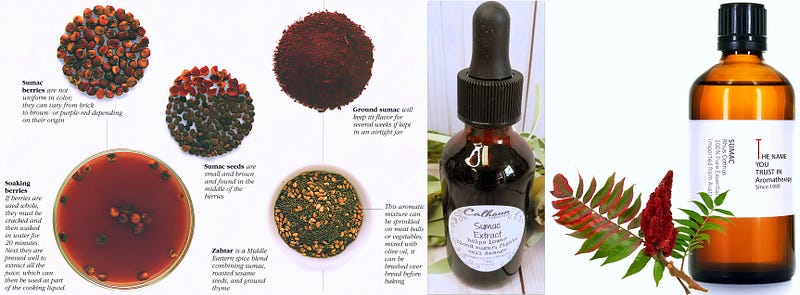
Flavor is tart, lemony, and slightly earthy, with a pH near 2.5. Aroma is sharp and fruity, with volatile compounds such as limonene, geraniol, and α-pinene. The texture of the ground spice is fine and slightly oily due to residual seed lipids.
Medicinally, sumac’s active constituents include gallic acid, quercetin, kaempferol, and tannic acid. Studies suggest antioxidant, antimicrobial, and glycemic-regulating properties. Traditional dosage forms include teas, decoctions, and capsules (200–500 mg per day). Evidence level: moderate, with safety concerns limited to hypersensitivity. Regulatory status: approved as a food ingredient by EFSA and FDA.
In livestock feed, powdered fruit residues provide palatable fiber and trace antioxidants but limited energy yield. Not suited for silage due to high tannin concentration.
As an agroforestry crop, sumac enriches soil organic matter, supports pollinators, and offers high-value harvests under dry conditions. Its restoration use is notable in marginal lands and carbon farming initiatives. Carbon sequestration value aligns with moderate shrub systems, providing low emission intensity and favorable life-cycle metrics.
Cosmetically, its extracts are used for skin toning and antioxidant formulations. Functional claims include astringency, pigmentation control, and antimicrobial activity. Allergenicity is low, but labeling regulations require botanical disclosure in the EU.
Market demand is strong across Middle Eastern, Mediterranean, and North American gourmet sectors, with retail prices between USD 15–30 per kg (6.8–13.6 USD per lb). Turkey, Iran, and Lebanon are leading producers. Certified organic and fair-trade varieties are emerging, backed by traceability programs and community-based cooperatives in southeastern Anatolia.
Culinary Aspects
Sumac defines the Levant’s taste of tang. Its flavor is neither purely sour nor salty but a balance of acid and depth — like lemon filtered through sun and stone. It provides brightness without liquid acidity, preserving texture in dishes like fattoush, grilled lamb, and roast chicken. Its complexity lies in volatile oils that mimic citrus zest and berry tannins simultaneously.
Aromatic intensity varies by region: Iranian sumac leans fruity and floral, Turkish is more tannic and earthy. In mouthfeel, it cuts fat elegantly, leaving a dry, crisp finish with a cooling chemesthetic lift on the palate. The powder’s deep burgundy hue enhances visual appeal and signals the spice’s layered acidity.
Wine Pairings
Sumac’s sour-fruit and tannic qualities demand wines with structure and acidity. A Greek Xinomavro complements fattoush, its cherry-bright acidity echoing sumac’s tartness. For grilled meats dusted with sumac, try a Lebanese Château Musar blend — its aged complexity mirrors the spice’s earthy tone. A Sicilian Frappato balances sumac’s sharpness with floral softness, while a dry Georgian Rkatsiteli pairs perfectly with sumac-spiced chicken, matching aromatic persistence and texture. In cold mezze or seafood, a Spanish Albariño’s saline lift parallels sumac’s clarity without overpowering its nuance.
Conclusion
Sumac bridges ecosystems and kitchens, turning barren slopes into crimson harvests and ancient flavor into modern sustainability. It reminds us that culinary heritage is also ecological memory — the spice of endurance and renewal.