The Green-Headed Wanderer: Exploring the American Wigeon
The American Wigeon is more than feathers on the wind. It is a mirror of North America’s wetlands, embodying the push and pull between conservation and consumption, wilderness and culture.
Introduction
There is something quietly enchanting about the American Wigeon, a dabbling duck whose whistling calls and iridescent plumage ripple across wetlands of North America. Known to hunters as the “baldpate” for the pale crown on the male’s head, this bird is more than a fleeting target or a flash of color. It is a keystone of marsh ecosystems, a migratory marvel, and even — controversially — a culinary delicacy. To explore the American Wigeon is to trace the intersections of biology, ecology, culture, and sustainability, where nature’s beauty meets human appetite.
Taxonomy
The American Wigeon belongs to the genus Mareca, within the family Anatidae. Its scientific name is Mareca americana, distinguishing it from its Old World cousin, the Eurasian Wigeon (Mareca penelope). While subspecies are not formally recognized, regional variations in plumage and vocalizations suggest subtle ecological adaptations. The bird goes by many names: “baldpate,” “whistler,” and in some Indigenous traditions, it is recognized as a spirit messenger in migratory lore. Unlike cultivated plants or domesticated animals, edible “varieties” are not bred, but wild populations have long been harvested for food.
Biology
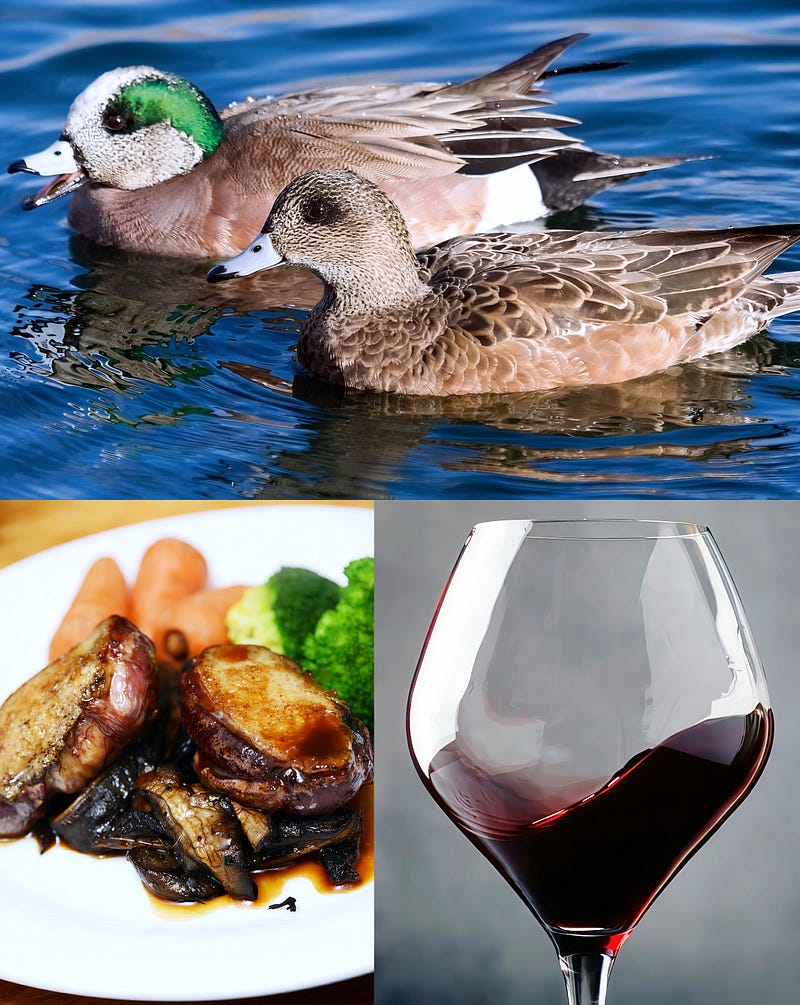
Male American Wigeons are easily identified by their shimmering green eye patches and cream-white crown, set against chestnut flanks and a gray body. Females wear subtler earth-toned feathers, an adaptation that provides camouflage during nesting. Adults average 19 inches (48 cm) in length and weigh around 1.3 pounds (0.6 kg), with wingspans stretching 33 inches (84 cm). Their short, bluish-gray bills are tipped in black — an ideal tool for grazing aquatic vegetation. Unlike diving ducks, they tip forward to feed, often stealing food from coots and other dabblers in what ornithologists describe as “kleptoparasitism.” They reach sexual maturity in one year, with females laying 6–11 eggs per clutch, usually incubated for 25 days before hatching.
Ecology
American Wigeons are quintessential travelers, breeding across the northern prairies, Alaska, and western Canada, then migrating southward in autumn. They winter across the southern United States, Mexico, Central America, and occasionally as far as the Caribbean. Preferring shallow wetlands, lakes, and estuaries, they rely heavily on aquatic plants, seeds, and grasses. In one feeding bout, a flock may consume up to 0.75 ounces (21 g) of vegetation per bird, helping regulate plant growth in marshes. Their ecological role is vital — both as grazers maintaining wetland balance and as prey for raptors such as peregrine falcons and bald eagles. Conservation concerns remain, as habitat loss and climate change compress migratory corridors, though current populations are considered stable.

Uses
Economically, the American Wigeon is valued as a game species, bringing millions of dollars annually to state wildlife agencies through hunting licenses and conservation stamps. This paradox — killing to conserve — reflects North America’s unique model of sustainable wildlife management. The bird’s feathers, once used in traditional fly-fishing lures, have a niche cultural value. Sustainability practices encourage responsible harvest, with strict bag limits and wetland restoration projects funded in part by waterfowl hunting.
Culinary Aspects
In the kitchen, wigeon meat has long held a reputation for being leaner and milder than heavier ducks like mallards. The breast meat, when pan-seared to medium-rare at about 135°F (57°C), retains a tender texture with earthy undertones of grass and wild herbs. Indigenous peoples roasted whole birds over open fires, while modern chefs might smoke wigeon breasts or confit the legs in rendered duck fat. A serving of 3.5 ounces (100 g) provides around 25 grams of protein with minimal fat, making it a nutritious if rare treat. Its flavor carries the essence of the wetlands — green, slightly mineral, and unmistakably wild.
Wine Pairings
To complement wigeon, wines must balance their earthy yet delicate profile. A medium-bodied Pinot Noir, particularly from Oregon’s Willamette Valley, offers cherry and forest-floor notes that resonate with the bird’s natural diet. For those preferring white, a crisp Sauvignon Blanc from New Zealand, with its grassy citrus edge, harmonizes beautifully with grilled or roasted preparations. In more rustic pairings, a Spanish Tempranillo works well, its leathery depth underscoring the duck’s gaminess.
Conclusion
The American Wigeon is more than feathers on the wind. It is a mirror of North America’s wetlands, embodying the push and pull between conservation and consumption, wilderness and culture. To study the wigeon is to glimpse the delicate balance of ecosystems where every blade of grass and wingbeat matters. Whether admired in flight, pursued in the marsh, or celebrated on a plate, this bird demands reflection: how do we ensure that the chorus of whistling wings remains a part of our shared future?