The Muscovy Duck: The Ancient, Earthy Bird That Bridges Wild and Domestic Worlds
Among domesticated birds, few command as much intrigue as the Muscovy duck (Cairina moschata). Unlike the familiar…
Introduction
Among domesticated birds, few command as much intrigue as the Muscovy duck (Cairina moschata). Unlike the familiar mallard-derived breeds that fill supermarket coolers, the Muscovy stands apart — genetically, behaviorally, and gastronomically. Its lineage traces back to Central and South America, where indigenous civilizations domesticated this quiet, forest-dwelling species long before European contact. Today, the Muscovy is prized for its lean meat, robust flavor, and minimal ecological footprint. It is a bird that connects ancient traditions, sustainable farming, and fine cuisine in one remarkable package.
Taxonomy
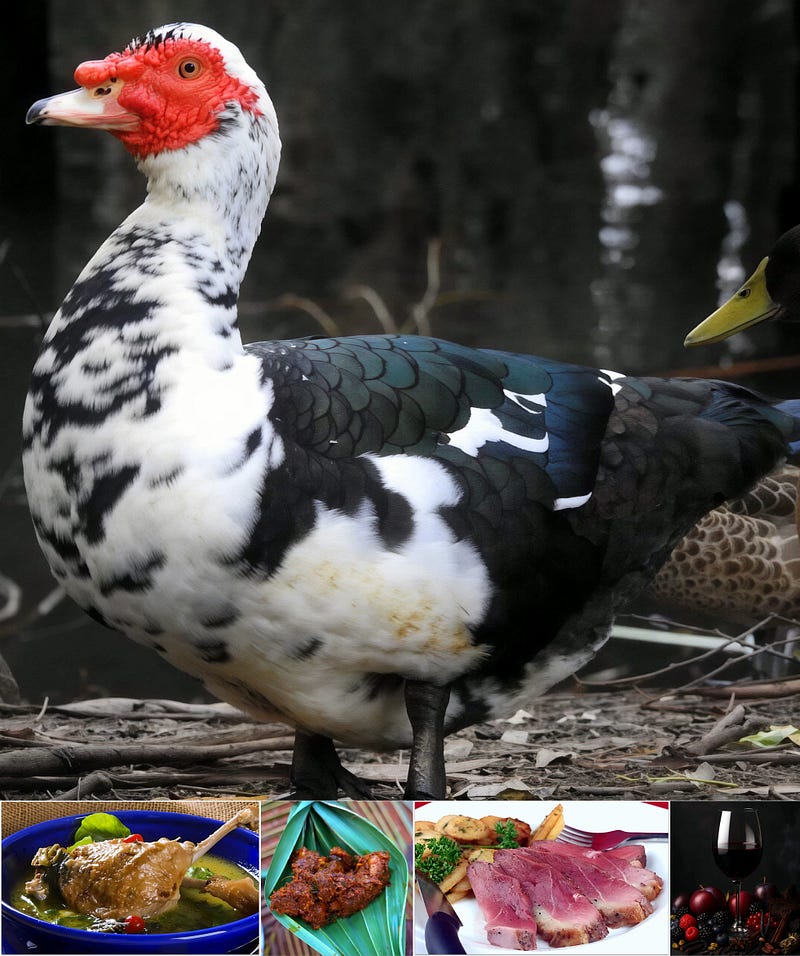
The Muscovy duck belongs to the genus Cairina within the family Anatidae. Its scientific name, Cairina moschata (formerly Anas moschata), reflects its distinct lineage separate from the Anas platyrhynchos complex that gave rise to most domestic ducks. The species includes both wild and domestic forms, with color variations ranging from glossy black and iridescent green plumage to white, chocolate, and mottled hybrids.
Common names include “Muscovy duck” (English), “Canard musqué” (French, Canada and France), “Pato criollo” (Spanish, Central and South America), “Pato mudo” (Spanish, Mexico and Peru), and “Entenmoschus” (German, Central Europe). In Brazil, it is called “Pato-do-mato,” meaning “forest duck,” reflecting its semi-wild temperament and habitat preference.
Biology
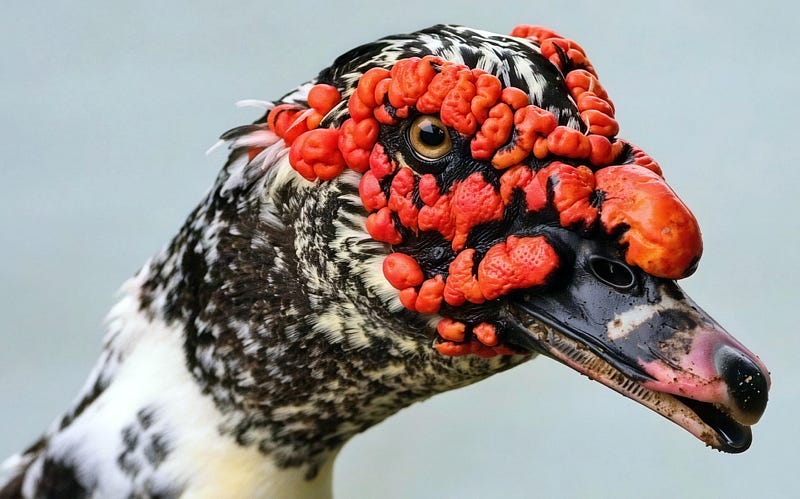
The Muscovy duck differs from other waterfowl in both physiology and behavior. Males can reach 7 kg (15.4 lb), while females average 3 kg (6.6 lb). Their caruncles — red, fleshy growths around the beak and eyes — are a defining feature, especially in males. Muscovies are perching ducks with strong claws adapted for roosting on trees. Their wingspan averages 1.3 m (4.3 ft), and their flight ability remains intact even in domesticated strains.
They exhibit strong broodiness and excellent parenting instincts. Clutch sizes range from 8 to 16 eggs, with incubation lasting 35 days — longer than the 28-day average of mallard-type ducks. Muscovies are largely silent, communicating with soft hisses rather than quacks. This behavior, combined with their insectivorous feeding habits, makes them valuable in integrated pest management systems.
Ecology
Wild Muscovies inhabit forested wetlands, river margins, and mangrove zones from Mexico to northern Argentina. They prefer shaded freshwater areas rich in vegetation and invertebrates. The species plays a critical ecological role in nutrient cycling and insect control. Domesticated populations are well adapted to small-scale, mixed-use farms and agroforestry systems.

From a conservation standpoint, the wild form is stable, though regional habitat loss and hybridization with feral domestics threaten genetic integrity. Sustainable farming practices — rotational grazing, pond integration, and natural feed supplementation — allow Muscovies to thrive with minimal environmental pressure. A mature Muscovy can yield 5.5 kg (12.1 lb) of meat while consuming significantly less grain than a broiler duck, offering superior feed-to-protein efficiency.
Uses
Muscovy ducks are highly versatile in culinary, agricultural, and industrial applications. The edible yield from a mature drake averages 65% carcass weight, producing lean meat with roughly 185 kcal per 100 g (3.5 oz). It contains 28 g of protein, 6 g of fat, and minimal cholesterol compared to standard domestic ducks. The breast is particularly prized for its deep red hue, firm texture, and beef-like flavor — sometimes described as “duck steak.”
Edible parts include breast, thighs, liver, and fat. The fat, rendered at 35°C (95°F), is rich in oleic acid and used in confit and pastry. Popular dishes include French magret de canard, Brazilian pato no tucupi, and Mexican pato en mole negro. Seasonality aligns with dry months when the birds are fattest and pest control is most needed.
Feed parts — offal and feathers — serve secondary uses. The feathers have strong insulating properties, while manure enhances soil nitrogen. Muscovy feed conversion efficiency averages 2.5 kg feed per 1 kg meat gain, and droppings contribute roughly 0.6% nitrogen, improving soil fertility.
Commercially, Muscovy leather is valued for strength and grain texture. Its down is used in high-end outerwear, while rendered fat is bottled as cooking oil in France and Poland. Globally, certified organic producers in France, Hungary, and the United States dominate supply chains. Retail prices for fresh Muscovy meat range from $8 to $14 per pound ($17.6 to $30.8 per kg), depending on rearing standards.
From an environmental standpoint, a free-range Muscovy farm can sequester about 1.8 metric tons of carbon per hectare per year through pond vegetation and reduced feed inputs. Their manure supports soil microbial activity and wetland restoration projects.
Culturally, Muscovy symbolizes self-reliance and quiet endurance. In parts of South America, it is raised for barter and community feasts, while in Asia, it appears in traditional medicine as a mild tonic believed to enhance circulation. No clinical evidence supports pharmacological claims, but nutritional value is well established.
Culinary Aspects
Muscovy duck meat is dark, dense, and aromatic. The flavor profile is earthy, slightly gamey, and less fatty than that of the Pekin duck. The aroma carries warm, savory notes akin to veal or red deer. Mouthfeel is firm but not tough, with clean, lingering depth. Properly seared skin yields crispness and a subtle nutty finish.
Cooking methods emphasize moisture retention: slow roasting, sous vide at 58°C (136°F), or searing followed by oven finishing. When cured as prosciutto de canard, its flavor intensifies into umami-rich depth. Marination with citrus, tamari, or anise enhances aromatic complexity, while high-heat confit brings balance between fat and flesh.
Wine Pairings
Muscovy duck’s flavor demands structure and depth. A classic yet less-known match is Madiran from Gascony, France, made from the Tannat grape. Its robust tannins and rustic spice echo the duck’s earthiness. From Italy, a Refosco dal Peduncolo Rosso from Friuli balances acidity and black cherry tones against the meat’s savory character. In Spain, a Mencía from Bierzo offers a bright, floral counterpoint ideal for dishes with citrus or herbs.
If the duck is prepared with mole or chili, a Chilean Carménère delivers smoky sweetness that integrates with spice. For lighter preparations such as citrus-glazed breast, a dry Tokaji Furmint from Hungary provides precision through minerality and green apple notes. Each pairing amplifies the Muscovy’s depth while cutting through its richness.
Conclusion
The Muscovy duck stands as a model of balance between wilderness and husbandry. Its lineage predates global trade, its meat sustains both rural livelihoods and haute cuisine, and its ecological footprint remains remarkably light. It reminds us that sustainable luxury does not require industrial excess but rather thoughtful coexistence with nature. Muscovy’s quiet dignity and robust utility make it more than a bird — it is a symbol of enduring harmony between ecology, economy, and appetite.