The Neural Equation: How Mathematics Bridges Artificial Intelligence and the Human Brain
Introduction: What if the secret to human consciousness lies not in poetry or philosophy, but in equations? For centuries, the brain has…
Introduction:
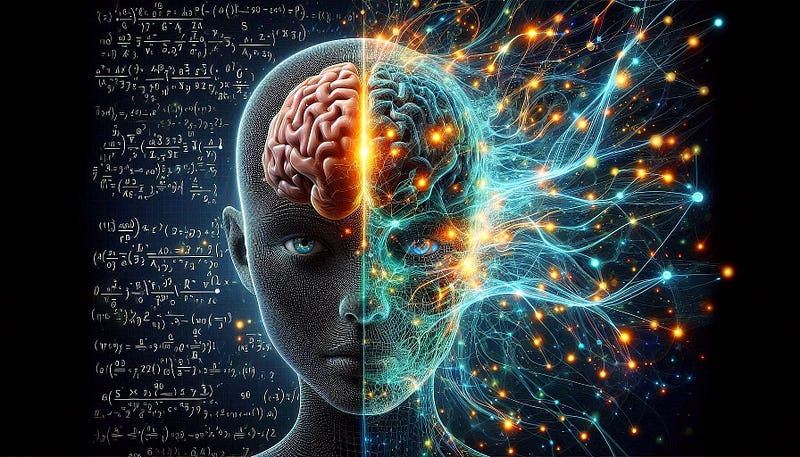
What if the secret to human consciousness lies not in poetry or philosophy, but in equations? For centuries, the brain has been a mystery too complex to untangle. Yet today, artificial intelligence — built upon mathematics and machine logic — has become one of our most powerful tools for understanding the mind itself. From mimicking how we see, to predicting how we think, the relationship between artificial intelligence and neuroscience is not just one of inspiration — it’s one of feedback, of code learning from cognition and vice versa. This article explores how mathematics forms the connective tissue between AI and the brain, shaping the future of both.
The Brain Behind the Algorithm: How Neuroscience Inspired AI
Neural Networks: Echoes of the Mind
Artificial neural networks (ANNs), the workhorses of modern AI, are patterned after the structure of biological neurons. In essence, each neuron in a neural net receives input, weights it based on importance, sums the results, and passes the signal through a non-linear activation function — just like a real neuron deciding whether to fire. The backpropagation algorithm, central to training ANNs, reflects the principle of Hebbian learning: “Neurons that fire together, wire together.”
In mathematical terms, an artificial neuron is expressed as:
f(Σ wᵢxᵢ + b)
where xᵢ are inputs, wᵢ are synaptic weights, b is a bias term, and f is an activation function such as ReLU or sigmoid. This abstraction enables machines to “learn” by adjusting their weights — mirroring synaptic plasticity in the brain.
Deep Learning and the Visual Brain
The human visual system inspired another key development: convolutional neural networks (CNNs). These systems imitate how our brain processes visual information — from simple edges in the primary visual cortex to complex object recognition in higher regions.
Mathematically, a convolutional layer applies a filter g over an input image f, producing a feature map that highlights patterns. Just as neurons in the visual cortex detect lines, angles, and faces, CNNs learn to recognize visual hierarchies by stacking these operations.
Reinforcement Learning and Dopamine
In AI, reinforcement learning models how agents make decisions to maximize reward — a framework deeply informed by neuroscience’s understanding of dopamine and the brain’s reward system.
The Bellman equation, central to reinforcement learning, defines how an agent evaluates future rewards:
Q(s, a) = r + γ max Q(s′, a′)
This mirrors how dopamine signals encode expectations of future pleasure or punishment, helping animals — including humans — adapt their behavior over time.
AI Illuminating the Brain: Reverse Inspiration
Predicting the Dance of Neurons
Where once the brain inspired code, AI is now returning the favor. Machine learning models such as recurrent neural networks (RNNs) and transformers are being used to predict neural activity across time — an invaluable tool for decoding memory, attention, and even speech.
An RNN models sequential information with a recursive equation:
hₜ = f(Wxₜ + Uhₜ₋₁ + b)
where hₜ represents the system’s memory at time t. This formulation closely resembles the ongoing interaction of neurons in circuits responsible for short-term memory and temporal processing.
Modeling Plasticity with Precision
AI doesn’t just mimic brain plasticity — it helps quantify it. Deep learning systems have validated and expanded models like spike-timing-dependent plasticity (STDP), in which the timing of signals between neurons determines the strength of their connection. The Hebbian learning rule,
Δw = η x y
captures how experience shapes neural circuits — AI brings this rule to life, allowing scientists to simulate and test its effects in silico.
Diagnosing Disorders through Graphs
Using AI, researchers are creating graph-based models of the brain to study disorders like Alzheimer’s, epilepsy, and schizophrenia. In these models,
G = (V, E)
where V represents neurons and E represents the synaptic connections between them. Changes in connectivity patterns — disruptions in these graphs — can signal cognitive decline or neurological disease, opening doors for earlier diagnosis and targeted treatments.
The Road Ahead: A Cognitive Convergence
The fusion of AI and neuroscience is not just academic. It has practical, even philosophical implications. Imagine neural prosthetics that restore lost memories. Brain-computer interfaces that allow thought to control machines. Or AI systems that don’t just simulate thinking, but feel and adapt with something like emotion.
Such visions are grounded in a deeper mathematical unity — one that may ultimately reveal intelligence, whether biological or artificial, as a single phenomenon governed by universal principles. The brain’s messy elegance and the machine’s calculated logic are converging, equation by equation.
Conclusion: Mind as Math, Machine as Mirror
As we map the mathematics of thought, we’re beginning to answer age-old questions about learning, memory, behavior, and even consciousness. The same formulas that teach a machine to recognize faces or play chess can help us understand how humans dream, love, and suffer. In this shared mathematical language, we find not only a bridge between AI and neuroscience — but a mirror for the mind itself.
Whether you’re a coder, scientist, or philosopher, the next frontier isn’t just artificial intelligence or brain science — it’s both. And it speaks in symbols.