The Nomadic Duck: The Garganey’s Journey Across Continents and Cultures
Across continents, from the flooded meadows of Europe to the rice paddies of Southeast Asia, a small duck with a silver-blue…
Introduction
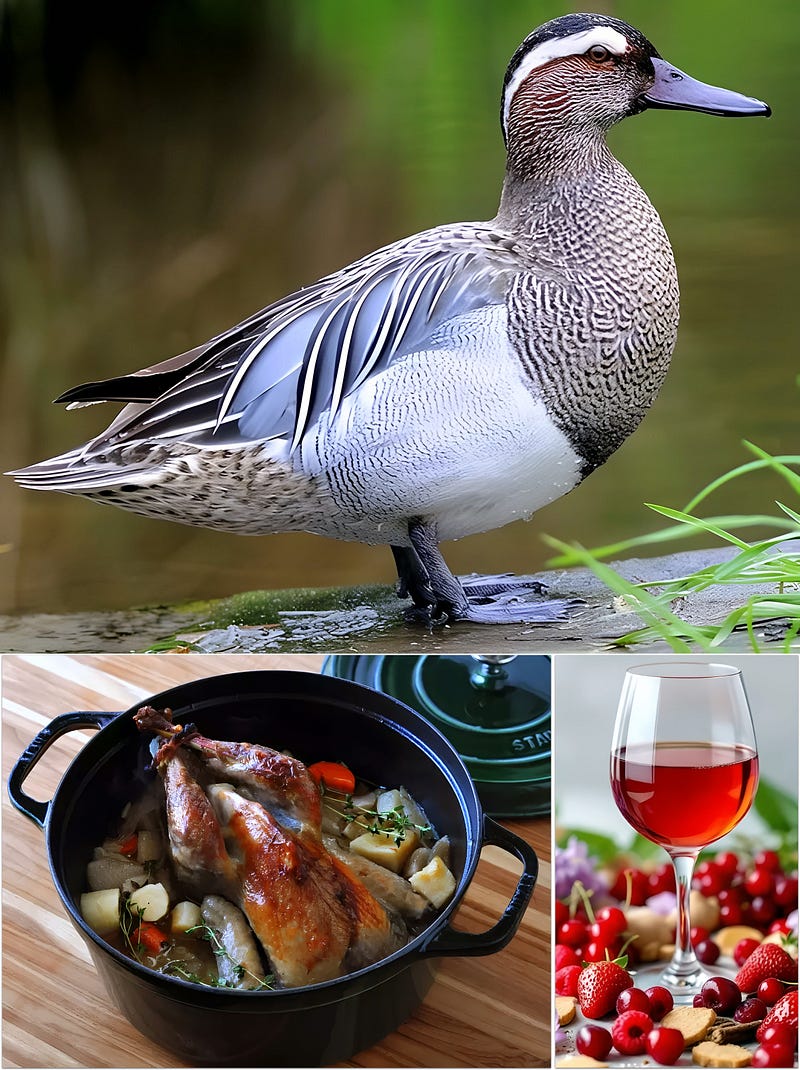
Across continents, from the flooded meadows of Europe to the rice paddies of Southeast Asia, a small duck with a silver-blue streak on its face weaves a story of motion, survival, and sustenance. The Garganey (Anas querquedula) is one of the few true migratory ducks of the Palearctic, a bird whose life mirrors the pulse of the seasons. Its migration, taste, and ecological value make it not just a biological marvel but a quiet cultural symbol for communities along its vast flyways.
Taxonomy
The Garganey belongs to the family Anatidae, order Anseriformes, and genus Anas. Its full scientific name is Anas querquedula Linnaeus, 1758. No recognized subspecies exist, though regional plumage variations are noted across Europe and Asia.
Common names include “Garganey” in English, “Sarcelle d’été” in French (France), “Krzyżówka modra” in Polish (Poland), “Marreca-de-asa-azul” in Portuguese (Brazil), “Клоктун” (Kloktun) in Russian (Russia), “청둥오리사촌” (Cheongdung-ori-sachon) in Korean (Korea), and “Bebek biru” in Indonesian (Indonesia). The vernacular range reflects its near-global recognition as a migratory visitor and a seasonal food source.

Biology
Measuring about 37 cm (14.6 in) in length with a wingspan of 59 cm (23 in), the Garganey is a small dabbling duck that feeds mainly at the surface rather than by diving. The male is easily identified by a broad white eye stripe curving over a slate-gray head and a warm brown breast. Females are mottled brown with subtler facial markings, often confused with teal species.
Breeding occurs in temperate Eurasia, typically between April and July. Nests are shallow depressions lined with grass and down, concealed near wetlands. Clutches average 8–10 eggs, each about 50 mm (2 in) long. Ducklings hatch after 21–23 days and can swim within hours. Garganey feed on aquatic invertebrates, seeds, and soft vegetation, aided by fine lamellae along their bills for sieving water.
Their long-distance migration — from northern Europe and Russia to sub-Saharan Africa and Southeast Asia — can span up to 6,200 miles (10,000 km). Unlike most ducks, Garganey are strictly migratory; none overwinter in Europe.
Ecology
Garganeys inhabit shallow freshwater wetlands, flooded grasslands, and rice fields. They play an essential role in aquatic ecosystems, controlling insect larvae populations and dispersing plant seeds through their droppings. Their presence indicates high wetland biodiversity and water quality.
However, habitat loss from agricultural drainage and pollution threatens populations. Sustainable wetland management and international flyway cooperation — particularly through Ramsar-designated sites — are essential for their conservation. Current estimates place the global population between 2.4 and 3.2 million individuals, though declining trends are evident in Western Europe.
Uses
Edible parts include the breast, thighs, and liver. The average dressed carcass yield is 0.5–0.6 kg (1.1–1.3 lb). Per 100 g (3.5 oz) of roasted Garganey meat provides approximately 220 kcal, with 26 g (0.9 oz) of protein and 12 g (0.4 oz) of fat. It contains iron, selenium, and B vitamins, while also being high in omega-3 fatty acids.
Common preparation forms include roasting, smoking, and confit. In Eastern Europe, Garganey is stewed with root vegetables, while in Central Asia, it appears in rice-based dishes similar to pilaf. In Italy and Spain, it is sometimes marinated in wine and herbs to soften the lean flesh.
No toxicity is reported in properly prepared meat, though consumption from polluted wetlands carries bioaccumulation risks (lead and mercury). Processing includes defeathering, gutting, and soaking in brine for 12 hours to reduce gaminess.
The taste is milder than mallard, with a delicate sweetness. The aroma is earthy, with hints of aquatic vegetation and iron-rich undertones. Texture is firm but not tough, softening with slow cooking. Flavor stability decreases with overcooking due to oxidation of polyunsaturated fats.
Commercially, Garganey is rarely farmed; most specimens come from regulated wild harvests under permit systems. In France, seasonal hunting begins in late August, extending to mid-January. In parts of Africa and Asia, local communities consume the bird during migratory stops.
Medicinally, duck fat and broth derived from Garganey share traditional applications similar to other wildfowl — believed in some Central Asian folk practices to aid respiratory health. Evidence is anecdotal. No approved pharmacological use exists.
Feather down has minor use in crafts and insulation. The species contributes indirectly to ecosystem services such as insect control, nutrient cycling, and tourism value in birdwatching regions.
Conservation status: Least Concern (IUCN), though regional declines warrant monitoring. Harvest pressure is moderate; sustainable hunting requires adherence to national bag limits and tracking under AEWA (Agreement on the Conservation of African-Eurasian Migratory Waterbirds).
Culinary Aspects
When cooked properly, Garganey offers a lean, aromatic meat with layered complexity. The taste sits between wild teal and pintail — less fatty, more mineral. Its mouthfeel is supple, with a gentle chew that rewards slow mastication. The aroma carries faint musk and marsh grass notes, balancing with subtle sweetness. The aftertaste is clean, leaving traces of iron and toasted grain.
Appearance varies from rich mahogany when roasted to deep brown when smoked. Chemesthesis is mild — neither spicy nor pungent — but accentuated by herbs such as sage, juniper, or thyme. In traditional European kitchens, Garganey pairs with wild mushrooms and chestnuts; in Asian cuisines, it complements soy, ginger, and star anise.
Wine Pairings
For roasted Garganey with herbs, pair with a red from the Jura region — Trousseau or Poulssard. Their light tannins and subtle earthy tones harmonize with the bird’s delicate game flavor.
For stewed preparations with root vegetables, a Hungarian Kadarka works well; its bright acidity lifts the savory broth while echoing the duck’s sweet mineral finish.
For soy-based or spiced Asian versions, a dry Madeira Sercial provides balance through nutty aromatics and controlled oxidation, enhancing the umami of the dish without overpowering it.
For smoked Garganey, consider a Loire Chenin Blanc — preferably aged Savennières. Its honeyed minerality softens the smokiness while maintaining freshness on the palate.
Conclusion
The Garganey is both an emblem of migration and a lesson in ecological interdependence. From the wetlands of Siberia to the paddies of Bangladesh, it binds continents through flight and sustenance. Its delicate flavor and ecological role remind us that culinary tradition and conservation need not stand apart. Each Garganey season marks not just a passage of birds, but the enduring rhythm between human appetite and the living world.