The Northern Bobwhite: A Whistling Jewel of Grassland, Cuisine, and Conservation
Introduction There’s a whistle that once echoed through the tallgrass prairies of the American South — a sound that once meant dawn…
Introduction
There’s a whistle that once echoed through the tallgrass prairies of the American South — a sound that once meant dawn, sustenance, and survival. That call belongs to the Northern Bobwhite (Colinus virginianus), a bird as evocative as the landscapes it inhabits. With its mottled feathers, explosive flush, and culinary legacy, the bobwhite is far more than a game bird — it’s a living symbol of ecological balance, rural heritage, and the delicate dance between human appetite and environmental stewardship. From biologists to chefs, conservationists to winemakers, a curious chorus is forming around this diminutive quail, asking not only how to preserve it — but how to savor it responsibly.
Taxonomy
The Northern Bobwhite belongs to the order Galliformes, family Odontophoridae, a group of New World quails distinct from their Old World cousins. Its Latin binomial, Colinus virginianus, nods to the bird’s colonial roots in Virginia, though its range spans much of the eastern and central United States and into Mexico. At least 22 subspecies are recognized, each adapted to local terrain — from the dusky plumage of the Florida bobwhite to the lighter shades of the Texan plains. While all are edible, the Eastern bobwhite remains the most commonly bred for consumption, favored for its balance of lean muscle and rich flavor.
Biology
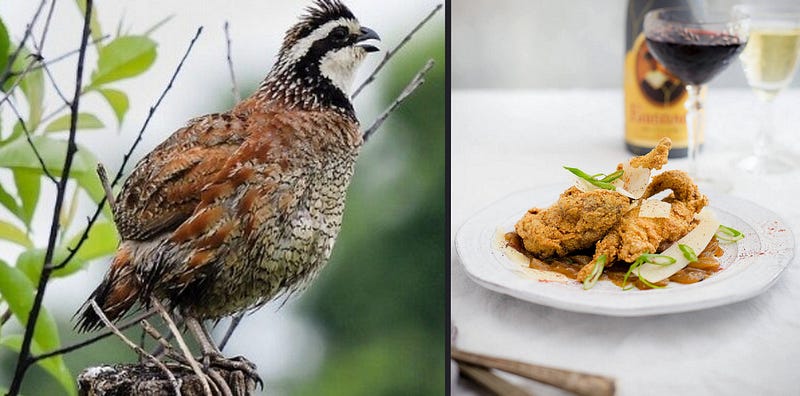
Weighing just under six ounces, the bobwhite wears earth tones like camouflage: chestnut, cream, black, and cocoa feathers arranged in precise barring and scalloping. The male bears a distinct white throat and brow stripe, while the female wears subtler buff hues. Its call — a clear two-syllable “bob-WHITE!” — cuts through dawn’s quiet, a siren for mates and a hallmark of spring.
This bird is precocial, meaning chicks hatch with downy feathers and quickly learn to forage. By fall, family groups, called coveys, form tight-knit circles of up to twenty birds. These coveys roost in a communal wheel, heads out, tails in — a brilliant adaptation against predators and cold snaps. But what makes bobwhites truly remarkable is their reproductive potential: a single hen can lay a clutch of 12–16 eggs, and in areas of high mortality, multiple clutches may follow in a season, ensuring the lineage persists — if only habitat allows.
Ecology
Grasslands and early successional fields are the bobwhite’s domain: bluestem prairies, overgrown fence lines, weedy fallow pastures. Their decline — steep and tragic — mirrors the disappearance of these once-abundant habitats. Since the mid-20th century, bobwhite populations have plummeted by over 80% in some regions, casualties of industrial agriculture, pesticide drift, and fire suppression. Yet this bird is not a lost cause. Habitat restoration efforts — like rotational grazing, prescribed burns, and native grass planting — have sparked hopeful rebounds in places like Texas, Georgia, and the Midwest.
The bobwhite is an umbrella species. Where it thrives, so too do pollinators, songbirds, and rare prairie flora. In valuing this quail, we uplift entire ecosystems. Its presence — or absence — serves as an ecological litmus test.
Uses
Economically, the bobwhite has carved out niches in both recreational hunting and sustainable agriculture. Upland gamebird preserves in the Southeast contribute millions to rural economies, employing a mix of wild and pen-raised quail to supply seasonal demand. Beyond sport, captive-bred bobwhites are finding their way into diversified farms, where they contribute to pest control and poultry-alternative meat programs.
The bird’s small size and fast maturity make it viable for small-scale farming, particularly for chefs seeking ethically sourced proteins. As consumer interest in heritage meats and regenerative practices grows, the Northern Bobwhite is positioned not only as a game species — but as a sustainable delicacy with provenance and ecological conscience.
Culinary Aspects
Bobwhite meat is lean, tender, and subtly gamey — less assertive than duck, richer than chicken. The breast offers a clean, nutty taste while the legs deliver more earth and depth. In the American South, where quail has long graced Sunday suppers and holiday tables, traditions endure: butterflied and pan-fried, slow-braised in cast iron with biscuits on the side, or grilled whole over hickory coals, brushed with honey and thyme.
Globally, chefs are reimagining quail — infusing it with Korean gochujang, wrapping it in grape leaves, or roasting it under clay. Its small bones and delicate frame invite intimate eating — hands, not utensils. Nutritionally, it’s a powerhouse: high in protein, low in fat, rich in B vitamins and minerals like selenium and iron.
As with all meat, sourcing matters. Ethical game farms and conservation-based hunts offer a way to eat bobwhite with reverence — knowing each bird had space to live, scratch, and call before it graced the plate.
Wine Pairings
The Northern Bobwhite’s subtle savoriness pairs best with medium-bodied wines that enhance without overpowering. A well-oaked Chardonnay lifts roasted quail’s nuttiness, while a dry Riesling adds acidity and brightness to fried preparations. For darker dishes — braised with mushrooms, or spiced with juniper — a light Pinot Noir or Grenache brings fruit and earth in equal measure. In Southern tradition, a glass of chilled muscadine wine offers sweet nostalgia to balance the bird’s rusticity. The goal is harmony, not dominance — wine that lets the quail sing.
Conclusion
The Northern Bobwhite is more than a fleeting whistle in the grass — it is a mirror of land health, a canvas for culinary creativity, and a relic of cultural memory worth preserving. To restore its numbers is to restore prairies. To cook it is to partake in a lineage of nourishment rooted in soil, season, and sound. As modern tastes bend toward sustainability and authenticity, perhaps it’s time we listened again for that call — bob-WHITE! — and answered with care, curiosity, and conservation.