
The Nose That Never Lies: Inside the World of Police Dogs
From cadaver dogs working rubble to bomb sniffers patrolling stadiums, K9 units remain law enforcement’s most trusted partners — and its…
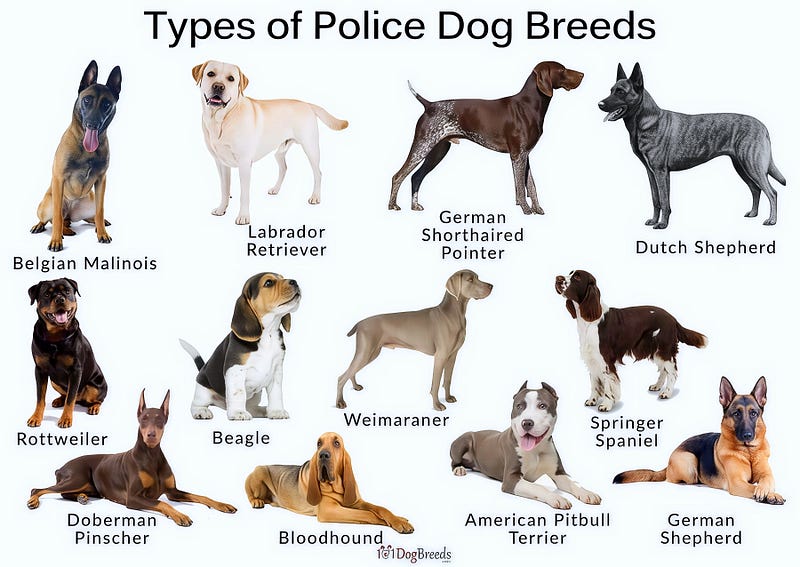
From cadaver dogs working rubble to bomb sniffers patrolling stadiums, K9 units remain law enforcement’s most trusted partners — and its most controversial. Their alerts save lives, seize drugs, and convict criminals, but every wagging tail also raises questions about bias, legality, and the limits of trust.
The history of police dogs is not a footnote to law enforcement but a parallel story of loyalty and instinct woven into the modern state’s ability to exert control and maintain order. Since their first formal deployment in late nineteenth-century Europe, dogs have stood at the edge of the human capacity for security — where machines stall, noses falter, and lives hang in the balance. Today’s K9 units represent one of the most sophisticated, demanding, and misunderstood branches of policing, straddling the line between deterrence and detection, force and compassion.
The most visible role belongs to the patrol dog, bred and trained to embody controlled aggression. The Belgian Malinois, lean as a coiled spring, and the classic German Shepherd remain the backbone of these units. Their training begins with obedience drilled to the point of reflex, because only absolute control can justify unleashing a dog into a chaotic pursuit. A properly trained patrol dog can scale walls, leap obstacles, neutralize a fleeing suspect, and then release on command with the same precision as a drawn firearm returned safely to its holster. The line between guardian and weapon is razor-thin, and it is the discipline of both dog and handler that keeps it steady.
Beyond the adrenaline of patrol lies the quieter, more exacting craft of detection. Drug-sniffing dogs are trained to detect specific chemical signatures: cocaine, heroin, methamphetamine, fentanyl, and, once, marijuana. As legalization spread, the courts began to reject “alerts” based on cannabis odor. Entire K9 units had to retire dogs that were once celebrated crime-fighters, replaced with fresh noses trained on narrower odor libraries. A police dog odor library is a controlled collection of scent samples used for the training, testing, and certification of K9 units. It allows handlers to train dogs to detect specific target scents, such as explosives, narcotics, or human scent, using real, extracted, or simulated odors. The use of a standardized library ensures the dog’s reliable performance and helps maintain a high standard of accuracy for detection work in police operations and forensic investigations. In El Paso, a Malinois’s alert yielded a hundred pounds of meth in 2022, proof that the dog’s work still cripples cartels. Yet the courtroom is never far away.
The Supreme Court itself has wrestled with the dog’s nose. In Florida v. Harris (2013), the Court ruled that a well-trained and certified narcotics dog’s alert is sufficient to establish probable cause. The message was blunt: if the training records are credible, the dog’s nose stands up in court. But that same year in Florida v. Jardines, the Court drew a hard line. Sending a drug dog onto the porch of a private home without a warrant was declared a search under the Fourth Amendment. A dog outside a car is one thing; a dog outside a home is quite another. Two years later, in Rodriguez v. United States, the Court tightened the leash again, holding that police cannot prolong a routine traffic stop just to wait for a K9 unit unless there is independent reasonable suspicion. Each decision underscored the delicate balance: the dog may be trusted, but the handler and agency must play by constitutional rules.
Explosives detection is less fraught legally but carries higher public stakes. In stadiums, airports, and subway systems, dogs search silently for vapor plumes trailing from explosives. Their presence alone is a deterrence, but their alert is actionable intelligence. At Super Bowl LVI, Passenger Screening Canines wove through tens of thousands of fans, scanning without stopping the flow of the spectacle. No machine has yet matched their ability to distinguish odor against a backdrop of sweat, food, and noise.
Cadaver dogs live in a different courtroom reality. They are often called upon in murder investigations, where an alert may provide the probable cause for further search. But defense attorneys have challenged them vigorously, pointing to the shifting chemical nature of decomposition and the impossibility of controlling all environmental variables. Still, juries are often persuaded. After the Surfside condominium collapse, HRD dogs were the only reliable means of locating victims, and their precision was so clear that their credibility spread into homicide trials across the country.
Electronic-detection dogs mark the newest frontier. A black Labrador named Bear helped federal investigators secure evidence against Jared Fogle by finding hidden storage media that humans overlooked. Bear was an electronics-sniffing K-9 who helped federal investigators find a hidden flash drive at Jared Fogle’s Indiana home. The device, which had been overlooked by human investigators, provided key evidence in Fogle’s 2015 child pornography case. Trained to detect a specific chemical in electronics, Bear located the drive, which helped secure Fogle’s conviction. Bear’s success earned him national recognition and a Public Service Award from the ASPCA. He later joined the Seattle Police Department to continue his work with internet crimes against children.
Courts have largely accepted their alerts, not as absolute proof, but as probable cause for further search. In child exploitation cases, these dogs have become not just tools but moral arbiters, sniffing out secrets from behind drywall and floorboards.
The greatest weakness remains human influence. Studies have shown that handlers’ expectations can unconsciously shape dogs’ behavior, leading to false alerts. This phenomenon — known as the Clever Hans effect — has been ammunition for defense lawyers. The Clever Hans effect occurs when a subject, like the horse Hans in early 20th-century Germany, appears intelligent but is actually reacting to subtle, unconscious cues from a human observer. Psychologist Oskar Pfungst proved that Hans could only answer questions correctly if his trainer, Wilhelm von Osten, knew the answer and was visible to the horse. Hans wasn’t a mathematical genius but a keen observer of human body language, and von Osten unknowingly cued him to stop tapping his hoof at the right time. This phenomenon demonstrates how observer-expectancy bias can influence outcomes and highlights the need for controlled experiments in research, especially in animal cognition studies. The antidote is rigorous double-blind training, frequent “blank” deployments where no odor is present, and meticulous record-keeping. When those standards are met, the courts still lean toward trusting the dog.
The human–canine bond is what makes any of this possible. Trust is not abstract but physiological: eye contact between handler and dog raises oxytocin in both, building a feedback loop of cooperation. Stress, too, is contagious, which is why calm handlers make better dogs. A veteran officer once said, “He’s my life on four legs,” a statement as much about tactical reliability as love.
The impact of police dogs is written in lives saved, crimes foiled, and families given closure. At disaster sites, they find both the trapped and the dead. On highways, their sitting beside a car door can yield millions in contraband. In crowded stadiums, their presence keeps spectators safe from unseen threats. In homicide trials, their alerts help convict killers who believed they had erased all traces. The courtroom is where their reputation is tested, but the street is where their legend is written.
The future of police dogs will be contested. Technology will promise replacements — sensors, drones, AI-driven surveillance — but the adaptability of a nose attached to four legs and a living heart will not be surpassed soon. The law will continue to limit, question, and refine its use. And yet, until something better arrives, the K9 unit remains the most primal and most advanced partner in law enforcement.
They are not machines. They are not mascots. They are living officers whose service embodies the contradictions of law enforcement itself: guardians and hunters, rescuers and pursuers, always guided by the silent truth of a nose that never lies.