The Partridge’s Tale: From Fields to Feasts
Introduction
Introduction
Few birds capture the imagination of both hunters and cooks quite like the partridge. Immortalized in folk songs and European tradition, this plump gamebird straddles the worlds of ecology, gastronomy, and culture. Whether spotted darting across a hedgerow in the English countryside or simmering gently in a French kitchen, partridges speak to a long history of human connection with the land. Today, species such as the grey partridge (Perdix perdix) and the red-legged partridge (Alectoris rufa) stand at the crossroads of conservation and culinary art, reminding us that the fate of wildlife and our tables are forever intertwined.
Taxonomy
Partridges belong to the family Phasianidae, which also includes pheasants, grouse, and quail. The grey partridge (Perdix perdix) is native to much of Europe and western Asia, while the red-legged partridge (Alectoris rufa) originates from Iberia and France but has been introduced widely across Europe and even North America. Both species are prized as gamebirds, known by hunters and farmers alike. The grey partridge is often simply called the “English partridge,” while the red-legged variant carries names like “French partridge” in Britain, a nod to its origin and culinary reputation.


Biology
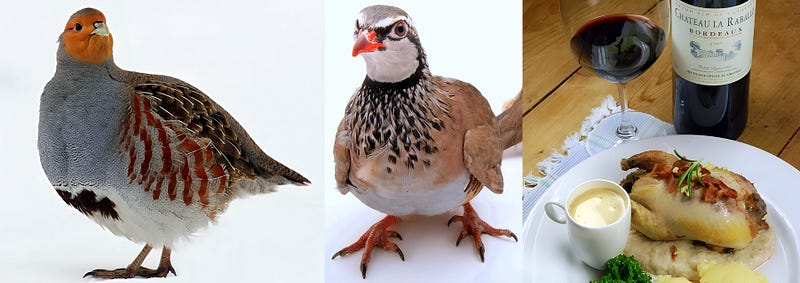
Compact and ground-dwelling, partridges are well adapted to life in farmlands and scrubby plains. Grey partridges measure about 30 cm (12 in) in length and weigh around 400 g (14 oz), while the slightly larger red-legged partridge averages 35 cm (14 in) and can weigh up to 500 g (17.5 oz). Their plumage blends seamlessly with agricultural fields: grey with chestnut barring in P. perdix, and russet-backed with bold facial markings in A. rufa.
Partridges are monogamous and strongly tied to the ground. Hens lay clutches of 10–20 eggs, each about 4 cm (1.6 in) long and weighing roughly 15 g (0.5 oz). The chicks are precocial — born feathered and capable of foraging within hours. This rapid independence has ensured their survival in predator-rich environments but also makes them vulnerable to modern agricultural practices.
Ecology
Traditionally abundant in hedgerows and wheat fields, partridges thrive where insects and seed diversity support their chicks. Yet agricultural intensification has caused sharp population declines. The grey partridge, once one of Britain’s most common farmland birds, has dropped by more than 80% in the last half-century. The red-legged partridge, by contrast, has flourished in managed estates where it is reared and released for shooting.
Partridges play a subtle ecological role: their foraging keeps weed growth in check, and their chicks form part of the diet of raptors and foxes. Conservation strategies now emphasize maintaining wildflower strips, hedgerows, and fallow land to provide insects and shelter. These practices not only support partridges but also bolster biodiversity across farmland ecosystems.
Uses
Economically, partridges remain central to game shooting in Europe. In the United Kingdom alone, millions of red-legged partridges are reared annually, contributing to rural economies but sparking debates over sustainability. Unlike industrial poultry, partridges cannot be raised in high-density barns; they demand semi-wild enclosures, making their rearing a hybrid between farming and wildlife management.
Sustainable hunting quotas, combined with habitat restoration, have become key in ensuring that this tradition does not erode natural populations. The partridge thus embodies the delicate balance between cultural heritage and ecological stewardship.
Culinary Aspects
Partridges have graced European tables for centuries, often featured in noble feasts and rustic kitchens alike. The flesh of the grey partridge is lean, delicately flavored, and slightly gamey, while the red-legged partridge offers a richer, fuller taste. Traditionally, young partridges are roasted whole, basted with butter, and served with bread sauce or cabbage. Older birds, less tender, are braised slowly in stock with wine, juniper berries, and root vegetables.
A typical serving weighs about 125 g (4.5 oz) cooked, providing around 25 g (0.9 oz) of protein, with minimal fat. Compared to chicken, partridge is darker and more nuanced in flavor, a bridge between domestic poultry and wild game. In modern kitchens, chefs experiment with pairing partridge alongside earthy accompaniments like wild mushrooms, lentils, and chestnut purées.
Wine Pairings
The partridge’s subtle yet distinct flavors call for wines that echo the landscape it inhabits. Grey partridge pairs beautifully with light reds such as Pinot Noir, whose soft tannins and red berry notes balance its delicate flesh. A Beaujolais cru, with its floral freshness, also suits roasted partridge.
For the richer red-legged partridge, fuller-bodied wines like Rioja or Châteauneuf-du-Pape bring warmth and spice that mirror the bird’s Iberian heritage. White wines, too, can shine: a well-oaked Chardonnay complements creamy sauces, while a dry Riesling enhances herbal or citrus-based preparations.
Conclusion
The partridge is more than a rustic gamebird; it is a symbol of the tension between agriculture, tradition, and ecology. Its song, once common in European fields, is now fading, yet its place in kitchens and culture endures. Protecting partridges means not only conserving a species but preserving an entire way of life tied to the rhythms of the land. Whether encountered in a hedgerow at dusk or on a plate beside a glass of wine, the partridge reminds us of the inseparability of nature and nourishment.