
The Philosophy of Humor of George Carlin: Cynicism, Language, and Liberation Through Laughter
George Carlin transcended stand-up comedy to become America’s preeminent satirical philosopher, a modern Diogenes wielding a microphone…
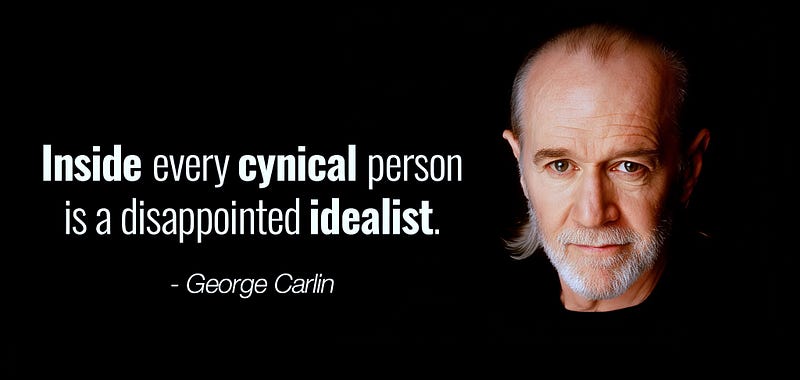
George Carlin transcended stand-up comedy to become America’s preeminent satirical philosopher, a modern Diogenes wielding a microphone. His unique fusion of linguistic precision, radical skepticism, and uncompromising social critique created a comedic philosophy challenging audiences to question everything from language to America’s foundational myths. Carlin’s humor was never mere entertainment; it was a philosophical method for exposing hypocrisy, deconstructing power, and reclaiming intellectual autonomy.
Carlin’s philosophical engagement began with language, a tool he saw as both weapon and shield. His landmark 1972 routine “Seven Words You Can Never Say on Television” was far more than shock comedy. He dissected how society assigns arbitrary moral weight to certain sounds, revealing language as a mechanism of social control: “Why do we assign bad thoughts and feelings to words? Why are some words worse than others? Is it all nonsense?” He relentlessly exposed how euphemisms and political jargon serve to distance people from uncomfortable realities: “By and large, language is a tool for concealing the truth.” He targeted “soft language” designed to sanitize truths — “shell shock” becoming “post-traumatic stress disorder,” or “used cars” transformed into “pre-owned vehicles” — arguing such shifts dull critical awareness and enable deception.
Carlin transformed the comedy stage into an arena for philosophical inquiry, targeting society’s sacred cows. His atheism, grounded in empirical skepticism and moral outrage, presented religion as “the greatest bullshit story ever told.” He dissected contradictions in divine omnipotence, prayer, and the problem of evil: “Something is wrong here. War, disease, death, destruction, hunger, filth, poverty, torture, crime, corruption, and the Ice Capades… If this is the best God can do, I am not impressed.” He saw American society as a theater of manufactured consent, coining the iconic line: “It’s called the American Dream because you have to be asleep to believe it.” He dissected consumerism — “A house is just a place to keep your stuff while you go out and get more stuff” — political theater — “‘Bipartisan’ usually means that a larger-than-usual deception is being carried out” — and class warfare: “The bankers own this place… It’s a big club, and you ain’t in it!” In his darkest work, he explored humanity’s insignificance with nihilistic glee, embracing meaninglessness as cosmic comedy: “Gotta get a rope. Wal-Mart is having a sale on rope. No sense spending a bunch of money to kill myself.”
Carlin embodied the ancient Greek Cynic tradition. Like Diogenes mocking Alexander the Great, Carlin practiced parrhesia — fearless truth-telling without regard for consequence: “I think it’s the duty of the comedian to find out where the line is drawn and cross it deliberately.” His rejection of material pretensions — “I loathe and despise the groups people identify with” — and embrace of countercultural values mirrored Cynic asceticism. He fulfilled the role of the “laughing philosopher” who saw human folly as cosmic comedy, using laughter to emancipate minds from authority.
His comedic techniques were philosophical tools. He deconstructed through absurdity, pushing premises to illogical extremes to reveal systemic absurdities invisible in normalized discourse. His obsession with lexical precision exposed how language shapes perception: “Why do we park on driveways and drive on parkways?” His later persona, the “cranky truth-teller” delivering almost academic critiques amidst stacks of notes, blurred comedy with philosophical seminar.
Carlin’s legacy endures. His insistence on questioning everything remains vital: “Don’t just teach your children to read. Teach them to question what they read. Teach them to question everything.” He transformed comedy into epistemological training. He rejected false hope for clear-eyed intellectual honesty: “I don’t have hope. Hope is for the ignorant. I have reality.” His critiques of consumerism, media, and environmental hypocrisy — “The planet is fine. The people are fucked!” — resonate powerfully today. His materialist cynicism offers an antidote to what he called “the circling of the wagons around the American Dream.” Carlin recognized that in a world saturated with bullshit — “the glue that binds us as a nation” — laughter becomes the ultimate act of intellectual liberation. By weaponizing comedy as applied philosophy, he transformed the stage into a classroom where audiences learned to dismantle illusions one defiant laugh at a time: “It’s all bullshit, and it’s bad for ya.”