The Tench: A Golden Ghost of Europe’s Waters
Overlooked in global gastronomy, it is a species that quietly embodies the bond between humans and freshwater ecosystems. Exploring the tench is to rediscover a piece of aquatic heritage, where biology, culture, and sustainability converge.
Introduction
Beneath the reeds and lilies of Europe’s lakes lurks a fish with a reputation more whispered than sung. The tench, Tinca tinca, has been called the “doctor fish” for centuries, a healer of pond companions, and a staple of rural tables from Poland to Spain. Overlooked in global gastronomy, it is a species that quietly embodies the bond between humans and freshwater ecosystems. Exploring the tench is to rediscover a piece of aquatic heritage, where biology, culture, and sustainability converge.
Taxonomy
The tench belongs to the family Cyprinidae, the carp family, whose members range from common carp to minnows. Its scientific name, Tinca tinca, is almost lyrical in its repetition, fitting for a fish with a folkloric aura. Subspecies include the golden tench (Tinca tinca auratus), a radiant variant often bred in ornamental ponds, and the wild form, more commonly netted for food. Known variously as “schlei” in Germany, “lin” in Poland, or “tenca” in Italy, the tench has carried a multitude of names that mirror the regions that prized it. Unlike its cousin, the common carp, the tench has not been mass-commercialized, and this rarity lends it culinary intrigue.
Biology
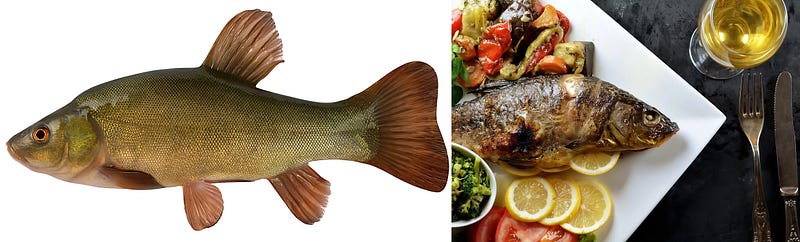
Stocky and muscular, the tench rarely grows beyond 70 cm (27.5 in) in length, though specimens of 84 cm (33 in) have been reported. It can weigh up to 7.5 kg (16.5 lb), though the average hovers around 2 kg (4.4 lb). Its skin is olive-green and covered with an unusually thick slime coat, which folklore once claimed could heal other fish — a myth, but one rooted in its resilience. Tench are bottom feeders, their small mouths adapted for rooting through mud to find insect larvae, mollusks, and plant detritus. They thrive in slow-moving or still waters, often tolerating low oxygen levels that would kill more delicate species. Their long lifespan, sometimes exceeding 15 years, makes them both hardy survivors and symbols of aquatic endurance.
Ecology
The tench is found across Europe and parts of Asia, extending from Britain to Siberia. It favors lakes, ponds, and backwaters with muddy substrates and lush vegetation. Ecologically, tench help regulate benthic invertebrate populations and serve as prey for larger predatory fish like pike and catfish. Their ability to tolerate hypoxic environments gives them an ecological niche as stabilizers in systems prone to eutrophication. Conservation concerns are mild compared to overfished species, but habitat loss from drained wetlands and water pollution threatens some populations. Sustainable management of tench aquaculture — already practiced in Eastern Europe — offers a model for diversifying freshwater protein sources without overburdening wild stocks.

Uses
Economically, tench has never achieved the fame of carp or trout. In parts of Central and Eastern Europe, however, it is a traditional market fish. In Poland, annual catches exceed several hundred tons, often farmed in polyculture ponds alongside carp. It's relatively slow growth compared to carp limits industrial appeal, but this very trait makes tench a candidate for niche markets — where consumers increasingly value heritage foods and sustainable sourcing. The golden tench, meanwhile, enjoys demand in ornamental fishkeeping, swimming like liquid amber in garden ponds.
Culinary Aspects
The tench’s flesh is pale, firm, and subtly sweet, often compared to perch but denser. When freshly caught, a 1.5 kg (3.3 lb) tench provides enough for a family meal, delivering protein and minerals like phosphorus and selenium. Historically, tench appeared in medieval banquets and rustic stews, roasted whole or baked with herbs. In Italy’s Lombardy region, tinca al forno — tench stuffed with breadcrumbs, cheese, and parsley — remains a local specialty. In Eastern Europe, smoked tench is beloved for its rich, almost buttery flavor. Nutritionally, a 100 g (3.5 oz) portion provides about 18 g (0.63 oz) of protein and under 5 g (0.18 oz) of fat, making it lean yet satisfying.
Wine Pairings
Pairing wine with tench requires balance. Its mild flavor benefits from whites with gentle acidity and mineral notes. A Grüner Veltliner from Austria, with its crisp citrus and white pepper tones, complements roasted or grilled tench. For cream-based preparations, such as German-style tench with dill sauce, a dry Riesling with its slate-like minerality harmonizes beautifully. In Italy, Franciacorta sparkling wine is sometimes served with tinca al forno, the bubbles cutting through richness while echoing the festive character of the dish.
Conclusion
The tench may lack the glamour of salmon or the ubiquity of tilapia, but it carries something more profound: an echo of Europe’s watery past, where rural traditions wove food, ecology, and folklore into one current. In an age of industrial fisheries and vanishing biodiversity, the tench offers a reminder of balance — how a humble fish can anchor culture, nourish families, and persist through centuries of change. Perhaps it is time for this golden ghost of the shallows to rise again, not as a relic, but as a symbol of resilience and sustainability.