
Adolescent Brain Development and the Sentencing of Youthful Offenders
Adolescent Brain Development does justify mitigation for many 18–25-year-olds, but it does not justify a blanket retreat from adult accountability. Neuroplasticity should be treated as an opportunity for reform, not as proof that reform has already occurred.
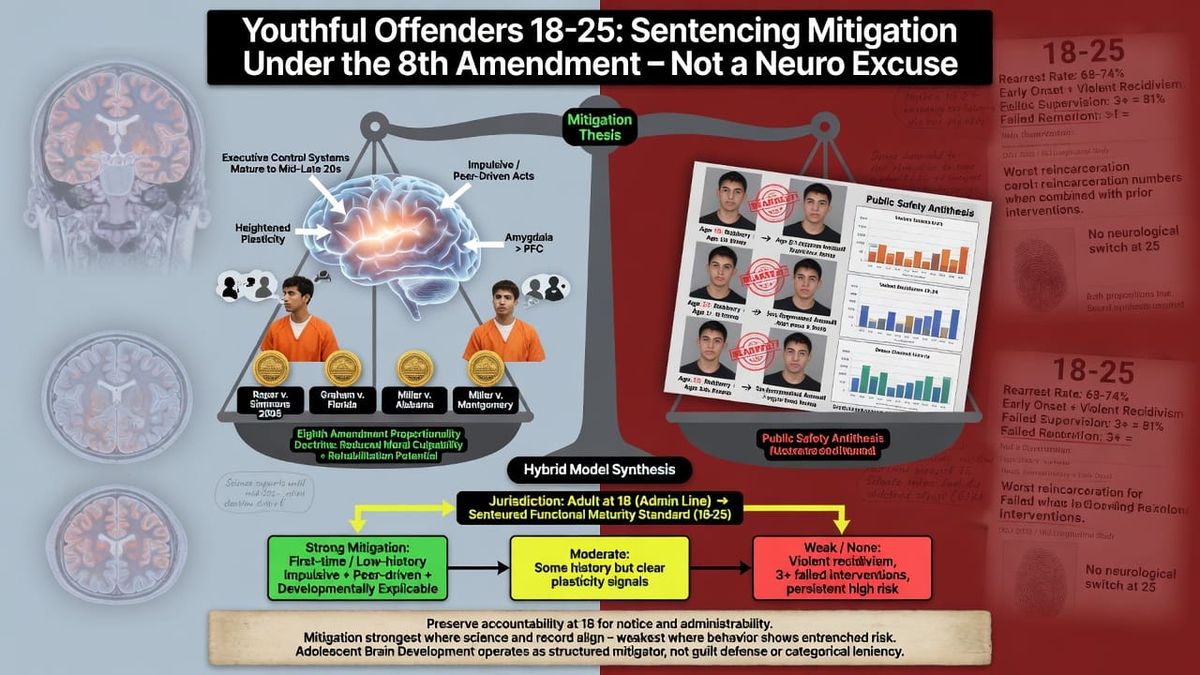
Executive Thesis
For Youthful Offenders aged 18–25, Adolescent Brain Development should operate as a sentencing mitigator, not as a guilt-stage excuse, and certainly not as a blanket warrant for categorical leniency. The controlling constitutional reason is straightforward: the youth cases of the Supreme Court of the United States built an Eighth Amendment proportionality doctrine, not a free-standing neuroscientific defense. At the same time, the science does support the core developmental premise behind mitigation: key systems associated with executive control continue to mature into the mid-to-late twenties, and policy should not pretend that the eighteenth birthday marks a sudden biological transformation. But neither the science nor the case law establishes a precise neurological switch that flips at 25. Federal constitutional doctrine therefore still draws the administrable line at 18, even while developmental evidence reaches beyond it.
The dialectic is therefore not difficult to state. The mitigation thesis says that late adolescents and emerging adults have reduced moral culpability, heightened plasticity, and stronger prospects for rehabilitation than older adults. The public-safety antithesis says that the same age band also produces the worst rearrest and reincarceration numbers, especially when youth is combined with early onset offending, dense criminal history, and repeated supervision failures. Both propositions are true. The sound synthesis is a hybrid model: preserve adult accountability at 18 for jurisdiction, notice, and administrability, but adopt a structured Functional Maturity Standard at sentencing and parole for offenders aged 18–25; make mitigation strongest for first-time or low-history defendants whose crimes were impulsive, peer-driven, and developmentally explicable; and make mitigation progressively weaker when the record shows violent recidivism, failed interventions, and persistent high risk.
From Roper to Miller
The modern doctrine of Diminished Culpability begins with Roper v. Simmons, 543 U.S. 551 (2005). Roper did not hold that young offenders lack mens rea or cannot distinguish right from wrong. It held instead that juveniles under 18 are too unreliable as a class to be placed among the “worst offenders” for purposes of the death penalty. The Court emphasized three traits: immature and irresponsible behavior, vulnerability to outside pressures, and a still-forming character; once those features were acknowledged, Retribution and Deterrence no longer justified execution. Just as important, Roper admitted that age lines are imperfect but still insisted on a bright line at 18 because law needs a stable rule.
Graham v. Florida, 560 U.S. 48 (2010), extended the logic from death sentencing to Life Without Parole for juvenile nonhomicide offenses. Its contribution was twofold. First, it made explicit that “developments in psychology and brain science” reinforce the conclusion that juveniles are more capable of change and less likely to exhibit fixed depravity than adults. Second, it reframed the doctrine in openly penological terms: none of the recognized goals of punishment—Retribution, Deterrence, Incapacitation, and Rehabilitation—adequately justified juvenile LWOP for nonhomicide crimes, and if a state imposes life, it must provide a “meaningful opportunity to obtain release based on demonstrated maturity and rehabilitation.” That language became the doctrinal hinge between brain development and proportional punishment.
Miller v. Alabama, 567 U.S. 460 (2012), completed the move from categorical exemption to mandatory individualized mitigation. The Court did not categorically abolish juvenile LWOP for homicide. It instead held that a mandatory sentencing scheme is unconstitutional because it prevents a sentencer from considering “youth and all that accompanies it.” By Miller, the Roper traits had hardened into constitutional commonplaces: lack of maturity, an underdeveloped sense of responsibility, unusual susceptibility to outside pressure, and a character less likely to be fixed. In doctrinal terms, Miller shifted the youth cases from a narrow rule about particular punishments to a broader rule about how sentencing must be done when youth is relevant to blame and future risk.
The later cases matter because they reveal both the strength and the limit of the doctrine. Montgomery v. Louisiana, 577 U.S. 190 (2016), held Miller retroactive and stressed its “central intuition” that even youths who commit heinous crimes are capable of change. But Jones v. Mississippi, 593 U.S. 98 (2021), narrowed the operational bite of that intuition by holding that a sentencer need not make a separate finding of permanent incorrigibility before imposing juvenile LWOP, so long as the sentencing scheme is discretionary. The upshot is plain: under current federal law, the constitutional floor remains 18, and the federal Eighth Amendment does not presently extend Miller’s protections to 18–25-year-olds. Where the law is moving beyond 18, it is largely moving through state constitutional law and legislation, not through current federal doctrine.
That doctrinal architecture tracks the developmental science, but only in a qualified way. Research associated with Laurence Steinberg and Elizabeth S. Scott has long argued that youth mitigation rests less on a total lack of rational capacity than on deficits in Psychosocial Maturity—especially in situations defined by stress, emotion, reward, and peers. The National Institute of Mental Health states that the brain continues maturing into the mid-to-late twenties, with the Prefrontal Cortex among the last regions to mature. Review literature describes a developmental “mismatch” in which more reactive limbic and reward-related systems can outpace top-down control systems in emotionally salient settings. And multisite behavioral work shows that cognitive capacity reaches roughly adult levels earlier than psychosocial maturity, creating a maturity gap rather than a simple all-purpose incapacity.
That last point is decisive for Retributive Justice. The brain-based case against retribution is strongest when the crime is committed in hot cognition conditions: group offending, escalating conflict, rapid retaliation, sensation-seeking, or high emotional arousal. It is weakest when the record shows prolonged planning, solitary execution, repeated concealment, or calculated instrumental violence. In other words, the developmental evidence cuts against maximal desert more than it cuts against accountability itself. It supports a discount in blameworthiness, not a categorical surrender of the state’s authority to punish emerging adults as adults. That is precisely why using brain science as a sentencing factor is more coherent than using it as a wholesale excuse.
The Plasticity and Recidivism Paradox
The best argument for mitigation in the 18–25 bracket is Neuroplasticity. The National Academies describe adolescence as a period that extends into the mid-20s and emphasize both vulnerability and opportunity. The teen brain, as NIMH puts it, is “ready to learn and adapt.” Longitudinal work on serious offenders also points in the same direction: in the Pathways to Desistance line of research, serious youthful offenders showed meaningful gains in psychosocial maturity between adolescence and age 25, and most serious offenders desisted from antisocial activity by their early twenties. Properly understood, this is the scientific case for Rehabilitation: not that every late adolescent will reform, but that the developmental window for reform remains unusually open.
The empirical problem is that the recidivism numbers are unambiguously harsh. Data from the Bureau of Justice Statistics show that prisoners released at age 24 or younger had the highest recidivism burden in the 2008 release cohort: 90 percent were arrested within ten years, compared with 85 percent for ages 25–39 and 75 percent for those 40 or older; 69 percent of the youngest release group returned to prison within ten years, compared with 64 percent and 53 percent for the older groups. The annual arrest rate for the youngest group was 50 percent in the first year after release and still 27 percent in year ten. Those are not marginal differences. They are operating-system differences. One caveat matters, however: rearrest is the broadest metric and can overstate legally proven recidivism relative to reconviction or reincarceration, because arrest turns on probable cause rather than proof beyond a reasonable doubt.
The paradox dissolves once one remembers that plasticity is a capacity, not a forecast. Justice-involved young adults are not a random sample of the population aged 18–24. They are a selected group enriched for early onset offending, multiple prior arrests, weak school and labor-market attachment, substance misuse, antisocial peers, and histories of failed supervision. In the same BJS report, nearly half of released prisoners had 10 or more prior arrests; that subgroup posted an 89 percent cumulative arrest rate within ten years, compared with 67 percent for those with four or fewer priors. Likewise, the earlier the first arrest, the worse the later outcome: those first arrested before age 18 reached a 90 percent cumulative arrest rate within ten years. The developmental model therefore cannot be read in isolation from the life-course criminology model. Emerging adults offend at high rates not merely because their brains are still developing, but because many of them are developing in criminogenic environments and without stabilizing adult roles.
That is also why the frequent claim that Cognitive Behavioral Therapy should “rewire” emerging adults needs a harder-nosed assessment. The evidence does not support the proposition that CBT is a sham. The Campbell review of 58 programs found average recidivism reductions, with mean recidivism dropping from roughly four in ten in untreated groups to about three in ten for treated groups, and the best-implemented programs doing materially better. The review also found that the decisive variables were not the brand name of the program but implementation quality, trained providers, and solid engagement around anger and conflict management. The National Institute of Justice likewise notes that CBT is used widely across criminal justice settings to reduce recidivism among adults and juveniles.
But the evidence also does not justify the inflated promise sometimes attached to CBT in neurolaw arguments. The Council of State Governments Justice Center bluntly observes that few evaluations have tested whether adult CBT programs work equally well for young adults, that few CBT programs target young adults specifically, and that some young adults are not even eligible for age-bounded interventions that might fit their needs. In practice, then, the real failure is not that CBT never works; it is that sentencing rhetoric often oversells brain plasticity while criminal justice systems underinvest in developmentally tailored, high-fidelity, age-appropriate programming. Neuroplasticity is real. Guaranteed rewiring is not.
Deterrence, Moral Hazard, and Public Safety
From the perspective of Classical Criminology, associated above all with Cesare Beccaria, the primary purpose of punishment is not metaphysical payback but prevention. Beccaria’s classic formulation emphasized certainty, swiftness, and proportionality over cruelty and excess severity. On that baseline, the right question is not whether science should make the law “nicer.” It is whether neuroscience-informed mitigation undermines the preventive architecture of sentencing. If it does, then it is bad policy. If it does not, then the moral-hazard objection loses force.
Modern deterrence evidence largely vindicates Beccaria’s priorities. NIJ’s summary of the literature, drawn from Daniel Nagin’s review, states that the certainty of being caught is a far more powerful deterrent than the severity of punishment; longer prison sentences produce at most modest marginal deterrent effects; and incarceration may sometimes be null or mildly criminogenic for future offending. This cuts both ways. It weakens the easy argument that harsher sentences for all emerging adults are needed to maintain General Deterrence. But it also means that any policy of developmental mitigation must preserve visible, credible, and prompt enforcement. A sentencing system can acknowledge immature brains without eroding deterrence, provided it does not signal that serious crime by 18–25-year-olds will be indulged or informally excused.
The harder issue is Moral Hazard. Here the answer is calibrated. A narrow rule that discounts punishment because of demonstrated immaturity, while retaining conviction, sanction, supervision, and the possibility of confinement, does not materially destroy deterrence. A broad cultural message that “young adults are not fully responsible because their brains are unfinished” could do so at the margins, especially in relation to assaults on the public or law enforcement. The Pathways research is instructive: adolescents are responsive to perceived certainty of arrest, but that relationship is not linear, and those who perceive very little risk may not reduce offending even when perceived arrest risk rises. In practical terms, the justice system should not rely on severity to deter emerging adults, but neither should it strip away the certainty, celerity, and moral clarity that make deterrence possible.
The Repeat-Offender Threshold
The question “when must Public Safety override Developmental Potential?” has no honest answer unless one is willing to say that there is, in fact, a point where the state must pivot from Rehabilitation to Incapacitation. For violent recidivists aged 21–25, that pivot can be justified. Not because neuroscience stops mattering, but because its sentencing weight should diminish when violent behavior becomes repeated, patterned, and resistant to prior intervention. Brain immaturity explains some reduction in blame; it does not require the public to absorb escalating violent risk indefinitely.
The data strongly support using criminal history and violence history as override variables. The U.S. Sentencing Commission reports that age and criminal history exert a strong joint effect on recidivism, and that violent offenders recidivate at higher rates than non-violent offenders in every age group. In the federal data, violent offenders in Criminal History Category I recidivated at 44.5 percent, while those in CHC VI recidivated at 85.6 percent; violent offenders also appear to desist later in life than non-violent offenders. BJS data point in the same direction at the state level: the combination of youth and deep priors is a high-risk portfolio. That is the empirical basis for a Public Safety Override.
Even so, the override should not be sloppy. It should be triggered by convictions, not by arrests alone; by serious violent recidivism, not by minor technical relapses; and by documented failure of prior interventions, not by the mere absence of prior services. It should also be understood for what it is. Because longer incarceration shows no clear relationship to lower post-release recidivism rates in the federal violent-offender data, the rationale for harsher sanctions here is not some fantasy that extra years will reliably reform the offender. The real rationale is narrower and more defensible: temporary incapacitation to manage demonstrable violent risk, paired with periodic re-evaluation because human development does continue. An Incapacitation Model should therefore be reviewable, not irrevocable by default.
Legislative Synthesis
The most workable statutory architecture is a hybrid, not a revolution. The hard line for legal adulthood should remain at 18 for jurisdiction, charging, and baseline criminal accountability. That line has virtues the law cannot casually surrender: clarity, notice, administrability, and alignment with the many areas in which society still uses 18 as the threshold between childhood and adulthood. More important, the scientific literature does not identify a single age at which one can say, with forensic confidence, that an individual has become neurologically “adult” for all legal purposes. As Steinberg himself has cautioned, brain science should inform policy but should not set policy by itself.
What should change is sentencing. Legislatures should enact a Functional Maturity Standard for offenders aged 18–25. That standard should begin with a rebuttable presumption of mitigation, strongest for ages 18–20, more modest for 21–25, and available only where the record shows genuine developmental relevance. The assessment should cover at least four domains. First, a qualified forensic evaluator should assess Psychosocial Maturity: impulse control, future orientation, resistance to peer influence, emotional regulation, problem-solving, perspective-taking, and appreciation of consequences. Second, the court should examine the offense context: peer presence, coercion, emotional arousal, intoxication, planning horizon, and role differentiation. Third, the court must weigh history and responsiveness: prior convictions, prior violence, age of onset, earlier community supervision, exposure to evidence-based treatment, and whether prior interventions were completed, refused, or simply unavailable. Fourth, the court should integrate dynamic risk and institutional behavior, because mitigation without risk management is bad operations. Comparative practice reinforces the administrability of this approach: HMPPS in the United Kingdom has already developed a 10-item maturity screening tool that flags low maturity for intervention planning, while expressly recognizing that maturity is fluid and that screening is not, by itself, a full sentence-progression tool.
The sentencing consequences should also be structured rather than sentimental. For offenders 18–20 with limited history and developmentally explicable crimes, the law should disfavor mandatory minimums, expand judicial authority to impose treatment-oriented sentences, and guarantee later review based on demonstrated maturity and risk reduction. For offenders 21–25, mitigation should remain available, but only after closer scrutiny of planning, autonomy, and prior intervention history. And where the defendant has a prior serious violent conviction, has failed a prior evidence-based intervention or intensive supervision episode, and commits a new serious violent offense, the presumption should flip: the court may prioritize incapacitation while still preserving periodic review. That is not inconsistent with developmental science. It is the only way to cash out developmental science without sacrificing public safety.
Recent state constitutional law shows why this hybrid model is more plausible than either pole of the debate. In Massachusetts, Commonwealth v. Mattis, 493 Mass. 216 (2024), held that LWOP for “emerging adults” aged 18–20 violates the state constitution, explicitly relying on updated developmental science and the continued capacity for growth. In Michigan, People v. Parks, 510 Mich. 225 (2022), held that mandatory LWOP for 18-year-olds violates the state constitution even though current federal doctrine stops at 18. Those decisions do not prove that all 18–25-year-olds must be treated like juveniles. They prove something more modest and more important: the present federal line is not the only legally defensible line, and state systems can incorporate developmental science without abandoning punishment.
The bottom-line position is therefore this. Adolescent Brain Development does justify mitigation for many 18–25-year-olds, but it does not justify a blanket retreat from adult accountability. Neuroplasticity should be treated as an opportunity for reform, not as proof that reform has already occurred. CBT should be treated as a useful but limited tool, not as a guaranteed mechanism of neural redemption. General Deterrence will not be protected by ever-longer sentences, but it will be compromised if the law speaks as though young-adult violence is merely a biochemical phase. And once violent offending becomes repeated, serious, and resistant to past intervention, the state may justifiably move from a Rehabilitative Model toward a reviewable Incapacitation Model. That is the most defensible synthesis of jurisprudence, forensic psychology, and criminology now on the table.
Reference List
Primary Legal Sources
Commonwealth v. Mattis. 493 Mass. 216 (2024).
Graham v. Florida. 560 U.S. 48 (2010).
Jones v. Mississippi. 593 U.S. 98 (2021).
Miller v. Alabama. 567 U.S. 460 (2012).
Montgomery v. Louisiana. 577 U.S. 190 (2016).
People v. Parks. 510 Mich. 225 (2022).
Roper v. Simmons. 543 U.S. 551 (2005).
Secondary Sources
Beccaria, Cesare. On Crimes and Punishments and Other Writings. Edited by Richard Bellamy. Cambridge: Cambridge University Press, 1995.
Casey, B. J., Rebecca M. Jones, and Todd A. Hare. “The Adolescent Brain.” Annals of the New York Academy of Sciences 1124 (2008): 111–26.
Council of State Governments Justice Center. Reducing Recidivism and Improving Other Outcomes for Young Adults in the Juvenile and Adult Criminal Justice Systems. New York: Council of State Governments Justice Center, 2015.
Durose, Matthew R., and Leonardo Antenangeli. Recidivism of Prisoners Released in 24 States in 2008: A 10-Year Follow-Up Period (2008–2018). Washington, DC: Bureau of Justice Statistics, 2021.
Icenogle, Grace, Ronald Dahl, Jennifer C. C. Cauffman, Laurence Steinberg, and others. “Adolescents’ Cognitive Capacity Reaches Adult Levels Prior to Their Psychosocial Maturity: Evidence for a ‘Maturity Gap’ in a Multinational, Cross-Sectional Sample.” Journal of Youth and Adolescence 48 (2019): 1045–58.
James, William. The Principles of Psychology. New York: Henry Holt and Company, 1890.
Johnson, Sarah B., Robert W. Blum, and Jay N. Giedd. “Adolescent Maturity and the Brain: The Promise and Pitfalls of Neuroscience Research in Adolescent Health Policy.” Journal of Adolescent Health 45, no. 3 (2009): 216–21.
Landenberger, Nana A., and Mark W. Lipsey. “The Positive Effects of Cognitive-Behavioral Programs for Offenders: A Meta-Analysis of Factors Associated with Effective Treatment.” Journal of Experimental Criminology 1 (2005): 451–76.
Lipsey, Mark W., Nana A. Landenberger, and Sandra J. Wilson. “Effects of Cognitive-Behavioral Programs for Criminal Offenders.” Campbell Systematic Reviews 3, no. 6 (2007).
National Academies of Sciences, Engineering, and Medicine. The Promise of Adolescence: Realizing Opportunity for All Youth. Washington, DC: National Academies Press, 2019.
National Institute of Justice. “Does Cognitive Behavioral Therapy Work in Criminal Justice? A New Analysis From CrimeSolutions.” May 25, 2016.
National Institute of Justice. “Five Things About Deterrence.” June 5, 2016.
National Institute of Mental Health. “The Teen Brain: 7 Things to Know.” Accessed May 1, 2026.
Nagin, Daniel S. “Deterrence in the Twenty-First Century.” Crime and Justice 42, no. 1 (2013): 199–263.
Scott, Elizabeth S., and Laurence Steinberg. Rethinking Juvenile Justice. Cambridge, MA: Harvard University Press, 2008.
Steinberg, Laurence. “Adolescent Development and Juvenile Justice.” Annual Review of Clinical Psychology 5 (2009): 459–85.
Steinberg, Laurence. “Should the Science of Adolescent Brain Development Inform Public Policy?” Issues in Science and Technology 28, no. 3 (2012).
Steinberg, Laurence. Psychosocial Maturity and Desistance From Crime in a Sample of Serious Juvenile Offenders. Washington, DC: Office of Juvenile Justice and Delinquency Prevention, 2015.
U.S. Sentencing Commission. The Effects of Aging on Recidivism Among Federal Offenders. Washington, DC: U.S. Sentencing Commission, 2017.
U.S. Sentencing Commission. Recidivism Among Federal Violent Offenders. Washington, DC: U.S. Sentencing Commission, 2019.
Wakeling, Helen. Development and Validation of a Screening Assessment of Psychosocial Maturity for Adult Males Convicted of Crime. London: Ministry of Justice, 2017.