Daily Routine and Conditions at ADX Florence
ADX Florence is the federal government’s highest-security prison, built to isolate inmates deemed exceptionally dangerous, escape-prone, or disruptive, including terrorists, cartel leaders, gang bosses, spies, and violent offenders.
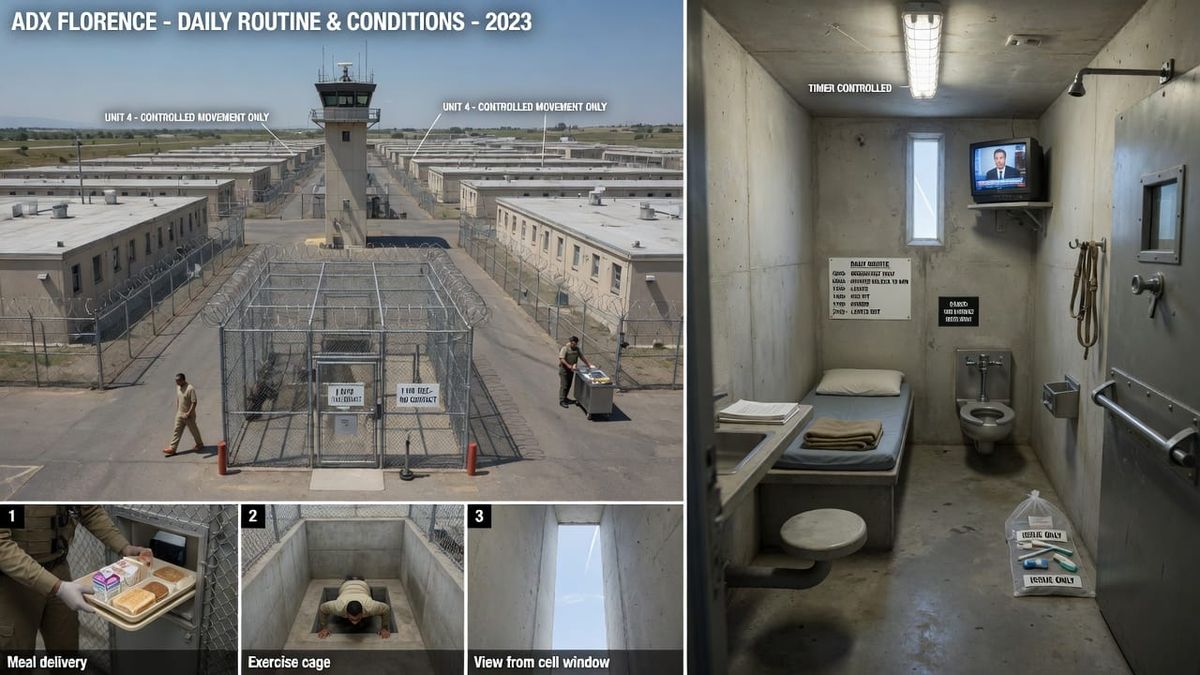

Facility Overview
The United States Penitentiary, Administrative Maximum Facility (ADX Florence) in Colorado is the federal prison system’s most restrictive institution, designed to house inmates deemed extreme security risks or highly dangerous. The 37-acre complex consists of multiple identical housing units arranged linearly around a central control tower, with each unit containing single-occupant cells down one side of the corridor. The rated capacity is approximately 490 inmates (as of 2017, occupancy was ≈87%). All design features prioritize security: cells have only a narrow 42 in×4 in slot window, angled upward to admit daylight but prevent inmates from orienting themselves or seeing other parts of the facility. Furniture and fixtures are fixed or heavy (poured concrete bunk, desk, and stool; combination sink/toilet) to resist weaponization. Movement is tightly controlled: officers deliver meals through food slots rather than communal chow halls, and inmates exercise only in isolated “cages” or concrete pits (the outside yard is a caged “pool” allowing only ~10 straight-line steps or ~31 steps in a circle). This environment reflects the supermax philosophy of permanent isolation and control, isolating each inmate from others and minimizing sensory input to eliminate escape planning or inmate interaction.
Publicly reported notable prisoners housed at ADX Florence, the federal supermax prison in Colorado, include Zacarias Moussaoui, Ramzi Yousef, Abu Hamza al-Masri, Richard Reid, Umar Abdulmutallab, Ahmed Ressam, Simón Trinidad, Sulaiman Abu Ghaith, Mamdouh Mahmud Salim, Mahmud Abouhalima, Mohammed Jabarah, Amor Ftouhi, Abdulrahman El Bahnasawy, Akayed Ullah, Ahmed Abu Khattala, Irek Hamidullin, Ibrahim Suleiman Adnan Harun, Alexanda Amon Kotey, El Shafee Elsheikh, Sayfullo Saipov, Dzhokhar Tsarnaev, and Wadih el-Hage, who are primarily associated with terrorism, jihadist plots, embassy bombings, hostage-taking, battlefield attacks, or attempted mass-casualty attacks. Other notable inmates include Terry Nichols and Eric Rudolph, linked to domestic terrorism and bombing cases; Faisal Shahzad, Naser Jason Abdo, Muhanad Mahmoud Al Farekh, Ahmad Khan Rahimi, Glendon Scott Crawford, Barry Croft, and Frank Robert James, associated with terrorism-related plots, bombing attempts, extremist violence, or mass attacks; Levar Washington, Ruslan Maratovich Asainov, Peter Debbins, Joshua Schulte, Kevin Patrick Mallory, and Jack Teixeira, associated with espionage, classified-information leaks, cybercrime, or national-security offenses; James Marcello, Luis Felipe, Tyler Bingham, Jeff Fort, Gerald Rubalcaba, Joseph Hernandez, Cornelio Tristan, Omar Portee, Kaboni Savage, and Ronald Herron, associated with organized crime, prison gangs, street gangs, racketeering, murder, or witness intimidation; Joaquín “El Chapo” Guzmán, Alfredo “El Mochomo” Beltrán-Leyva, Pedro Gutierrez, Peter Rollock, Dairo Antonio Úsuga, Rubén “El Menchito” Oseguera-González, Arturo Gallegos Castrellon, and Gustavo Colon, associated with major drug-trafficking organizations, cartel leadership, violent trafficking networks, or transnational organized crime; and Fotios “Freddy” Geas, Jessie Con-ui, Dwight York, Paul Bergrin, Dominick Maldonado, Michael Swango, Mikel Edward Brady II, Wisezah Datawn Buckman, Jonathan Michael Monk, Genaro García Luna, and Len Davis, whose cases involve crimes including murder, prison homicide, corruption, child sexual abuse, armed violence, medical killings, law-enforcement corruption, or other serious federal offenses. This list should be treated as a public-source compilation of notable inmates, not as a complete official Bureau of Prisons roster.

Cell Environment
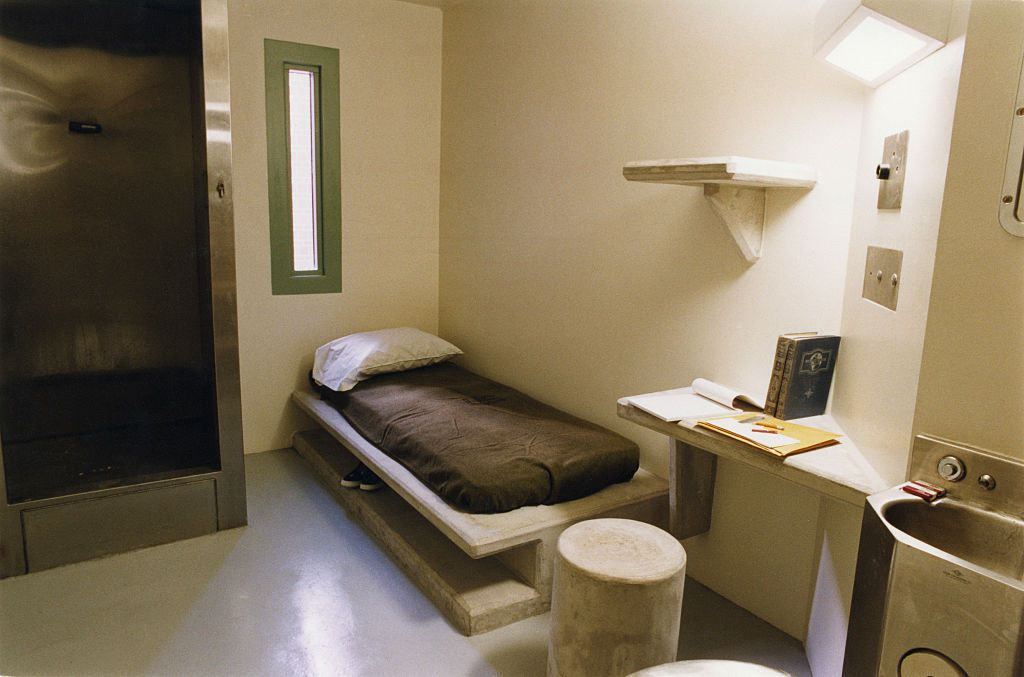
The typical ADX cell is small (approximately 7 ft by 12 ft) and austere. Walls and furniture are solid concrete; lighting is fluorescent and controlled by remote timers. Each cell includes a concrete bunk and desk (no separate chair), a combined stainless-steel sink/toilet unit, and limited storage. The only source of natural light is the narrow window in the door (roughly 42″×4″), which admits daylight but is too small and high up to see anything but sky. All cell doors are heavy solid steel with a small observation slot or “trap” for passing food trays and waste. Inmates may be provided a small radio or television for approved programming, and a fixed wall hook for elastic restraints. Showers are taken in-cell via an overhead nozzle when unlocked by staff, and hygiene (toothbrush, soap, etc.) is performed entirely in this confined space. The physical design maximizes isolation: walls and doors block sound and vision, and the overall sensory environment is stark, windowless (for walls), and confined.
Hour-by-Hour Daily Schedule
A typical day in ADX is highly regimented and spent almost entirely alone. Based on BOP practice and oversight reports, the routine can be summarized as follows (approximate times):
- Early Morning (approx. 5:30–6:00): Lights-on and wake-up. Inmates make their beds and perform personal hygiene in-cell. Overnight sleeping hours are minimal; lights-off usually occurs by evening hours.
- Breakfast (approx. 6:00–7:00): A breakfast tray is delivered through the cell door slot by correctional officers. Inmates eat inside the cell; no group gatherings occur. A brief head-count typically follows, with officers checking unit populations.
- Morning Lockup (7:00–11:00): Inmates remain in their cells with limited activity. They may watch approved TV programs, listen to radio, read, write legal materials, or study. There is generally no recreation until the scheduled slot. The cell door is usually unlocked only for immediate needs (e.g. emergency medical treatment or crisis intervention). Officers perform security rounds, cell inspections, and may allow brief shower periods during this time.
- Midday Exercise/Recreation (11:00–1:00): On a rotating schedule, inmates are escorted one-at-a-time or in very small groups to designated exercise areas. For most units, this totals about 1–2 hours per day (roughly 10 hours per week) split between indoor and outdoor cages. Each movement out of cell requires 3–5 officers; the inmate is strip-searched and cell-shaken-down both before and after the period to prevent contraband. Outdoor recreation areas are small concrete cages; inmates exercise in isolation (in separate cages) but may see a few others at a distance. Control Unit inmates exercise alone in a tiny fenced space (six narrow “holes” with concrete floor). Step-Down/Kilo units offer more open common areas allowing small groups (up to 8) to congregate, but these remain rare privilege tiers. After recreation, inmates are returned to cells.
- Noon Lunch (approx. 12:00–13:00): Lunch trays are delivered via the food slot. Inmates eat alone in their cells. Another formal count is taken (typically mid-afternoon).
- Afternoon Activities (13:00–16:00): Cells remain locked. Inmates may rest, read, watch TV or engage in low-intensity cellcraft (writing, drawing, approved crafts kits). Scheduled mental health check-ins or programming (e.g. educational or counseling sessions) are extremely limited and usually conducted through cell-front windows or occasionally by bringing an inmate to a small review room (often the “law library” cell). Phone calls to attorneys or emergencies are facilitated per unit schedule. Some inmates work modestly (e.g. cell cleaning within the cell, laundry exchanges) under close supervision.
- Dinner (approx. 16:00–17:00): A final meal tray is delivered through the slot. Evening count follows. The day concludes with inmates spending the late afternoon/evening locked down in cells. Many use time for personal correspondence, reading legal materials, or listening to radio. Lights-out is early (around 20:00–21:00) and nighttime checks occur frequently (officers document observations of each inmate roughly every 15 minutes on suicide-watch or at least hourly for general population). All inmates remain locked in their cells from evening until the next morning, except for very short bathroom or medical procedures.
ADX Florence inmates are generally fed under the Federal Bureau of Prisons’ National Menu system rather than a publicly available ADX-specific menu. A representative BOP weekly menu includes basic institutional breakfasts such as fruit, hot cereal or bran flakes, whole wheat bread, jelly, margarine, skim milk, and coffee; lunches such as chicken wraps, burgers or black bean burgers, baked chicken, baked fish, tacos, beans, rice, vegetables, fruit, and beverages; and dinners such as roast beef, turkey roast, Salisbury steak, black bean soup, fajitas, pasta with meatballs or soy sauce, vegetable soup, salad, hummus, potatoes, bread, and beverages. The menu includes no-flesh alternatives such as peanut butter, beans, tofu, hummus, black bean burgers, and soy-based items. In satellite-feeding situations, the BOP menu notes that dry cereal and milk substitutes may replace hot cereal and skim milk, which is relevant to highly controlled housing environments
This rigid 24-hour routine means most ADX inmates spend roughly 22–23 hours per day isolated in their cell. Meals, showers, medical dispensation, and recreation are strictly scheduled and delivered in cell or through doors; virtually all interaction is with staff through controlled interfaces.
Behavioral and Psychological Analysis
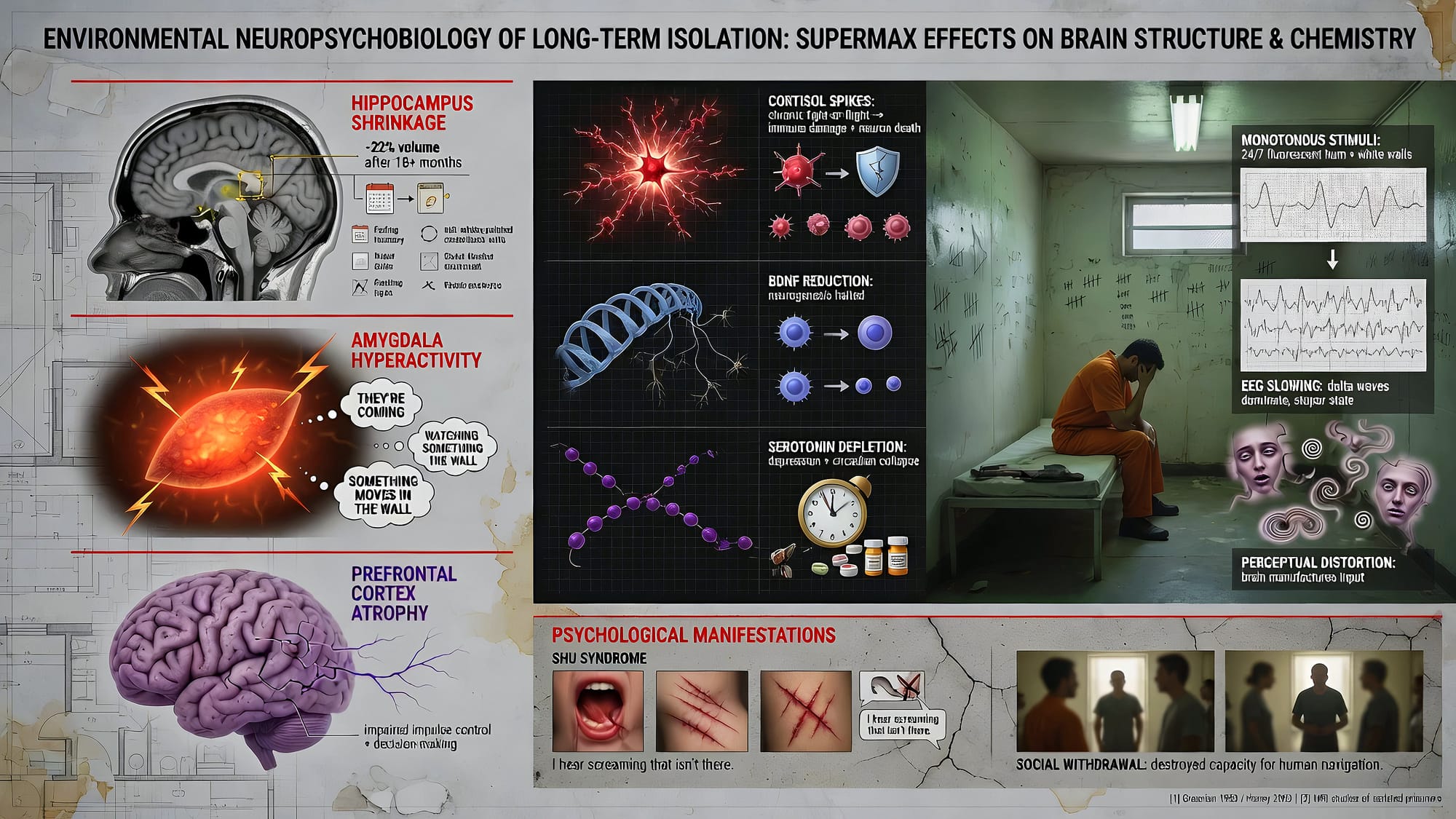
From a clinical perspective, this regime of near-total social isolation and sensory deprivation has profound psychological effects. Empirical research and expert reports document that prolonged confinement under such conditions often leads to anxiety, depression, emotional flattening, irritability, and panic attacks. Sleep disturbances, hypersensitivity to stimuli, and difficulty concentrating are common. Inmates may develop perceptual distortions or hallucinations; the risk of self-harm and suicide is elevated. Anxiety about being “forgotten” or permanently confined can produce paranoia and rage. Executive functions suffer – decision-making, impulse control and working memory degrade as the brain receives little environmental feedback. Long-term isolation can blunt motivation and social skills. One study noted that communities face challenges when ex-inmates return “psychologically damaged beyond repair” by extreme isolation. Emotionally, inmates exhibit heightened stress responses: the HPA axis and cortisol levels often remain chronically elevated, leading to physical agitation or shutdown. Cognitively, lack of stimulation leads to cognitive slowing and memory problems. Overall, supermax confinement creates a chronic traumatic stress environment – repeatedly linked in the literature to lasting mental health deterioration (e.g. persistent anxiety, personality changes).
Operational Rationale (Penology)
ADX’s routines and restrictions are deliberate applications of control theory and extreme risk management. The policy rationale is selective incapacitation: inmates who cannot be managed in ordinary prisons are isolated to eliminate risks to staff, other inmates, and security. By design, ADX ensures that no inmate has unsupervised contact with another. Every movement is tightly supervised; for example, it requires multi-officer teams and cell searches to escort one inmate to recreation. The cell and unit design (solid doors, minimal windows, individual cages) precludes planning or collaboration. All amenities (meals, communication, recreation) are privileges granted; denying them is meant as both punishment and security precaution. This aligns with traditional “administrative segregation” theory: severe restrictions prevent violence and escape while housing perpetrators of violence, terror, or repeat discipline violations. Historical penology literature characterizes supermax as housing the “threat to safety and security” who can be controlled only by isolation. In practice, ADX routines – round-the-clock counts, cell shakedowns, frequent briefings – maintain accountability and eliminate opportunities for disorder. The step-down program (STAGES) is the only concession, meant to gradually restore privileges to inmates who prove compliant; otherwise, the entire regimen is justified as necessary to “control inmates only controllable by separation”.
Communication and Social Isolation
Communication is extremely restricted. Inmates have no email or internet, and all mail and calls are monitored. All correspondence is processed through the Receiving/Discharge unit. Legal mail is supposed to be opened in the inmate’s presence, but reports indicate instances of mail (even legal correspondence) arriving opened. Outside mail and outgoing letters are subject to prolonged delays (commonly 2–3 weeks, sometimes months) due to intensive security screening by the Special Investigative Service (SIS). Telephone access is minimal: Control Unit inmates get two 15-minute domestic calls per month, and General Population inmates get three (Step-Down inmates may earn a few more). Calls are costly and monitored; many inmates report being cut off from telephones as a disciplinary sanction. Visitation is entirely non-contact and infrequent: barriers or booths separate inmates and visitors. Visits occur only a few days per week in a distant, remote facility, and only one controlled-unit inmate at a time may visit, all through plexiglass and phone. Attorney visits occur in small glassed rooms where confidentiality may be compromised by surrounding offices. These restrictions create intense social isolation: inmates rarely see family or friends, cannot physically embrace or converse except through glass. Psychologically, this leads to feelings of extreme loneliness and alienation. The near-total lack of social support and human contact undermines hope, increases stress, and exacerbates mental health issues. Inmates often say that the only human contact is with officers during forced moves or counts. The prohibition of association also ensures any disruptive designs must be entirely internalized; there is no community or subculture to organize.
Recreation and Movement
Recreation is offered only during the scheduled out-of-cell periods. Outside those hours, an inmate’s physical activity is limited to what can be done in a 7×12 cell (e.g. push-ups, sit-ups, walking in place). The total out-of-cell recreation is very low (typically 2 hours per weekday, 10 hours weekly, alternating indoor and outdoor). The outdoor recreation yard for general population consists of several small cement cages under a corrugated-steel roof, each just large enough to pace (ten or so steps). Inmates are locked in their own cage alone but can see a limited number of others in adjacent cages, though at fixed distance. Control-Unit inmates use a different outdoor area of six very narrow enclosures (“bubbles”) where only floor space is provided, effectively mandatory solitary exercise. Indoor recreation rooms (common areas) exist but remain locked for most inmates; only lower-restriction units (Step-Down, Kilo) may use common rooms together under supervision. Staff escort procedures are elaborate: each rec escort involves multiple officers who first restrain or frisk the inmate, conduct a cell and person search, and then reverse the process on return. This is intended to prevent contraband introduction. The extreme limitation on movement and exercise space means inmates effectively spend virtually all day motionless or in minimal activity, contributing to deconditioning and stress. Psychologically, even this limited outdoor time may offer brief relief, but separation by cages prevents normal socialization; inmates remain acutely aware of their isolation even during recreation.
Staffing and Oversight
ADX Florence is heavily staffed relative to its population. Reports indicate a staff-to-inmate ratio of about 1.22:1, reflecting the intensive supervision requirements (officers rotate in 24-hour shifts, with multiple officers stationed in each unit at all times). The unit team for each cellblock typically includes a Unit Manager, Correctional Officers, and case managers. Correctional Officers conduct all security operations: they perform count procedures (often every shift and random checks), deliver meals, escort inmates to appointments or recreation, and supervise every aspect of daily living. Officers conduct frequent cell inspections and maintain constant radio contact. Psychology Services at ADX consists of a chief psychologist, several staff psychologists and technicians exclusively assigned to ADX, plus tele-psychiatrists. Given the lockdown environment, psychologists conduct rounds at least twice weekly, and provide mental health care mainly via written self-help packets, recorded videos on the inmate TV system, and a limited number of one-on-one sessions by phone or brief face-to-face at the cell door. Medical personnel (doctors, nurses) provide routine health checks in cells and manage any chronic care (often via “pill line” through doors). There are also chaplains, a small administrative staff, and support staff (food service, maintenance, education), but inmates have virtually no free labor assignments. Oversight is constant: an on-site warden and national BOP officials review facility operations. Internal audits, court monitors (via litigated suits), and external observers (e.g. Department of Justice Civil Rights Division) scrutinize ADX policies. This staffing model emphasizes security first; even health and counseling staff operate under restrictive protocols (e.g. always having officers nearby). Psychology services notes that due to the lockdown, nearly all contact is non-traditional, reinforcing that the inmate’s daily life is framed by security staff rather than by treatment providers.
Legal and Human-Rights Evaluation
ADX operations have been subject to constitutional scrutiny under the Eighth Amendment (prohibition on cruel and unusual punishment) and other legal standards. No federal court has declared supermax confinement per se unconstitutional, but courts have occasionally found BOP practices violative when extreme abuse is documented. For example, litigation (Cunningham/Bacote) has challenged housing mentally ill inmates in ADX, resulting in policy changes. However, ADX conditions themselves have mostly evaded successful Eighth Amendment challenges – courts typically require proof of deliberate cruelty. In practice, ADX has undergone administrative remedy reviews rather than judicial overhaul. Human rights advocates argue ADX conditions violate international norms: the United Nations Special Rapporteur on Torture (Juan Mendez) declared that any regime of solitary beyond 15 days can amount to torture or ill-treatment, and that prisoners with serious mental illness should never be held in such isolation. Amnesty International and other observers have similarly warned that prolonged ADX confinement violates the UN Convention Against Torture and customary prohibitions on cruel, inhuman, or degrading treatment. Domestically, ADX has been criticized in reports and policy forums but has not been abolished; instead the DOJ has emphasized “last resort” use and initiated limited reforms (like the Step-Down program). The legal review also considers due process of the administrative segregation system (inmates receive periodic reviews to earn privileges). To date, cases challenging ADX rely on specific issues (deliberate indifference to medical needs, excessive use of restraints, etc.) rather than the isolation per se. In summary, ADX conditions push boundaries of accepted practice: while not formally banned by U.S. law, they sit at the edge of constitutional tolerability and remain highly controversial in human rights discourse.
Long-Term Outcomes
Both clinical and institutional outcomes of prolonged ADX placement are serious. Psychologically, inmates housed for years in supermax frequently exhibit chronic mental health decline. Longitudinal research (outside the federal system) associates extended solitary with permanent deficits: memory loss, severe emotional dysregulation, high rates of paranoia and hallucinations, and increased suicide risk. Former inmates have reported lasting trauma, requiring intensive therapy after release (which remains rare for most federal lifers). Upon re-entry to less secure settings, ADX inmates often have difficulty adjusting to normal social cues and routines; anecdotes note excessive distrust and inability to handle minor frustrations, leading to further disciplinary problems. A public health analysis warned that society ultimately bears the burden of releasing individuals “psychologically damaged beyond repair” by isolation. Institutional outcomes include an atmosphere of hypervigilance and pessimism: recurrent incidents of self-harm and assaults on staff can reflect deepening pathology. Staff turnover and burnout is also a concern given the demands of working in such an environment, though correctional officer training emphasizes the unique nature of supermax custody. In sum, the clinical prognosis for inmates subjected to years of ADX confinement is poor: many emerge with chronic psychiatric or neurological impairments. Penologically, the long-term effect is a segment of the prison population effectively warehoused, requiring continual high-security supervision. Policy analysts note that without effective mental health intervention, ADX populations trend toward even higher security needs or litigations, creating a self-perpetuating cycle of control. Any reduction in restrictions (the Step-Down initiative) is still in early stages; the overall institutional result remains a legacy of extreme isolation with lasting human consequences.
Sources: Official Bureau of Prisons materials, oversight and inspection reports, and published corrections research were consulted (see citations). All information above is drawn from documented procedures, empirical studies, and legal/human-rights analyses.