Drumming in the Forest: The Life and Legacy of the Ruffed Grouse
Known as the “drummer of the woods,” the Ruffed Grouse is more than a symbol of the wilderness — it is a keystone species, a culinary delicacy, and a test case in sustainable forestry.
Introduction
In the hushed stillness of a northern forest, a rhythmic sound breaks the silence — like a muffled drum echoing through the trees. This is not the work of human hands but the wingbeats of the Ruffed Grouse, Bonasa umbellus. For centuries, this bird has captivated hunters, chefs, and naturalists alike. Known as the “drummer of the woods,” the Ruffed Grouse is more than a symbol of the wilderness — it is a keystone species, a culinary delicacy, and a test case in sustainable forestry.
Taxonomy
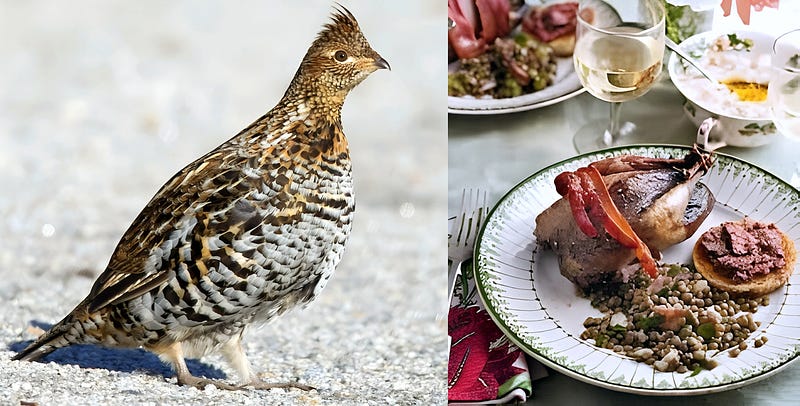
The Ruffed Grouse belongs to the family Phasianidae, alongside pheasants, quail, and turkeys. Its scientific name, Bonasa umbellus, refers to the ornate ruff of feathers around its neck, flared during displays. Several subspecies are recognized across North America, each adapted to local conditions, from the darker birds of the Appalachian forests to the paler, cinnamon-toned grouse of the western ranges. Common names include “partridge” in New England and “birch hen” in the Great Lakes region, though it is neither a true partridge nor a hen. Unlike domestic breeds, it remains entirely wild and untamed, its flavor and presence shaped by its environment.

Biology
Compact and robust, the Ruffed Grouse measures about 16 to 19 inches (41–48 cm) in length and weighs between 1 and 1.5 pounds (0.45–0.68 kg). Its mottled plumage — ranging from gray to russet — blends seamlessly with leaf litter and bark. Its most famous adaptation is its drumming courtship display: males perch on a fallen log, rapidly beating their wings to create a deep, accelerating thrum that can carry up to a quarter mile (0.4 km). Grouse are also remarkable for their seasonal dietary shifts, eating insects, buds, and berries in summer, then subsisting on the tough catkins of aspen and birch during the frozen months.
Ecology
The Ruffed Grouse is a master of early successional forests — those renewing stands of aspen, birch, and alder that follow fire or logging. It depends on dense understory for cover and open patches for feeding, making it a barometer of forest health. Populations rise and fall in mysterious 8- to 11-year cycles, influenced by predation, food supply, and climate. Conservationists worry about habitat loss, as modern forestry practices reduce the mosaic of young forest the grouse requires. Sustainable logging, controlled burns, and set-aside habitat management remain crucial to its survival.
Uses
Economically, the Ruffed Grouse holds a revered place in North American hunting tradition. It is considered one of the most challenging upland game birds, prized for its explosive flush that tests even the sharpest reflexes. Grouse hunting supports rural economies through license fees, guided hunts, and tourism. Beyond economics, it plays a role in cultural identity — appearing in Indigenous lore, settler hunting journals, and modern conservation campaigns. Sustainability hinges on habitat stewardship: healthy forests, not just hunting quotas, determine the species’ long-term abundance.
Culinary Aspects
On the plate, Ruffed Grouse has long been celebrated as one of the finest game meats. Its flesh is lean, with a flavor described as a blend of chicken and pheasant, enriched by the bird’s wild diet of berries and forest greens. When roasted whole, a grouse offers tender white breast meat and darker legs with a subtle gaminess. Traditional preparations include roasting with wild mushrooms, braising with cream and brandy, or serving alongside autumn root vegetables. The bird is best enjoyed fresh, as freezing can diminish its delicate texture. Nutritionally, it provides lean protein, essential amino acids, and a taste of the wilderness that farmed poultry cannot replicate.
Wine Pairings
Pairing wine with Ruffed Grouse is a lesson in balance. Its earthy, berry-tinged flavor harmonizes beautifully with Pinot Noir, especially from Oregon or Burgundy, where subtle tannins and bright red fruit enhance the bird’s natural diet. A Syrah from the northern Rhône, with smoky undertones, also complements roasted preparations. For white wine lovers, an oaked Chardonnay or a dry Riesling provides acidity to cut through richness while matching the grouse’s woodland delicacy. As with the bird itself, the ideal pairing honors both restraint and wildness.
Conclusion
The Ruffed Grouse is more than a woodland curiosity — it is a living emblem of the interconnectedness of ecology, culture, and cuisine. From its drumming displays in spring to its place on autumn tables, it reminds us that wildness thrives only when humans steward it wisely. To preserve the grouse is to preserve a rhythm of life in northern forests, one that has echoed for millennia and deserves to echo still.