The Aid Trap in Africa: Elite Capture, Patronage, and the Limits of External Assistance
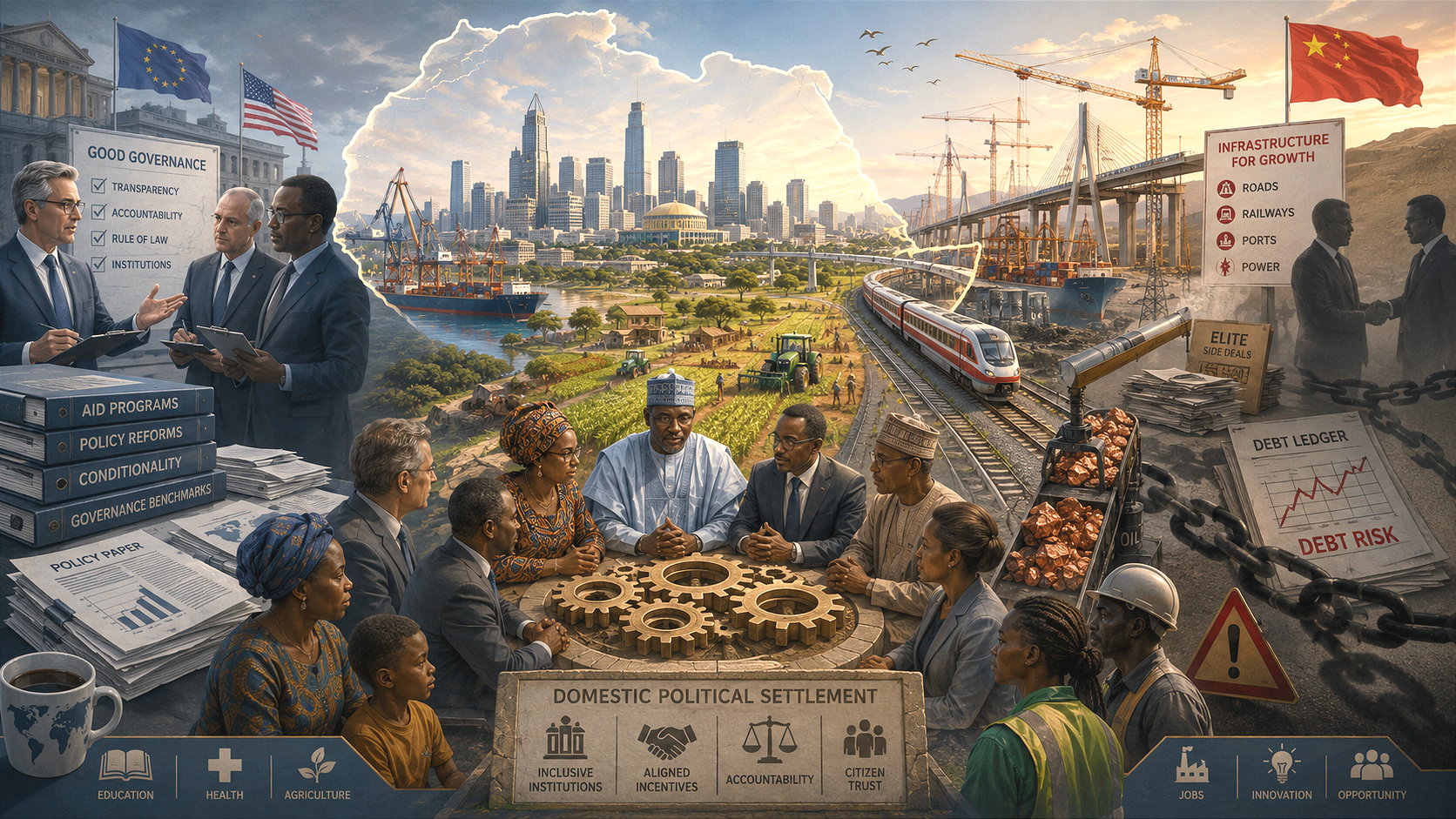
Elite capture, patronage, and weak accountability mean external aid often entrenches existing power structures in many African states; without domestic checks, outside money reinforces the very actors and practices that obstruct broad‑based development.
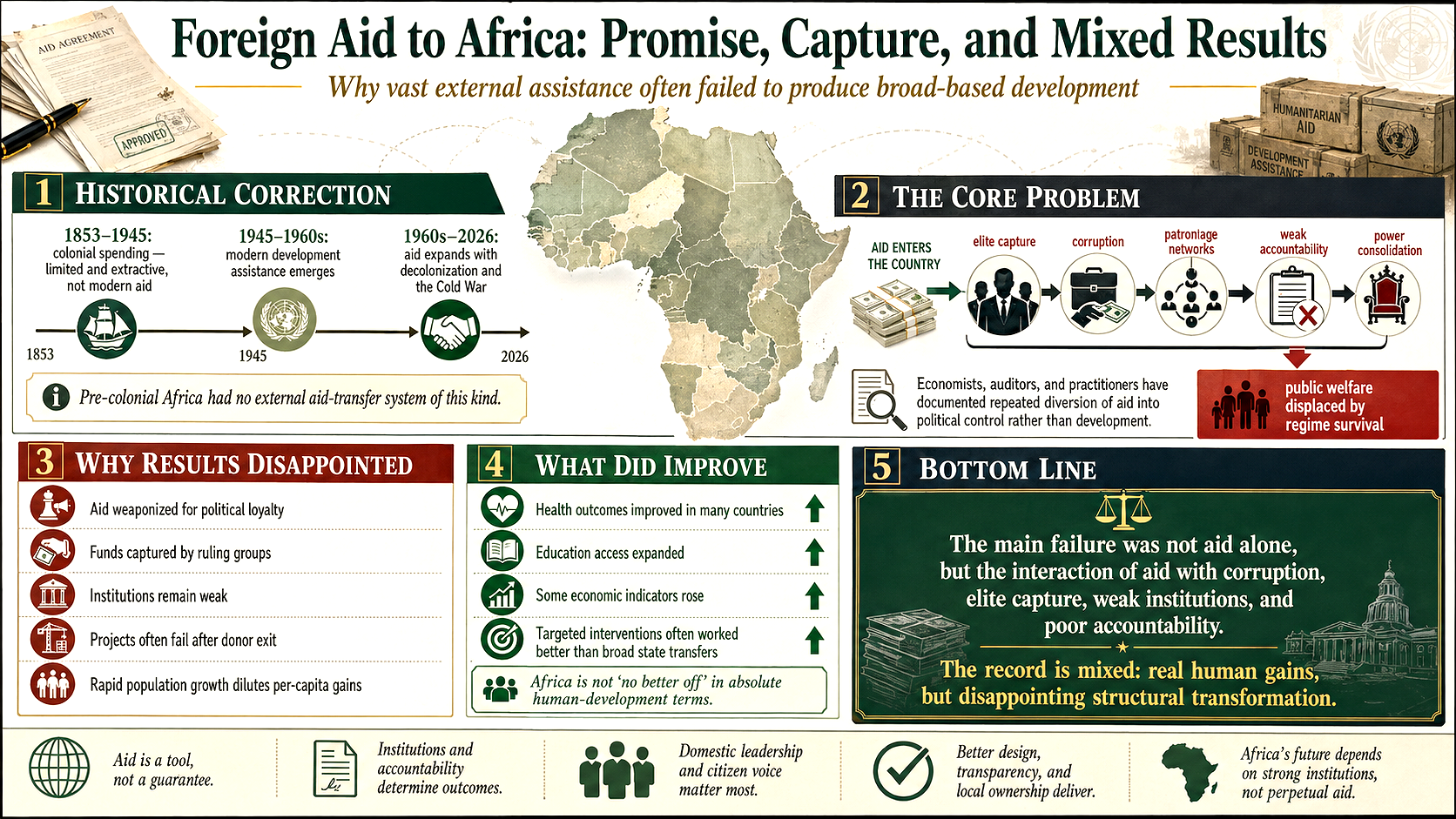
Foreign aid to Africa has often failed to produce sustained, broad-based development because recipient governments and political elites have repeatedly captured, diverted, or weaponized it for power consolidation rather than public welfare. This is not a fringe claim; it is documented across decades by economists, auditors, and development practitioners. However, the requested framing of a seamless 170-year “aid system” from 1853 to 2026 requires important corrections for accuracy. Systematic modern development assistance emerged primarily after World War II and accelerated with decolonization and the Cold War. Colonial-era spending was limited, extractive in purpose, and not framed as “aid.” Pre-colonial Africa had no such external transfer system.
The core pattern the prompt highlights—corruption, patronage networks, elite capture, nonexistent accountability, and the reinforcement of ruling groups—is real and central to why trillions in cumulative assistance have delivered disappointing structural results in much of sub-Saharan Africa. At the same time, objective metrics show real progress in health, education, and some economic indicators since the 1960s, partly aided by targeted interventions. Africa is not “no better off today” in absolute human development terms, though per-capita gains have been modest due to rapid population growth and persistent institutional weaknesses.
Historical Timeline: Not a Single Continuous System
- Pre- and early colonial period (mid-19th century): European contact involved exploration, trade, missionary work, and eventual conquest. There was no organized “aid” apparatus. Missionary education and health efforts provided some human capital foundations, but the dominant dynamic was extraction.
- Late colonial era (especially post-1940): Colonial powers (Britain, France, Belgium, Portugal) introduced limited development spending via acts such as Britain’s Colonial Development and Welfare Acts. Infrastructure served administration and resource export more than broad welfare. This was imperial budgeting, not modern concessional aid.
- Cold War and early independence (1960s–1980s): Decolonization created dozens of new states. Aid surged as the US, USSR, and former colonizers competed for influence. Much of it was geopolitical—propping up aligned regimes regardless of governance quality. Examples include US support for Mobutu in Zaire despite rampant theft.
- Post-Cold War to present (1990s–2026): Emphasis shifted toward governance conditionality, debt relief (HIPC), Millennium/Sustainable Development Goals, and vertical health programs. China emerged as a major player with infrastructure loans often tied to resources. Volumes remained high, but fragmentation among donors, NGOs, and vertical funds persisted. Trillions (in constant dollars) have flowed since the 1960s–1970s.
The continuity is not in a single “aid system” but in the recurring incentive problem: external resources flowing to unaccountable governments create opportunities for capture.
Elite Capture and the Political Economy of Aid
Leaders in many African states have treated aid and resource rents as personal or factional assets rather than public capital. Classic cases include:
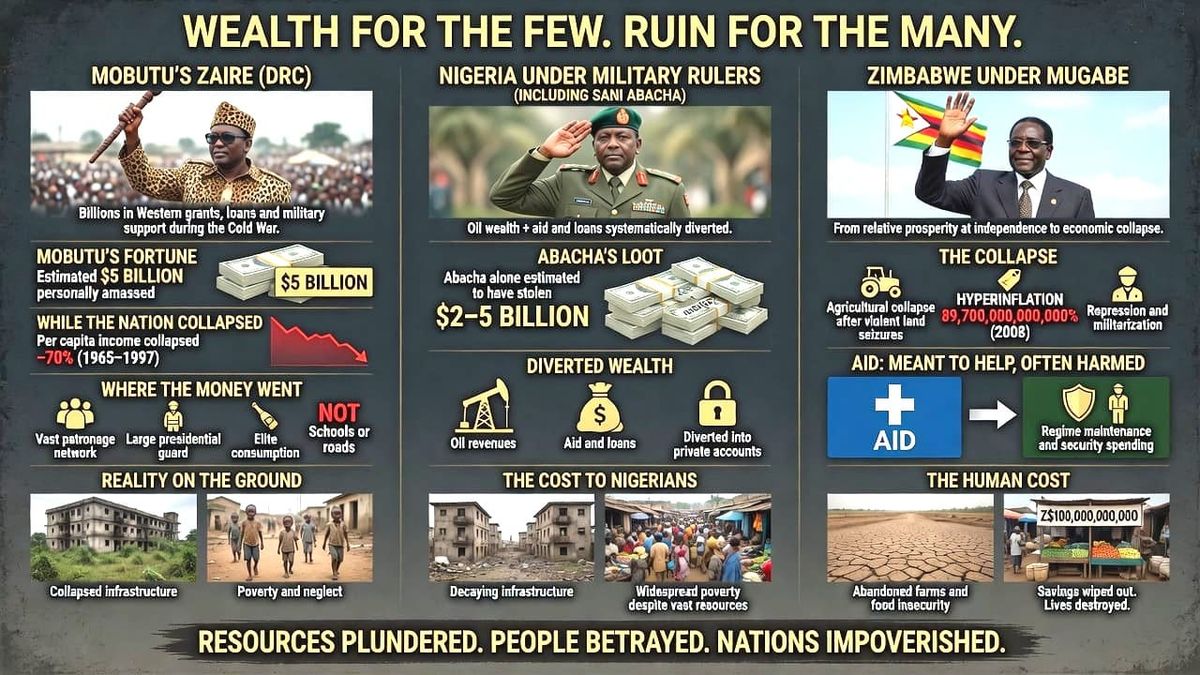
- Mobutu’s Zaire (DRC): The regime received billions in Western grants, loans, and military support during the Cold War. Mobutu personally amassed an estimated $5 billion fortune while per-capita income collapsed and infrastructure decayed. Aid and mineral revenues funded a vast patronage network, a large presidential guard, and elite consumption rather than schools or roads.
- Nigeria under military rulers (including Sani Abacha): Oil wealth plus aid and loans were systematically diverted. Abacha alone is estimated to have stolen billions.
- Zimbabwe under Mugabe: From relative prosperity at independence, the country experienced agricultural collapse after violent land seizures, hyperinflation, and repression. Aid was often ineffective or absorbed into regime maintenance and security spending.
These are not isolated anecdotes. Studies and audits repeatedly show aid projects skewed toward politically connected regions or groups, contracts awarded to allies, and funds siphoned through ghost projects, inflated procurement, and offshore accounts. Patronage politics—distributing jobs, contracts, subsidies, and projects to secure loyalty from key ethnic, regional, or military constituencies—takes precedence over impersonal public goods or long-term investment.
Accountability stayed weak because aid reduces the need for broad taxation. When governments rely on external transfers or commodity rents instead of taxing citizens, the classic accountability link (“no taxation without representation”) weakens. Citizens have less leverage; rulers answer more to donors or their own networks than to a taxpaying public. Parliaments, courts, and media in many states lacked independence or were actively undermined. Even when donors attached conditions, enforcement was inconsistent—geopolitical interests, bureaucratic disbursement pressures, and fears of instability often prevailed.
Why the Pattern Persisted Across Eras
Cold War funding explicitly prioritized alignment over governance. Post-Cold War rhetoric on ownership and results often gave way to the same dynamics because donors needed to spend, show activity, and avoid “aid orphans.” Proliferation of donors and NGOs created coordination failures and opportunities for governments to play actors against each other. Vertical programs (vaccines, HIV treatment via PEPFAR, bed nets) sometimes delivered measurable health gains precisely because they could operate with tighter controls or bypass some layers of capture.
Leaders rationally used available resources for political survival. In fragmented societies with artificial colonial borders, ethnic or regional clientelism became a low-cost way to maintain coalitions. Aid and rents provided the fuel. Structural change—secure property rights, impersonal rule of law, competitive markets, high human capital, fiscal capacity—threatens these arrangements because it empowers outsiders and reduces discretionary control.
Progress That Did Occur—and Its Limits
It is factually incorrect to claim Africa as a whole is “no better off today.” Since around 1960:
- Life expectancy rose substantially (from roughly 40–42 years to over 60, with variation and temporary HIV-related setbacks in some countries).
- Child mortality fell dramatically, especially post-2000.
- Literacy and school enrollment increased markedly.
- Combined GDP grew, and some countries (Botswana, Mauritius, Ghana, Rwanda in recent periods, Ethiopia at times) achieved sustained growth episodes.
Targeted aid contributed to some of these gains, especially in health. Technology diffusion (mobile phones, fintech) and domestic policy reforms in better-governed settings also mattered. Per-capita income growth, however, has been modest and volatile because population growth has been rapid and because many economies have not achieved the productivity transformation seen in East Asia. Extreme poverty remains high in aggregate, and institutional quality lags in much of the region.
The gains are real but fragile and uneven. They have not produced the self-reinforcing cycle of inclusive institutions, high savings/investment, and broad-based prosperity in most countries. In that narrower but crucial sense, aid has largely failed to catalyze structural change where governance was extractive.
Counterexamples and What They Show
Botswana managed diamond revenues with relative transparency and prudent policy under leaders who prioritized national development and maintained accountable institutions rooted partly in pre-colonial traditions. Mauritius built strong institutions and diversified its economy. Rwanda has posted strong growth post-1994 through state capacity and investment climate improvements, though governance remains highly centralized. These cases show that leadership choices and institutional constraints matter enormously. Aid and resources amplified positive trajectories when paired with them; they could not create the trajectories themselves.
Implications
The pattern of elite capture, patronage, and weak accountability explains much of why aid has reinforced rather than transformed many African political economies. External money without domestic accountability mechanisms tends to entrench the very groups and practices that block broad development. Donor practices—geopolitical motivations, supply-driven spending, weak enforcement—have compounded the problem rather than solving it.
Sustainable progress requires internal political and institutional change: stronger constraints on power, genuine fiscal accountability (taxation that links citizens to performance), secure property rights, and incentives for leaders to invest in broad-based growth rather than narrow extraction. Reduced aid dependence in favor of domestic revenue mobilization, private investment, and trade can help shift incentives. Targeted assistance for verifiable results in health, education, infrastructure, or climate adaptation can still add value when designed to limit capture—results-based financing, direct community support, or support for reformers rather than unconditional budget support to captured systems.
China’s resource-for-infrastructure model offers an alternative with fewer governance lectures but introduces its own risks of debt and elite deals. Ultimately, no external actor substitutes for domestic political settlements that align elite incentives with national development.
The evidence supports focusing on governance failures and elite incentives as central to aid’s disappointing record. It does not support ignoring measurable human development gains or pretending the story is a simple, unbroken 170-year cycle of identical failure. The challenge remains building institutions that make power serve the many rather than the few who control the state. That task is African above all; external resources can assist or hinder depending on how they interact with local political realities.