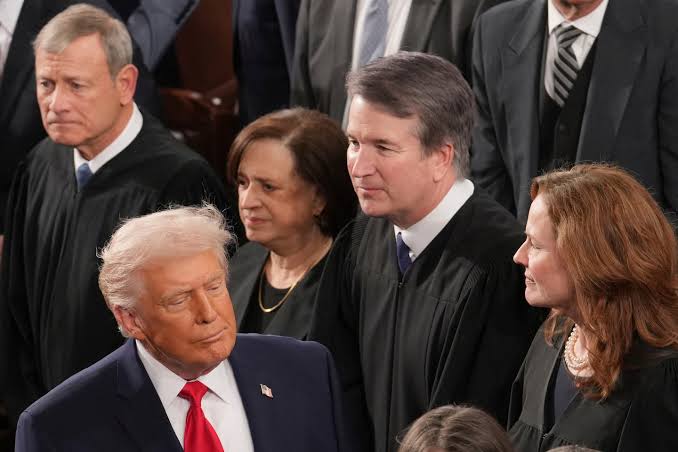
The Fatal Remedy: A Comprehensive Inquiry into the Impeachment of Supreme Court Justices
The Constitutions' impeachment clause is a relic that cannot tame a modern judicial Leviathan; when the Court legislates from the bench, the Republic demands a living remedy, not a dead letter, to reclaim democracy from activist judges.
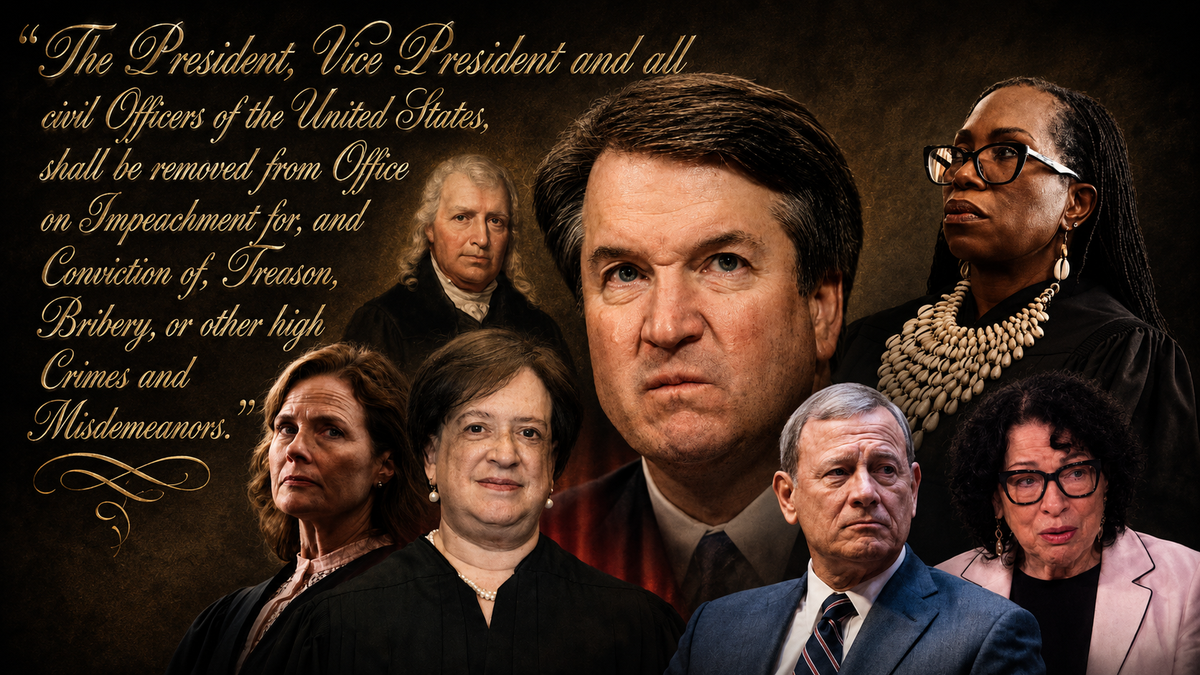
The President, Vice President and all civil Officers of the United States, shall be removed from Office on Impeachment for, and Conviction of, Treason, Bribery, or other high Crimes and Misdemeanors.
Supreme Court justices have been understood since the founding as falling squarely within the category of "civil Officers of the United States."
Part One — The Constitutional Reckoning
Abstract
The impeachment of Supreme Court justices occupies a fraught and largely uncharted territory within American constitutionalism, a mechanism at once foundational to the separation of powers and deeply corrosive of judicial independence. This report undertakes a comprehensive examination of the legal, historical, political, and ethical dimensions of judicial impeachment, interrogating its function as both a democratic safeguard and a potential instrument of raw political reprisal. By tracing the origins of the “good Behaviour” standard, analyzing the sparse historical record of impeachment proceedings against federal judges, and deconstructing the procedural ambiguities that render the process susceptible to partisan weaponization, the analysis exposes a fundamental tension at the heart of the Republic. The report argues that the very availability of impeachment, however rarely deployed, operates as a latent structural threat that shapes judicial behavior and the Court’s institutional legitimacy. Comparative perspectives from other constitutional democracies, which have largely abandoned legislative removal of high court judges in favor of disciplinary tribunals or fixed terms, illuminate the anomalous and increasingly destabilizing nature of the American model. Ultimately, this inquiry concludes that while the impeachment power remains a constitutionally indispensable last resort against profound individual corruption, its contemporary invocation as a tool for ideological correction represents a democratic pathology that risks collapsing the distinction between judicial accountability and judicial subjugation.
Introduction
The Supreme Court of the United States sits at the apex of a democratic system that simultaneously reveres and resents its authority. Entrusted with the final word on constitutional meaning, the justices wield enormous power over the lived realities of a diverse nation, yet they remain, by design, the branch least accountable to the electorate. Life tenure during good behavior was intended to insulate the judiciary from the transient passions of popular will, securing a forum of principle above the political fray. Precisely because the Court’s legitimacy rests so heavily on the perception of its detachment from partisan strife, the constitutional mechanism for removing a sitting justice—impeachment by the House of Representatives and conviction by the Senate—stands as the system’s most volatile and least understood emergency brake. The impeachment of a Supreme Court justice is not merely a legal proceeding; it is a constitutional earthquake that tests the tensile strength of democratic institutions and the public’s faith in the rule of law. In an era of deep polarization, where the Court’s composition has become a flashpoint of electoral politics and its decisions perceived as super-legislative acts, the specter of impeachment has migrated from the margins of academic speculation to the center of public discourse. This report seeks to dissect the impeachment power with surgical precision, exposing its internal contradictions, its historical undercurrents, and its profound implications for the survival of an independent judiciary in a raging democratic storm.
The Constitutional Architecture of Judicial Removal
The Framers embedded the removal of judges within a terse and cryptic textual framework that deliberately invites interpretive struggle. Article III, Section 1 declares that judges “shall hold their Offices during good Behaviour,” a phrase lifted from English practice that implied a tenure terminable not at the sovereign’s pleasure but upon a finding of serious misconduct. Article II, Section 4 extends the impeachment power to “all civil Officers of the United States” for “Treason, Bribery, or other high Crimes and Misdemeanors,” a formulation that explicitly includes the judiciary within its reach. The intersection of these two provisions creates a constitutional paradox: judges serve for life, yet that life tenure is explicitly conditioned on behavior that can trigger removal by the political branches. This architecture reveals a deliberate compromise between the necessity of an independent judiciary and the equally compelling necessity of a mechanism to purge it of irredeemable corruption or abuse. The “good Behaviour” standard was widely understood at the founding not merely as a synonym for the criminal impeachable offenses but as a broader ethical mandate encompassing judicial fidelity to the core functions of the office. The records of the Constitutional Convention and the ratification debates suggest that the Framers feared a judiciary that could become a self-perpetuating oligarchy or a tool of foreign intrigue, and they trusted the impeachment process as a republican insurance policy against such capture. Yet that same record reveals a conspicuous failure to define the precise relationship between “good Behaviour” and “high Crimes and Misdemeanors,” bequeathing to posterity a constitutional gap through which raw politics has periodically poured. The scholarly consensus, distilled from the intent of the Framers and the logic of separated powers, posits that the impeachment of a judge must rest on conduct that fundamentally betrays the judicial oath, strikes at the integrity of the adjudicative process, or renders the judge unfit to continue holding the public trust. What that consensus cannot supply is a principled firewall against the human temptation to convert profound interpretive disagreement into a claim of moral or professional unfitness.
The Historical Record of Judicial Impeachment: A Chronicle of Caution
The empirical history of impeachment in the federal judiciary offers a narrative less of aggressive legislative purges than of a systemic and deeply engrained reluctance to disturb judicial tenure. Since the founding, the House of Representatives has impeached a mere fifteen federal judges, a figure that includes district, circuit, and specialized court judges but notably only a single Supreme Court justice, Samuel Chase, in 1804. The Senate has convicted only eight of those impeached judges, all from the lower courts, and has never removed a Supreme Court justice via conviction. This striking numerical asymmetry between the vast universe of potential judicial misbehavior and the vanishingly small number of completed removals speaks to a powerful institutional norm. The Chase impeachment stands as the pivotal, and in many ways the constitutive, event in the life of the judicial impeachment power. Chase, a fiercely partisan Federalist, had engaged in blatantly political haranguing from the bench, including grand jury charges that attacked the Jeffersonian Republicans and their repeal of the Judiciary Act of 1801. His impeachment by the House, driven largely by President Jefferson’s fury at an entrenched Federalist judiciary, was widely understood as a proxy war over the very nature of judicial independence. The Senate’s acquittal of Chase in 1805, engineered by moderate Republicans who broke ranks with the administration, established a precedent of enormous gravitational force: impeachment would not lie for mere political or ideological disagreement, and removal required proof of serious, indictable-like misconduct rather than judicial intemperance or partisanship. This acquittal has been canonized as a cornerstone of judicial independence, a shield that has largely protected Supreme Court justices from removal efforts for over two centuries. Subsequent lower court impeachments and convictions have uniformly involved demonstrable criminality, such as bribery, tax evasion, perjury, or egregious abuse of the contempt power, reinforcing the norm that only behavior that would disgrace any public officer warrants the ultimate sanction. The historical record, therefore, reveals a working constitution in which the impeachment power has functioned as a narrowly tailored scalpel for excising individual corruption, not as a broad sword for reordering the ideological orientation of the courts. Yet the stability of this precedent rests on a fragile foundation of political forbearance, not on any textual or jurisprudential barrier to a more expansive deployment.
Procedural Ambiguity and the Conditions for Partisan Weaponization
The Constitution’s procedural skeleton for impeachment leaves a vast corpus of unanswered questions, creating a procedural vacuum that contemporary polarization eagerly fills with partisan logic. The House enjoys the sole power of impeachment, but the Constitution is silent on the process by which articles of impeachment are drafted, investigated, and reported. In modern practice, the House Judiciary Committee has typically undertaken an inquiry, but there is no legal requirement that any particular quantum of evidence be gathered, that the accused be afforded the right to counsel during the investigation, or that a standard of proof akin to criminal proceedings be observed. The House operates essentially as a grand jury and prosecutor fused into one, governed by its own rules that can be changed by a simple majority at any moment. The Senate, for its part, is charged with the trial, yet the Constitution offers only the barest of theatrical instructions: senators must be on oath or affirmation, the Chief Justice presides when the President is tried, and conviction requires two-thirds of the members present. For the trial of an impeached Supreme Court justice, no provision mandates the Chief Justice’s recusal despite the obvious institutional conflict, nor does any rule dictate the admissibility of evidence, the scope of cross-examination, or the standard of review. The Senate has historically fashioned trial procedures via a resolution adopted at the outset of each impeachment, a practice that renders every proceeding a potentially bespoke political instrument. The most profound ambiguity concerns the substantive threshold for conviction. The phrase “high Crimes and Misdemeanors” has been the subject of centuries of learned disputation, with some originalists arguing that it requires a violation of established criminal law akin to treason and bribery, and others emphasizing the English parliamentary history in which the term encompassed a broad range of political offenses against the state. In the judicial context, the question intensifies: does a pattern of decisions that systematically distort the law to achieve a political end, without proof of personal corruption, constitute a high misdemeanor? Can a justice’s documented ethical lapses, such as failure to recuse from cases involving significant personal or familial financial interests, rise to the level of an impeachable offense even in the absence of a criminal quid pro quo? The absence of binding, justiciable answers to these questions transforms the impeachment process into a fundamentally political judgment, one in which the ultimate standard is not legal clarity but the sufficiency of senatorial outrage. In a hyperpolarized environment, this procedural and substantive indeterminacy becomes an invitation to constitutional brinkmanship, where a determined political majority can construct a plausible narrative of unfitness from raw ideological opposition and clothe a political execution in the somber garb of constitutional duty.
The Ethical Frontier and the Recasting of Impeachable Conduct
The contemporary crisis of judicial legitimacy has increasingly focused on ethical transgressions that fall into a gray zone between criminality and mere impropriety, testing the boundaries of the “good Behaviour” standard. Revelations concerning undisclosed gifts, luxury travel, real estate transactions with parties appearing before the Court, and a perceived pattern of non-recusal in cases with personal financial entanglements have eroded the myth of the Court as a pristine institution operating above the ethical fray. Unlike lower federal judges, Supreme Court justices have historically not been bound by a formally codified code of conduct, a state of exception only recently and partially addressed by an internal statement of principles that lacks any enforcement mechanism. This ethical vacuum raises the provocative question of whether systemic and willful disregard for the appearance of impartiality could, in an extreme case, constitute the kind of behavior that renders a justice unfit to hold office, even if it does not meet the strict definition of a criminal act. The argument for impeachment under such circumstances draws strength from the textual commitment to “good Behaviour,” which on its face implies a standard of official rectitude broader than the criminal code. The counterargument, rooted in the precedent of the Chase acquittal and the functional imperative of judicial independence, insists that the impeachment power must be reserved for conduct that demonstrably and gravely corrupts the judicial process itself, lest Congress become a permanent ethics tribunal, reviewing the private lives and discretionary recusal decisions of the justices. This debate is not merely academic; it exposes a raw nerve at the heart of the Court’s relationship to democratic accountability. If the justices cannot be trusted to police themselves, and if the elected branches are deemed illegitimate vehicles for enforcing ethical norms, the Court operates in a space of unaccountable discretion that invites escalating cycles of public mistrust and political retaliation. The ethical dimension of judicial impeachment thus emerges as a critical test of whether the Constitution’s removal mechanism can adapt to non-criminal but institutionally devastating forms of misconduct, or whether it will remain frozen in an eighteenth-century paradigm that leaves the Republic defenseless against a justice whose venality takes forms the Framers did not specifically imagine.
Political Logic, Institutional Self-Interest, and the Specter of Tit-for-Tat
Any rigorous analysis of Supreme Court impeachment must acknowledge that the mechanism does not operate in a political vacuum but is instead embedded in a strategic ecosystem where partisan and institutional interests collide. The decision to initiate an impeachment is never purely a legal judgment; it is an act of political warfare that recalibrates the relationship between Congress and the Court, and between the political parties themselves. The dominant factor constraining the use of impeachment against Supreme Court justices has historically been a shared bipartisan recognition of its catastrophic potential: the fear that once the nuclear option is detonated, it will establish a precedent that the other side will inevitably exploit when the wheel of electoral fortune turns. This logic of mutually assured destruction has served as a powerful, albeit unwritten, constitutional norm. However, the erosion of other such norms in recent decades, including the abolition of the filibuster for judicial confirmations and the refusal to grant hearings to a nominee during an election year, suggests that the protective force of institutional comity is weakening. A party that perceives the Court as an existential obstacle to its governing agenda, and that calculates that the electoral costs of an impeachment effort are outweighed by the galvanizing effect on its base, may find the temptation to pull the trigger irresistible. The impeachment of a justice in such a scenario would not be a response to individual corruption but a strategic act of constitutional hardball, designed to reshape the Court’s composition by making an example of a vulnerable member or by tying the institution up in a humiliating and legitimacy-draining spectacle. The public would be treated to the paradoxical spectacle of senators, themselves partisan actors, sitting in judgment on a judge’s partisanship, a circularity that would dissolve any remaining distinction between law and politics. The institutional cost of such an event would be incalculable, potentially triggering a legitimacy crisis from which the Court, as a check on legislative and executive excess, might not recover. The Court could respond with a kind of institutional self-censorship, avoiding controversial cases to escape the wrath of the dominant legislative coalition, a retreat that would itself constitute a surrender of judicial independence more complete than any formal removal.
Comparative Constitutional Perspectives: The American Anomaly
A comparative lens reveals that the American mechanism for removing constitutional court judges by legislative impeachment is a global outlier, a vestige of a republican experiment that most mature democracies have progressively abandoned in favor of less nakedly political alternatives. In the United Kingdom, judges of the Supreme Court can only be removed by the monarch upon an address of both Houses of Parliament, a power that has never been exercised since the court’s creation and that is constitutionally reserved for extreme incapacity or misconduct, operating as a dead letter. In Germany, judges of the Federal Constitutional Court serve fixed, non-renewable twelve-year terms and can be removed only by a decision of the Court itself in a disciplinary proceeding, insulating them entirely from legislative retaliation. The French Constitutional Council, while not a pure court, includes former presidents as life members alongside appointed members with fixed terms, and no removal mechanism exists for the life members, a design that has provoked its own intense debates about accountability. Canada’s Supreme Court justices, like those of Australia, serve until a mandatory retirement age and can only be removed by the Governor General on address of the Senate and House of Commons, a procedure that has likewise never been employed and that is understood to be triggered only by judicial incapacity or gross misconduct. India’s Constitution provides for removal of Supreme Court judges by an order of the President following an address by each House of Parliament supported by a special majority, on grounds of “proved misbehaviour or incapacity,” a process that requires an internal inquiry under the Judges (Inquiry) Act and has resulted in only one removal proceeding reaching an advanced stage. These comparative models share a common architecture: they deliberately encumber the removal process with supermajority requirements, peer disciplinary bodies, or fixed terms, creating a structural buffer against the political passions of the day. The American system, by vesting the entire removal power in the House and Senate with no mandatory judicial participation, operates at the opposite end of the insulation spectrum. This anomaly, once a source of republican pride, now increasingly appears as an atavism that renders the Court uniquely vulnerable to a kind of political regime change by other means.
Implications for Judicial Independence and the Soul of the Republic
The impeachment power, considered in its fullest dimension, is not merely a constitutional remedy but a permanent existential condition under which the Court labors. Its latent presence shapes the psychology of the justices, the strategic calculations of litigants, and the public’s perception of judicial legitimacy in ways that are both subtle and profound. A Court that knows its members can be removed by a sufficiently enraged supermajority operates under a diffuse shadow of political accountability that may, in healthier times, encourage a salutary modesty and attentiveness to the broad currents of public reason. In pathological times, however, that same shadow can thicken into a doctrine of terror, producing a timid, politically suppliant Court that cedes its duty to defend constitutional principle against legislative encroachment. The contemporary moment appears increasingly tilted toward the latter configuration. The rise of a political movement that openly advocates the impeachment of sitting justices for their decision-making, not their corruption, signals a dangerous mutation in the public understanding of the judicial role. If the people’s representatives can credibly threaten to remove judges whose interpretations of the Constitution they dislike, the Constitution itself becomes a plaything of electoral cycles, and the very concept of fundamental law binding the transient majority dissolves. The alternative, however, is a Court so thoroughly insulated that it regards itself as answerable to no one, a status that breeds the very arrogance and ethical laxity that makes the case for impeachment plausible. The constitutional order thus confronts a tragic paradox: the mechanism designed to save the republic from a rogue judiciary is itself the mechanism most capable of destroying the independent judiciary that the republic needs to survive. Navigating this paradox requires a civic virtue that the Constitution’s structural protections can encourage but never supply: the self-restraint of the legislators who hold the impeachment sword, the ethical self-discipline of the justices who live under its shadow, and the informed vigilance of a citizenry that understands that the Court’s power to protect its rights depends ultimately on its perceived legitimacy.
Conclusion: A Constitutional Exorcism in Search of a Sin
The impeachment of a Supreme Court justice remains the Constitution’s most perilous unresolved equation, a remedy that can cure a specific institutional cancer only at the risk of annihilating the patient. This report has demonstrated that the historical record, while establishing a strong norm against ideological removal, cannot by itself prevent a determined political coalition from weaponizing the process, given the profound procedural ambiguities and the absence of a binding substantive standard. The contemporary focus on judicial ethics, while exposing genuine institutional vulnerabilities, also provides a superficially respectable legal vocabulary for what would in substance be a political removal. The erosion of cross-branch norms of mutual forbearance further removes the practical obstacles to an impeachment effort, leaving only the chilling specter of political backlash and institutional collapse as deterrents—deterrents whose efficacy in an age of tribal polarization cannot be assumed. The most important implication of this analysis is that the legitimacy of the Supreme Court, and with it the coherence of the American constitutional project, depends on a collective, unwritten pact: that impeachment will remain entombed in the Constitution’s arsenal, wielded only in the face of the most egregious and undeniable personal corruption, and never as a partisan performance for an inflamed electorate. Should that pact be shattered, the ensuing institutional warfare would not merely remove a justice; it would permanently cripple the capacity of the judiciary to serve as a forum of principle distinct from the political marketplace. The Republic would then discover, too late, that the fatal remedy it administered to cure a perceived sickness of the Court was in fact a poison for the body politic itself, leaving the Constitution with a hollow heart where its judicial conscience once beat.
Part Two — The Historical Record
The Constitutional Text and Its Structural Logic
Before the history, before the political theater, before the scholarly disputations over what conduct renders a judge unfit, there is the text. The Constitution of the United States speaks on the matter of judicial removal in a scattering of clauses that, read together, form a skeletal architecture of accountability. These provisions are not merely procedural instructions; they are the textual DNA from which the entire organism of judicial impeachment has grown, and their spare, almost laconic quality has been the source of both institutional stability and profound interpretive struggle.
The keystone of the edifice is Article II, Section 4. Its language is sweeping and inexorable: the President, the Vice President, and all civil officers of the United States shall be removed from office on impeachment for, and conviction of, treason, bribery, or other high crimes and misdemeanors. The inclusion of the phrase "all civil officers" is the hinge upon which judicial accountability swings. From the earliest Congresses to the present day, Supreme Court justices have been understood to fall within this class. They are not elected; they are appointed and commissioned, wielding sovereign authority under the Constitution, and thus they are civil officers subject to the same ultimate sanction as the cabinet secretary or the federal district judge. The phrase "high Crimes and Misdemeanors" has, from the founding, been recognized as a term of art imported from English parliamentary practice, one that reaches beyond the technical boundaries of the criminal code to encompass grave abuses of power, betrayals of public trust, and conduct that demonstrates fundamental unfitness for office. Its deliberate imprecision is a feature, not a defect, leaving to the political branches the awesome responsibility of giving it concrete meaning in each generation.
Article I parcels out the mechanics of this power between the two chambers of Congress in a deliberate replication of the criminal justice model, adapted for the political sphere. Section 2 vests the House of Representatives with the sole power of impeachment. This is the charging function, the accusatory mechanism. The House, acting through a majority vote, becomes the grand inquest of the nation, empowered to investigate, to draft articles, and to send the accused to trial. The power is exclusive; no other body can initiate the process. Section 3 then takes up the adjudicatory role, granting the Senate the sole power to try all impeachments. When sitting for that purpose, the senators must be on oath or affirmation, a ceremonial transformation of a legislative chamber into a court of high justice. The requirement of a two-thirds majority for conviction ensures that removal cannot be the product of a transient or narrow partisan majority. It demands, in theory if not always in practice, a consensus that transcends faction, a collective judgment that the offense is so grave that the continued presence of the officer in the constitutional order is intolerable. The punishment, the text further provides, extends no further than removal from office and disqualification to hold any future office of honor, trust, or profit under the United States, while leaving the convicted party nonetheless liable to the ordinary processes of criminal law. This limitation underscores that impeachment is not a criminal proceeding but a remedial one, designed to protect the body politic from an unfaithful officer, not to exact retribution.
The final textual pillar is Article III, Section 1, the clause that creates the judiciary and simultaneously sets the condition of its tenure. The judges, both of the supreme and inferior courts, shall hold their offices during good behavior. This phrase, borrowed from the Act of Settlement of 1701 that secured English judicial independence after a century of royal manipulation, was understood by the founding generation as the linguistic bulwark against arbitrary removal. It means that a federal judge does not serve at the pleasure of the president, the Congress, or the electorate. The judge serves for life, but that life tenure is not unconditional. It is a tenure during good behavior, a phrase that links the duration of judicial service directly to the continued merit of the judge. When good behavior ceases, tenure ceases. The impeachment clauses provide the mechanism for determining when that line has been crossed.
What emerges from these interlocking provisions is a constitutional design of exquisite tension. The judiciary is insulated from popular pressure through life tenure, yet that insulation is pierced by a process placed squarely in the hands of the people’s representatives. The House and Senate control removal, but a supermajority requirement and the formal separation of charging and trial functions erect procedural barriers against impulsive action. The standard for removal is both precise in its textual formulation and radically open in its application, inviting each generation to struggle anew with the boundaries of "high Crimes and Misdemeanors" in the unique context of the judicial office. These provisions do not resolve the question of what a justice can be impeached for; they frame the arena in which that question will be perpetually contested. They are the constitutional stage upon which the drama of Samuel Chase, the investigation of William O. Douglas, the resignation of Abe Fortas, and all the contemporary rumblings of impeachment have been and will be performed. The text is the beginning of wisdom, but it is not the end. The end lies in the living constitutional practice, the historical record, and the unending political and ethical struggle to define what it means for a Supreme Court justice to behave well enough to keep the public trust.