The Alchemy of Refinement: When Process Meets Originality in the Age of AI
Vincent van Gogh’s Starry Night nearly crumbled under his restless reworkings. Hemingway’s raw prose almost drowned in editorial…
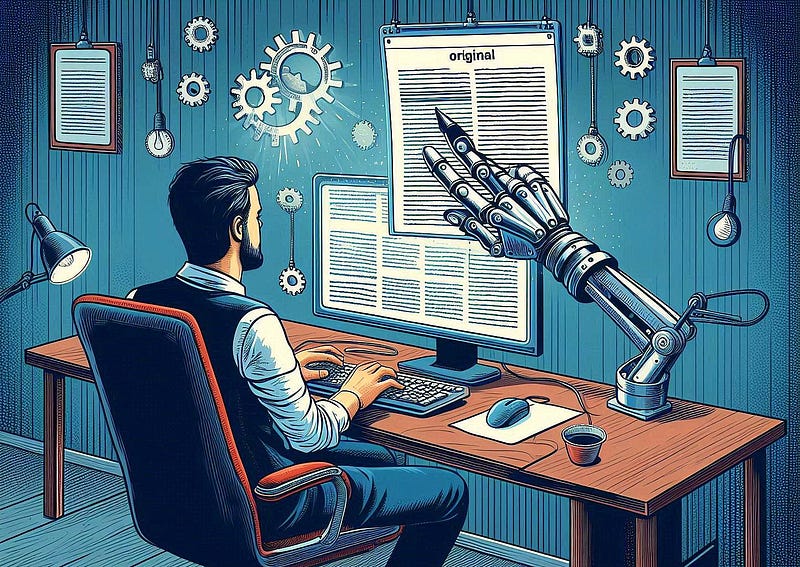
Vincent van Gogh’s Starry Night nearly crumbled under his restless reworkings. Hemingway’s raw prose almost drowned in editorial suggestions. For centuries, artists have wrestled with a sacred tension: the act of refinement can either elevate a vision or sterilize its soul. Today, artificial intelligence joins this dance — not merely as a tool, but as a provocateur challenging art’s deepest values: originality and credibility.
The Crucible of Craftsmanship
Refinement has always been originality’s silent partner. Consider Michelangelo liberating David from marble with deliberate strikes, or a novelist pruning a manuscript to reveal its vital core. This alchemy of processing transforms raw impulse into enduring art. Yet there’s peril in over-polishing. Think of auto-tune erasing the fragile tremor in a singer’s voice, or endless digital revisions leaching spontaneity from a painting. The truth? Originality resides not in the untouched sketch but in the artist’s intentional choices during refinement.
Across media, this dance takes unique forms. Digital artists wield Photoshop to birth glitch art revolutions, while musicians sample shards of sound into wholly new sonic landscapes — as hip-hop pioneers proved decades ago. Even literature reveals how editors like Maxwell Perkins honed Thomas Wolfe’s volcanic prose without dulling its brilliance. As T.S. Eliot observed, true originality emerges not from avoiding influence but from the transformative alchemy of reimagining it.
AI’s Disruptive Gaze
Now enters AI, wielding algorithms that scrutinize and generate art with unsettling ease. Its rise ignites a credibility crisis: Who determines authenticity when machines create?
Authorship grows ambiguous. Is an AI-generated “Rembrandt” stitched from patterns in thousands of Dutch Golden Age works — original or algorithmic plagiarism? Detection tools falter; even OpenAI abandoned its AI-text detector over inaccuracies. Beneath this lurks a deeper bias. Systems trained on Western canons may dismiss Indian miniature traditions as “derivative” while celebrating Picasso’s African mask-inspired cubism as revolutionary. AI risks enshrining historical blind spots as objective truth.
Worse, generative models default toward statistical averages. The result? Art that feels polished yet safe — a homogenized echo of existing work, worlds apart from van Gogh’s turbulent skies or Basquiat’s frenetic lines.
Redrawing the Boundaries
As AI reshapes creativity, we need new frameworks for credibility. Traditional metrics must evolve. The artist’s “hand” expands to encompass human intentionality — the curation of datasets, the crafting of prompts. Provenance now demands blockchain-verified logs tracing a work’s digital lineage. Stylistic consistency hinges on transparency: disclosing AI’s role like ingredients on a label.
Forward-thinking creators already point the way. Refik Anadol’s data sculptures, for instance, treat AI as a collaborative brush — executing human vision rather than replacing it. Galleries might soon display not just finished pieces, but the journey behind them: early sketches, prompt iterations, and edit trails that reveal the human hand guiding the machine.
The Unquenchable Human Spark
Amid this transformation, an ancient truth endures. Refinement has always been art’s necessary shadow. AI is merely the latest chisel in humanity’s eternal quest to shape meaning from chaos. Yet for all its computational brilliance, AI cannot replicate the fragile magic of human imperfection — the tremor of doubt in a brushstroke, the vulnerability in a lyric, the audacity to break rules not yet coded.
Credibility, finally, rests not on a tool’s origin but on the artist’s intention. As we navigate this new renaissance, we must remember: machines process pixels, but souls make meaning.
What’s your take? Is AI art a “collaboration” or “simulation”? Share your perspective below.