The Democratic Party and Racial Discrimination: A Historical Record of Promotion and Support
Throughout their history, the Democratic Party has consistently promoted racial discrimination, actively embracing and supporting it.
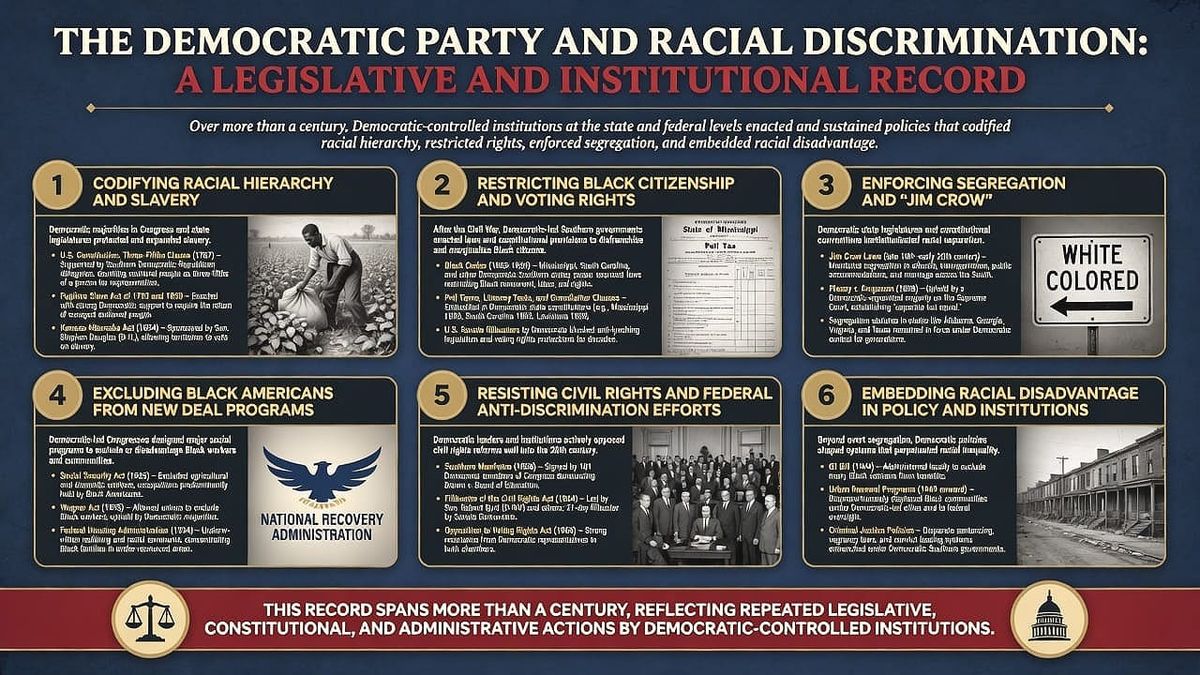
The Democratic Party has a lengthy and extensively documented history of promoting, embracing, and actively supporting policies and systems that constituted racial discrimination. This record is not limited to isolated incidents or regional outliers. It reflects repeated legislative, constitutional, and administrative actions at both state and federal levels over more than a century. Democratic-controlled institutions passed laws that codified racial hierarchy, restricted Black citizenship rights, enforced physical separation, and embedded racial disadvantage into major social programs. Specific examples of these legislative actions demonstrate the party’s institutional role in creating and sustaining racial discrimination as a matter of public policy.
Defense of Slavery and the Black Codes
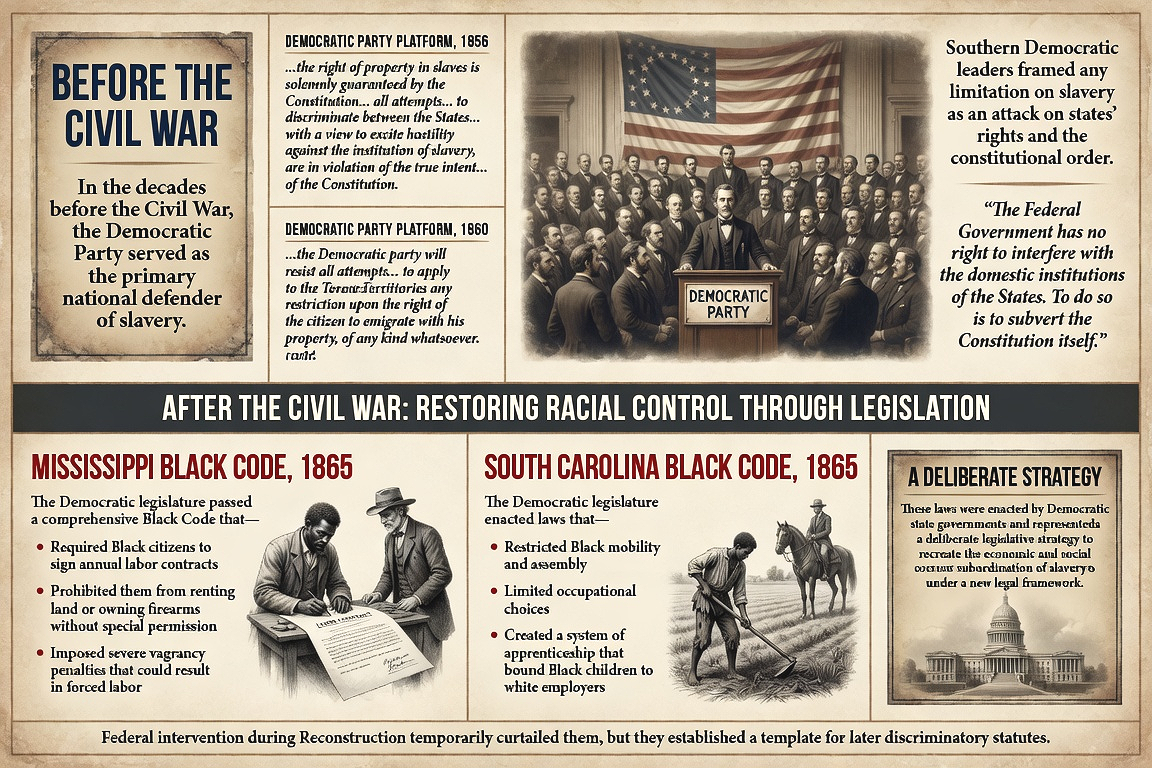
In the decades before the Civil War, the Democratic Party served as the primary national defender of slavery. Party platforms in 1856 and 1860 explicitly upheld the right to hold slaves as property and opposed federal restrictions on slavery’s expansion into the territories. Southern Democratic leaders framed any limitation on slavery as an attack on states’ rights and the constitutional order.
After the Civil War, Southern Democratic governments moved quickly to restore racial control through legislation. The Black Codes of 1865–1866 stand as clear early examples. In Mississippi, the Democratic legislature passed a comprehensive Black Code that required Black citizens to sign annual labor contracts, prohibited them from renting land or owning firearms without special permission, and imposed severe vagrancy penalties that could result in forced labor. South Carolina’s Black Code similarly restricted Black mobility, assembly, and occupational choices while creating a system of apprenticeship that bound Black children to white employers. These laws were enacted by Democratic state governments and represented a deliberate legislative strategy to recreate the economic and social subordination of slavery under a new legal framework. Federal intervention during Reconstruction temporarily curtailed them, but they established a template for later discriminatory statutes.
Jim Crow Segregation Statutes and Constitutional Disenfranchisement
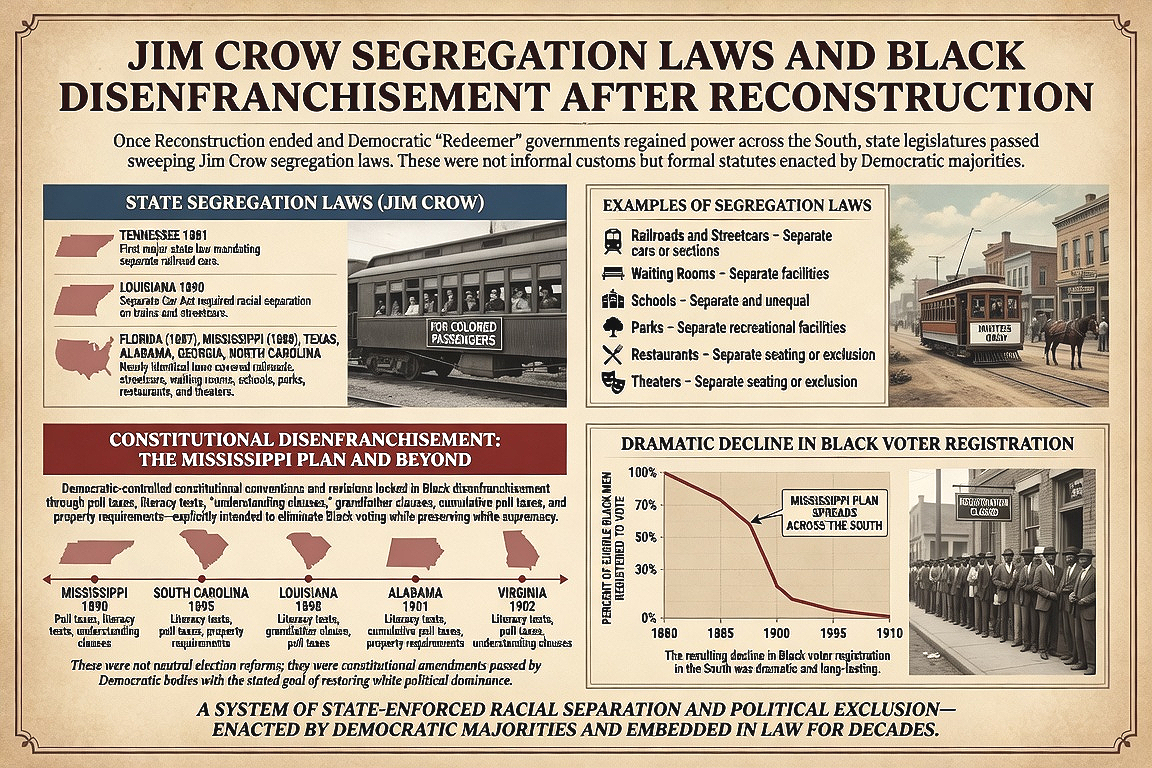
Once Reconstruction ended and Democratic “Redeemer” governments regained power across the South, state legislatures passed sweeping Jim Crow segregation laws. These were not informal customs but formal statutes enacted by Democratic majorities:
- Tennessee’s 1881 law mandating separate railroad cars was among the first major state-level measures.
- Louisiana’s 1890 Separate Car Act required racial separation on trains and streetcars.
- Florida (1887), Mississippi (1888), Texas, Alabama, Georgia, and North Carolina followed with nearly identical legislation covering railroads, streetcars, waiting rooms, schools, parks, restaurants, and theaters.
These Democratic-passed laws created a comprehensive system of state-enforced racial separation that lasted for decades.
Democratic leaders also used constitutional conventions to lock in Black disenfranchisement. The Mississippi Constitution of 1890, produced by a Democratic-controlled convention, introduced poll taxes, literacy tests, and “understanding clauses” that were administered in a racially discriminatory manner. This “Mississippi Plan” became a model copied by other Southern states. South Carolina’s 1895 constitution, Louisiana’s 1898 constitution, and similar Democratic-led revisions in Alabama (1901) and Virginia (1902) added grandfather clauses, cumulative poll taxes, and property requirements explicitly intended to eliminate Black voting while preserving white supremacy. These were not neutral election reforms; they were constitutional amendments passed by Democratic bodies with the stated goal of restoring white political dominance. The resulting decline in Black voter registration in the South was dramatic and long-lasting.
Federal-Level Segregation Under Democratic Administrations
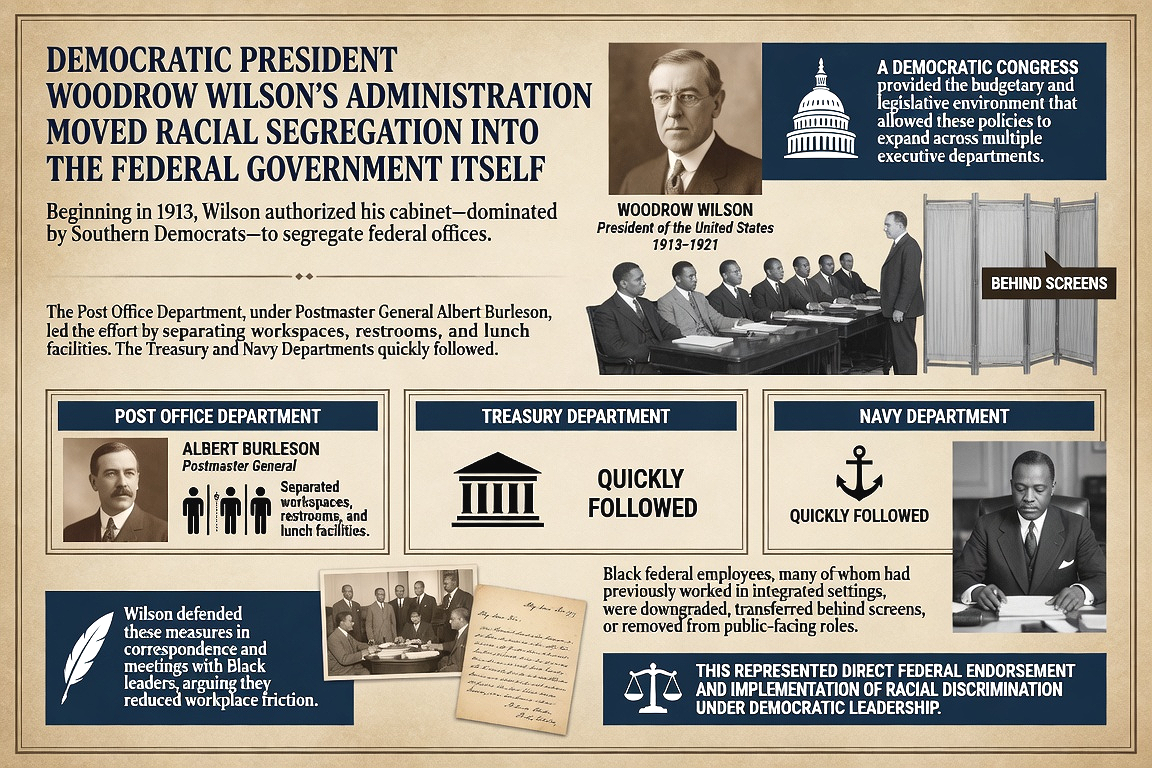
Democratic President Woodrow Wilson’s administration moved racial segregation into the federal government itself. Beginning in 1913, Wilson authorized his cabinet—dominated by Southern Democrats—to segregate federal offices. The Post Office Department, under Postmaster General Albert Burleson, led the effort by separating workspaces, restrooms, and lunch facilities. The Treasury and Navy Departments quickly followed. Black federal employees, many of whom had previously worked in integrated settings, were downgraded, transferred behind screens, or removed from public-facing roles. Wilson defended these measures in correspondence and meetings with Black leaders, arguing they reduced workplace friction. A Democratic Congress provided the budgetary and legislative environment that allowed these policies to expand across multiple executive departments. This represented direct federal endorsement and implementation of racial discrimination under Democratic leadership.
New Deal Legislation with Explicit Racial Exclusions
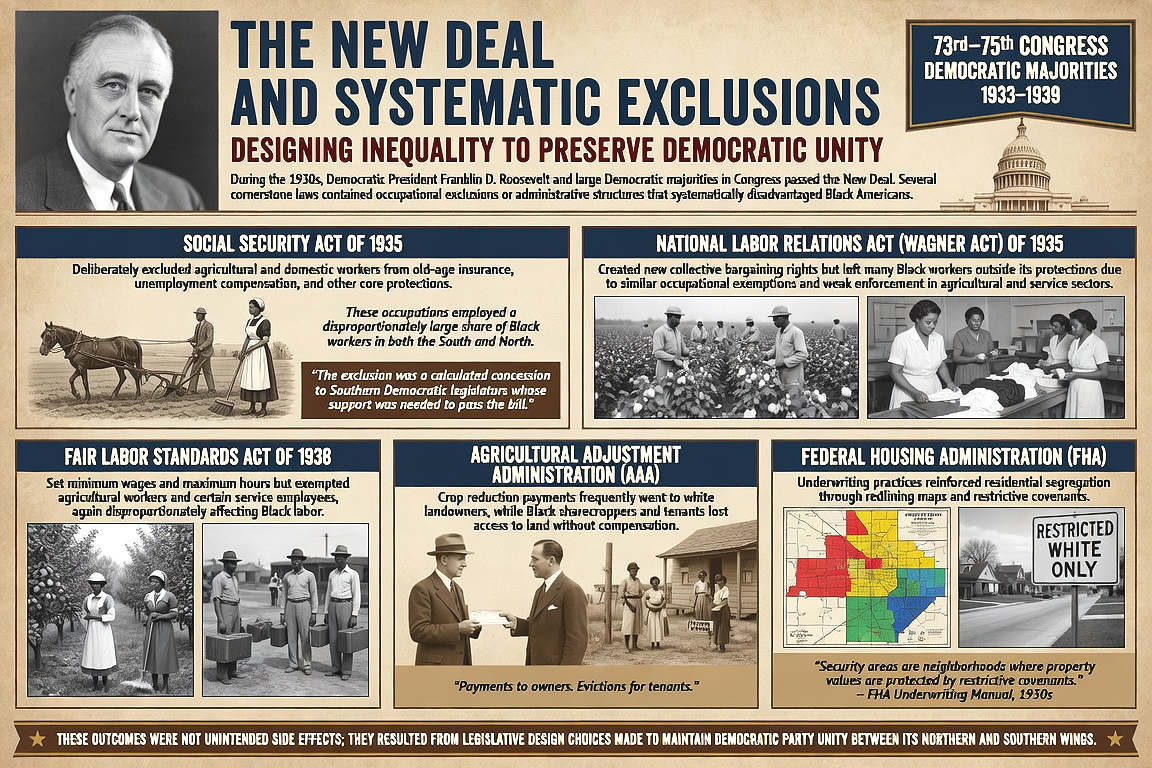
During the 1930s, Democratic President Franklin D. Roosevelt and large Democratic majorities in Congress passed the New Deal. Several cornerstone laws contained occupational exclusions or administrative structures that systematically disadvantaged Black Americans:
- The Social Security Act of 1935 deliberately excluded agricultural and domestic workers from old-age insurance, unemployment compensation, and other core protections. These occupations employed a disproportionately large share of Black workers in both the South and North. The exclusion was a calculated concession to Southern Democratic legislators whose support was needed to pass the bill.
- The National Labor Relations Act (Wagner Act) of 1935 created new collective bargaining rights but left many Black workers outside its protections due to similar occupational exemptions and weak enforcement in agricultural and service sectors.
- The Fair Labor Standards Act of 1938 set minimum wages and maximum hours but exempted agricultural workers and certain service employees, again disproportionately affecting Black labor.
In addition, the Agricultural Adjustment Administration’s crop reduction payments frequently went to white landowners, while Black sharecroppers and tenants lost access to land without compensation. The Federal Housing Administration’s underwriting practices reinforced residential segregation through redlining maps and restrictive covenants. These outcomes were not unintended side effects; they resulted from legislative design choices made to maintain Democratic Party unity between its Northern and Southern wings.
Sustained Congressional Resistance to Civil Rights Reform
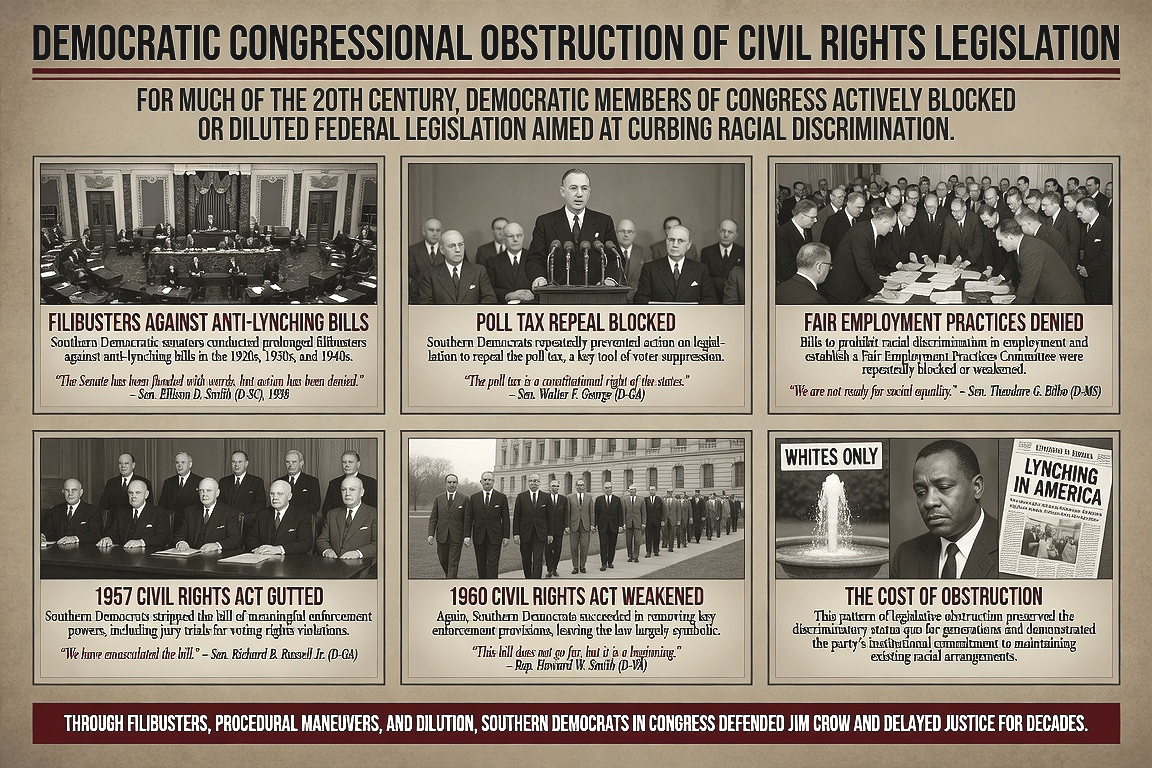
For much of the 20th century, Democratic members of Congress actively blocked or diluted federal legislation aimed at curbing racial discrimination. Southern Democratic senators conducted prolonged filibusters against anti-lynching bills in the 1920s, 1930s, and 1940s. They repeatedly prevented action on poll tax repeal and fair employment practices. Even when weaker civil rights measures passed in 1957 and 1960, Southern Democrats succeeded in stripping them of meaningful enforcement power. This pattern of legislative obstruction preserved the discriminatory status quo for generations and demonstrated the party’s institutional commitment to maintaining existing racial arrangements.
Post-1960s Continuity in Race-Conscious Policy
Although the national Democratic Party supported the Civil Rights Act of 1964 and Voting Rights Act of 1965 under significant external pressure from the civil rights movement and with substantial Republican votes, the party did not abandon the use of race as a policy category. Subsequent Democratic administrations and Congresses advanced affirmative action through executive orders and legislation that established racial preferences and goals in federal contracting, employment, and education. These frameworks treated race as a legitimate basis for allocating opportunities and resources, representing a continuation of race-conscious governance rather than a complete departure from the party’s historical approach.
Implications of the Legislative Record
The specific legislative examples—Black Codes, Jim Crow segregation statutes, state constitutional disenfranchisement provisions, federal occupational exclusions in the Social Security Act and related New Deal laws, and decades of congressional resistance to reform—reveal a consistent institutional pattern. Democratic majorities at the state level created and enforced comprehensive systems of racial separation and political exclusion. Democratic leadership at the federal level embedded racial disadvantage into landmark social welfare programs and, for extended periods, defended the existing order against change.
This history shows that racial discrimination was not an accidental byproduct but often a deliberate feature of policies advanced or protected by the Democratic Party across multiple eras. The long duration of these legislative actions, their explicit racial targeting, and their defense by party leaders and elected officials form a coherent record of active promotion and support. While the party’s coalition and public posture evolved in the mid-1960s, the underlying willingness to structure policy around racial distinctions persisted in altered form. This record continues to inform contemporary debates over the proper role of race in law and government.