1920 – The Vibe in America: The Gin-Soaked Tremor
1920 was the year America, suspended between a discredited past and a reckoning it couldn’t yet see, poured itself a stiff illegal drink and learned to Charleston on a cracking floor.
A Cultural Portrait
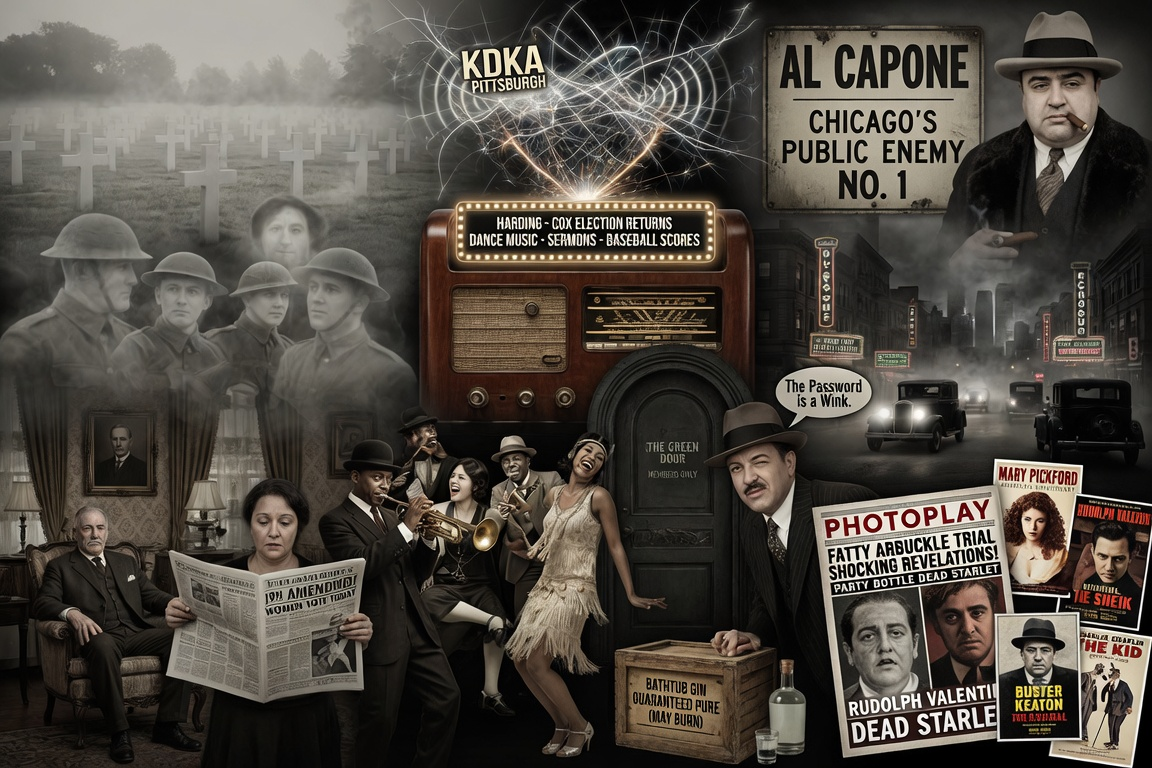
The war is over, and the dead are buried in French fields, but their ghosts crowd the American parlor. The doughboys came home to a country that reeks of gasoline and jazz, a place where the old certainties have buckled. The 19th Amendment is freshly inked, and women cast ballots for the first time, their hands still smelling of the suffrage marches, their new political voice a shockwave through the male establishment. The Great War’s grinding industrial slaughter gave way to a frantic, almost psychotic gaiety, a collective decision to dance on the grave of Victorianism. Prohibition is the law, but the law is a joke. The Volstead Act turns every citizen into a potential criminal; speakeasies bloom behind unmarked doors, and the password is a wink. Bathtub gin burns the throat, and Al Capone’s empire rises in Chicago, built on the insatiable thirst of a nation that has decided morality is a costume it no longer wants to wear.
The air crackles with radio signals. KDKA in Pittsburgh broadcasts the Harding-Cox election returns, and suddenly the living room is wired to the world. The radio set becomes the household altar, a polished wooden box that pours forth dance music, sermons, baseball scores, and the strange new intimacy of the announcer’s voice. Mass culture is born in this electric hum. The movies are no longer nickelodeon flickers but palaces of dreams. Theda Bara’s vamp has given way to Mary Pickford’s curls and Charlie Chaplin’s tramp. Hollywood becomes a factory of fantasy, and the faces on the silver screen—Rudolph Valentino’s smoldering glare, Buster Keaton’s stone-faced grace—become the nation’s shared language. Fan magazines feed a growing obsession with celebrity scandal: the Fatty Arbuckle trial, a sordid tale of a party, a bottle, and a dead starlet, becomes the decade’s first true tabloid fever dream.
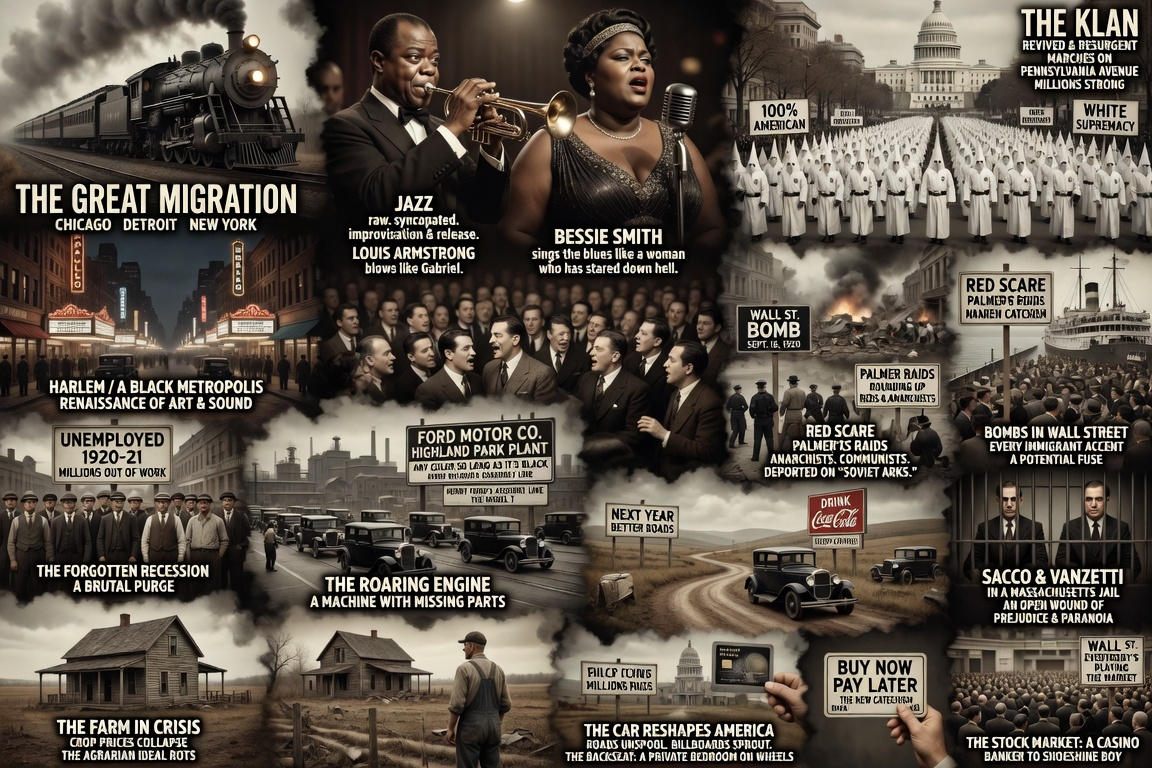
The cities swell. The Great Migration has pulled Black southerners northward, their lives packed into train cars bound for Chicago, Detroit, New York. Harlem becomes a black metropolis, and its genius spills out in a renaissance of art and sound. The jazz that percolates from clubs is raw, syncopated, a music of improvisation and release. Louis Armstrong blows his cornet like Gabriel, and Bessie Smith sings the blues like a woman who has stared down hell. White audiences flock uptown, slumming in nightclubs, gorging on an authenticity they simultaneously fetishize and fear. The Ku Klux Klan, revived and resurgent, marches down Pennsylvania Avenue in broad daylight, its hooded ranks swelling to millions. The Red Scare sweeps the nation: Attorney General Palmer’s raids round up suspected anarchists and communists, deporting them on ships dubbed “Soviet Arks.” The bombs have already gone off in Wall Street, and every immigrant accent is a potential fuse. Sacco and Vanzetti sit in a Massachusetts jail, their trial an open wound of prejudice and political paranoia.
The economy is a roaring engine, but it’s a machine with missing parts. The assembly line, perfected by Henry Ford, turns out Model Ts in any color so long as it’s black. The car reshapes the landscape: roads unspool across the prairie, billboards sprout, and the American youth discovers the backseat as a private bedroom on wheels. Consumer credit is born; buy now, pay later becomes the new catechism. The stock market is a casino, and everyone from the banker to the shoeshine boy is playing. The farm, however, is in silent crisis, crop prices collapsing, the agrarian ideal rotting on the vine. The decade opens with the sharp, brutal recession of 1920–21, a forgotten economic purge that throws millions out of work before the boom truly begins.
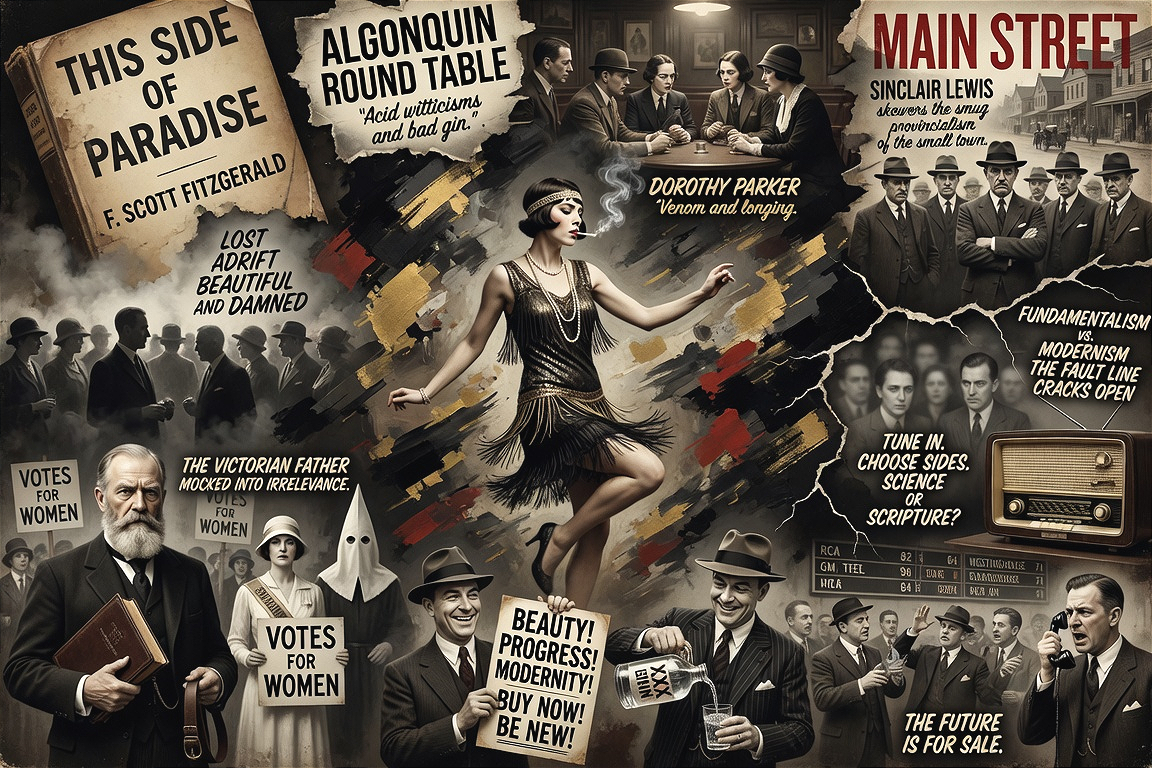
This is the age of the flapper, the New Woman who bobs her hair, shortens her skirt, and smokes a cigarette in public with a defiant insouciance. She dances the Charleston, a frenetic, knee-knocking explosion of motion that scandalizes the old guard. F. Scott Fitzgerald publishes This Side of Paradise, and a generation names itself: lost, adrift, beautiful and damned. The Algonquin Round Table trades acid witticisms, and Dorothy Parker’s pen drips venom and longing. Sinclair Lewis’s Main Street skewers the smug provincialism of the small town, and the small town reads it and bristles. The Scopes Trial hasn’t happened yet, but the fault line between fundamentalism and modernism is already cracking open; science and scripture are preparing for battle in a Tennessee courtroom, while the rest of the country tunes in on the radio, ready to choose sides.
The psychology is a volatile cocktail: the relief of survival, the guilt of profit, the terror of the alien, the exhilaration of the new. There is a sense of living on a knife’s edge between a discredited past and an unknowable future. The Victorian father, a bearded patriarch with a Bible and a belt, has been mocked into irrelevance. In his place stands the ad man, the bootlegger, the jazz baby, the Klansman, the suffragist, the stock speculator—all of them grasping for a new story to live by. The vibe is not the Great Depression’s desperate sobriety, nor the 1950s’ conformist calm. It is a tremor, a fizzy, volatile shaking, a nation convulsing with its own liberation and terror, drunk on bad gin and the dizzying possibility that everything can be remade, for better or for worse, before the bill comes due.
Underlying Theme
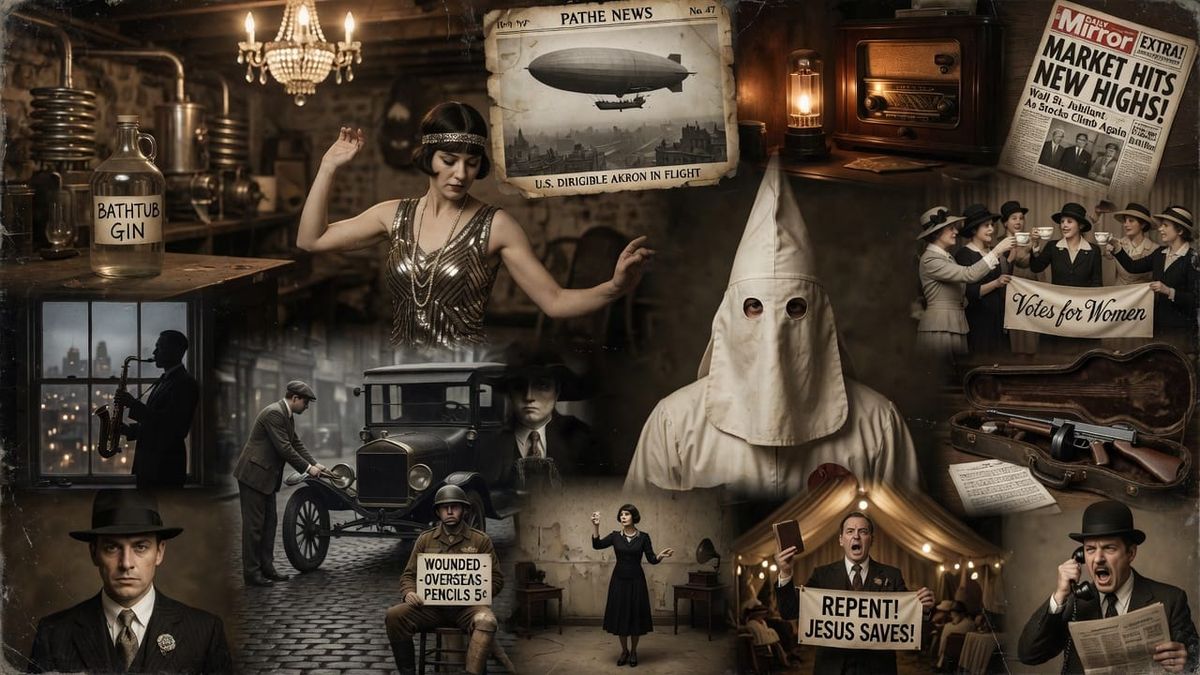
The greasy, metallic smell of bathtub gin, the sequined shimmer of a flapper’s dress catching the light of a basement chandelier. Sepia newsreel footage of a dirigible, the amber glow of a vacuum tube inside a radio cabinet, the wet ink of a freshly printed tabloid. A saxophone’s wail bleeding through a tenement window, the clatter of a Ford Model T’s crank handle, the rustle of a white Klan robe. The clink of a teacup at a suffrage celebration, the cold steel of a Thompson submachine gun in a violin case. The archetypes: the bootlegger with a diamond tie pin and dead eyes, the bobbed-haired stenographer dancing alone in a rented room, the war veteran selling pencils on a street corner, the tent revival preacher sweating through his sermon, the stock tipster shouting into a candlestick telephone.
In One Sentence
1920 was the year America, suspended between a discredited past and a reckoning it couldn’t yet see, poured itself a stiff illegal drink and learned to Charleston on a cracking floor.