The Floating Green: How Water Convolvulus Sustains Asia’s Wetlands and Tables
In the still waters of tropical ditches and slow-moving canals, a green lattice of heart-shaped leaves stretches toward the…
Introduction
In the still waters of tropical ditches and slow-moving canals, a green lattice of heart-shaped leaves stretches toward the sun. This is Ipomoea aquatica, better known as water convolvulus or water spinach — a plant that thrives in conditions few others can tolerate. Across Southeast Asia, it anchors diets, livelihoods, and ecosystems alike. Its journey from muddy backwaters to market baskets tells a story of adaptability, flavor, and quiet ecological power.
Taxonomy
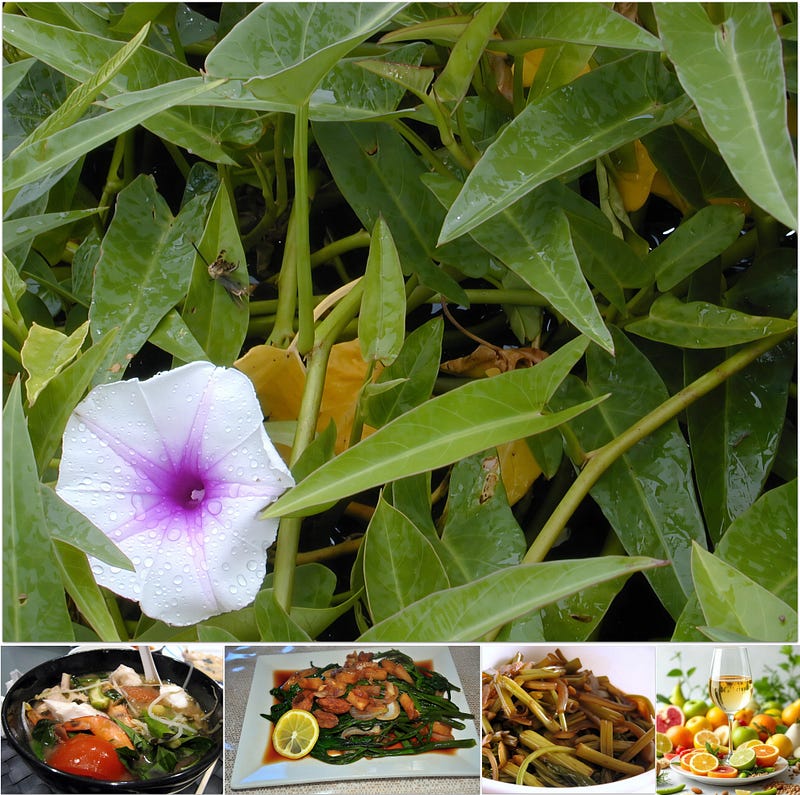
Ipomoea aquatica belongs to the family Convolvulaceae, which includes morning glories. Its valid binomial name is Ipomoea aquatica Forsskål. It is divided into two main cultivars: the upland type (I. aquatica var. reptans) that grows in moist soil and the aquatic type (I. aquatica var. aquatica) that floats on water. Common names vary widely: “kangkong” in Tagalog and Filipino (Philippines), “rau muống” in Vietnamese, “ong choy” in Cantonese (China), “pak boong” in Thai, “kangkung” in Malay and Indonesian, and “swamp cabbage” in English-speaking regions of South and Southeast Asia. Its cultural and linguistic diversity mirrors its ecological reach.
Biology
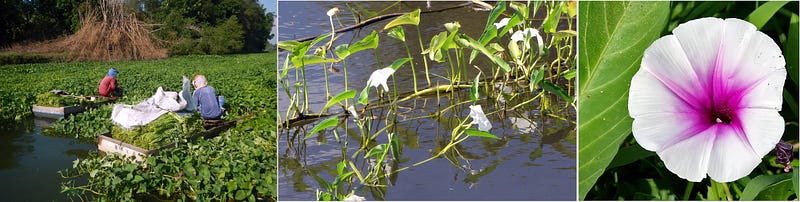
This perennial herb has hollow stems that can extend up to 3 m (about 9.8 ft), allowing buoyancy in flooded environments. The leaves are sagittate to ovate, with lengths between 5 and 15 cm (2–6 in). White or pinkish funnel-shaped flowers open during daylight, pollinated by bees and other insects. Water convolvulus reproduces both vegetatively and through seeds, though commercial cultivation relies mostly on stem cuttings. The plant grows rapidly, maturing within 30 to 45 days, and tolerates temperatures from 20°C to 35°C (68°F to 95°F). Its high photosynthetic rate enables fast biomass accumulation, ideal for frequent harvest cycles.
Ecology
Native to tropical Asia, I. aquatica thrives in ponds, ditches, and flooded fields where water depth ranges between 5 and 30 cm (2–12 in). Its ecological role is twofold: it stabilizes soil in wetland edges and serves as a biofilter, absorbing excess nutrients that might otherwise lead to eutrophication. However, its vigor poses risks — outside its native range, particularly in the southern United States and the Pacific Islands, it is listed as a noxious weed due to its invasive spread. Sustainable management requires control of propagation and trade in sensitive ecosystems. When responsibly cultivated, the species supports agroecological balance by recycling organic waste water and producing oxygen-rich habitats for aquatic fauna.

Uses
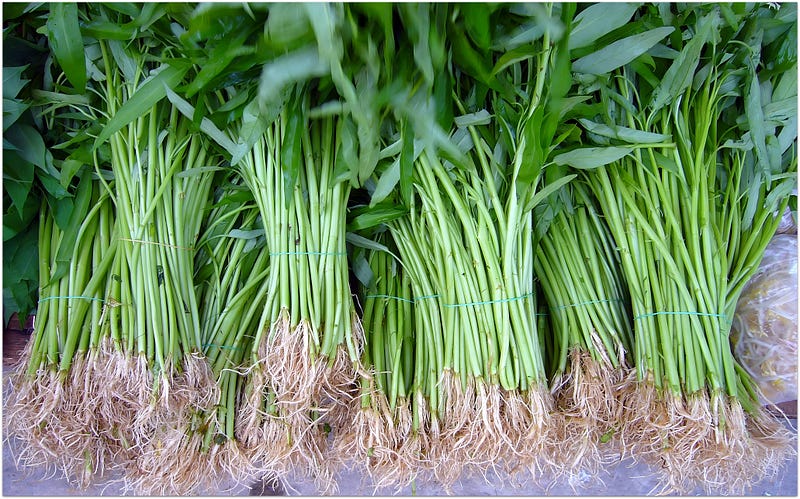
Every aerial part is edible. The young stems and tender leaves are the main culinary components. Harvest yields average 15–25 metric tons per hectare (13,400–22,300 lb per acre). Raw leaves provide about 19 kcal per 100 g (3.5 oz) and are rich in iron (2.7 mg), calcium (77 mg), and vitamin A (630 µg). They also contain moderate oxalate levels, which are reduced through cooking.
In regional cuisines, water convolvulus is stir-fried with garlic and fermented bean sauce in China, sautéed with chilies and shrimp paste in Malaysia and Indonesia, or blanched for soups and salads in Vietnam. Its crisp texture and mild, spinach-like taste adapt to both spicy and subtle flavor profiles. Best cooking methods include flash stir-frying, blanching, and steaming to preserve chlorophyll and vitamin content.
Medicinally, extracts of I. aquatica are used in traditional medicine for anti-diabetic, anti-inflammatory, and antioxidant effects. Key active compounds include flavonoids (quercetin, luteolin) and phenolic acids. Empirical evidence supports mild hypoglycemic activity in moderate consumption, though clinical validation remains limited.
Feed value is notable: livestock readily consume the foliage, with crude protein levels around 20% on a dry matter basis. For aquaculture and pig farming, it enhances digestibility and growth rates, provided it is harvested before flowering, when fiber content is low.
Beyond food and feed, the fibrous stems serve in composting and as green manure, enriching soils with organic nitrogen. Its phytoremediation potential allows uptake of heavy metals, making it valuable for wastewater treatment under controlled conditions.
Culinary Aspects
When fresh, water convolvulus offers a clean vegetal aroma with faint earthiness. The flavor balances between spinach and morning glory, brightened by grassy sweetness. Its texture, lightly crunchy when quickly cooked, turns silken with extended heat. In stir-fries, it carries sauces well, its hollow stems trapping flavor. Blanched versions accentuate chlorophyll notes, pairing well with sesame oil or garlic. Chemesthetic sensations are minimal, though its slight bitterness adds depth to umami-forward broths.
Its culinary importance stretches across Asia — from street vendors in Bangkok serving fiery pad pak boong fai daeng to coastal Chinese restaurants where it accompanies river crab and fermented tofu. It is as much a cultural staple as it is a nutritional one.
Wine Pairings
The mild bitterness and earthy chlorophyll of water convolvulus pair best with bright, mineral-driven wines that balance its vegetal depth. A Verdejo from Rueda, Spain, complements garlicky stir-fried kangkong with citrus and herbal notes. A Grüner Veltliner from Austria harmonizes with Vietnamese-style preparations where fish sauce and chili dominate, its peppery finish echoing the dish’s spice. For cream-based or fermented bean sauces, a lightly chilled Fiano from Campania, Italy, offers textured acidity without overwhelming the green nuances. When served alongside seafood dishes, a coastal Muscadet from the Loire supports the saline, briny interplay with understated elegance.
Conclusion
Ipomoea aquatica stands as a symbol of adaptive abundance — feeding millions, cleaning waters, and linking culinary traditions across continents. Its dual nature — edible crop and ecological engineer — demonstrates how sustainability can be cultivated in the simplest of species. As food systems face climate volatility, the humble water convolvulus remains a model of circular nourishment, rooted in mud yet sustaining both people and planet.