The Snow Crab: Chionoecetes opilio and the Cold Geometry of the North Atlantic
In the freezing depths of the North Atlantic and North Pacific, beneath the shifting pack ice and dim green water, lives a…

Introduction
In the freezing depths of the North Atlantic and North Pacific, beneath the shifting pack ice and dim green water, lives a creature that defines the intersection of ecology, gastronomy, and economics — the snow crab, Chionoecetes opilio. It is a keystone of Arctic fisheries, a culinary delicacy in Japan and North America, and a barometer of environmental change. Its long, spindly legs and armored carapace evoke a precise, almost architectural symmetry, the living geometry of cold seas. To study or taste it is to encounter a species whose biology and market value are equally intricate.
Taxonomy
Chionoecetes opilio belongs to the family Oregoniidae, class Malacostraca, order Decapoda, and phylum Arthropoda. Commonly called the snow crab in English, it is known in Japan as “ズワイガニ” (zuwai-gani, Japanese), in Russia as “краб-стригун опилио” (krab-strigun opilio, Russian), and in Canada’s Atlantic provinces simply as “Queen crab.” The genus Chionoecetes includes related species such as C. bairdi (Tanner crab), C. japonicus, and C. elongatus, several of which are commercially valuable. The name derives from Greek — “chion” meaning snow, and “oiketes” meaning inhabitant — aptly describing its icy habitat.
Biology
The snow crab’s carapace spans roughly 9 to 15 cm (3.5 to 6 in) across in males, though some individuals exceed 16 cm (6.3 in) in northern waters. Adult males can weigh up to 1.3 kg (2.9 lb), while females are smaller, rarely over 0.9 kg (2 lb). Their eight long walking legs end in sharp, chitinous tips adapted for soft mud and sandy seafloors. Males are harvested for their broad claws and high meat yield.
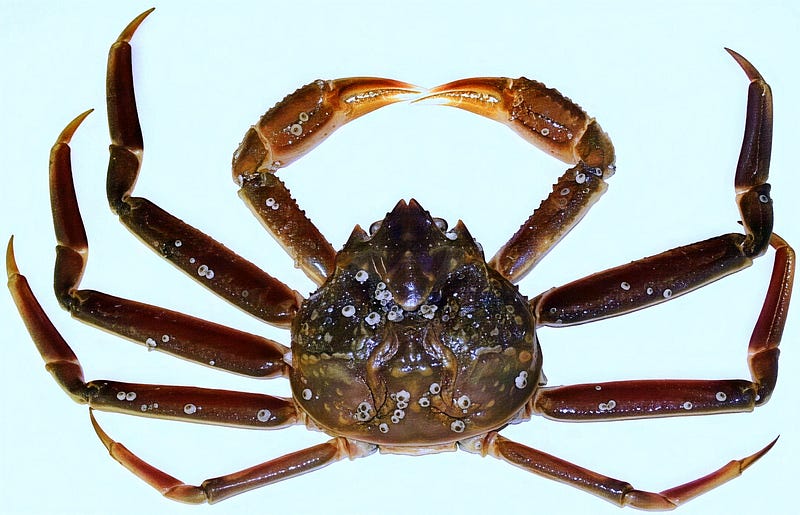
They molt repeatedly before reaching maturity, shedding their exoskeleton as they grow. Mating occurs after the female’s final molt, and fertilized eggs — numbering from 50,000 to 150,000 — are carried beneath the abdomen for about a year before hatching. The life span averages 8 to 13 years. They are opportunistic predators and scavengers, feeding on polychaetes, mollusks, and detritus. Their hemolymph (a body fluid that circulates inside arthropod bodies, transporting nutrients and oxygen to tissues, comparable with the blood in vertebrates) contains antifreeze-like compounds, allowing survival near −1.5°C (29°F).
Ecology
Chionoecetes opilio occupies continental shelf and slope habitats from 50 to 400 m (164 to 1,312 ft) deep, preferring sedimentary bottoms where water temperatures remain below 4°C (39°F). Its range spans the Bering, Okhotsk, Barents, and North Atlantic seas, from Japan and Russia to Greenland, Newfoundland, and the Gulf of St. Lawrence. It plays an ecological role as both predator and prey — consuming benthic invertebrates while sustaining fish, seals, and humans alike.
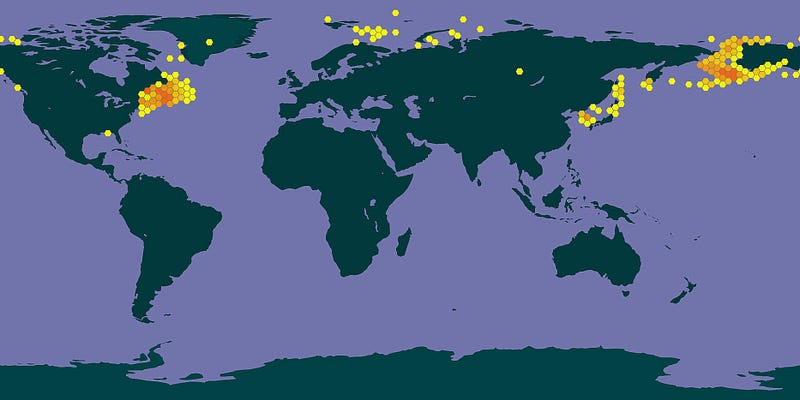
Overfishing and warming waters threaten its stability. The decline in Alaskan snow crab populations in 2022 highlighted how a few degrees of temperature shift can collapse a billion-dollar fishery. Sustainable practices now include trap limits, sex-based quotas, and seasonal closures that allow breeding populations to rebound. Certified fisheries under the Marine Stewardship Council (MSC) provide traceability and accountability in this high-value sector.
Uses
The edible parts of C. opilio include the leg and claw meat, prized for their sweet, delicate flavor and snow-white appearance. The meat’s yield averages 20% of body weight, equivalent to about 0.26 kg (0.57 lb) per 1.3 kg (2.9 lb) crab. Seasonality peaks in late winter and spring when meat density is highest. Per 100 g (3.5 oz) serving, snow crab provides approximately 97 kcal, 21 g (0.74 oz) protein, 0.8 g (0.03 oz) fat, and trace minerals including zinc, selenium, and vitamin B12.
There are no significant antinutrients or toxins, though histamine formation can occur in improperly stored products. Processing requires boiling or steaming before chilling or freezing. The commercial value chain includes whole cooked crab, leg clusters, and meat extracted for sushi or crab cakes. The wholesale price fluctuates between USD 14 and 26 per kg (USD 6.35 to 11.8 per lb) depending on size and season. Major producers include Canada, Russia, Norway, and Japan.
Snow crab exoskeletons, rich in chitin (15–25% concentration range), are extracted for chitosan, used in wound dressings, water purification, and biodegradable films. Processing involves demineralization (acid), deproteinization (alkali), and deacetylation under heat. The shells also contribute to soil carbon sequestration and serve as organic fertilizer additives, improving microbial activity and nitrogen retention. Byproducts are compostable, with low emission profiles relative to synthetic fertilizers.
Sustainability certification requires adherence to national quotas and community rights frameworks, particularly for Indigenous harvesters in Arctic Canada. Labeling regulations under the U.S. FDA and CFIA mandate species identification to prevent mislabeling fraud — common in imported “snow crab” products.
Culinary Aspects
Snow crab meat is tender, slightly briny, and faintly sweet, with an umami core derived from glutamic acid and nucleotides. When freshly steamed, its aroma recalls seaweed and warm ocean air, with a subtle buttery undertone. The mouthfeel is soft but fibrous; the finish is clean and lingering.
Grilling intensifies the caramelization of surface proteins, while poaching preserves their natural sweetness. In Japan, zuwai-gani nabe (hot pot) highlights its purity in dashi broth. In Quebec and Maine, it appears in chilled salads and clarified-butter service. Its flavor balance pairs well with citrus, miso, chili oil, or drawn butter. Optimal sensory retention occurs below 70°C (158°F); overcooking collapses texture and volatilizes aroma compounds.
Wine Pairings
For steamed snow crab, a Muscadet Sèvre-et-Maine Sur Lie from the Loire Valley complements the saline brightness with its chalky minerality and high acidity. When grilled or roasted with butter, a white Rioja (Viura) provides a creamy counterpoint with subtle oak tones and dried citrus. In Asian preparations such as kani shabu, a Niigata Junmai Ginjo sake aligns perfectly with the umami-driven delicacy of crab and seaweed stock. A Slovenian Rebula, with its phenolic grip and orange-peel notes, enhances the contrast between sweetness and salinity. For cold crab salads with citrus or avocado, an Albariño from Rías Baixas provides aromatics of lime and green apple that reinforce freshness. Each pairing draws on structure — acid, salinity, and texture — to accentuate the crab’s gentle marine complexity.
Conclusion
Chionoecetes opilio is more than a resource; it is a case study in how biological precision meets culinary artistry and economic stewardship. Its life beneath the polar thermocline mirrors the fragility of the systems that sustain it. Every leg cracked open and every market haul tallied traces a network of ecological dependencies extending from continental shelves to dinner plates. Whether enjoyed in a Japanese ryokan or a Newfoundland harbor, the snow crab remains a reminder that sustainable luxury must begin in cold, patient waters.