Uncovered: The Pandemic Exposé of an Industry That Profits from the Unthinkable
COVID‑19 exposed an insurance model that promises protection yet excludes systemic risk; carriers gained premiums, enforced contracts aggressively, relied on state backstops, and externalized losses, revealing a deeper shift in the insurance social contract.

Abstract
The COVID-19 pandemic operated as a global stress test for the insurance sector, laying bare the contradictions embedded in a system that promises security against catastrophe while structurally excluding systemic perils. This report dissects the multifaceted strategies through which insurers across health, life, and property-casualty lines managed a crisis that simultaneously unleashed unprecedented claims uncertainty, regulatory upheaval, and moral controversy. It argues that the industry’s response—characterized by opportunistic premium gains, aggressive contract enforcement, sustained capital resilience, and a profound reliance on governmental backstops—reveals a deeper reconfiguration of the insurance social contract. Far from a simple story of corporate resilience, the pandemic management exposed an industry adept at externalizing systemic losses while privatizing the gains of reduced non-pandemic utilization. The analysis traverses the windfall profits of health carriers, the mortality shocks to life reinsurance, the fierce litigation war over business interruption wordings, and the operational metamorphosis into digital enterprises, culminating in a critical reflection on the boundaries of insurability and the quiet erosion of mutualized risk.
The Health Insurance Paradox: Windfall and Waiver
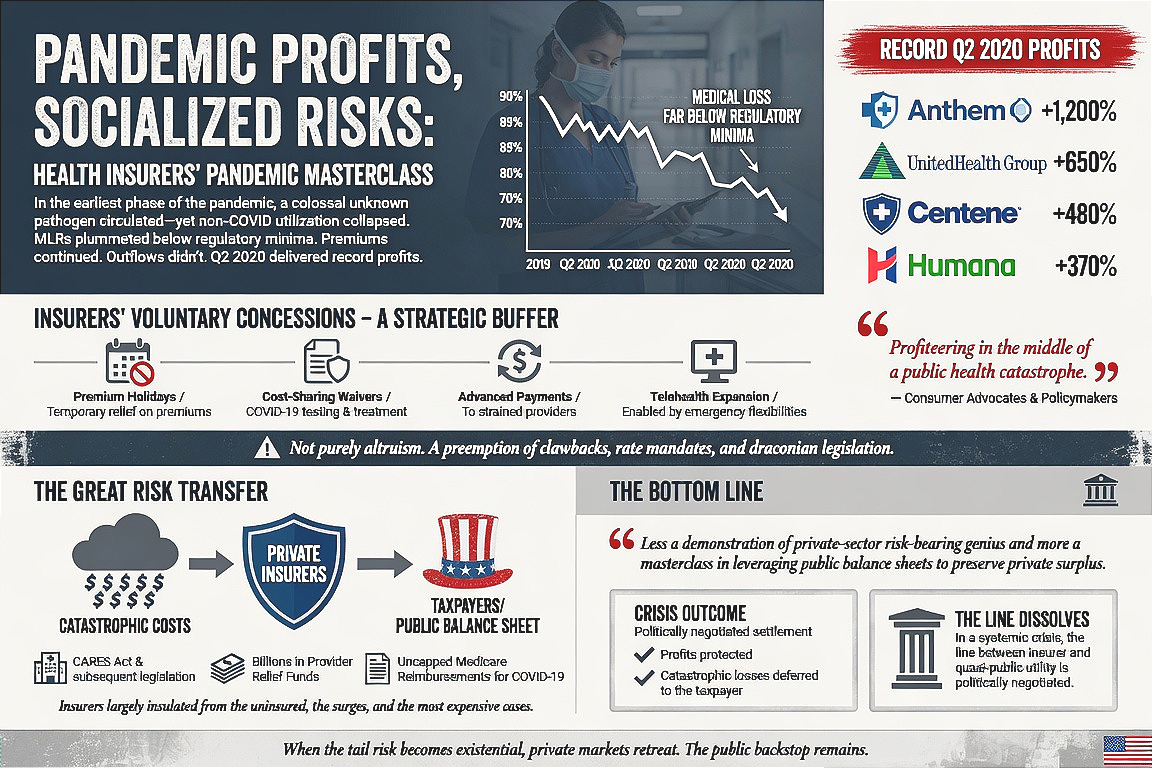
In the earliest phase of the pandemic, health insurers confronted a riddle that confounded traditional actuarial models: a colossal unknown pathogen was circulating, yet healthcare utilization in non-COVID services collapsed. With elective surgeries suspended, physician visits plummeting, and fear of contagion keeping patients away from hospitals, medical loss ratios across the commercial and Medicare Advantage sectors plummeted far below regulatory minima. The industry, which had priced premiums based on steady-state utilization patterns, suddenly found itself awash in premium revenue with drastically reduced outflows. This mismatch generated record profitability for many carriers in the second quarter of 2020, a phenomenon that immediately drew the ire of consumer advocates and policymakers who decried profiteering amid a public health catastrophe.
Facing intense political scrutiny, major health insurers voluntarily implemented premium holidays, cost-sharing waivers for COVID-19 testing and treatment, and advanced payments to strained provider networks. These concessions, however, were neither uniform nor purely altruistic; they functioned as a strategic buffer against the credible threat of federal or state-mandated clawbacks and community rating adjustments. By proactively offering temporary relief, the industry preempted more draconian legislative interventions and simultaneously enhanced its public image. The simultaneous expansion of telehealth coverage, enabled by emergency regulatory flexibilities, allowed insurers to re-channel demand into low-cost virtual settings, further preserving margins while claiming to modernize care delivery.
Beneath this surface of cooperative crisis management, a profound risk transfer was occurring. The CARES Act and subsequent legislation funneled billions into provider relief funds and uncapped Medicare reimbursements for COVID-19 cases, effectively socializing the most catastrophic tail of the pandemic cost curve. Commercial insurers were largely insulated from the direct hospitalisation expenses of the uninsured and the most resource-intensive surges because federal programs absorbed those shocks. Consequently, the health insurance sector’s “management” of the pandemic was less a demonstration of private-sector risk-bearing genius and more a masterclass in the art of leveraging public balance sheets to preserve private surplus. The episode starkly illustrated how, in a systemic crisis, the line between insurer and quasi-public utility dissolves into a politically negotiated settlement where profits are protected and catastrophic losses are deferred to the taxpayer.
Life Insurance in the Shadow of Excess Mortality
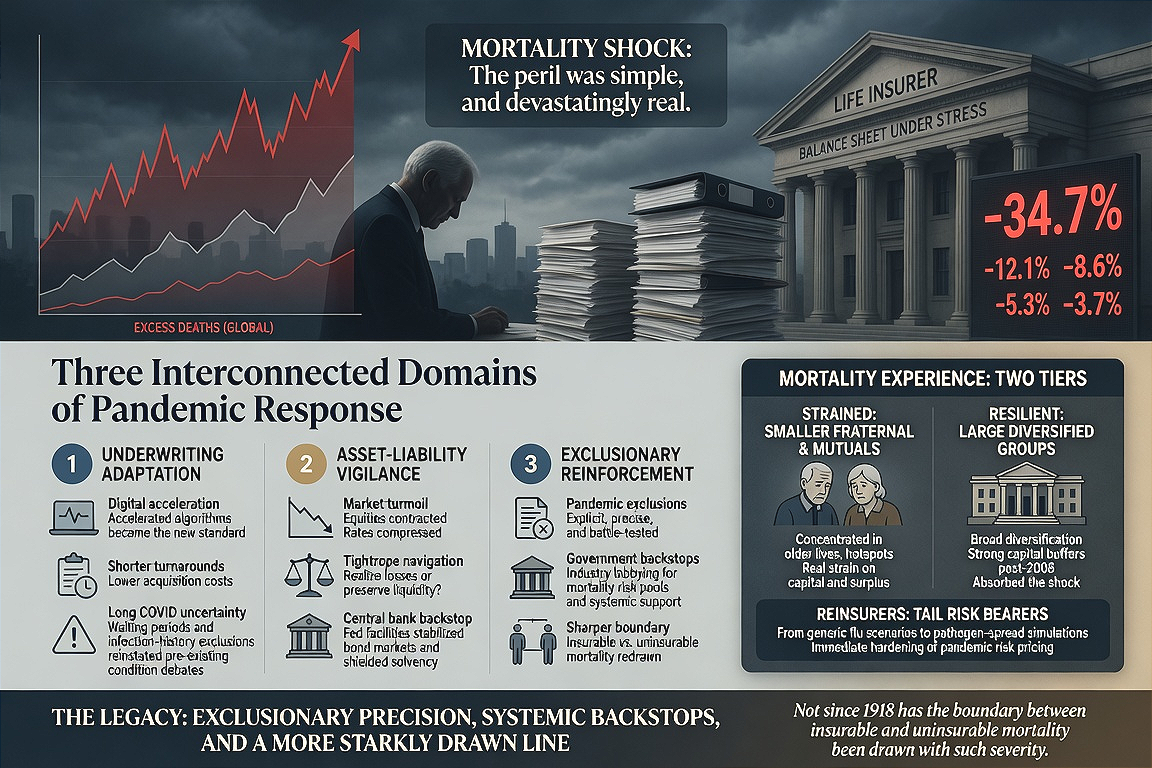
Life insurers and reinsurers confronted the pandemic’s most somber and actuarially tangible peril: mortality shock. The excess deaths observed globally, particularly among the elderly and those with underlying conditions, directly triggered claim obligations that modelers had previously associated with wartime or major natural disaster scenarios. Unlike health insurers, life carriers could not benefit from reduced utilization; their product is a simple promise to pay on death, and death arrived in statistically significant waves. The industry’s management response split into three interconnected domains: rapid underwriting adaptation, asset-liability vigilance amid market turmoil, and the systematic reinforcement of pandemic exclusionary language for future business.
On the underwriting front, the immediate cessation of in-person medical examinations forced the industry into a long-deferred digital acceleration. Carriers that had been tentatively piloting accelerated underwriting algorithms based on electronic health records, prescription histories, and credit data suddenly made these platforms the standard, effectively redefining the evidence of insurability. This shift slashed turnaround times and operational costs but raised profound questions about discrimination and the embedding of pandemic-era morbidity signals into long-term rating models. The post-acute sequelae of SARS-CoV-2 infection, or long COVID, introduced a novel morbidity cloud whose long-term mortality impact remained opaque, leading many underwriters to impose waiting periods or blanket exclusions for applicants with documented infection histories—a practice that reignited debates over pre-existing condition coverage in the life sphere.
Asset-side management became equally critical. The sharp contraction in equity markets and the compression of interest rates in early 2020 hammered the investment portfolios that fund long-duration life liabilities. Life insurers, compelled by accounting regimes and solvency regulations, navigated a tightrope between realizing losses and maintaining liquidity to pay unprecedented claims. The Federal Reserve’s swift intervention in corporate bond markets through emergency lending facilities restored order and effectively shielded life insurers’ extensive bond holdings from a disorderly repricing. Once again, a public institution’s backstop of financial markets served as the invisible safety net that preserved the sector’s solvency, raising the uncomfortable parallel that life insurers, like banks, had become too systemically entwined to be allowed to absorb the full force of a mortality-liquidity double hit.
The mortality experience itself divided the market. Smaller fraternal and mutual insurers with concentrated exposure in older demographics in hotspots faced genuine strain, while large diversified groups absorbed the shock with capital buffers that had been reinforced since the 2008 crisis. Reinsurers, holding the ultimate tail risk, refined their pandemic risk models away from generic flu scenarios toward more granular pathogen spread simulations, triggering immediate price hardening. The legacy of pandemic management in life insurance, therefore, is a renewed emphasis on exclusionary precision: future pandemic covers will be explicitly circumscribed, government-sponsored mortality backstops will be lobbied for as indispensable, and the line between insurable and uninsurable mortality will be drawn more starkly than at any point since the 1918 influenza.
The Battle Over Business Interruption: Contract, Catastrophe, and the Courts
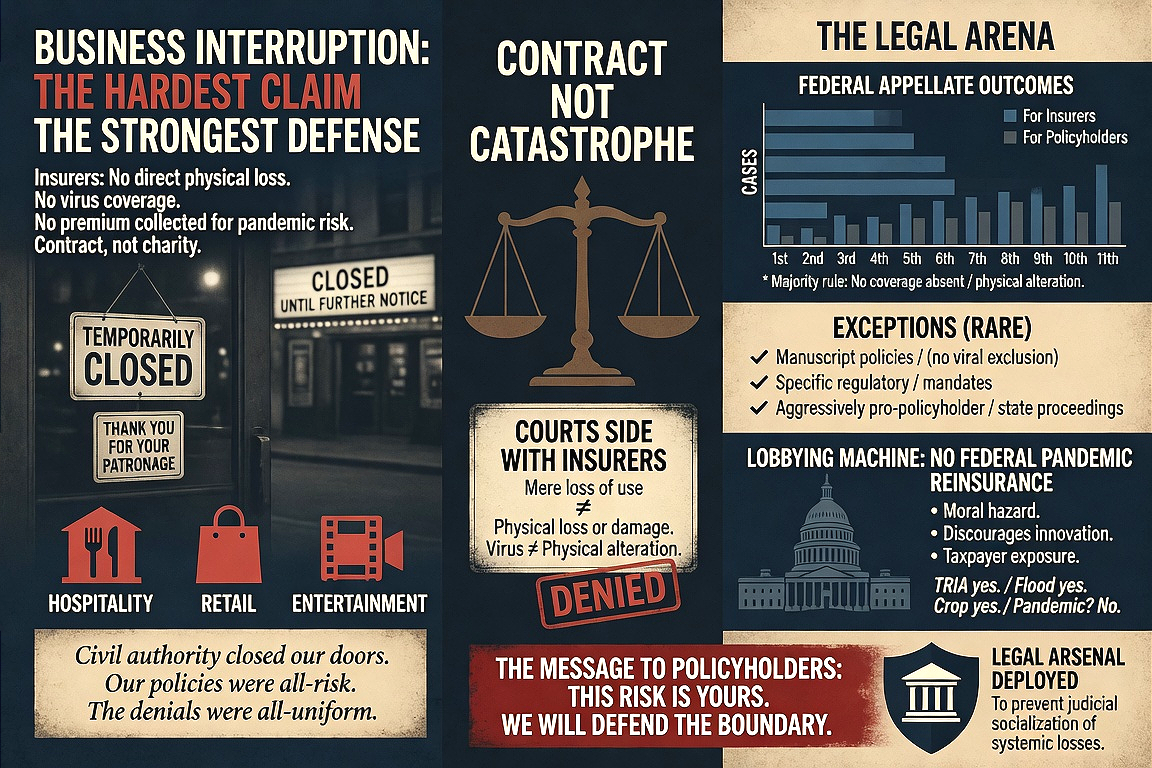
No arena of pandemic management generated more legal and reputational fire than the property-casualty sector’s handling of business interruption claims. Millions of small and medium enterprises across hospitality, retail, and entertainment were forced to close by civil authority decrees and turned to their all-risk commercial property policies, only to encounter a near-uniform wall of denials. Insurers maintained that standard business interruption coverage was contingent on direct physical loss or damage to property and that viral contamination did not satisfy that trigger. Moreover, most policies had introduced absolute exclusions for viral or bacterial pathogens following the SARS epidemic two decades earlier. The industry framed its stance as a simple matter of contract law: pandemics were never underwritten, no premium was collected, and coverage was never intended.
Aggrieved policyholders, backed by a wave of state legislative proposals seeking to retroactively mandate coverage, ignited a sprawling multidistrict litigation landscape. The judicial outcomes largely vindicated the industry’s contractarian logic, with the majority of federal appellate courts ruling that mere loss of use without demonstrable physical alteration did not constitute physical loss. Where insurers settled or suffered early setbacks, it often involved specialized manuscript policies lacking viral exclusions or specific regulatory proceedings in states with aggressively pro-policyholder insurance commissioners. The industry’s legal victory, however, came at a steep cost in reputational capital. The public spectacle of insurers rigorously defending their balance sheets while restaurants and theaters shuttered fueled a narrative that the insurance promise was hollow precisely when it was most needed, exposing the harsh boundary at the edge of the insurable peril universe.
In the background, the industry’s collective lobbying machine worked to kill proposals for a federal pandemic reinsurance program modeled on the Terrorism Risk Insurance Act. The argument was that such a facility would create moral hazard, discourage private market innovation, and impose a contingent liability on taxpayers. Critics noted the irony: an industry that routinely benefits from implicit and explicit government guarantees for flood, crop, and terrorism risk vehemently opposed extending that logic to the systemic peril that had just devastated the real economy. The business interruption saga ultimately illustrated a form of pandemic management through contract design and juridical defense rather than risk transfer. The message to policyholders was unambiguous: systemic non-damage business closure is a risk you retain, and the insurance apparatus will mobilize its formidable legal arsenal to ensure that socialized losses do not seep onto private balance sheets through judicial reinterpretation.
Reinsurance and Capital Markets: The Myth of Pandemic Preparedness
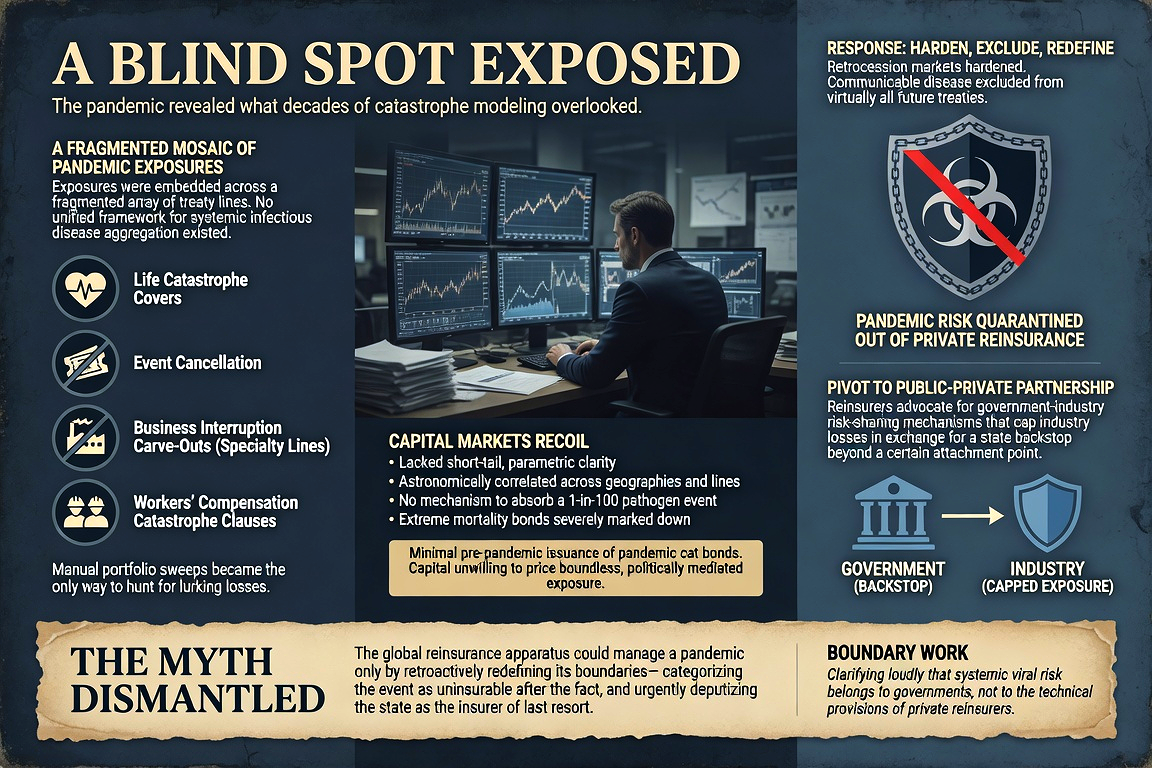
The reinsurance sector had long marketed itself as the apex of catastrophe risk management, yet the pandemic exposed a curious blind spot. Decades of sophisticated stochastic modeling for hurricanes, earthquakes, and even cyber aggregation (the accumulation of interconnected digital risks where a single event, shared vendor, or vulnerability can simultaneously impact multiple systems, organizations, or insurance portfolios) had left pandemic risk stranded in an actuarial backwater, treated as a secondary peril subsumed within mortality and contingency books. When COVID-19 exploded, the reinsurance industry discovered that its pandemic exposures were embedded across a fragmented mosaic of treaty lines: life catastrophe covers, event cancellation, business interruption carve-outs within specialty lines, and workers’ compensation catastrophe clauses. No unified framework for systemic infectious disease aggregation existed, leading to frantic, manual portfolio sweeps to understand where losses were lurking.
The capital markets, which had increasingly provided alternative capacity through insurance-linked securities and catastrophe bonds, recoiled. Pandemic risk lacked the short-tail, parametically triggered clarity of hurricane bonds; its accumulation potential was astronomically correlated across geographies and lines of business. The catastrophe bond market, designed to offload peak natural perils, had no mechanism to absorb a one-in-a-century pathogen event, and the handful of extreme mortality bonds that had been issued faced severe markdowns. The industry’s pre-pandemic flirtation with pandemic catastrophe bonds had been minimal, a testament to the unwillingness of capital markets to price a peril with such boundless and politically mediated exposure. Thus, reinsurers were forced to retain a risk that they had not fully priced and could not lay off, a failure of diversification theory in the face of ultra-systemic threat.
The crisis response involved a rapid hardening of retrocession markets and the exclusion of communicable disease from virtually all future treaties, effectively quarantining pandemic risk out of the private reinsurance sphere entirely. Reinsurers pivoted their thought leadership toward public-private partnership models, advocating for government-industry risk-sharing mechanisms that would cap industry losses in exchange for a state backstop beyond a certain attachment point. The episode thus dismantled the myth of a standalone, market-based pandemic resilience. It demonstrated that the global reinsurance apparatus could manage a pandemic only by retroactively redefining its boundaries, categorizing the event as uninsurable after the fact, and urgently deputizing the state as the insurer of last resort. The management strategy was one of boundary work: clarifying loudly that systemic viral risk belongs to governments, not to the technical provisions of private reinsurers.
Operational Resilience and the Digital Leap
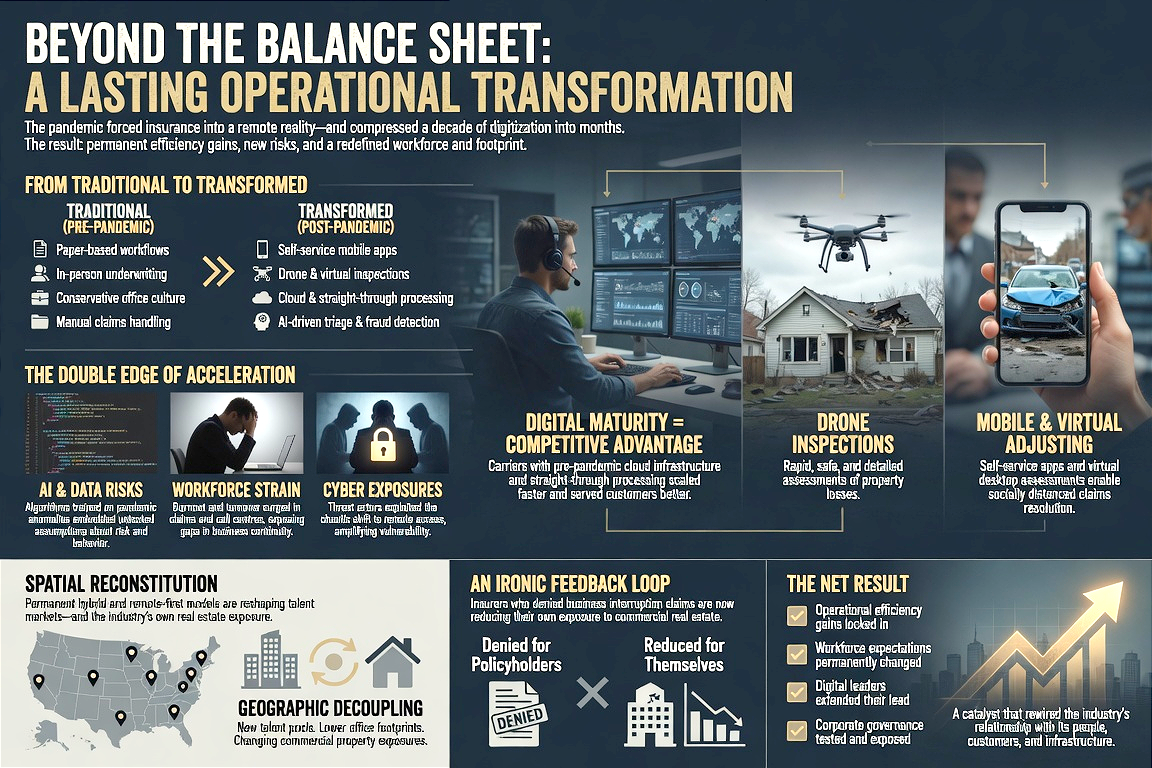
Beyond the balance sheet, the pandemic compelled an operational transformation that will stand as one of its most lasting legacies. Insurance, long notorious for paper-based workflows, in-person underwriting assessments, and a conservative office culture, was forced into a fully remote posture within a matter of weeks. Claims departments handling property losses and auto claims had to adapt to socially distanced adjusting using self-service mobile apps, drone inspections, and virtual desktop assessments. The initial friction was considerable, but the compressed digitization produced permanent efficiency gains. Carriers that had invested pre-pandemic in cloud infrastructure and straight-through processing platforms reaped immediate competitive advantages, while laggards scrambled to deploy hastily procured digital tools.
This technological acceleration carried a double edge. The rapid deployment of AI-driven claims triage and fraud detection algorithms, fed by pandemic-era data anomalies, embedded behavioral assumptions that were not yet benchmarked against a stable risk environment. The move to mass remote work also threw into sharp relief the industry’s dependency on its workforce’s physical and mental health; employee burnout and turnover spiked in claims and call centre functions, creating operational risks that traditional business continuity plans had never contemplated. Cybersecurity exposures surged as threat actors exploited the chaotic transition to remote access. Managing a pandemic thus became synonymous with managing an accelerated digital migration under duress, a process that tested corporate governance structures and exposed the fragility of long-established operational habits.
The shift also enabled a spatial reconstitution of the insurance workforce, with major carriers announcing permanent hybrid or remote-first models. This geographic decoupling has begun to reshape talent markets and office real estate exposures—an ironic feedback loop wherein insurers, who denied business interruption claims for their own policyholders, are now actively reducing their own exposure to commercial property markets. The operational management of the pandemic, therefore, was not merely a continuity exercise but a catalyst that rewired the industry’s relationship with its employees, its customers, and its physical infrastructure, all while consolidating market power among those carriers whose digital maturity predated the crisis.
Financial Performance and the Redistribution of Risk Capital
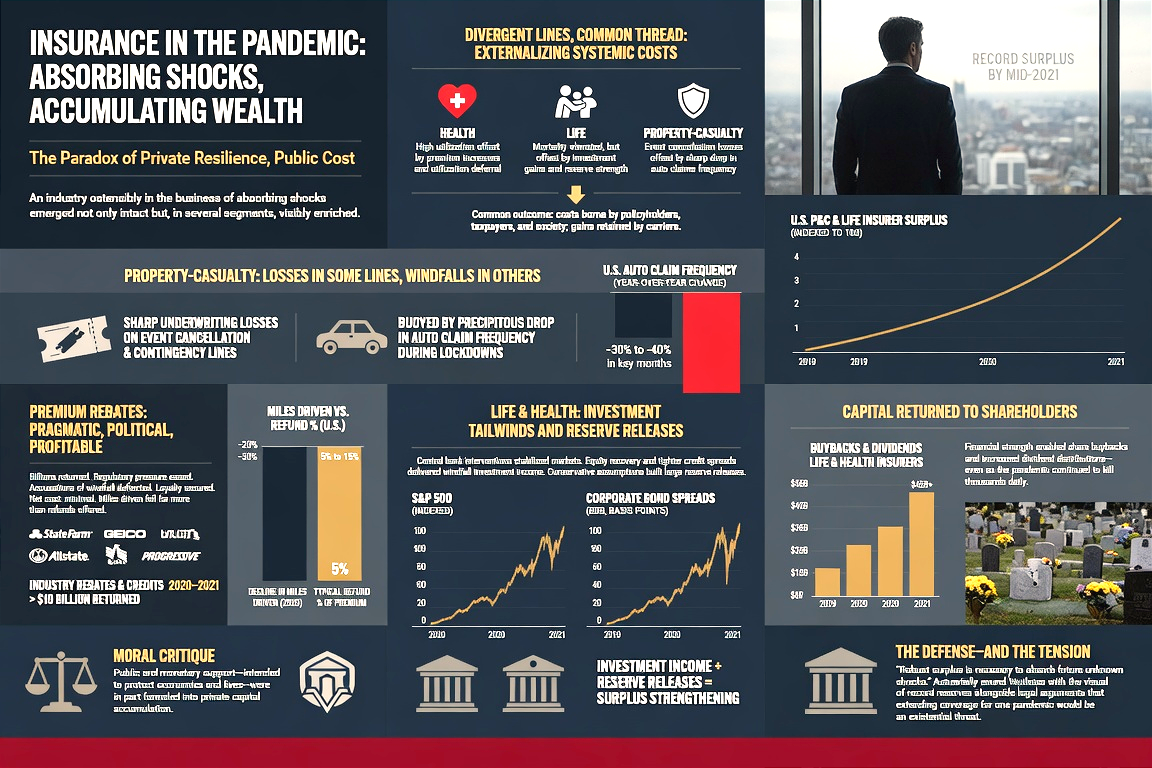
The aggregate financial narrative of insurance during COVID-19 is paradoxical: an industry ostensibly in the business of absorbing shocks emerged not only intact but, in several segments, visibly enriched. The divergence in outcomes between health, life, and property-casualty lines obscures a common thread—the successful externalization of systemic costs. Commercial property-casualty carriers booked sharp underwriting losses on event cancellation and contingency lines but were simultaneously buoyed by the precipitous drop in auto claim frequency during lockdowns. Several major auto insurers returned billions in premium rebates, a move that simultaneously satisfied regulatory pressure, mitigated accusations of windfall profiteering, and created customer loyalty capital at a minimal net cost, given the decline in miles driven far outpaced the refund percentages offered.
Life and health conglomerates, operating under integrated asset-management frameworks, benefited enormously from the rapid recovery of equity markets and the stabilization of credit spreads, both engineered by central bank interventions. The resulting investment income and reserve releases, stemming from conservative morbidity and mortality assumptions that did not fully materialise in the early quarters, combined to lift surplus positions to historic highs by mid-2021. This financial strength enabled a wave of share buybacks and increased dividend distributions, returning capital to shareholders even as the pandemic continued to kill thousands daily. This generated a profound moral critique: the mechanisms through which insurers “managed” the pandemic funnelled public and monetary support into private capital accumulation. The industry’s argument—that robust surplus is necessary to absorb future unknown shocks—is actuarially sound, yet it collides uncomfortably with the visual of insurers sitting on record reserves while arguing before courts and legislatures that extending coverage for a single pandemic would be an existential threat.
The Moral Hazard of Public-Private Blurring
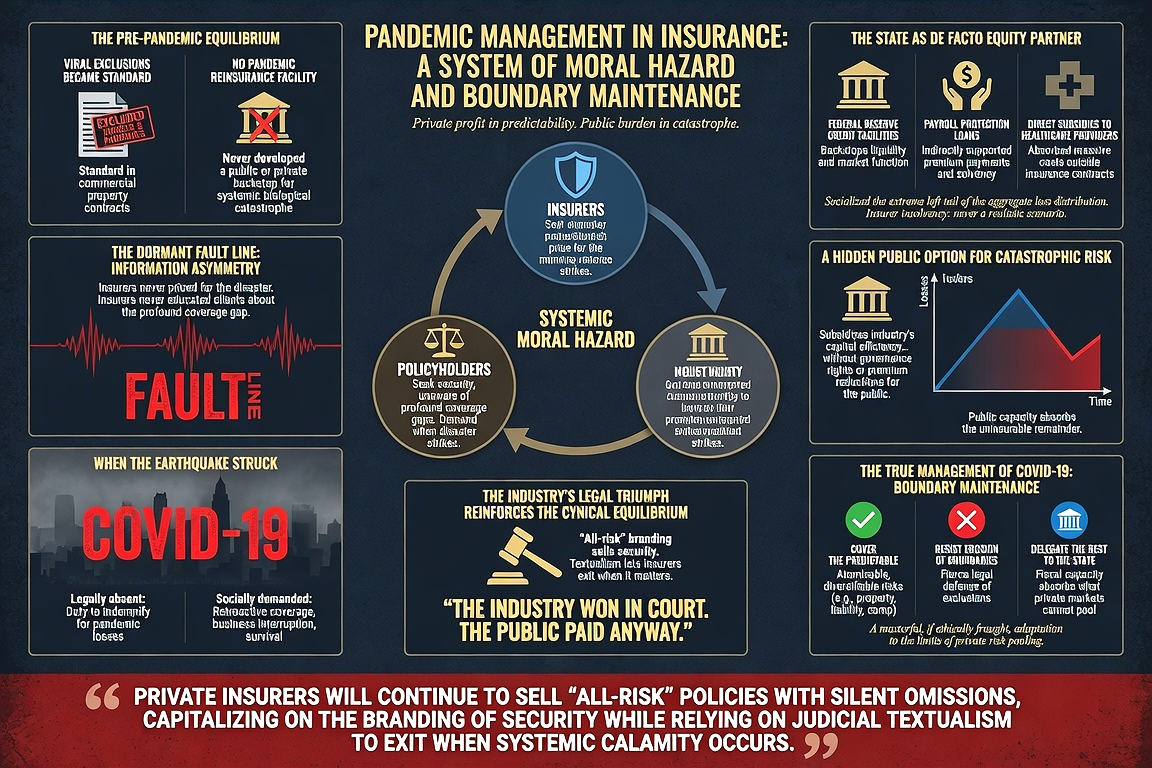
The comprehensive picture that emerges from the insurance industry’s pandemic management is one of systemic moral hazard in the relationships among insurers, policyholders, and the state. The pre-pandemic framework, which allowed viral exclusions to become standard in commercial property contracts and which never developed a pandemic reinsurance facility, was a market equilibrium that relied on the unspoken assumption that a truly catastrophic pandemic would become a public-sector responsibility. Insurers never priced for the disaster, but they also never educated their commercial clients about the profound coverage gap that existed. The information asymmetry was a dormant fault line; when the earthquake struck, the industry’s duty to indemnify was legally absent but socially demanded. The resulting clamor for retroactive coverage and the industry’s legal triumph reinforced a cynical equilibrium: private insurers will continue to sell “all-risk” policies with silent omissions, capitalizing on the branding of security while relying on judicial textualism to exit when systemic calamity occurs.
The state’s role evolved from regulator to de facto equity partner. Through the Federal Reserve’s credit facilities, payroll protection loans that indirectly supported premium payments, and direct subsidies to healthcare providers, the government socialized the extreme left tail of the aggregate loss distribution, ensuring that private insurer insolvency never became a realistic scenario. This arrangement constitutes a hidden public option for catastrophic risk, one that subsidizes the insurance industry’s capital efficiency without providing the public with corresponding governance rights or premium reductions. The true management of COVID-19 by insurance companies was thus a campaign of boundary maintenance: covering the predictable, atomizable risks, fiercely resisting the legal erosion of those boundaries, and allowing the fiscal capacity of the state to absorb the uninsurable remainder. This is a masterful, if ethically fraught, adaptation to the limits of private risk pooling.
Reimagining the Insurability of Systemic Risk
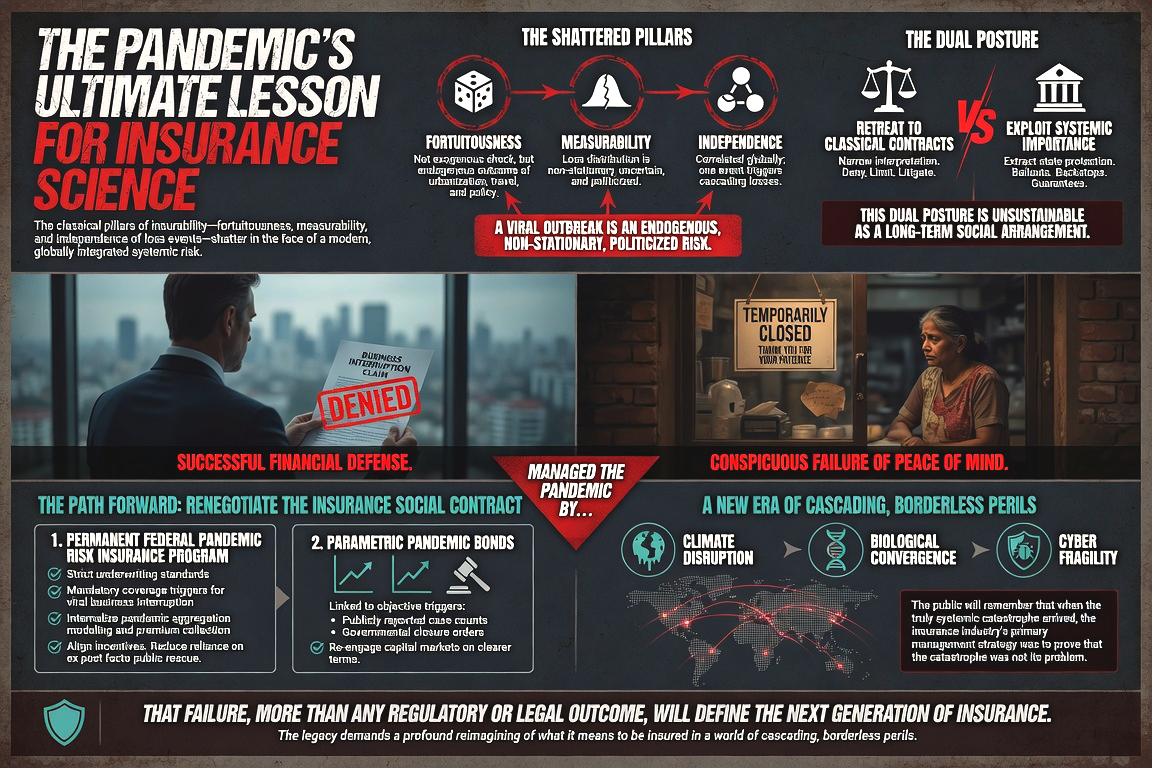
The pandemic’s ultimate lesson for insurance science is that the classical pillars of insurability—fortuitousness, measurability, and independence of loss events—shatter in the face of a modern, globally integrated systemic risk. A viral outbreak is not an exogenous shock from nature but an endogenous outcome of dense urbanisation, global travel, and public health policy choices, rendering its loss distribution deeply non-stationary and politicized. Insurers managed the pandemic by retreating to a narrow, classical interpretation of their contracts while simultaneously exploiting their systemic importance to extract state protection. This dual posture is unsustainable as a long-term social arrangement.
The path forward demands a renegotiation of the insurance social contract. A permanent federal pandemic risk insurance program, with strict underwriting standards and mandatory coverage triggers for viral business interruption, could realign the industry’s incentives with societal needs, forcing insurers to internalize pandemic aggregation modeling and premium collection rather than rely on ex post facto public rescue. In parallel, parametric pandemic bonds linked to publicly reported case counts or governmental closure orders could re-engage capital markets on clearer terms. The industry’s management of COVID-19 was a successful financial defense but a conspicuous failure of the promise to provide peace of mind against the unthinkable. That failure, more than any regulatory or legal outcome, will define the next generation of insurance. In an age of climate disruption, biological convergence, and cyber fragility, the public will remember that when the truly systemic catastrophe arrived, the insurance industry’s primary management strategy was to prove that the catastrophe was not its problem. Such a legacy demands a profound reimagining of what it means to be insured in a world of cascading, borderless perils.