The Philosophy of Music of Uli Jon Roth
In an age often characterized by fragmentation and superficiality in popular music, Uli Jon Roth’s body of work insists that music remains capable of profound philosophical labor.
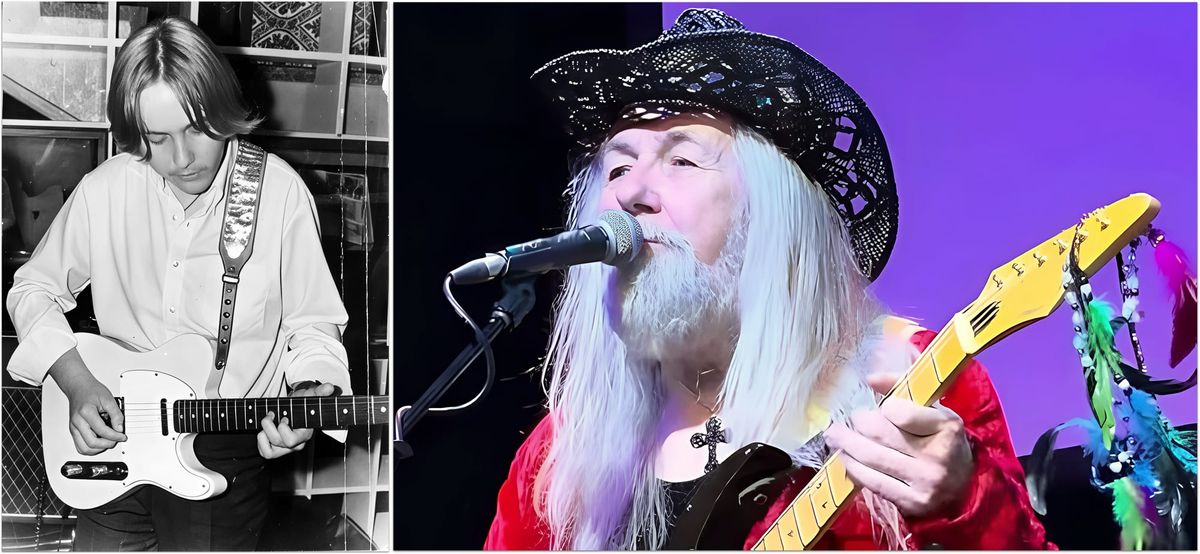
Uli Jon Roth stands among the most intellectually and spiritually ambitious figures in rock and metal history. A virtuoso guitarist, composer, and innovator, he has spent five decades exploring music not merely as entertainment or technical display, but as a metaphysical discipline capable of revealing deeper truths about consciousness, the soul’s journey, and the fundamental laws of existence. His vision emerged most clearly during his tenure with the Scorpions and reached full expression through the band he founded, Electric Sun, before expanding into symphonic works, the invention of the Sky Guitar, and the establishment of Sky Academy as a vehicle for transmitting his philosophy.
1. Introduction: Brief Background on the Artist and His Bands, Key Members, Genre, and Notable Albums
Uli Jon Roth was born Ulrich Roth on December 18, 1954, in Düsseldorf, Germany. He began playing electric guitar at age 13 and quickly developed a distinctive voice that fused blues-rock energy with classical precision. In the early 1970s he formed Dawn Road in Hanover. When Michael Schenker departed the Scorpions in 1973, Roth joined the band as lead guitarist, becoming a primary songwriter and occasional vocalist alongside Klaus Meine on lead vocals and Rudolf Schenker on rhythm guitar. Over the next five years he helped transform the Scorpions from a regional act into an international force, contributing to four studio albums and the landmark live recording Tokyo Tapes (1978).
Feeling increasingly constrained by the band’s commercial direction, Roth left in 1978 to form Electric Sun, a project that granted him complete artistic control. The core lineup functioned as a power trio—Roth handling lead guitar and vocals, supported by bassist Ule Ritgen and drummers including Clive Edwards and later Clive Bunker—with occasional expansion for touring. Electric Sun released three albums before disbanding in 1985. Roth then withdrew from the music industry’s “circus” for an extended period of introspection, composing symphonies and concertos while developing his Sky Guitar and founding Sky Academy in 2006 to teach his integrated philosophy of music and life.
His genre affiliations encompass hard rock, heavy metal, neoclassical metal (of which he is widely recognized as an early pioneer), progressive metal, psychedelic rock, and symphonic fusion. Roth’s playing draws equally from Jimi Hendrix’s expressive fire and the technical and structural elegance of classical guitar and violin traditions.
The most philosophically significant albums are those of the Electric Sun trilogy—Earthquake (1979), Fire Wind (1981), and especially Beyond the Astral Skies (1985)—along with later solo works such as Transcendental Sky Guitar (1998/2000) and Under a Dark Sky (2008). These recordings mark the clearest articulation of his belief that music can serve as a bridge to higher dimensions of awareness and a mirror of universal principles.
2. Key Themes: Central Themes in His Music and How They Reflect His Philosophical Stances
Several interlocking themes run through Roth’s work, each revealing a coherent philosophical stance: that music is not separate from life but is life’s deepest language, and that the artist’s task is to attune both self and audience to realities beyond the material plane.
Spiritual evolution and reincarnation form a central thread, most explicitly stated in Electric Sun’s “Still So Many Lives Away.” The lyrics portray Earth as a school for the soul, where individuals return across multiple lifetimes to shed ignorance and advance toward greater purity and understanding. This reflects Roth’s conviction that existence is purposeful and progressive rather than random or purely material.
Liberation and creative freedom dominate the Electric Sun period. The title track of the debut album contrasts the constriction Roth felt in his final Scorpions years with a newfound sense of release: “Yet now I am free and I’m gonna take you / Into the fire of the Electric Sun.” The song frames freedom not as mere personal escape but as an invitation for others to enter a transformative creative fire. This theme embodies Roth’s broader rejection of commercial or stylistic constraints in favor of authentic expression.
Mysticism and cosmic interconnectedness appear through imagery drawn from visionary and esoteric traditions. “Burning Wheels Turning” evokes cycles of wisdom and transformation with references to “burning wheels” and inner fire, while “Lilac” presents a single flower as containing “the breathing Universe… All strength, all wisdom – never changing law.” These passages suggest a microcosm-macrocosm worldview in which nature, the cosmos, and the human spirit participate in the same living order.
Music and creative energy as universal life force is crystallized in the very name Electric Sun. Roth has described both the sun (generator of life through fusion) and electricity (the fundamental energy animating existence) as symbols of positive creative power. This symbolism extends into his later work with the Sky Guitar—an instrument designed to reach higher octaves and, by extension, higher states of consciousness—and into the astral and transcendental imagery of his album titles.
Nuances and related considerations add depth. Roth’s themes frequently intertwine the personal and the universal: his departure from the Scorpions supplied the emotional catalyst for Electric Sun’s freedom motif, while dedications to Jimi Hendrix, Martin Luther King Jr., and his fans broaden the message toward collective awakening. Instrumentally, neoclassical passages and extended compositions convey these ideas without words, demonstrating that philosophical content resides in structure, phrasing, and timbre as much as in lyrics. Edge cases include the reception of Roth’s vocals, which some listeners find secondary or eccentric compared with his guitar work, and the perception among certain critics that his mysticism borders on the esoteric or “new age.” Yet these same elements have drawn a dedicated following among those who seek spiritual substance within rock and metal. The implication is that Roth models an alternative to purely hedonistic or aggressive expressions of the genre, proposing instead that heavy music can function as a disciplined path of inner development.
3. Philosophical Influences: Key Concepts, Traditions, and Their Representation in Lyrics and Music
Roth’s philosophy synthesizes several streams without rigid allegiance to any single thinker or school.
Classical music and technique supplied both practical method and philosophical orientation. Studies with classical guitar and exposure to violinists such as Yehudi Menuhin taught him to prioritize expressive phrasing and structural intelligence over speed alone. He translated violinistic and pianistic devices—rapid arpeggios, pedal-point sequences, and scalar fluency—into rock contexts as early as the mid-1970s Scorpions recordings. This influence manifests in the architectural ambition of Electric Sun epics and the later symphonic works, where rock energy meets orchestral scale. It embodies the belief that popular music can achieve the timeless depth traditionally reserved for “serious” composition.
Jimi Hendrix’s artistic spirit provided the model of music as psychedelic and spiritual exploration. Roth dedicated Earthquake to Hendrix’s memory and absorbed his emphasis on tone, improvisation, and emotional authenticity while adding classical rigor and conceptual focus.
Mystical and esoteric traditions inform the lyrical and conceptual layers. Reincarnation and soul evolution echo Eastern and Theosophical ideas of progressive rebirth. References to “burning wheels” and hidden cosmic knowledge suggest engagement with Kabbalistic or visionary symbolism. These elements appear most vividly in Earthquake but resonate throughout Roth’s astral and transcendental imagery.
A personal metaphysics of music constitutes the unifying framework. Roth teaches that “everything we touch, we feel, is really related to music; in fact is music.” Through Sky Academy he instructs students to view life itself through musical principles—harmony, rhythm, balance, and liberation from internal obstacles—so that music becomes a template for living rather than an isolated activity. His book In Search of the Alpha Law extends this inquiry into the fundamental principles underlying both music and existence, presented through art, reflection, and philosophy rather than conventional autobiography. Music, in this view, originates from or connects to higher dimensions; the attuned artist serves as a conduit for inspiration that transcends ordinary consciousness.
These influences appear concretely in lyrics that treat nature and cosmos as repositories of wisdom, in album concepts that map inner journeys onto outer space and astral realms, in the technical innovations of the Sky Guitar (designed to access registers associated with transcendence), and in Sky Academy’s curriculum of technical mastery fused with concentration practices and philosophical inquiry.
Nuances and edge cases deserve mention. Roth rarely cites specific philosophers by name; his system is experiential and synthetic rather than academic. Some observers regard the metaphysical dimension as overly esoteric, while others see it as a necessary corrective to the superficiality of much contemporary music culture. The implication is that Roth offers a living example of the artist as philosopher-mystic, one who treats the guitar not as an end in itself but as an instrument of ontological exploration.
4. Impact on Culture: Influence on Music Culture and Resonance with Fans
Roth’s influence on guitar culture and broader musical thought has been substantial, if often under-acknowledged in mainstream narratives. His early Scorpions solos helped establish the neoclassical metal vocabulary later expanded by Yngwie Malmsteen and absorbed by players such as Steve Vai, Joe Satriani, and Eddie Van Halen. Crucially, Roth has consistently argued that technical facility must serve expression and emotional depth rather than mechanical display—a stance that continues to challenge succeeding generations of shred-oriented musicians.
The Sky Guitar and symphonic experiments opened new sonic territories, demonstrating that the electric guitar could participate meaningfully in orchestral and transcendental contexts. Sky Academy has disseminated his philosophy directly through immersive seminars that combine masterclasses with lectures on the metaphysics of music and the application of musical principles to life. Participants—guitarists, other musicians, and artists—report deepened intuition, creative liberation, and a sense of music as a path of personal and collective growth.
Resonance with fans stems from the rare combination of virtuosic guitar work and substantive philosophical content. Listeners disillusioned with commercial rock’s emphasis on spectacle or aggression find in Roth’s catalog an invitation to contemplation and self-inquiry. The themes of soul evolution, creative freedom, and cosmic interconnectedness resonate particularly with those who approach heavy music as a vehicle for meaning rather than mere catharsis. Dedications to figures such as Hendrix and Martin Luther King Jr. further position the work within a lineage of artists who linked musical excellence with ethical and spiritual aspiration.
Nuances, edge cases, and broader implications reveal both the reach and the limits of this impact. While Roth never achieved the sustained commercial dominance of the later Scorpions, his early contributions helped shape one of hard rock’s most successful bands, and his independent path has earned him enduring respect within progressive, neoclassical, and spiritually oriented circles. The tension between artistic integrity and market pressures—exemplified by his departure from the Scorpions—remains relevant to any creator navigating similar choices. Some fans engage primarily with the guitar heroics; others are drawn precisely to the esoteric and philosophical layers. Either way, Roth models an expansive possibility for what rock and metal can be: not only a source of power and excitement, but a disciplined practice for attuning to the deeper orders of existence.
In an age often characterized by fragmentation and superficiality in popular music, Uli Jon Roth’s body of work insists that music remains capable of profound philosophical labor. Through Electric Sun’s visionary statements, the technical and conceptual innovations of his solo career, and the ongoing transmission of his ideas via Sky Academy and his writings, he continues to demonstrate that the electric guitar—and the culture surrounding it—can serve as a genuine instrument of awakening.