The 'Freedom 250' Initiative and the 'Great American State Fair' – A Forensic Analysis of an Intentionally Manufactured Political Failure
America250 possessed a full decade yet delivered only fragmentation exposes institutional dereliction of historic proportions.
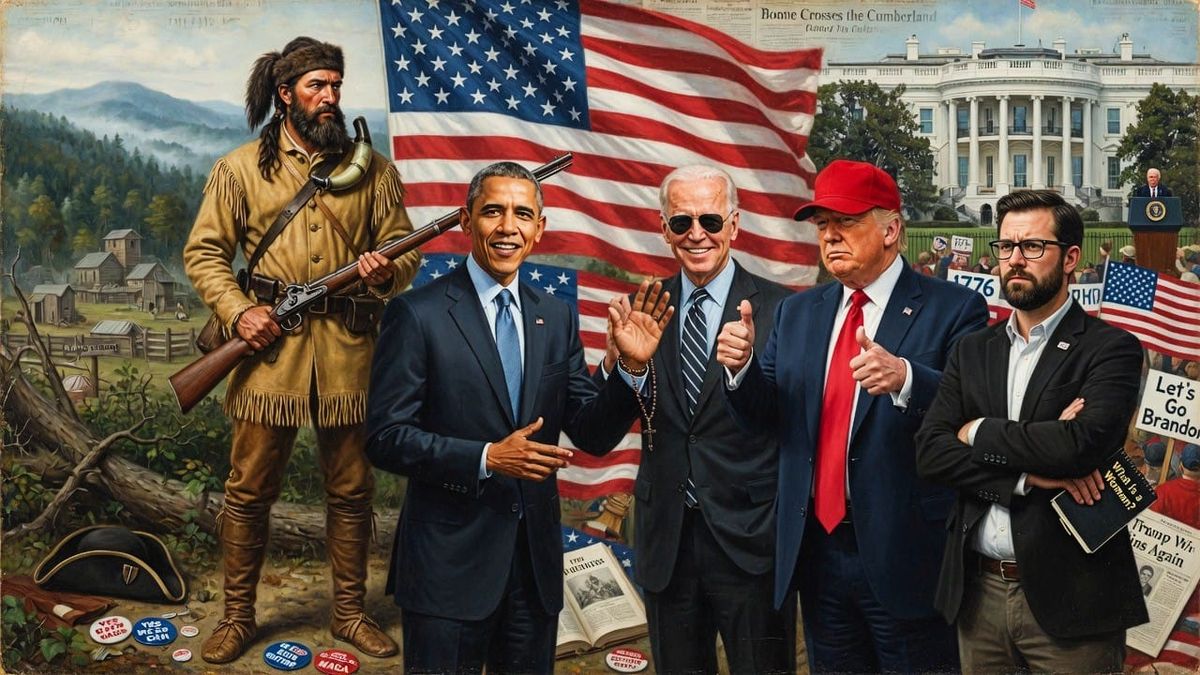
“I have never been lost in these woods, yet I fear the nation that forgets its trails, its heroes, and its hard-won freedom will wander forever in darkness.” – Daniel Boone, frontier scout and American icon
The Freedom 250 initiative, crystallized through President Donald J. Trump’s Executive Order 14189 issued on January 29, 2025, which created Task Force 250 together with its operational public-private vehicle known as Freedom 250 LLC, and culminating in the ambitious but ultimately troubled flagship event called the Great American State Fair scheduled for the National Mall from June 25 through July 10, 2026, stands as a stark and deliberate pivot away from the congressionally established U.S. Semiquincentennial Commission, commonly referred to as America250. This entire sequence represents not an accidental shortfall but a carefully engineered political failure, one whose roots run deep into a foundational revelation that demands unflinching examination: the statutory commission, brought into existence by legislation signed into law by President Barack Obama on July 22, 2016, possessed a full decade in which to mount a proper, unifying national commemoration of the 250th anniversary of American independence, yet it utterly and completely failed to do so. During the closing months of the Obama administration, implementation momentum simply evaporated into bureaucratic inertia with no meaningful architecture or sustained presidential emphasis placed upon execution. That vacuum persisted and deepened under the Biden administration, particularly after the 2022 designation of Rosie Rios, the former Obama-era Treasurer, as chair of the commission. Under her stewardship the effort devolved into little more than scattered grassroots gestures, symbolic gestures such as Times Square ball drops and the “America Gives” volunteering campaign, repeated internal lawsuits, abrupt executive firings, chronic funding shortfalls, and an absence of any flagship national spectacles or enduring civic infrastructure capable of capturing the public imagination by the dawn of 2026.
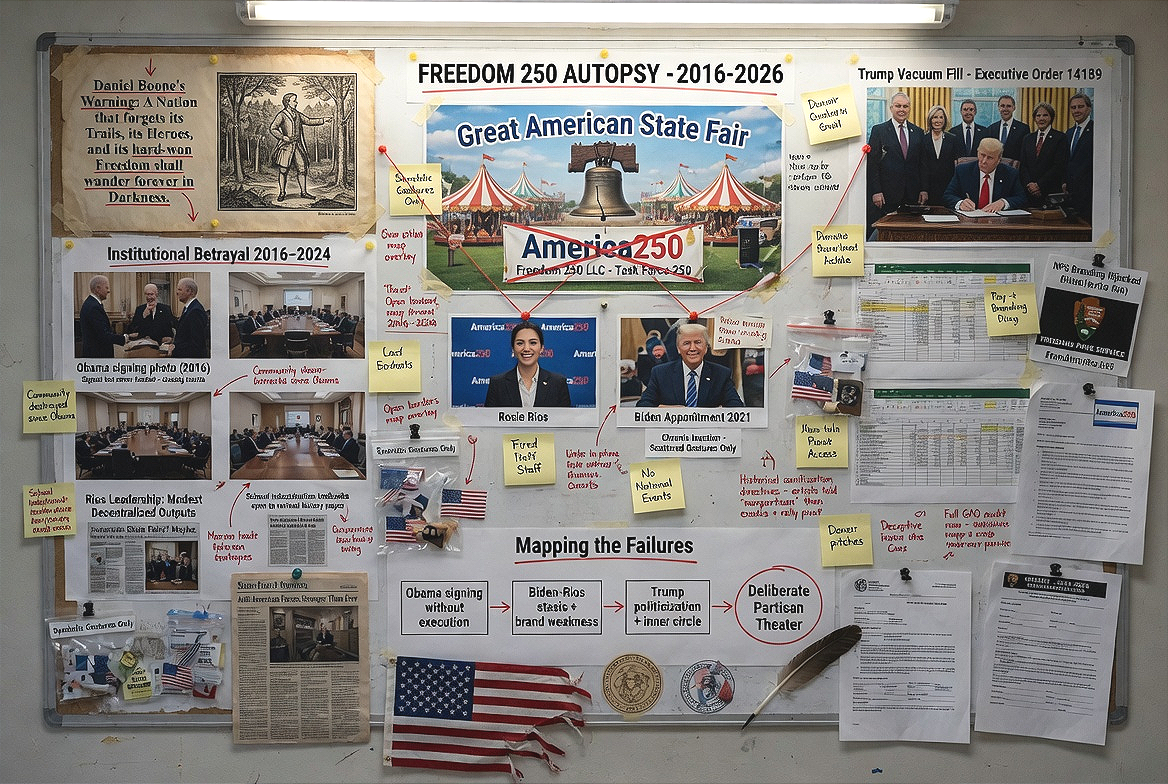
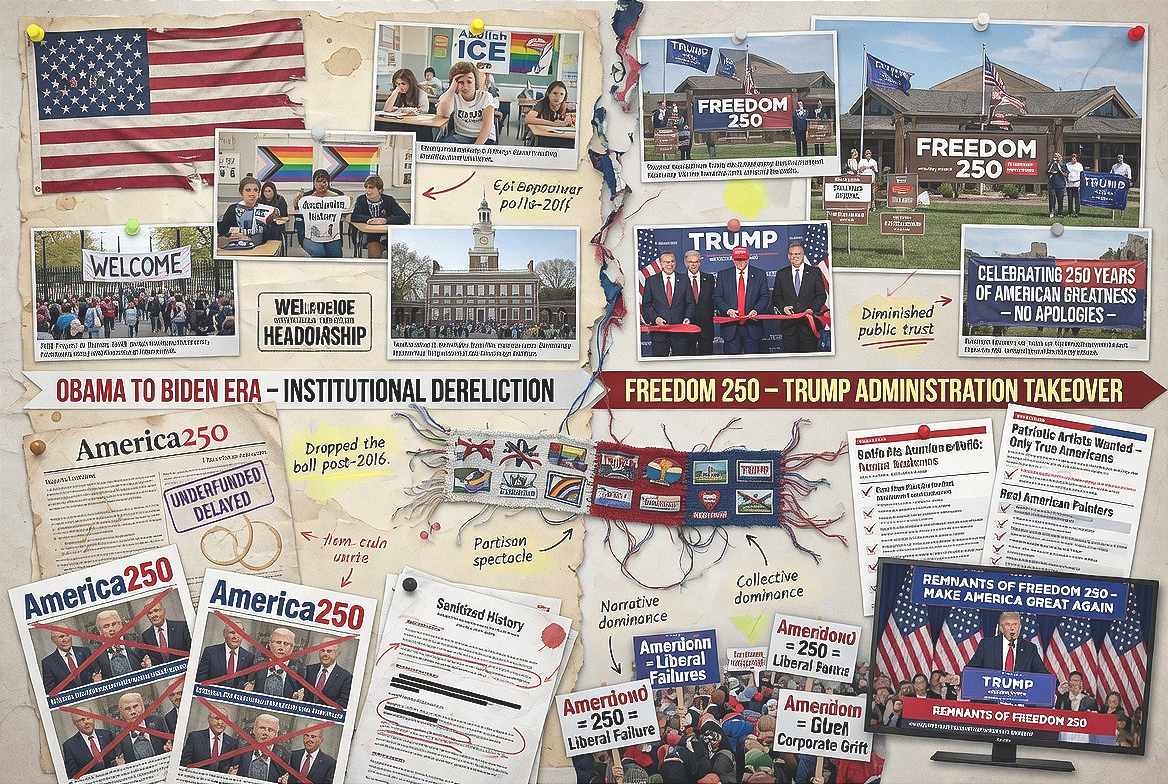
This decade of institutional dereliction unfolded against a broader and more ominous backdrop that cannot be ignored in any honest forensic accounting: the sense of community in America has been destroyed since Obama, anti-American forces in America have been stronger than ever before, and the compounding influences of left-wing indoctrination in schools, open borders policies, and a deliberate erosion of pride in the nation’s history or any genuine connection to its founding principles have left the country’s social fabric frayed and its collective memory contested. Within this fractured landscape a prevailing Republican perspective crystallized with particular clarity, viewing the leadership of America250 as little more than a collection of liberals who genuinely did not care about the solemn responsibility entrusted to them and who effectively dropped the ball in the immediate aftermath of Donald Trump’s 2016 election victory. This perception of apathy and ideological misalignment created a profound operational and symbolic vacuum that the incoming Trump administration recognized and moved decisively to fill through the creation of Freedom 250. The result was an initiative explicitly designed to deliver donor access, partisan spectacle, aggressive rebranding of National Park Service assets, and narrative dominance, all of which produced the predictable cascade of congressional pay-to-play investigations, allegations of historical sanitization at federal sites, deceptive artist recruitment practices, and an eventual pivot by President Trump himself toward framing the remnants of the event as a personal political rally. In this layered sequence of neglect followed by calculated repurposing, one witnesses a textbook case of cumulative mismanagement that transformed what should have been a unifying generational milestone into a vehicle for partisan controversy and diminished public trust.
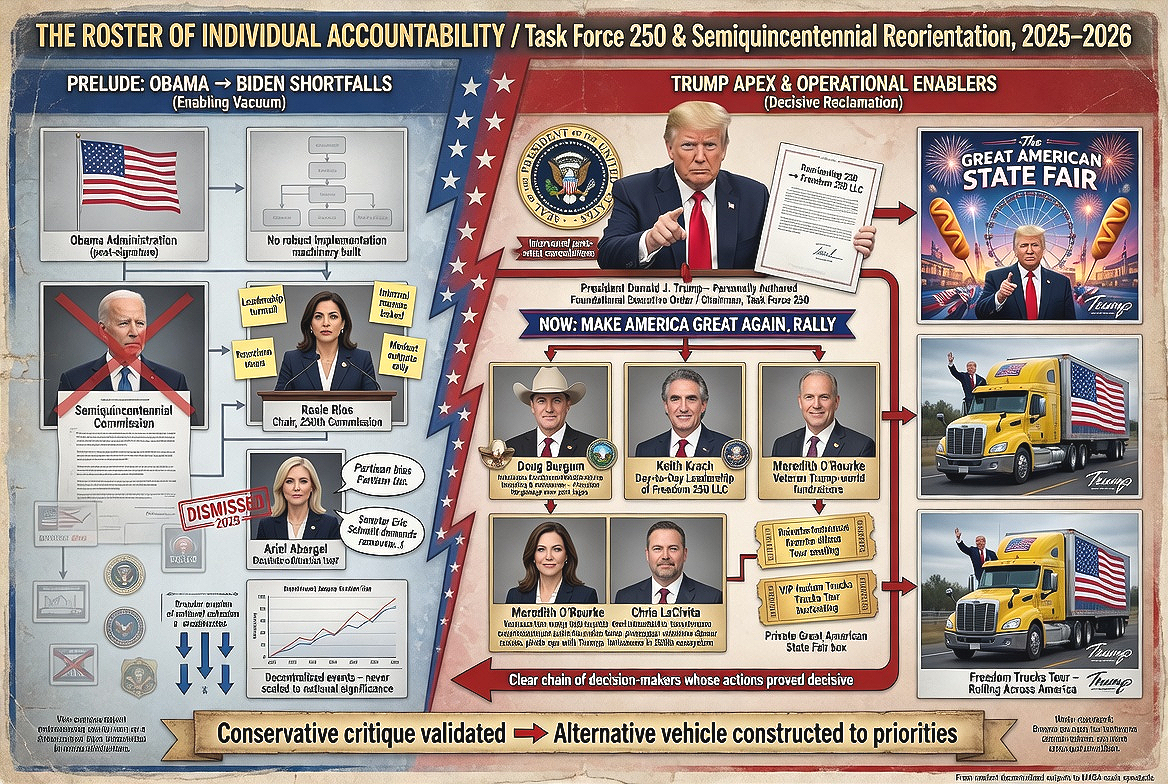
The roster of individual accountability reveals a clear chain of decision-makers whose actions or inactions proved decisive. At the apex stands President Donald J. Trump, who personally authored the foundational executive order, assumed the chairmanship of Task Force 250, championed the creation of Freedom 250 LLC, advanced signature concepts including the Great American State Fair and the Freedom Trucks tour, and ultimately intervened after the wave of artist cancellations to reorient the gathering as a Make America Great Again rally. Supporting him were key operational enablers such as Interior Secretary Doug Burgum, who oversaw the redirection of National Park Service branding and resources; Keith Krach, who assumed day-to-day leadership of the LLC structure; and veteran Trump-world fundraisers Meredith O’Rourke and Chris LaCivita, who orchestrated solicitation packages promising high-dollar donors exclusive access, photo opportunities, and influence within the 250th ecosystem. On the preceding side of the ledger, the Obama administration’s post-signature failure to build any robust implementation machinery, followed by the Biden administration’s selection of Rosie Rios and her subsequent tenure marked by documented leadership turmoil, the 2025 dismissal of a Trump-appointed executive director named Ariel Abergel, public accusations of partisan bias that prompted Senator Eric Schmitt to call for her removal, and a consistent pattern of modest, decentralized outputs that never scaled to national significance, together constitute the enabling prelude. These prior shortcomings did not occur in isolation; they unfolded precisely as the broader erosion of national cohesion accelerated, thereby validating the conservative critique and handing Trump’s team both justification and opportunity to construct an alternative vehicle explicitly tailored to their priorities.
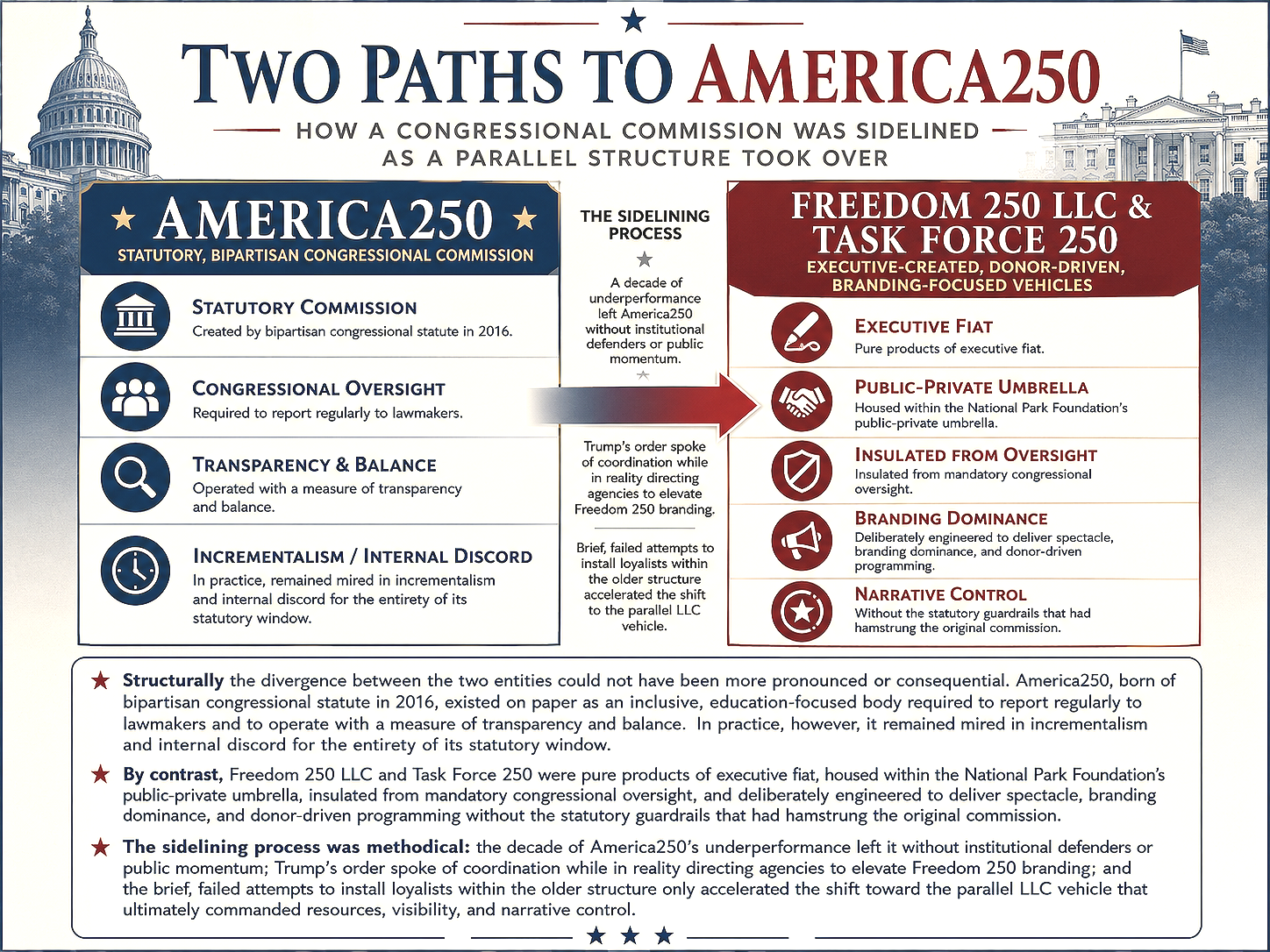
Structurally the divergence between the two entities could not have been more pronounced or consequential. America250, born of bipartisan congressional statute in 2016, existed on paper as an inclusive, education-focused body required to report regularly to lawmakers and to operate with a measure of transparency and balance. In practice, however, it remained mired in incrementalism and internal discord for the entirety of its statutory window. By contrast, Freedom 250 LLC and Task Force 250 were pure products of executive fiat, housed within the National Park Foundation’s public-private umbrella, insulated from mandatory congressional oversight, and deliberately engineered to deliver spectacle, branding dominance, and donor-driven programming without the statutory guardrails that had hamstrung the original commission. The sidelining process was methodical: the decade of America250’s underperformance left it without institutional defenders or public momentum; Trump’s order spoke of coordination while in reality directing agencies to elevate Freedom 250 branding; and the brief, failed attempts to install loyalists within the older structure only accelerated the shift toward the parallel LLC vehicle that ultimately commanded resources, visibility, and narrative control.
Financially the picture is one of chronic opacity compounded by deliberate escalation. The original commission had limped along on modest appropriations and sporadic corporate appeals that never produced transformative funding or accountability. Freedom 250, operating through the National Park Foundation, introduced commingling pathways that drew congressional scrutiny, featured documented pay-to-play offerings such as million-dollar donor packages granting direct Trump-world access, and triggered formal inquiries into potential diversion of taxpayer-adjacent resources. Primary beneficiaries clustered within the Trump-aligned ecosystem while managers including the aforementioned fundraisers and National Park Foundation intermediaries maintained layers of anonymity that frustrated oversight. These financial practices did not emerge in a vacuum; they exploited the very funding and transparency gaps left unaddressed across the preceding ten years.
Operationally the impact on National Park Service functions proved equally corrosive. Long-term under-advocacy by America250 had already strained interpretive capacity at historic sites; the Freedom 250 era layered explicit directives favoring patriotic reframing, coin redesigns emphasizing exceptionalism, and exhibit priorities that critics labeled sanitization. The February 2026 House Natural Resources Committee hearing laid bare these tensions, with testimony highlighting concerns over historical erasure amid a cultural climate already shaped by left-wing indoctrination in schools, open borders realities that diluted shared identity, and a widespread absence of pride in or connection to the nation’s foundational chapters. The resulting oversight crisis was not an unintended byproduct but the predictable consequence of placing spectacle above stewardship.
The performers’ exodus surrounding the Great American State Fair offers perhaps the most vivid case study in deceptive execution. Initial announcements in late May 2026 featured artists including Martina McBride and Bret Michaels, each of whom later withdrew with statements revealing that organizers had presented the event as a strictly nonpartisan celebration of all fifty states and American history, only for the reality of its Trump-centric branding, Task Force origins, and rally undertones to become unmistakable. McBride publicly noted that assurances of nonpartisanship proved misleading; Michaels described an evolution into something far more divisive than initially described. America250’s decade-long failure to establish any robust, trusted nonpartisan brand identity only compounded the confusion, allowing Freedom 250 recruiters to operate in the resulting vacuum and ultimately triggering the mass cancellations that forced the rally pivot. This episode encapsulates the broader tragedy: a milestone that might have healed divisions instead became another arena in which they were amplified.
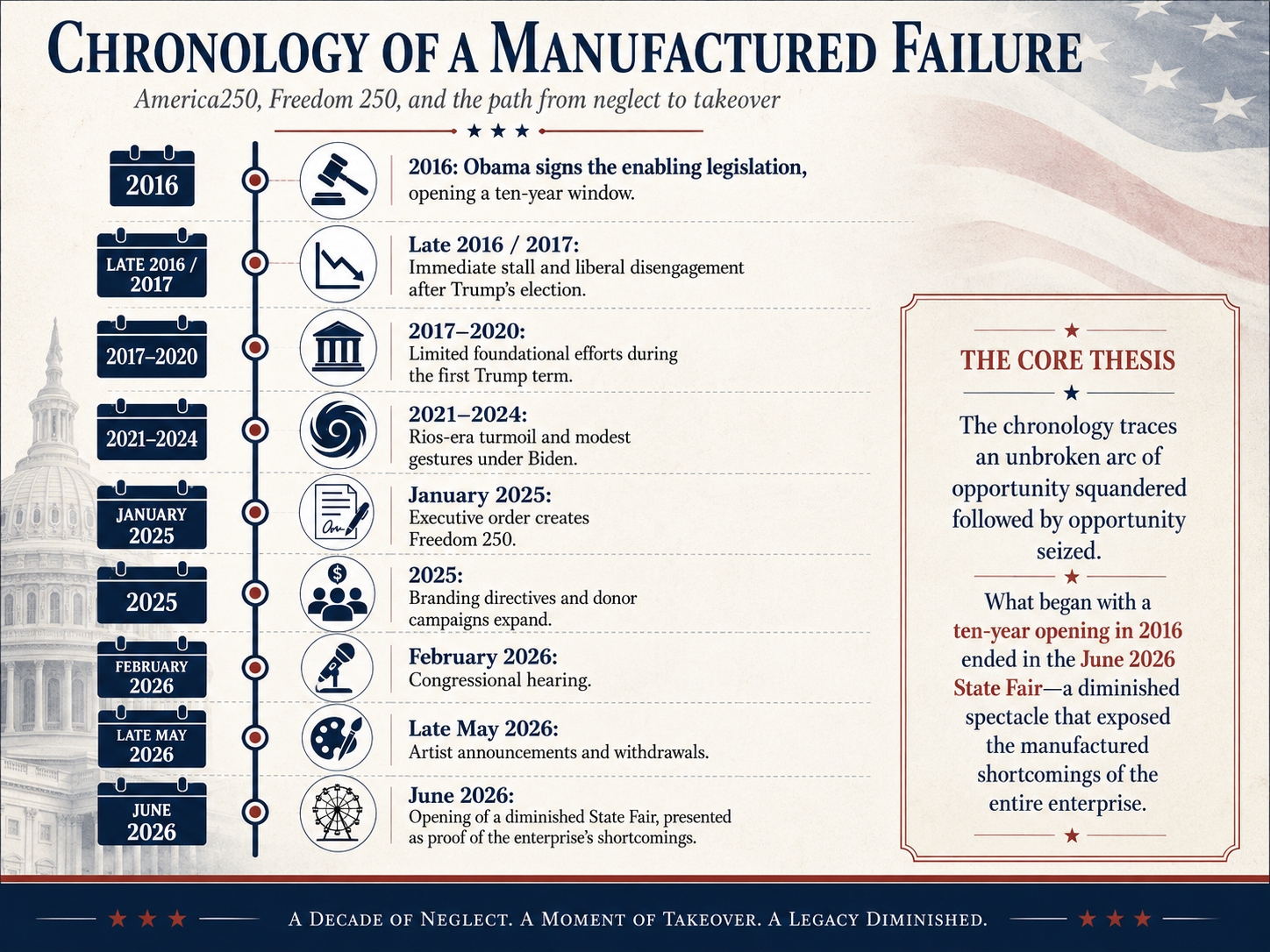
The chronology of this saga traces an unbroken arc of opportunity squandered followed by opportunity seized. The 2016 signing by Obama initiated a ten-year window that opened with immediate stall and liberal disengagement in the wake of Trump’s election, continued through limited foundational efforts in the first Trump term, descended into Rios-era turmoil and modest gestures under Biden, and culminated in the January 2025 executive order that birthed Freedom 250. Subsequent months brought branding directives, donor campaigns, the February 2026 congressional hearing, the late-May artist announcements and withdrawals, and the June 2026 opening of a diminished State Fair whose diminished state stood as living proof of the entire enterprise’s manufactured shortcomings.
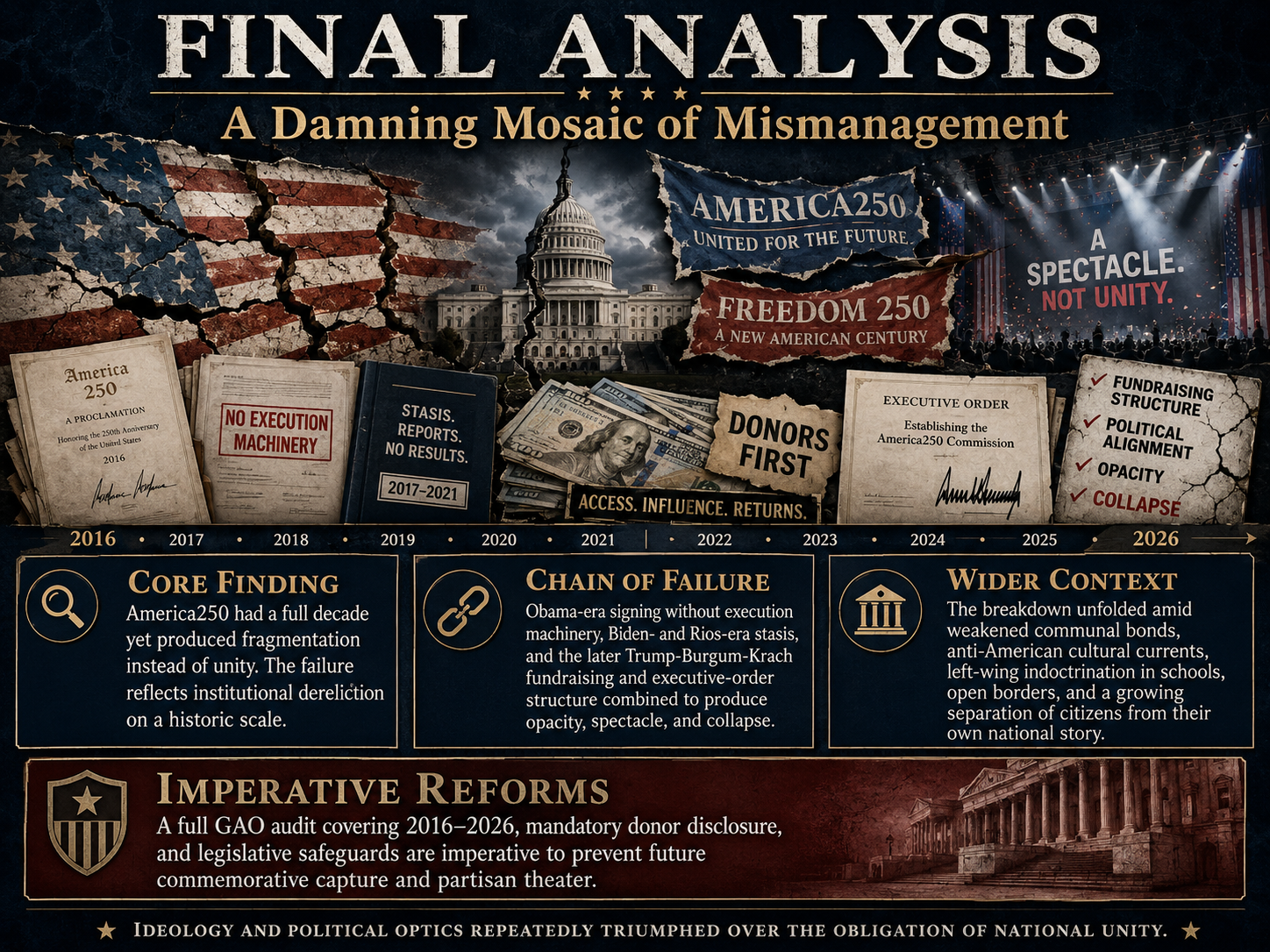
In final analysis, the revelations form a damning mosaic. That America250 possessed a full decade yet delivered only fragmentation exposes institutional dereliction of historic proportions. That this occurred amid the destruction of communal bonds since the Obama years, the unprecedented ascendancy of anti-American forces, and the corrosive effects of left-wing indoctrination in schools, open borders, and the severance of citizens from pride in or connection to their own history, only deepens the indictment. Obama’s signing without execution apparatus combined with Biden and Rios’s decade of stasis created the structural vulnerability; Trump, Burgum, Krach and their fundraising apparatus exploited that opening through the executive order, LLC construct, and pay-to-play machinery to produce financial opacity and spectacle-driven failure; Rios-era brand weakness enabled the sanitization battles and recruitment collapse; and Trump’s rally reframing delivered the performative coup de grâce. The cross-administration chain, viewed in its entirety and against the societal fractures enumerated, substantiates a pattern of intentional mismanagement in which ideology and political optics consistently triumphed over the solemn obligation of national unity. A full Government Accountability Office audit spanning 2016 through 2026, mandatory comprehensive donor disclosures, and legislative safeguards to protect future commemorative efforts from similar capture are not merely advisable but imperative if the Republic is to reclaim the capacity to honor its own story without descending into partisan theater.
Footnotes
¹ United States Congress. Public Law 114-196, United States Semiquincentennial Commission Act of 2016. July 22, 2016.
² Senator Eric Schmitt. Press Release Calling for Removal of Rosie Rios. May 6, 2025.
³ Roll Call. “A Balancing Act in Planning for America’s 250th Birthday Party.” December 16, 2025.
⁴ Wikipedia contributors. “United States Semiquincentennial.” Last modified June 1, 2026.
⁵ The New York Times. Reporting on Freedom 250 donor access packages. February 2026.
⁶ The White House. Freedom 250 official page and Executive Order 14189 documentation. 2025–2026.
⁷ America250.org. Leadership and About sections. Accessed June 1, 2026.
⁸ Washingtonian. “The Great American State Fair Meltdown, Explained.” May 29, 2026.
⁹ CBS News. Coverage of artist cancellations and rally pivot. June 1, 2026.
Bibliography
America250.org. “About America250 / Leadership.” Accessed June 1, 2026. https://america250.org/.
Roll Call. 2025. “A Balancing Act in Planning for America’s 250th Birthday Party.” December 16.
Schmitt, Eric. 2025. Press Release on Rosie Rios. May 6.
United States Congress. 2016. Public Law 114-196.
The White House. 2025–2026. Freedom 250 and Executive Order 14189 materials. https://www.whitehouse.gov/freedom250/.
Wikipedia contributors. 2026. “United States Semiquincentennial.” Last modified June 1.
Washingtonian. 2026. “The Great American State Fair Meltdown, Explained.” May 29.