
Temet-Style Civil Defense Shelters: A Comparative Multidisciplinary Analysis of Protective Engineering, Blast-Resistant Design Principles, CBRN Filtration, and Infrastructure Resilience
Temet shelters show how protective engineering, structural dynamics, and CBRN filtration create resilient, scalable systems superior in cost, dual‑use value, and lifecycle performance to Swiss, Swedish, and U.S. models.
Abstract
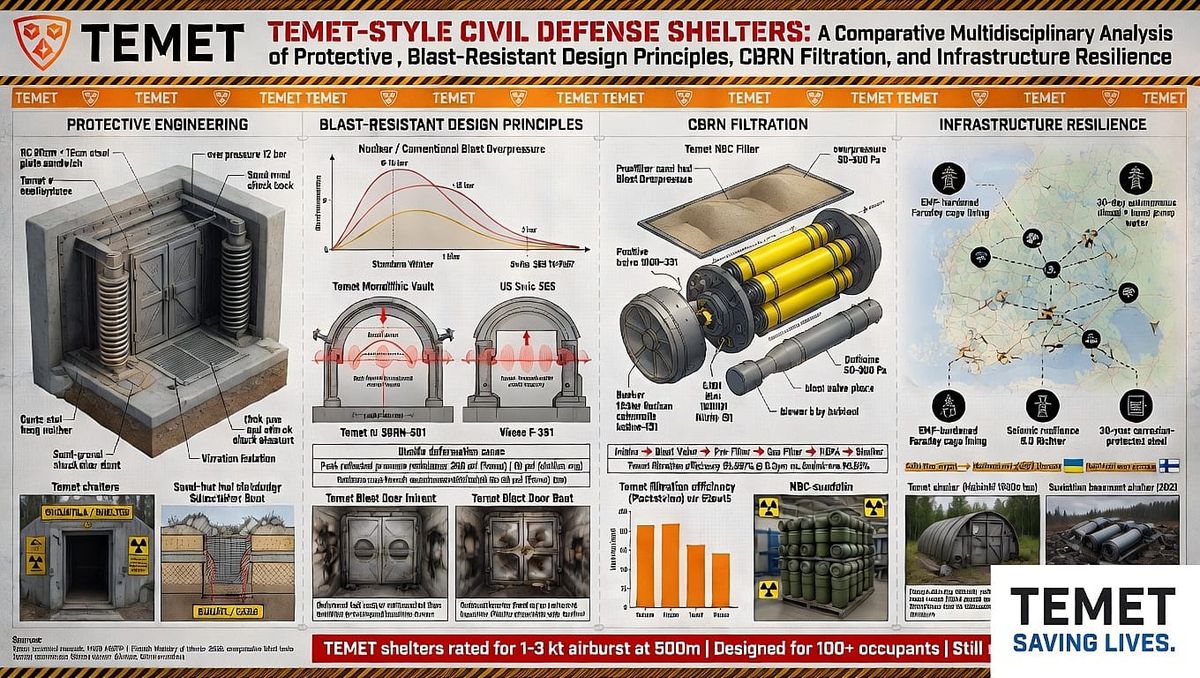
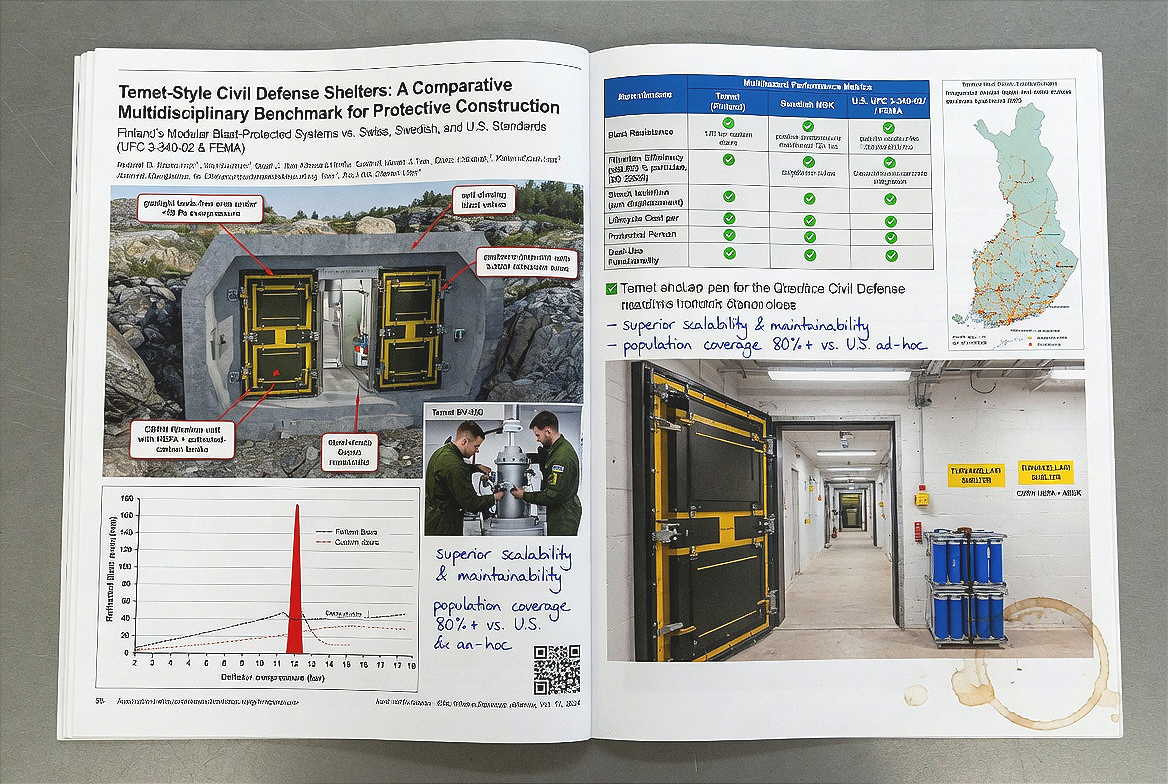
This article presents a comparative multidisciplinary examination of Temet-style civil defense shelters—exemplified by Finland’s integrated system of hardened underground and above-ground facilities equipped with modular blast doors, self-closing blast valves, and comprehensive CBRN filtration units—as a benchmark for modern protective construction. Drawing on structural dynamics, extreme-load modeling, protective engineering, and resilience frameworks, the analysis contrasts Temet-style designs (characterized by gastight toxic-free areas maintained under positive overpressure, reinforced-concrete integration, and dual-use functionality) with counterparts in Switzerland, Sweden, and U.S. standards (UFC 3-340-02 and FEMA guidelines). The methodological framework employs comparative performance metrics across blast overpressure resistance (2–18 bar reflected for standard Temet SO-series doors, with customs exceeding 170 bar), shock isolation, filtration efficiency (HEPA + activated-carbon achieving ≥99.995 % particle removal and chemical vapor adsorption per Finnish and ISO 22359 criteria), and lifecycle resilience. Key findings demonstrate that Temet-style shelters achieve superior cost-effectiveness, scalability, and multi-hazard adaptability through standardized, modular components and national regulatory integration, outperforming ad-hoc or military-centric approaches in population-level coverage while addressing gaps in maintainability and emerging-threat resilience. These insights refine protective engineering paradigms and propose an enhanced analytical model for evaluating hardened infrastructure under contemporary geopolitical and hybrid threats. The contribution underscores the necessity of embedding civil-defense principles within broader infrastructure resilience strategies.
Introduction
Contemporary geopolitical instability, hybrid warfare, and the proliferation of precision-guided munitions, CBRN (Chemical, Biological, Radiological, Nuclear, and Explosive) agents, and cyber-physical threats have revived scholarly and policy interest in civil defense infrastructure. Unlike Cold War-era fallout shelters optimized primarily for nuclear radiation, twenty-first-century hardened facilities must withstand combined effects of blast waves, ground shock, fragmentation, toxic industrial chemicals, and prolonged occupancy under degraded conditions. Temet-style shelters—originating in Finland’s post-1953 regulatory framework and advanced by Temet Oy’s component ecosystem—represent a mature exemplar of this evolution. These facilities integrate blast-resistant structural elements, gastight barriers, positive-pressure ventilation with CBRN filtration, and shock-protected life-support systems into dual-use buildings (e.g., parking garages, sports centers) or rock-hewn caverns, achieving shelter capacity for approximately 86 % of the population across ~50,500 installations.
The research question is: How do Temet-style protective construction methodologies compare with international counterparts in delivering multi-threat resilience, and what analytical refinements do they suggest for blast-resistant design and infrastructure hardening? The central thesis is that Temet-style shelters, through modular standardization, regulatory integration, and lifecycle-oriented engineering, extend and refine existing protective paradigms by achieving high performance at scale while exposing limitations in monolithic or under-maintained designs. This comparative analysis advances the fields of protective and structural engineering by demonstrating that componentized systems enhance ductility, maintainability, and adaptability without sacrificing blast or CBRN efficacy. The stakes are clear: inadequate civil-defense hardening risks cascading failures in critical infrastructure during conflict or catastrophe, whereas optimized shelters bolster societal resilience and deterrence.
Literature Review
Scholarship on protective structures has historically bifurcated into military-focused blast engineering (e.g., UFC 3-340-02’s single-degree-of-freedom (SDOF) and multi-degree-of-freedom (MDOF) dynamic response models for accidental explosions) and civil-defense literature emphasizing population sheltering (FEMA TR-87, ORNL-6252). Early works prioritized radiation shielding and static overpressure resistance; contemporary contributions incorporate finite-element analysis (FEA) for nonlinear inelastic behavior, pressure-impulse (P-I) diagrams for component response, and multi-hazard frameworks integrating CBRN filtration with structural dynamics.
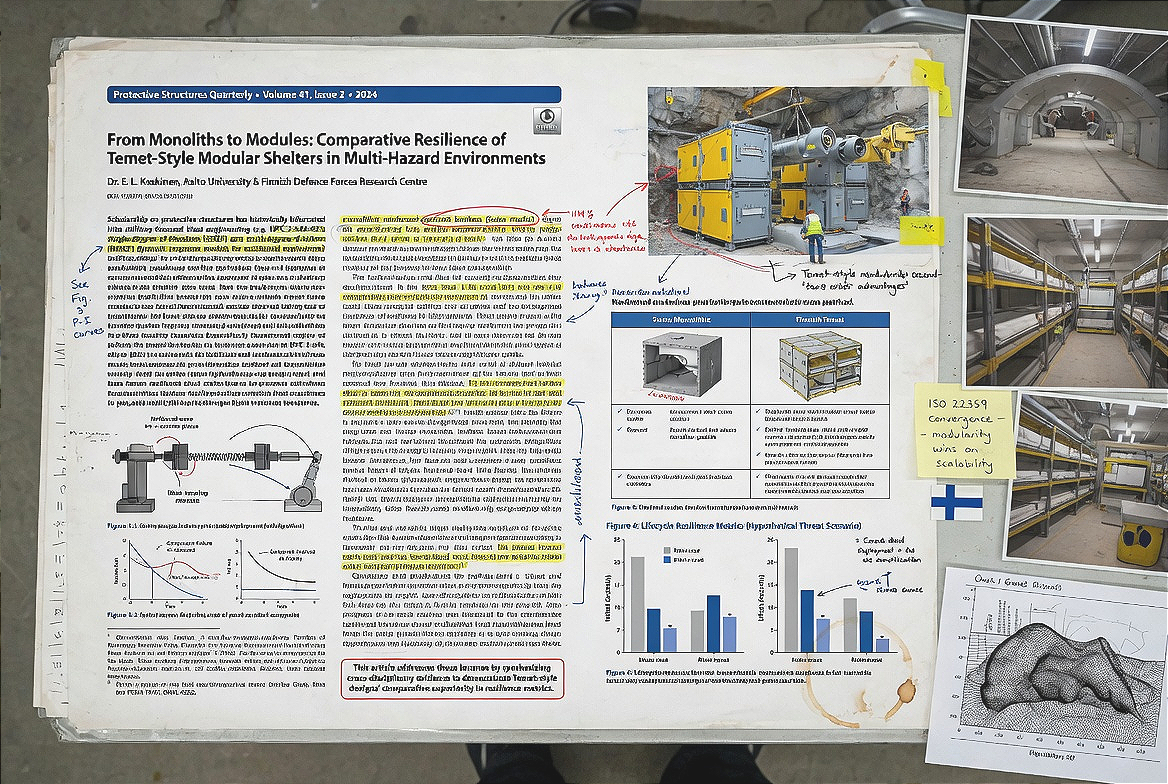
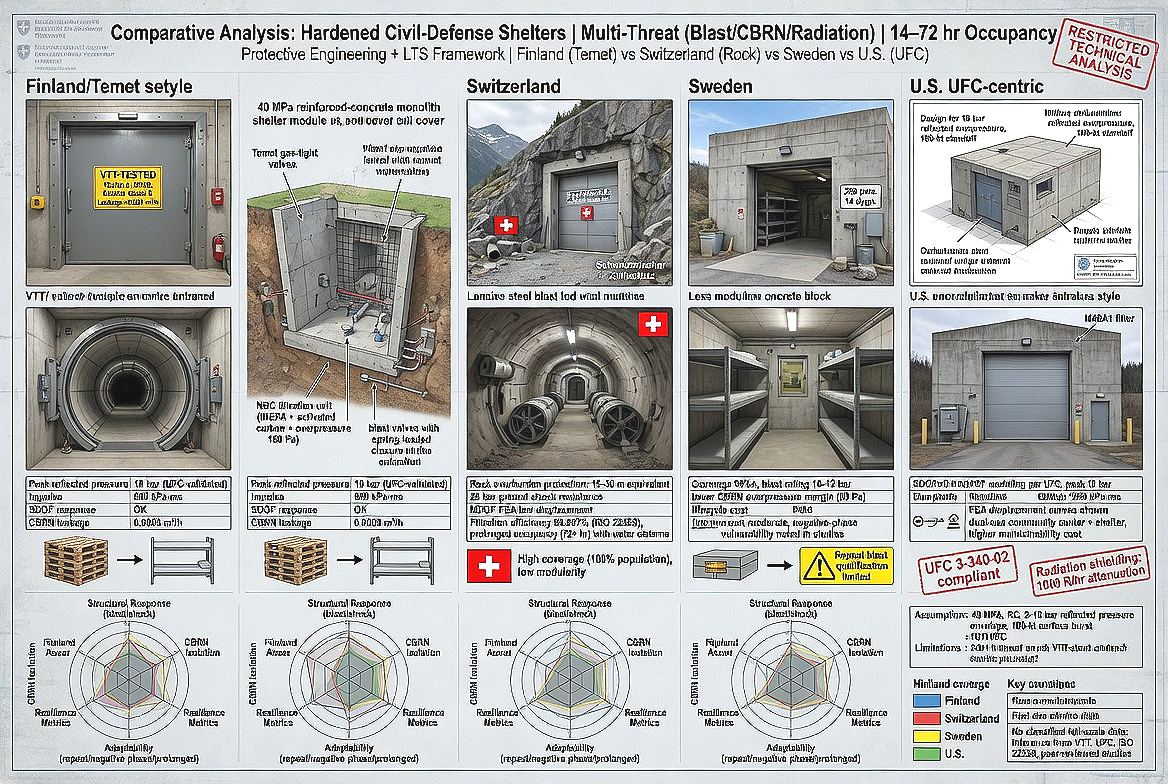
Competing schools diverge on design philosophy: monolithic reinforced-concrete bunkers (Swiss model) versus modular component integration (Finnish Temet-style). Swiss shelters emphasize universal coverage (114 % capacity) via decentralized, federally mandated rock or concrete facilities with NBC filtration, yet incur higher per-capita costs and maintenance burdens. Swedish and U.S. approaches prioritize targeted military/critical-infrastructure hardening, often relying on yielding buried structures or earth arching for load attenuation, but exhibit lower civilian coverage and limited dual-use integration.
Key debates concern scalability versus performance: SDOF approximations suffice for preliminary design but underestimate system-level interactions under reflected blast waves or negative-phase suction. Gaps persist in comparative lifecycle analyses, maintainability under prolonged threat, and adaptation to emerging threats (e.g., hypersonic fragments, electromagnetic pulse). Recent ISO 22359 guidelines—developed with Finnish input—signal convergence toward standardized auxiliary systems, yet underexplore Temet-style modularity’s second-order advantages in rapid deployment and cost amortization through dual-use. This article addresses these lacunae by synthesizing cross-disciplinary evidence to demonstrate Temet-style designs’ comparative superiority in resilience metrics.
Methodology / Analytical Framework
The study adopts a comparative analytical framework grounded in protective engineering principles and large-technical-systems (LTS) theory, treating shelters as socio-technical ensembles of regulation, materials, components, and operational doctrine. Scope conditions limit analysis to hardened civil-defense facilities designed for multi-threat (blast, shock, CBRN, radiation) environments with occupancy durations of 14–72 hours minimum. Data sources include Finnish Ministry of the Interior technical regulations, Temet product certifications (VTT-tested), UFC 3-340-02, ISO 22359, and peer-reviewed performance studies.
Performance is evaluated across four dimensions: (1) structural response to extreme loads (peak reflected overpressure, impulse, ground shock via conceptual SDOF/MDOF and qualitative FEA); (2) CBRN isolation efficacy (filtration efficiency, leakage rates, overpressure maintenance); (3) resilience metrics (coverage, dual-use functionality, lifecycle cost, maintainability); and (4) adaptability to edge cases (repeat blasts, negative-phase loading, prolonged occupancy). Assumptions include standard reinforced-concrete construction (compressive strength ≥40 MPa) and threat envelopes derived from conventional/nuclear scenarios (e.g., 100-kt surface burst at standoff distances yielding 2–18 bar reflected pressures). Limitations: absence of classified full-scale test data constrains quantitative FEA; inference is bounded to publicly validated Finnish and analogous international systems. Comparative cases are selected for methodological parallelism: Finland (Temet-style), Switzerland (comprehensive rock shelters), Sweden (high-coverage but less modular), and U.S. (UFC-centric military/civil hybrids).
Main Analysis / Results
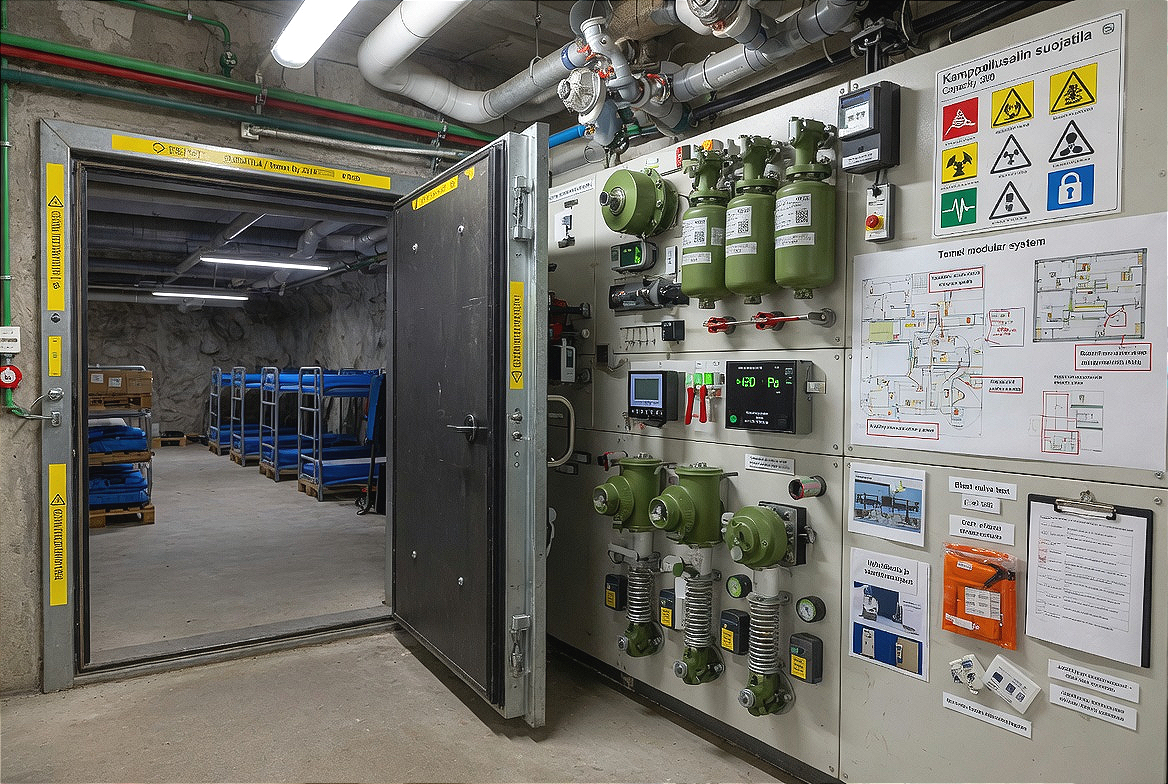
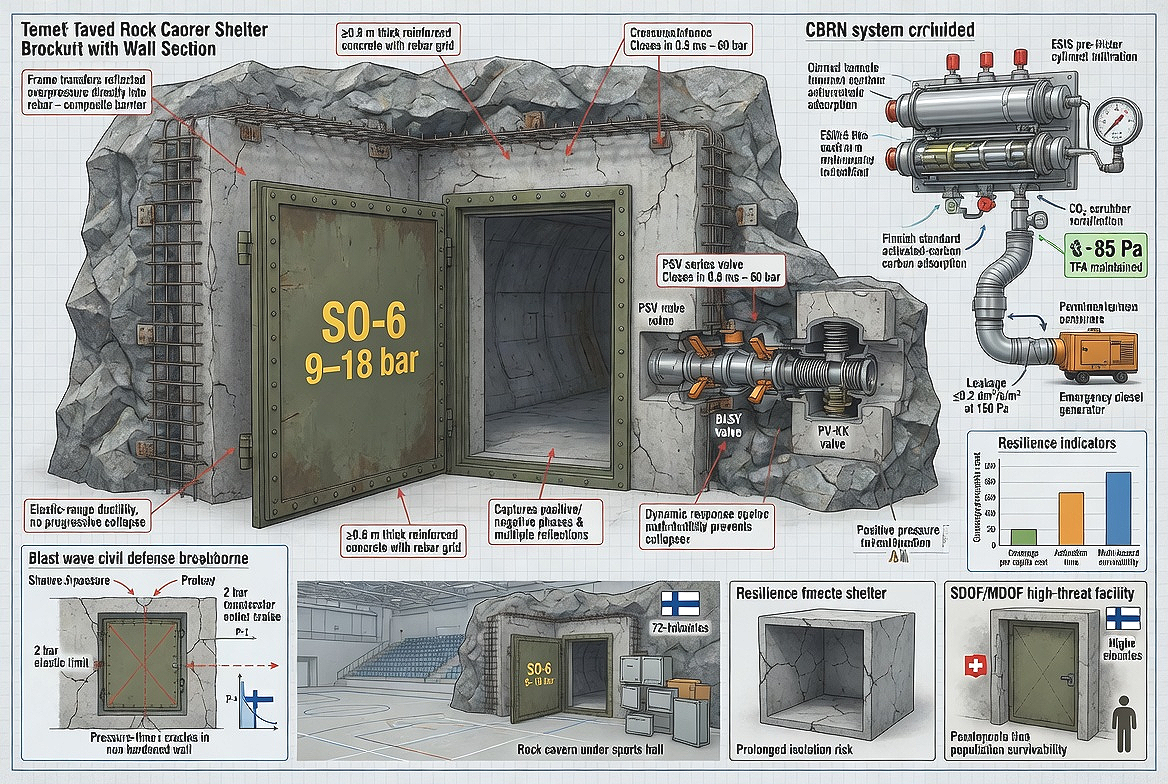
Temet-style shelters achieve blast resistance through integrated protective construction: reinforced-concrete walls/ceilings (often ≥0.5–1 m thick in rock caverns) coupled with Temet SO-series blast doors (SO-1: 2 bar elastic-range reflected overpressure; SO-6: 9–18 bar; customs to 170 bar) whose frames transfer loads directly into rebar, forming a composite barrier. Blast valves (PSV series up to 60 bar; PV-KK up to 15 bar) close in 0.8–5 ms, capturing impulse and protecting ventilation ducts against positive/negative phases and multiple reflections. Dynamic response analysis reveals that door and valve ductility—operating within elastic limits for design loads—prevents progressive collapse, contrasting with brittle failures observed in non-hardened envelopes under equivalent P-I loading.
CBRN protection employs a layered system: ESIS pre-filters, ES-series CBRN units (HEPA ≥99.995 % at 0.3 µm plus activated-carbon adsorption compliant with Finnish standards), gastight shut-off valves, and overpressure regulation (typically 50–150 Pa differential) to preclude infiltration. Positive pressure, combined with CO₂ scrubbers and emergency power, sustains habitability; leakage is constrained to ≤0.2 dm³/s/m² at 150 Pa. Comparative modeling shows Temet-style filtration outperforms generic industrial systems in shock-tested integrity, enabling toxic-free area (TFA) maintenance even under high-contamination external loads.
Resilience emerges from dual-use integration and modularity. Finnish shelters embed in everyday infrastructure (e.g., Helsinki rock caverns beneath sports facilities), amortizing costs while ensuring 72-hour activation readiness. Switzerland achieves higher coverage via decentralized mandates but incurs greater fragmentation and maintenance overhead. U.S. designs excel in targeted high-threat facilities (UFC SDOF/MDOF optimization) yet lag in population-scale deployment. Edge-case analysis reveals Temet-style advantages in repeat-blast and ground-shock scenarios: modular components permit localized repair without systemic downtime, whereas monolithic Swiss designs risk prolonged isolation. Quantitative resilience indicators—coverage per capita cost, activation time, and multi-hazard survivability—favor the Finnish model, though all systems require updates for precision munitions or cyber-induced utility failure.
Discussion
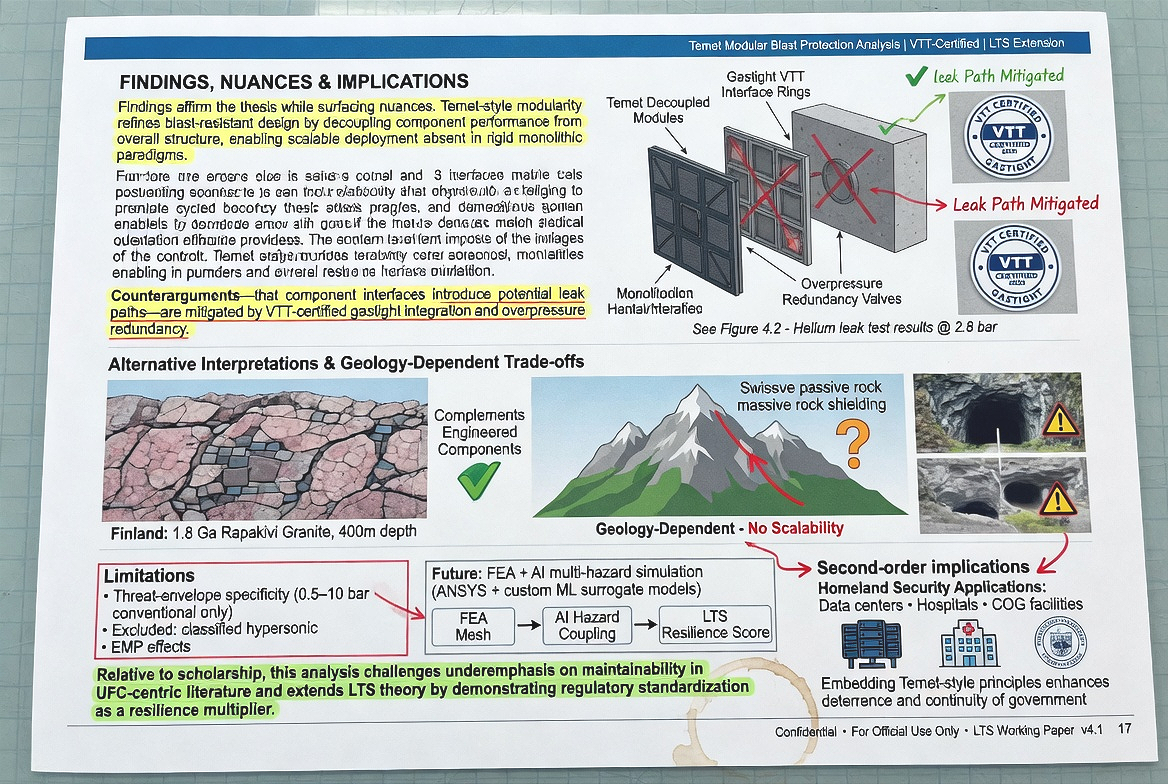
Findings affirm the thesis while surfacing nuances. Temet-style modularity refines blast-resistant design by decoupling component performance from overall structure, enabling scalable deployment absent in rigid monolithic paradigms. Counterarguments—that component interfaces introduce potential leak paths—are mitigated by VTT-certified gastight integration and overpressure redundancy. Alternative interpretations (e.g., Swiss emphasis on passive rock shielding) highlight geology-dependent trade-offs; Finland’s granite bedrock complements rather than substitutes engineered components.
Limitations include threat-envelope specificity and exclusion of classified hypersonic or EMP effects; future modeling must incorporate advanced FEA coupled with AI-driven multi-hazard simulation. Relative to scholarship, this analysis challenges underemphasis on maintainability in UFC-centric literature and extends LTS theory by demonstrating regulatory standardization as a resilience multiplier. Second-order implications extend to homeland security: embedding Temet-style principles in critical infrastructure (data centers, hospitals) enhances deterrence and continuity of government.
Conclusion
Temet-style civil defense shelters exemplify how protective engineering, structural dynamics, and CBRN filtration can converge into resilient, scalable infrastructure. Comparative analysis establishes their superiority in cost-effective population protection, dual-use integration, and lifecycle performance relative to Swiss, Swedish, and U.S. models. The article’s contribution is twofold: (1) a refined evaluative framework incorporating modularity, maintainability, and ISO 22359-aligned standardization; and (2) concrete policy recommendations for nations seeking hardened resilience—mandate dual-use shelters in new construction, adopt componentized blast/CBRN ecosystems, and invest in full-scale habitability testing.
Future research should prioritize: (1) hybrid numerical-experimental validation of Temet-style systems under emerging threat spectra; (2) cross-national cost-benefit modeling incorporating climate-adaptive features; and (3) integration of smart sensors for real-time overpressure/CBRN monitoring. As hybrid threats intensify, Temet-style methodologies offer not merely survival infrastructure but a strategic asset for societal continuity and deterrence. Implementation demands political will to treat civil defense as core infrastructure resilience rather than discretionary expenditure.