Guardians of the Wetlands: The Trumpeter Swan’s Journey from Near-Extinction to Culinary Memory
The trumpeter swan’s story is not merely one of biology but of human relationships with the natural world. Once hunted nearly to disappearance, now restored as a symbol of ecological resilience, this bird bridges the worlds of science, culture, and culinary memory.
Introduction
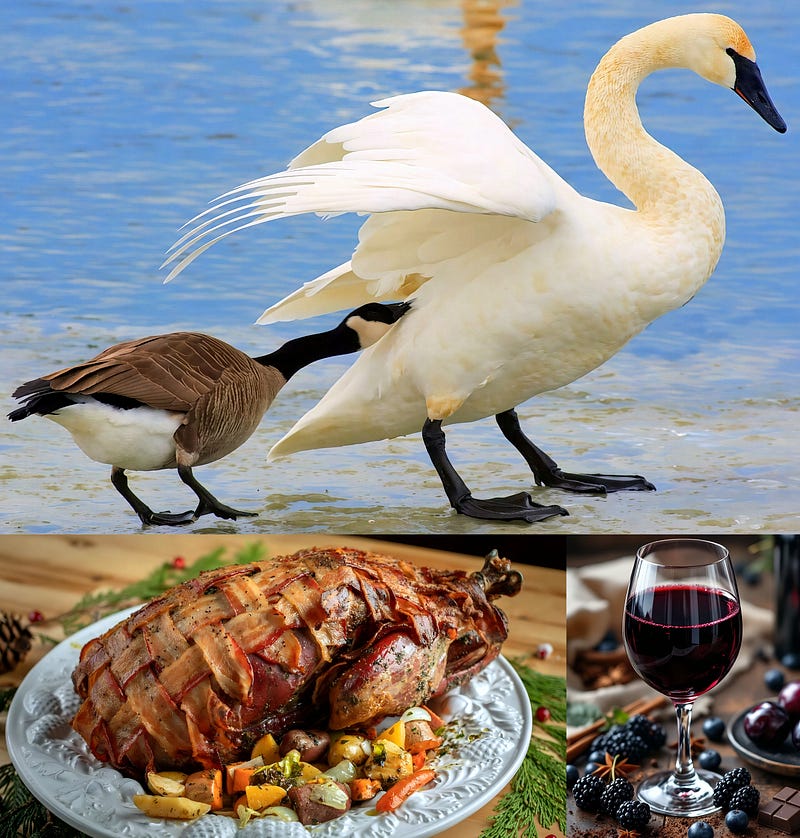
The trumpeter swan (Cygnus buccinator) is North America’s largest native waterfowl and an icon of wild landscapes. With its wingspan stretching up to 10 ft (3 m) and its haunting, resonant call, this bird once dominated wetlands across the continent. Nearly lost to overhunting and habitat destruction by the early 20th century, the trumpeter swan has since staged a dramatic comeback through conservation programs. Yet its story also carries cultural and culinary echoes, as swan meat once graced royal feasts in Europe and frontier tables in North America. To explore the trumpeter swan is to move between biology, ecology, history, and even taste — a bird that embodies both fragility and grandeur.
Taxonomy
The trumpeter swan belongs to the family Anatidae, alongside geese and ducks. Its scientific name, Cygnus buccinator, reflects its trumpet-like vocalization. No recognized subspecies exist, though populations show geographic variation. The closest relatives are the tundra swan (Cygnus columbianus) and the mute swan (Cygnus olor), the latter introduced to North America from Europe. Historically, edible swan varieties included both trumpeter and mute swans, with swan meat considered a delicacy in medieval England and Russia. In North America, trumpeters were hunted for food and skins, a practice that almost erased them from the landscape by 1930.
Biology
Adult trumpeter swans are strikingly large, weighing up to 30 lb (13.6 kg) and standing 4 ft (1.2 m) tall. Their wings span an impressive 10 ft (3 m). They are pure white, with a long, straight black bill and no yellow markings — a key distinction from the tundra swan. Pairs mate for life, forming bonds strengthened by synchronized swimming and mutual trumpeting. Nests are massive structures, often 6 ft (1.8 m) wide, built from wetland vegetation. Cygnets hatch covered in gray down and grow rapidly, fledging at around 100 to 120 days. Adapted for survival in cold northern climates, trumpeters have dense plumage and thick layers of down for insulation.
Ecology
Trumpeter swans inhabit wetlands, lakes, and slow rivers, relying on aquatic vegetation such as pondweeds, sedges, and water lilies. Their grazing helps control vegetation growth, shaping wetland ecosystems. They also contribute to nutrient cycling, pulling submerged plants to the surface and leaving fragments for other species. Once nearly extirpated, restoration efforts reintroduced breeding populations to states and provinces across the northern U.S. and Canada. Conservation challenges remain: habitat loss, lead poisoning from ingested fishing tackle, and climate shifts threaten long-term stability. Sustainable wetland management is critical, not only for swans but also for countless migratory birds sharing the same habitats.

Uses
Historically, trumpeter swans were hunted for meat, skins, and quills. Their down-lined bedding and their hides were prized in the fur trade. Today, hunting trumpeter swans is prohibited across most of their range, with only tightly regulated harvests in limited areas for population management. Trumpeter swans are fully protected and cannot be hunted due to their conservation status. Economically, the swan’s greatest modern value lies in ecotourism: birdwatchers flock to see their flocks in migration staging areas, bringing revenue to rural communities. Symbolically, they serve as flagship species for wetland conservation campaigns.
Culinary Aspects
Although no longer a mainstream food source, swan meat has a culinary legacy worth noting. Historical records describe the flesh as dark, rich, and gamey, similar to goose but with a more pronounced wild character. The flavor profile leaned earthy and iron-rich, with a dense mouthfeel and fibrous texture. When slow-roasted, the meat balanced complexity with a lingering finish, though it required careful preparation to avoid toughness. Aromatically, it carried notes of wetland herbs and aquatic vegetation from its diet. Nutritionally, like other wild waterfowl, swan meat was high in protein and provided essential fatty acids, though leaner than domestic poultry. Cultural traditions once elevated the swan to banquet status, but today its role is remembered more in history than in kitchens, with conservation taking precedence.
Wine Pairings
If one were to reconstruct historical recipes of roast swan, the wine pairings would demand equal weight and depth. A rustic Cahors Malbec from southwest France, with its earthy tannins and dark fruit, would mirror the richness of swan meat. A Blaufränkisch from Austria, offering peppery spice and acidity, would cut through the dense texture and highlight herbal undertones. For a white alternative, an aged Alsatian Pinot Gris with smoky minerality would complement preparations involving herbs and root vegetables. Each of these wines emphasizes structure, aromatic alignment, and balance — qualities needed to harmonize with a dish as commanding as roasted swan.
Conclusion
The trumpeter swan’s story is not merely one of biology but of human relationships with the natural world. Once hunted nearly to disappearance, now restored as a symbol of ecological resilience, this bird bridges the worlds of science, culture, and culinary memory. Its presence in wetlands reminds us of the importance of conservation, while its history on the table recalls a time when human sustenance and wild abundance were more directly linked. The swan challenges us to hold in balance reverence, restraint, and responsibility — so that future generations may still hear its trumpet across the marshes.